Higgsfield Supercomputer is scary good at motion design 🤯
You describe what you want, it orchestrates major creative tools and picks the right models to create up 60-minute FULL videos.
→ Routes reasoning to Opus 4.7, GPT-5.5 Pro, or Gemini 3.1 Pro
→ Picks Seedance, Veo, or Kling for video
→ Native audio in the same pass
→ Three-layer memory that compounds across sessions
A full video studio running inside one agent.
You can use now Codex in Claude Code 🤯
OpenAI has dropped a plugin that lets you run Codex directly inside Claude Code.
Code reviews, adversarial reviews, background tasks…one command to install:
/plugin install codex@openai-codex
Woah.. Pika just launched Pika agents 🤯
It completely automates workflows and takes them to a whole other level by incorporating GPT Image, Seedance…and skills.
Watch me teach my agent a full creative ads skill and get it done in one shot.
If you found OpenClaw too technical, this is for you.
ZooClaw just launched as the version of OpenClaw built for everyone. You speak, and the right specialist takes over.
→ Research, Writing, Companion, and Presentation agents.
→ Triple security audits and SOC 2 in progress.
→ If a token leaks, the isolated cloud environment makes it useless.
Claude Cowork complete crash course from zero to expert in 12 minutes.
Installation, automations, connectors, plugins..all of it:
00:00 Intro
01:00 Installation & setup
02:08 Your first task
03:01 Global instructions (most skip this)
04:00 What Cowork can actually access
05:15 Skills feature
06:08 Connectors explained
07:04 Real workflow (Drive + Gmail)
07:46 Claude in Chrome
08:43 Scheduled tasks
09:52 Plugins (why $285B was wiped out)
11:41 Big picture
the software development industry is about to get completely disrupted.. 💀
someone just built a fully autonomous AI production engineer
it’s called PlayerZero.
it connects to your codebase, logs, and support tickets understands how your system behaves and tells you exactly what broke zero manual debugging
this isn’t just “better QA”
it’s a shift in how software fails
before:
> humans wrote the code > humans tested it > humans debugged it
now:
> AI writes the code > systems run continuously > failures happen across tools, state, and time
and here’s the problem
your stack wasn’t built for this
• logs show events
• monitoring shows spikes
• alerts tell you something broke
but nothing tells you what actually happened
this AI production engineer finally does
🚨BREAKING: ANTHROPIC IS GIVING AWAY THE SAME CERTIFICATION THAT DELOITTE IS MASS-TRAINING 15,000 EMPLOYEES TO GET.
It costs $0. You need a laptop. That's it.
It's called the "Claude Certified Architect."
Think of it like the AWS cert but for AI.
If you were around when AWS certs started, you know what happened. They went from "cool to have" to "you're not getting hired without one." That took about 5 years.
This is going to happen way faster.
Look at who's already moving:
Accenture - training 30,000 people on Claude
Cognizant - rolled it out to 350,000 employees
Deloitte - opened Claude access to 470,000 people
Infosys - anchor partner
These aren't startups experimenting. These are billion dollar consulting firms restructuring their entire workforce around Claude.
And the certification they need? You can take it right now from your bedroom.
Let me be real though. This is not one of those "watch 2 videos and get a badge" type certs that nobody respects.
This thing is hard.
60 questions. 2 hours. Proctored. Webcam on. No breaks. No googling.
They drop you into real scenarios like designing a customer support agent that handles refunds or setting up Claude in a CI/CD pipeline. The wrong answers look right on purpose. They're the exact mistakes real engineers make in production.
720 out of 1000 to pass.
People who took it are saying the agentic architecture and multi-agent orchestration sections are brutal.
Most of the exam is about building AI systems that actually work in the real world. Not prompting. Not chatting with Claude. Architecting production systems.
All the prep? Free. Anthropic put out 13 courses on their Academy. No paywall. The cert itself is free for the first 5,000 people. After that $99 per attempt.
How to get it:
1. Join the Claude Partner Network (free) → https://t.co/TWMshPoKDn
2. Start the free prep courses → https://t.co/9OVwtjbvh0
3. Register for the exam → https://t.co/WWFAhSZUVd
4. Take the official practice exam
5. Book the real one when you're ready
It launched 10 days ago. Almost nobody has it yet.
That's the whole point. Get it before it becomes the thing everyone has.
🚨 BREAKING: Someone just open-sourced a full offline survival computer with AI, Wikipedia, and maps built in.
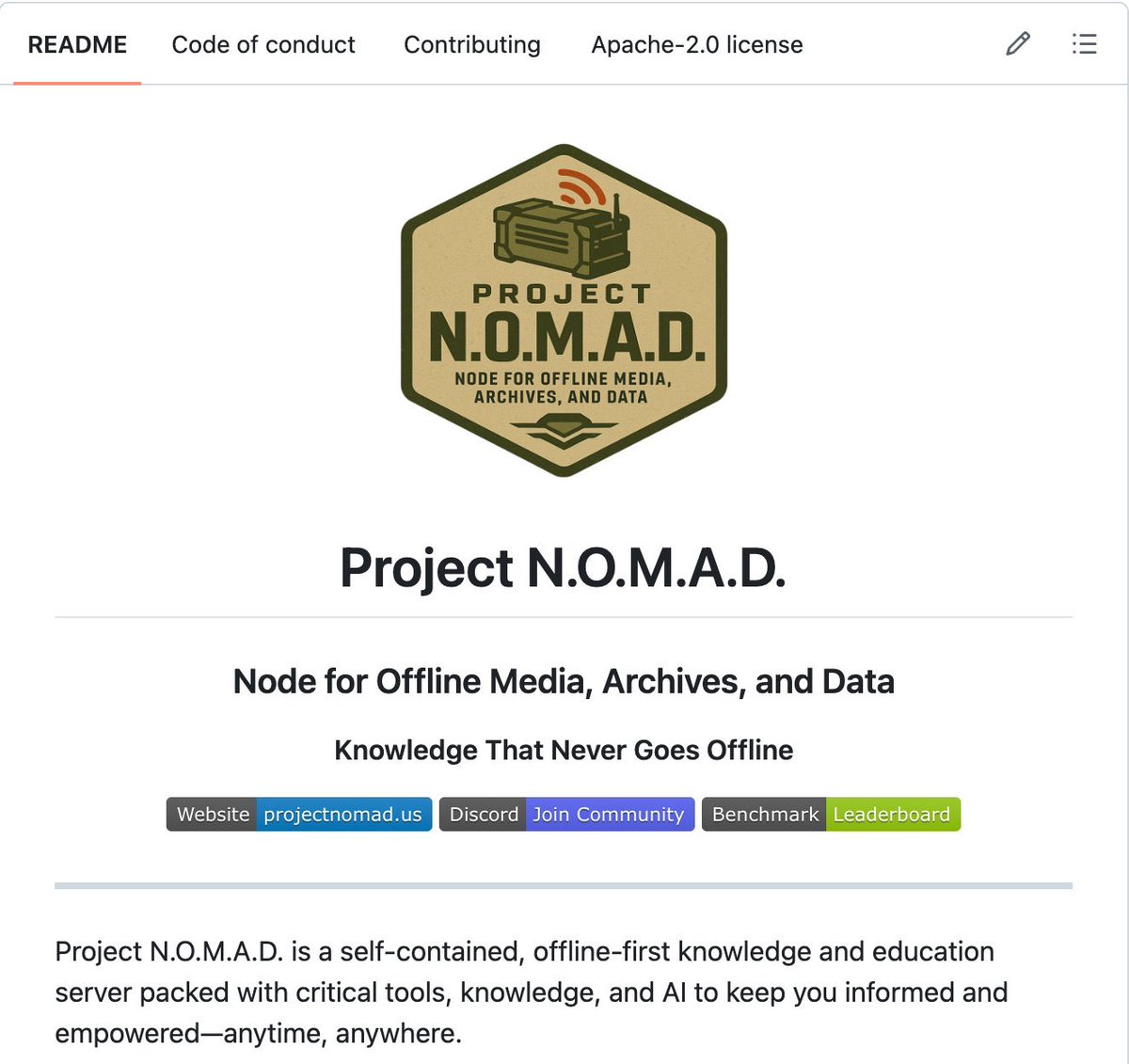
Project N.O.M.A.D. is an open-source offline survival computer.
Self-contained.
Zero internet required after install.
Zero telemetry. Everything runs locally on your hardware.
What it includes:
→ Full Wikipedia archives via Kiwix
→ Offline maps via OpenStreetMap
→ Local AI models via Ollama + Open WebUI
→ Calculators, reference tools, resource libraries
→ A management UI to control
everything from a browser
One curl command installs the entire system on any Debian-based machine.
Runs headless as a server so any device on your local network can access it.
Minimum specs to run the base system: dual-core processor, 4GB RAM, 5GB storage.
To run local LLMs offline, you want 32GB RAM and an NVIDIA RTX 3060 or better.
No accounts.
No authentication by default.
No cloud dependency.
No phone-home behavior.
Built to function when nothing else does.
The grid, the cloud, the API you depend on. None of it is guaranteed.
The people building local-first systems right now are the ones who won’t be asking for help when access disappears.
How to setup your Claude code project?
TL;DR
Most developers skip the setup and just start prompting. That's the mistake.
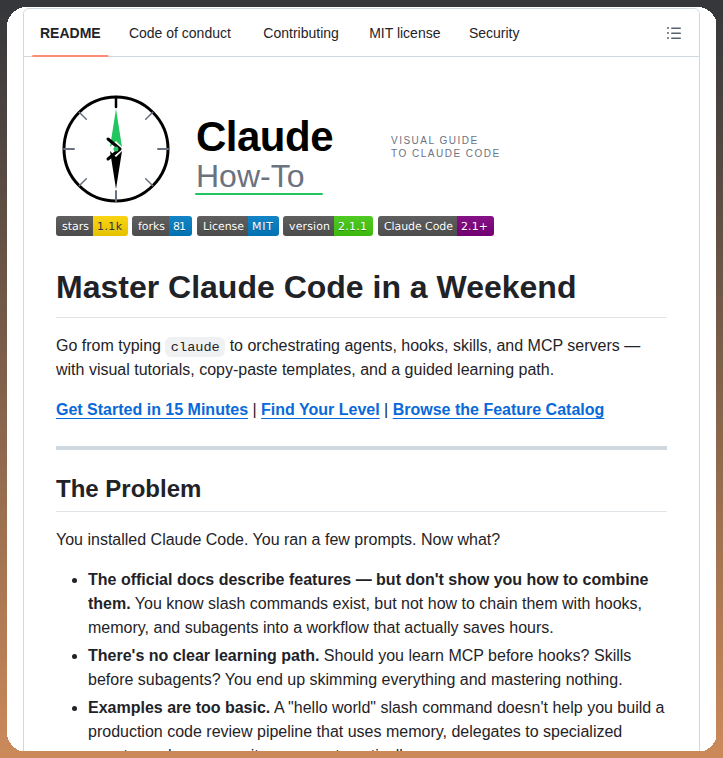
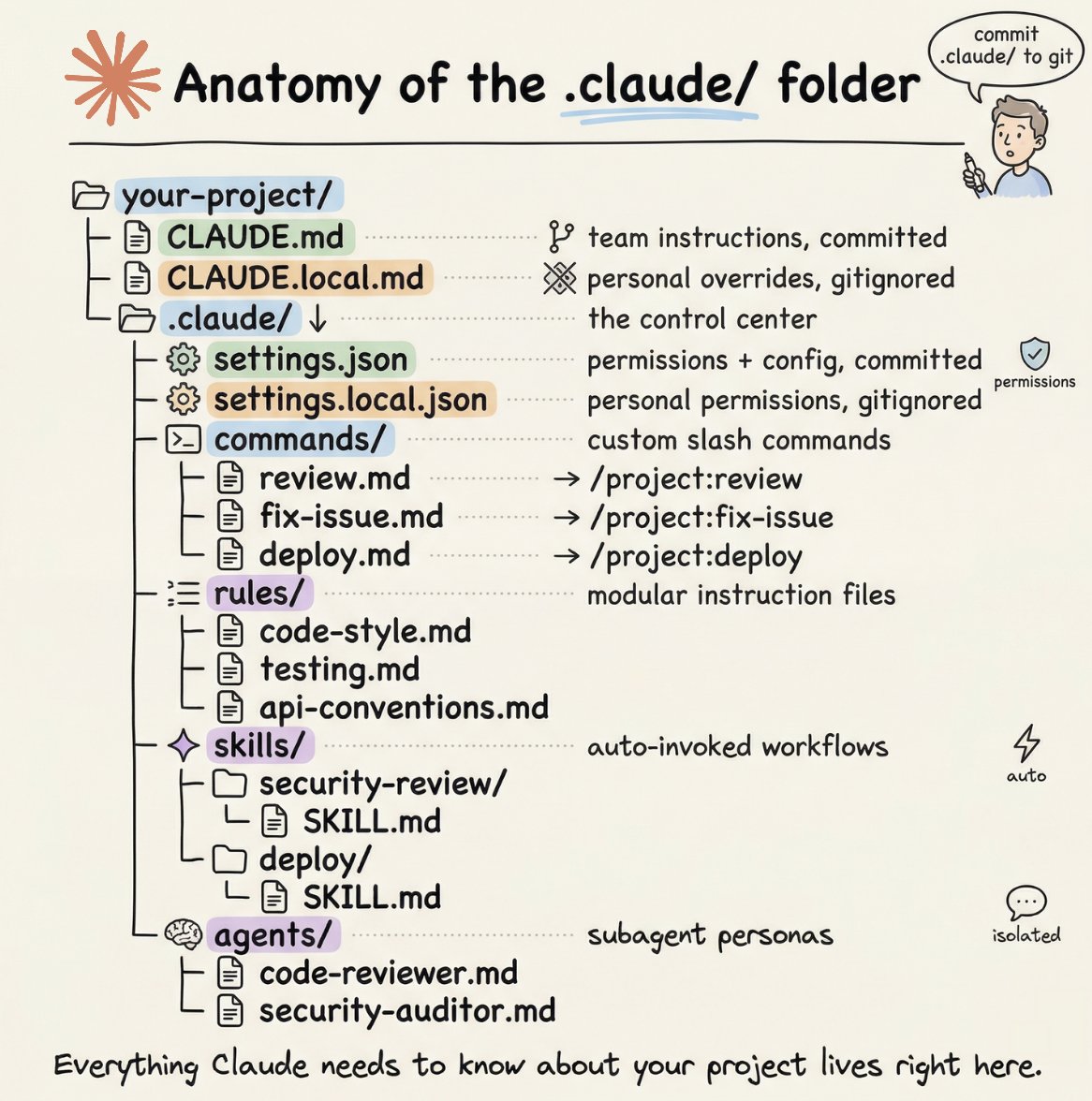
A proper Claude Code project lives inside a .𝗰𝗹𝗮𝘂𝗱𝗲/ folder. Start with 𝗖𝗟𝗔𝗨𝗗𝗘.𝗺𝗱 as Claude's instruction manual. Split it into a 𝗿𝘂𝗹𝗲𝘀/ folder as it grows. Add 𝗰𝗼𝗺𝗺𝗮𝗻𝗱𝘀/ for repeatable workflows, 𝘀𝗸𝗶𝗹𝗹𝘀/ for context-triggered automation, and 𝗮𝗴𝗲𝗻𝘁𝘀/ for isolated subagents. Lock down permissions in 𝘀𝗲𝘁𝘁𝗶𝗻𝗴𝘀.𝗷𝘀𝗼𝗻.
There are two .𝗰𝗹𝗮𝘂𝗱𝗲/ folders: one committed with your repo, one global at ~/.𝗰𝗹𝗮𝘂𝗱𝗲/ for personal preferences and auto-memory across projects.
The .𝗰𝗹𝗮𝘂𝗱𝗲/ folder is infrastructure. Treat it like one.
The article below is a complete guide to 𝗖𝗟𝗔𝗨𝗗𝗘.𝗺𝗱, custom commands, skills, agents, and permissions, and how to set them up properly.
🚨 BREAKING:
Claude can now build your entire resume and LinkedIn profile for free.
I used it and started getting interview calls within 3 days (including Google and Amazon).
Here are 12 Claude prompts you should try before applying to any job:
(save this)
Higgsfield just launched the first streaming platform for AI films 🤯
→ $500K paid to independent creators
→ Open submissions for filmmakers
→ Audiences vote on which pilots get a full season
→ Every frame cleared with IP similarity scoring
Their first original: Arena Zero. Produced by 4 people in 4 days.
The face of it? A bartender from New Brunswick who licensed his likeness for over $1,000,000.
No audition. No onset days. No agent.
He didn't act. He was rendered.
The most valuable thing you own might not be your skills.
AI coding agents are only as good as the prompts you feed them.
CodeRabbit just launched Plan to fix that.
It takes vague ideas and turns them into structured, phased plans with prompts packed with context from your:
→ Codebase
→ Jira or Linear tickets
→ Notion or Confluence knowledge base
You just type a prompt (optionally attach an image), and you get back a full plan your agent can actually execute.