Macroeconomics || Markets || Fixed Income || Commodities.
Views are Independent and Intellectually Genuine.
DM for Academic & Non-Academic Research Assistance
Zero Equilibrium Economic Community (ZEEC):
Zero Equilibrium is a think-tank dedicated to the enlightenment of individuals, and spreading knowledge. The objective of this Economic Community is to improve economic thinking and synchronize seekers of knowledge and people of knowledge.
We have a strong passion for education, so academic development and support is a big part of our objective, but we are no less dedicated to professional (academics or institutional research support and analysis).
The community welcomes certified economists, enlightened and ordinary economic enthusiasts. A meeting point for discussing economic theory, and economic policy. Anyone is free to contribute to the discussion with relevant posts, comments and contents.
And as anchor, I will be providing contents centered around core Macro theory: books, journals by renowned economists.
We would also be discussing policy: notable local, and foreign macroeconomic indicators and developmens, as well a broad-based analysis on various segments of the financial markets: Fixed Income, Equity (Indexes), Commodities, Cryptocurrency.
Core Contents and Tenets of ZEEC:
Contents are divided into 6 with the 5th and add-on bonus that would later grow in prominence.
1. Macro/Micro Academia:
Free flowing syllabus, with threads (and papers) on macro economic concepts, from different schools, even though this is a Post-Keynesian outfit.
There would be explanatory comments and responses to questions and queries in order to boost understanding different schools of thought.
[Monthly Spaces to have a chance for an interactive session on published content]
2. Applied Macroeconomics:
Here we link economics to real life, analysing different spheres of the economy, sports, health, government policy, public sector efficiency, Industry,etc.
Debates on Policy and Theories (and Markets):
3. Global/Local Macro:
Economic Indicator Watch Analysis, Commentary, and
Interpretations of trending policies, central bank, fiscal and trade policies.
4. Commodity Watch:
Updated Analytical Research Papers. On a select group of commodity futures.
Should be tailored for traders, or purchasers.
5. [Periodic] Financial Markets Analysis:
a. Currency
b. Bonds
c. Stocks
d. Index movements
e. Crypto
6. Investment Education:
a. Basics of Investing.
b. Portfolio advisory.
Rules of Engagement:
1. Contrarian ideas and against arguments are welcome, and anyone can respond to ZE posts, or articles on the blog, and anyone who wishes can write and send rlevenat articles to our email that we would the then post on the our blog.
2. Queries, questions and demands for clarification on any topic (theory, markets or policy) will be most welcome and responded to swiftly. Anyone with knowledge can also throw in theirs
3. The discussions around policy and national economic development WOULD be factual, objective, and without malice. Emotional arguments are not welcome.
4. There is no right and wrong just reason.
Good Afternon Mr Emeka,
Look at it this way:
In November you buy a Sachet of Nescafe for N50,
In December, the price increases by 100% to N100,
In January, the price increases by 50%, to N150,
And then in February, the price increases by 33.33%, to N200.
Whilst the rate of growth in prices have reduced, over the three month period, the absolute price did not stop moving. Because inflation which is the rate of growth in prices didn't cease, it only reduced. But coffee is still higher by x4 from November's price of N50.
To makeup a little bit clearer, let's assume that inflation falls ro 1% in March, that's stil a N2.00 price increase to N202. In April if inflation increases by 0.5% the price will still be higher at N203.10.
This is why, it seems not to be mathing. And why only a significant and broad increase in profuctive capacity and by extension, output can rejuvenate real wages. For prices never really fall for anything of REAL value.
Inflation can be 0% for 10 years, and if our nominal income doesn't change, Nigerians would still be as constrained as they are, today, for the entire decade.
To "catch up" we need to stimulate real investments, across board. Local and foreign. Though it takes time, there is a lot left to be desired by the adminstrations economic policy, today.
When you lose your direction, it ceases to become just a distance challenge, it is now one of direction and bearing. You do mot need a soothsayer at that point to let you know your biggest problem is that you have lost sight of the direction in which you intended to go.
My two cents on inflation and real wage issues in the Nigerian economy.
Economics csnt be justifiable discussed with emotions or blind loyalty. I assume you do not know this account, thats alright.
To your question I d jot.know where .you're headed. But for clarity on something I thought would be obvious I'd say this;
1. The conversion did not extinguish the debt. It changed its structure, maturity and repayment terms.
2. The government swapped the N22.7 trillion financing obligation for a formal debt instrument, thereby making it a formal debt-servicing obligation.
3. Of course, that includes interest payments and eventual principal repayment. The interst ad duration is 9% per annum for 40 years.
4. My comment above is a logical push back against false narratives, by the fraud posing as an economist - @MasterBolaji - on his statement that Ways and Means he been 'Paid'.
5. What's your actual point, Sir?
Please know where and who you get your economic updates from.
This poster has no formal education. And definitely.soesnt have one on economics. You will have to actually.have a rain tonstudy the course.
Legacy debts Tinubu inherited:
Pensions: ₦2tr (₦1tr paid)
Electricity: ₦4tr (₦1.2tr paid)
Ways & Means: ₦22tr (₦7.3tr paid)
Forex backlog: $5bn (fully paid)
Total: ₦34.7tr
Paid: ₦16.23tr
Past leaders drove us deep down.
We're recovering, & we have BAT to thank for it.
DM bonds are no longer an unconditional havens, and not all EM binds are as risky as the maket oerci3ves them to be. However , soverigns continue to actively contending with inflationary pressures, high issuance, and hawkish central bank mandates.
For many investors, the most attractive destination "today" isn't a long-term bond, but short-dated, dollar-denominated cash equivalents.
For ZE analysts, the most attractive medium term destination is Gold and Gold Stocks, Copper and Mining stocks, Fixed-Income of selected countries in the DM /EM ad stable FM markets, (or ETFs offering DM/EM/FM soverigns exposure).
6/6
Zero Equilibrium Macro and Markets Brief: Where The Money is Moving to Today.
Summary:
As of November 12, 2026, the global capital flow landscape is being reshaped by a complex interplay of geopolitical jitters in the Middle East, a structural squeeze on US Dollar (USD) liquidity, and diverging monetary policy expectations in Developed Markets (DM).
While the immediate threat of military escalation in the Middle East has slightly eased, its residual uncertainty continues to drive defensive positioning.
This environment has significantly boosted the appeal of precious metals, particularly gold, and has reinforced the dollar's role as the premier global safe haven.
However, the impact on DM sovereign bonds is more nuanced, with domestic fiscal policy and inflation dynamics often outweighing classic haven demand.
1/6
Conclusion: Navigating the Cash-Is-King Mindset
Today, capital is moving more than resilience.across asset classes, woth Gild suffering from the volatile nature of the US-Iran-Israel conflict. Energy, at the expense of Agric and industria commidity complex. Fixed-Income and Equities tat the expense of EM soverings and cyclical stocks, across Europe, and America. And an argument can be made for Nigerian (NGX) equities and Fixed-income.
The monetary chanel has seentially stripped the precious metals as primary beneficiarues of the recurring Middle East noise. And as ut stands, the true safe haven is the USD, which is benefiting from the very factors that are plaguing other asset clases (precious metas) and casuing a structural liquidity drain.
5/6
FRUAD ALERT!!!!!!!!
No. The Federal Government has NOT paid the N17.5 trillion owed to NNPC as at December 2024.
Tje gederal government didnt even pay a dime in fresh Naira. What happened was an accounting reconciliation, you'd know this if you actually had ANY education. Cause N8.67 trillion energy-security receivable was offset against royalties, taxes and dividends NNPC owed the Federation. That is NOT the same as the Federal Government transferring N8.67 trillion to NNPC.
Then, you have other receivables from the Federation rising from the N8.84 trillion the balance after the reconciliation, (not cash payments) rising an additional between 2024 to N11.20 trillion in 2025, an additional N2.36 trillion was https://t.co/paCq8rCtTh the 'debt' or receivables between 2024 and today.
So, before ignorantly misleading Ngwrians and celebrating a debt repayment that never actually happened in cash, perhaps we should understand the difference between a receivable, an accounting offset and a cash settlement.
These are basic accounting distinctions. Getting them wrong while making economic claims make such claims misleading.
This is either ignorance, or willful deception. Either one is not a good look. And we would not tolerate misinformation on issues that are of such importance. Economics shouldn't be political, but more so, one who's never seen a University, shoul nt be making such claims.
Legacy debts Tinubu inherited:
Pensions: ₦2tr (₦1tr paid)
Electricity: ₦4tr (₦1.2tr paid)
Ways & Means: ₦22tr (₦7.3tr paid)
Forex backlog: $5bn (fully paid)
Total: ₦34.7tr
Paid: ₦16.23tr
Past leaders drove us deep down.
We're recovering, & we have BAT to thank for it.
Salam Congressman,
Please would you be interested in a policy proposition email, just to pick your brain and see what you think. US analysts miss a lot from not being on the scene.
✍️🏽 @Muhammad_Okoye
Update XII: (Unguwar Dosa Ward) . In the name of Allah, the most Beneficent, the most Compassionate. Our Primary Healthcare Support Initiative has now reached 11 Primary Healthcare Centres across Kaduna North, with Unguwar Dosa Ward being the latest beneficiary. This leaves us with Kabala Ward. We are currently working with our development partner to acquire more syringes and then we will complete those wards. I take full responsibility for the delay.
Our team has delivered 2,000 syringes and other essential medical supplies to the Primary Health Care Centre in Mai Burji Ward as we have done in other wards over the past months. As with our previous interventions, these supplies will be provided free of charge to residents of the designated ward, regardless of ethnicity, religion or political affiliation. Attached is a letter from members of the ward, which I received today expressing their gratitude. While I appreciate it, I am using this medium to remind them that it is our duty.
Reaching 11 PHCs is an important milestone, but the real value lies in the communities served, the healthcare workers supported and the families who can access basic medical consumables without bearing the additional cost.
I sincerely appreciate Medical Plastics Limited and my friend, Amir Baba Kusa, for their continued generosity and partnership. Their support has helped us extend this intervention to more communities.
We will continue to identify practical ways to strengthen primary healthcare and improve the wellbeing of our constituents. For us, the work must go beyond promises; it must translate into tangible benefits for our people.
Signed
Hon. Mohammed Bello El-Rufai
Member.
Kaduna North Federal Constituency
Chairman, Committee on Banking Regulations.
November 10, 2026.
ZE Take:
Some market participants now considering the possibility of a 50-basis-point increase.
However, the inflation outlook remains a major constraint, as stronger than expected US CPI and last week's robust employment data (ad stated in the quoted thread 👇🏾) have reinforced expectations of a December Fed rate hike.
Crude remains driven by the precarious state of geopolitical tensions in the Middleeast, and also a major inflation driver.
We hold that central banks should hold I'm December, because, strong jobs numbers doesn't necessarily mean a strong US Conumer, but rather a financed US consumer. Hiking aggressively risks turning the tide a little bit too much risking inflationary or even stagflationary trends.
4/4
ZERO EQUILIBRIUM MARKETS BRIEF: EUROPEAN EQUITIES RALLY AS AI OPTIMISM OFFSETS RATE CONCERNS; OIL REBOUNDS ON MIDDLE EAST TENSIONS
Europe:
European equities advanced on Wednesday, with the STOXX 600 gaining +0.70% to a record close of 663.04. Germany's DAX rose +1.10%, France's CAC 40 gained +0.70%, while the UK's FTSE 100 advanced +0.48%. Unlike yesterday this was a broad rally int he regions majornidices
The rally was supported by resilient corporate earnings and renewed optimism around AI infrastructure spending following stronger-than-expected revenue and cloud demand from CoreWeave.
The European semiconductor stocks rallied, with BE Semiconductor and $ASM International gaining over 4%, while $ASML and $STMicroelectronics advanced more than 3%.
1/4
As highlighted by ZE Chief Economist, (@Muhammad_Okoye )today's commodities and energy markets review, oil prices remain particularly sensitive to the interaction between physical supply expectations, geopolitical risk and changing financial conditions. [See link to the post: ]
Monetary Policy:
ECB President Christine Lagarde's remarks also attracted attention as investors assessed how European monetary policy might respond to the competing pressures of subdued economic activity, energy-price volatility and imported inflation, adding potential additional costs.
Solid corporate balance sheets have also helped sustain institutional equity exposure despite volatility in bond and energy markets.
3/4
Correction!!!
"ENERGY PRICES ARE SCREAMING INFLATION BUT.....'
The chart you shown below is a headline data that tells you nothing about a link between the broad commodity index, and CPI.
Let's start with your charts:
(Frame 1): between the years 2018 to 2023, commodditybp4ices tracked headline CPI, as one would naturally expect though mot the case this time.
The reason for this is that, at every point in time in that period, and even up until 2025Q4, more than one commodity complexes drove the commodity index.this you can see a directional price movements correlation, all four complexes (Agric, Energy, Industrial Mtsls, and Precious metals), moved in the same direction – upwards.
Post-2023, the close knit directional movment broadened, but stil moved in tandem up until, Q42025 where the picture changed.
2026:
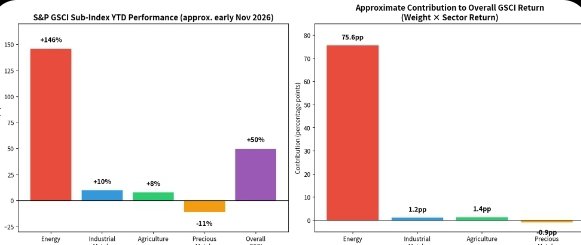
The charts in Frame 4 below reveal thay the +51% year-to-date % increases, isn't as a result.if a currency devasement, or abnormal inflation, or even money supply. It is driven by Precious metals which contribute 52% to the commodity index, and gained triple digits (%) (as a complex).
This is largely driven by Middle East supply disruptions, tight refined product markets (especially diesel, gasoil and heating oil), inventory drawdowns and elevated risk premia.
Because the GSCI is production-weighted, this energy performance dominates the index move [See Chart 3 below] the other complexes are secondary and driven by monmontary factors.
Supported by electrification, data-centre/AI demand and some supply tightness, industrial/base metals (copper, aluminium, zinc) have posted solid double-digit gains and constitute a real but far smaller positive contribution given its 12% weight.
This is not a broad commodity-complex story. Demand conditions outside specific pockets (notably copper) have not shifted materially enough to justify a generalised upward price movement. The index strength is an energy-supply-risk phenomenon, and recent oil weakness that has already pulled the overall GSCI lower simply underscores energy’s outsized influence.
This year, and year-to-date, the gap widend (per your screenshoted chart in frame 2), is essentially an energy supply story, there is zero indication or correlation to the rest
ZERO EQUILIBRIUM® APPLIED FINANCE SERIES (PART I: FOUNDATIONS OF APPLIED FINANCE)
Topic 8: Understanding Financial Markets & Market Participants.
So far we've covered the basics of financial assets, instruments and investment vehicles, diversification, valuation, and portfolio theory.
These are basic maxims required for understanding, and so we now build on the above with an introduction to financial markets – the meeting point for all financial services and financial assets (through financial instruments and investment vehicles), the broad financial markets.
What Are Financial Markets?
By 'meeting point' we mean that financial markets are the arrangements, platforms and mechanisms through which financial assets are issued, bought, sold and exchanged.
They operate within a broader financial system that includes institutions such as banks, funds, brokerages, asset management companies, insurance companies and pension funds.
These range from banking to huge funds, mutual funds, Exchange Traded Funds (ETFs), Money Market Funds, brokerages, asset management companies, banks, insurance companies, pension funds, etc.
By providing differentiated services suitable for different objectives and investment policies, they facilitate the movement of funds between economic agents with surplus financial resources and those requiring financing.
This is their basic job, and the institutions only vary in modalities, regulations, financial capacity and the financial assets and services they provide.
For clarity, financial services and financial assets are related but not identical. A bank deposit, for example, is a financial claim against a bank, while an insurance policy creates contractual rights and obligations.
Bonds, equities and other securities also represent financial claims. The financial service provides the mechanism through which these claims and associated rights are created, managed or transferred.
From the above, it is clear that financial markets are much more complex and do considerably more than connect savers and borrowers. They facilitate capital formation, price discovery, liquidity management, risk transfer and the allocation of financial resources across an economy – through various mediums.
The foundations of understanding financial markets require understanding not just the instruments being traded, but also the participants, their incentives and how their interactions influence financial outcomes.
1/15
#ZeroEquilibrium #AppliedFinance #FinancialMarkets #FinancialEducation #FinancialIntermediation
If my father wanted to buy stocks whch he did, here's what will happen:
1. He would have to carry his briefcase and in it, all necessary documents.
2. He'd enter his car, and drive to the Brkers or Banks office, where,
3. He'd be made to fil a hundred forms, asked for a passport photograph, an then issue a check or cash.
4. In about 2 weeks, He'd drive to his P.O Box (Federal Secretariat PH), then retrieve his share certificates, and Al that other shit.
He will have to incur;
- extra liters of fuel cost (he wouldn't make that additional daily trip if he didn't decide to invest),
- money for a passport photograph,
- photocopy all documents (that's money and ink.),
- but most of all, it will cost him TIME and INCOME. He was a doctor with a private practice, a Surgeon at UPTH a lecturer at Uni Port. So time is really valuable, it could cost him money, and cost the patient his life.
If he had to educate himself in fiance, he'd need to read a tonne of material 📚 today, he just needs YouTube.
TODAY???????
With N1,000 data. And the equivalent of N20,000 then (N63.99).
Real Value (1991) = N20,000 × 2.75263
─────
860.32
Real Value = N63.99
(At Year 2000 Constant Prices)
If smartphones and fast Internet connectivity existed in his day, for less than N65, and from the comfort if his phone, what would have taken 3 weeks, wpuld b done in less than 15 minutes via @investbamboo
Mt father invested, woth all these hutdles. So, whats your excuse?
ZERO EQUILIBRIUM® APPLIED FINANCE SERIES (PART I: FOUNDATIONS OF APPLIED FINANCE)
Topic 8: Understanding Financial Markets & Market Participants.
So far we've covered the basics of financial assets, instruments and investment vehicles, diversification, valuation, and portfolio theory.
These are basic maxims required for understanding, and so we now build on the above with an introduction to financial markets – the meeting point for all financial services and financial assets (through financial instruments and investment vehicles), the broad financial markets.
What Are Financial Markets?
By 'meeting point' we mean that financial markets are the arrangements, platforms and mechanisms through which financial assets are issued, bought, sold and exchanged.
They operate within a broader financial system that includes institutions such as banks, funds, brokerages, asset management companies, insurance companies and pension funds.
These range from banking to huge funds, mutual funds, Exchange Traded Funds (ETFs), Money Market Funds, brokerages, asset management companies, banks, insurance companies, pension funds, etc.
By providing differentiated services suitable for different objectives and investment policies, they facilitate the movement of funds between economic agents with surplus financial resources and those requiring financing.
This is their basic job, and the institutions only vary in modalities, regulations, financial capacity and the financial assets and services they provide.
For clarity, financial services and financial assets are related but not identical. A bank deposit, for example, is a financial claim against a bank, while an insurance policy creates contractual rights and obligations.
Bonds, equities and other securities also represent financial claims. The financial service provides the mechanism through which these claims and associated rights are created, managed or transferred.
From the above, it is clear that financial markets are much more complex and do considerably more than connect savers and borrowers. They facilitate capital formation, price discovery, liquidity management, risk transfer and the allocation of financial resources across an economy – through various mediums.
The foundations of understanding financial markets require understanding not just the instruments being traded, but also the participants, their incentives and how their interactions influence financial outcomes.
1/15
#ZeroEquilibrium #AppliedFinance #FinancialMarkets #FinancialEducation #FinancialIntermediation