Andrej Karpathy’s multi-agent architecture breaks down how hundreds of AI agents can actually work as one system.
Some of the biggest takeaways:
• 1 goal → 4 core layers: trigger, planner, agent swarm, memory + outputs.
• 1 planning agent breaks the objective into smaller tasks before execution starts.
• up to 300 agents can handle research, execution, verification, routing, and recovery in parallel.
• 5 core primitives drive the system: trigger, plan, dispatch, verify, merge.
• temporary swarms can spin up for 1 objective, execute in parallel, compress the useful state, then shut down.
• the system keeps the shared memory + final result, not 300 agents running 24/7.
Read the full breakdown below.
Andrej Karpathy’s multi-agent architecture breaks down how hundreds of AI agents can actually work as one system.
Some of the biggest takeaways:
• 1 goal → 4 core layers: trigger, planner, agent swarm, memory + outputs.
• 1 planning agent breaks the objective into smaller tasks before execution starts.
• up to 300 agents can handle research, execution, verification, routing, and recovery in parallel.
• 5 core primitives drive the system: trigger, plan, dispatch, verify, merge.
• temporary swarms can spin up for 1 objective, execute in parallel, compress the useful state, then shut down.
• the system keeps the shared memory + final result, not 300 agents running 24/7.
Read the full breakdown below.
Google just dropped a 1-hour course on agentic engineering from scratch:
00:00 – How to build your first AI agent
08:24 – Build agent memory
28:34 – Agentic loops, long-horizon AI agents
1:00:22 – Multi-agentic systems
This 1-hour watch will replace 10 paid agentic courses and any bootkamp
Watch it today, then read how to build a self-improving agentic system in the article below.
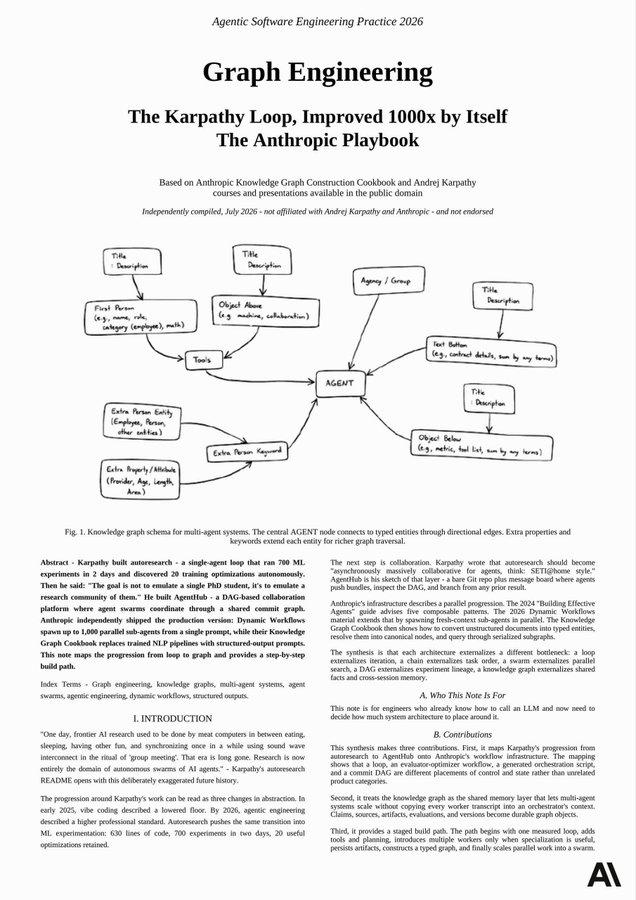
Two Anthropic seniors just made Karpathy's loop 1000x better with "Graph Engineering" - dropped 11-page PDF
the shift: the agentic systems got 1000x better the moment you wired agents into a graph
here's the playbook in 6 steps:
step 1 → build one loop: generate, critique, revise - one self-review cycle beats a smarter model with none
step 2 → add tools: search, code execution, database - thinking without tools is hallucinating
step 3 → go parallel: spin up agents in separate worktrees - same repo, different branches, no conflicts
step 4 → add a graph: agents write findings as typed nodes and edges - not transcripts - every claim keeps its source
step 5 → ground your evaluator: it checks claims against graph edges, not vibes - "Triple not found" beats "seems off"
step 6 → the graph survives every session - your agents stop rebuilding context from scratch
the result: Karpathy ran 1 agent in 1 direction - this system runs 1,000 with shared memory - same model, it's the architecture
read this 11-page PDF and paste it into your Claude - you won't regret it
bookmark - then read the article on building graphs from scratch ↓
Anthropic Engineer Andrej Karpathy:
Everyone wants to build agents.
Karpathy’s point is that most people are skipping the layer that actually matters: understanding the model itself.
His argument is simple:
1. Don’t start by wrapping a model in tools, loops, and autonomy. Learn what the base model can and can’t do first.
2. A flashy demo can take days. A reliable product can take years. Self-driving was the proof.
3. Agents are the consequence, not the foundation. Get the underlying intelligence right and the agent layer becomes much easier to build.
That’s the part most of the industry is trying to reverse.
And according to Karpathy, the people experimenting with agents today are already pushing into the frontier themselves.
Watch it, save it, then read the full article below ↓
Andrej Karpathy Anthropic Head of Technical Staff:
"Multi-task learning has a team problem nobody talks about."
Karpathy's team runs 100 subtasks inside one neural network
In this 15-minute talk, Karpathy breaks down the full multi-task stack:
architecture tradeoffs + loss balancing + data engines + team workflow.
Worth more than any $500 ML bootcamp.
Watch it & then read the full article below
Andrej Karpathy Anthropic Head of Technical Staff:
"Multi-task learning has a team problem nobody talks about."
Karpathy's team runs 100 subtasks inside one neural network
In this 15-minute talk, Karpathy breaks down the full multi-task stack:
architecture tradeoffs + loss balancing + data engines + team workflow.
Worth more than any $500 ML bootcamp.
Watch it & then read the full article below