We've published the EF Protocol cluster's priorities and our first shared Hegotá EIP tier list, with input from ~60 researchers and engineers across all 9 Protocol teams.
We're aggressively targeting a quantum-resistant Ethereum L1 no later than December 2029. That has implications for what we propose including in Hegotá, and how much capacity we leave for the forks after it.
Keeping mainnet safe remains our first priority.
We'll be on r/ethereum for an AMA on September 16 at 2pm UTC. Please come ask us about the priorities, the tier list, or anything else you're curious about.
Tier and priorities posts and question form can be found below in this thread:
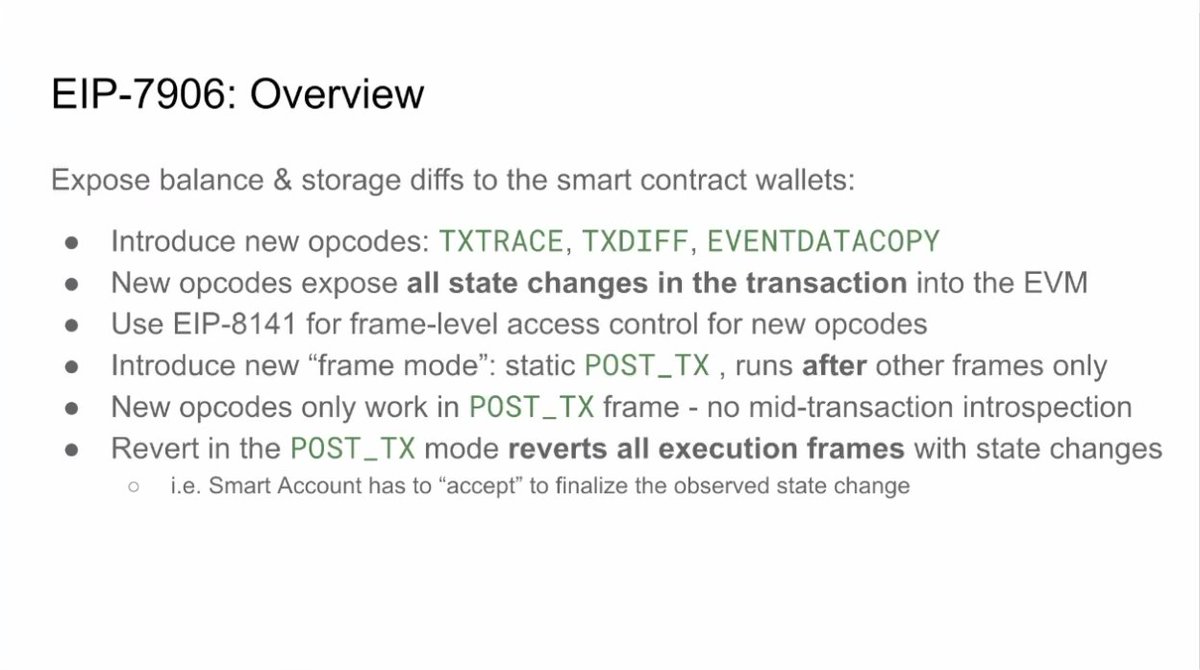
TLDR: EIP-7906 lets transactions include assertions defining permitted outcomes. If one fails, the execution effects are reverted.
One example scenario could be that you interact with a contract you believe claims an airdrop. With 7906 you should be able to assert that the transaction produce only the expected effects of receiving the airdrop, and if it instead were to grant a malicious third party permission to spend your ERC-20 tokens, the assertion would fail and the execution effects would instead be reverted.
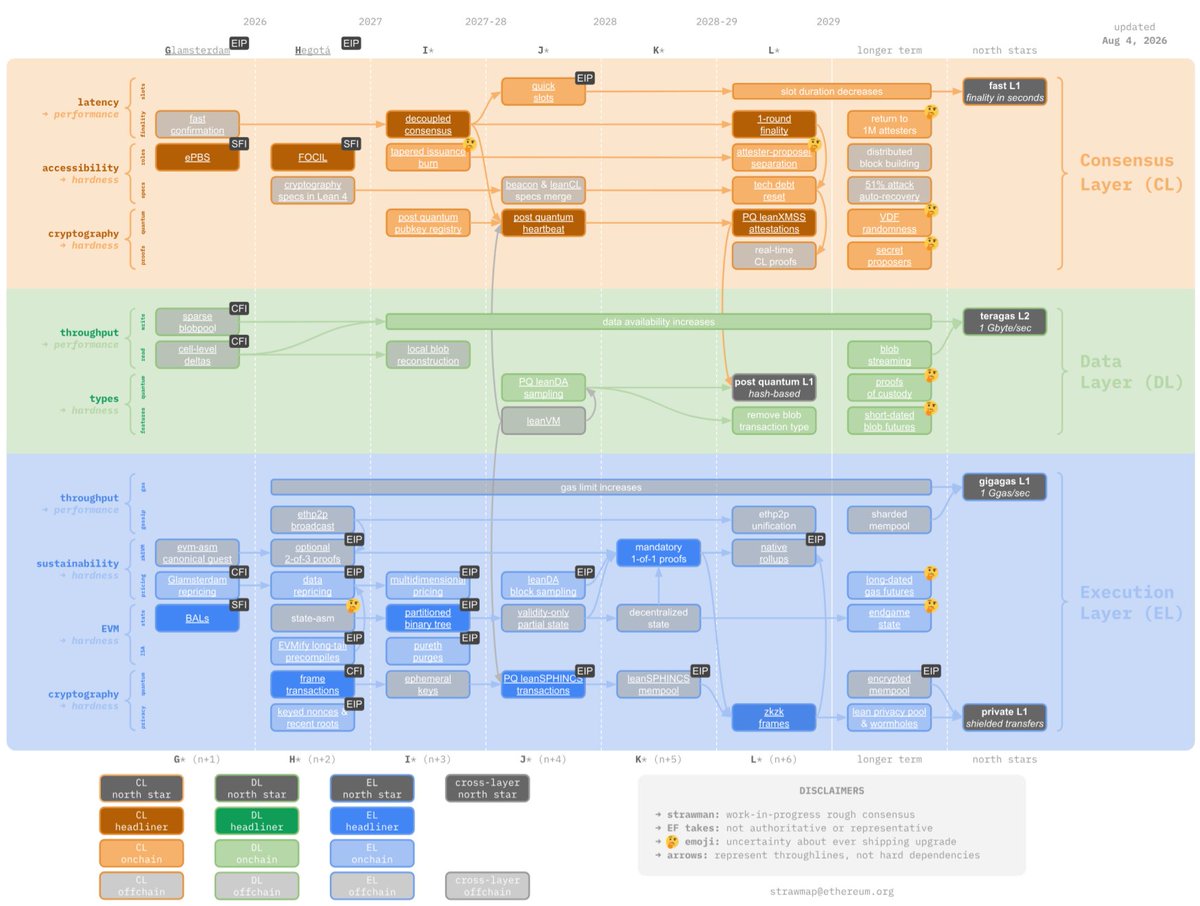
I updated my 2023 roadmap diagram to overlay where the items that were there sit in the current Strawmap ( https://t.co/I35mrXutP2 ).
In general, a lot of overlap, but:
* Some things got reshuffled in order (eg. quantum safety up-prioritized)
* Some things deprioritized (eg. VDFs; many EVM improvements)
* Some things replaced with superior constructions (eg. Verkle -> unified BT -> PBT; state expiry -> new state types)
What's most striking, however, is that some completely new things are in the strawmap that are NOT in this diagram, because they were not in the 2023 roadmap at all. These reflect changing priorities.
Notably:
* First-class attention to strong privacy. This covers: keyed nonces and recent roots, aspects of FOCIL, lean privacy pool & wormholes
* Aggressive scaling in the context of post-quantum. This covers: leanSPHINCS signatures and aggregation, zkzk frames (see https://t.co/ibrOpMxMfO )
* Lean-ification of the spec, to assist in formal verification (full FV of everything is only possible because of modern AI)
* Blob and gas futures (this idea just didn't exist back in 2023)
* Native rollups (SNARKs were nowhere near mature enough to even consider this back in 2023)
* A more open design space for the "future of the EVM". zkzk frames already implies that the protocol will expose to users some ISA that's not the EVM - current leading candidates are leanISA and RISC-V. These ISAs are more simple, modern and efficient than the EVM. Once they're there, why not expose them to developers everywhere? (And then, why not turn the EVM into being an IR on top of that ISA, instead of an enshrined feature massively complicating the base protocol?) Though much of the deeper exploration here is too early even for the strawmap.
* New state types are not just a replacement for expiry, they're a fundamentally different paradigm to how Ethereum does scaling
A common theme in scaling, found in both state types and zkzk frames (both new ideas), is that instead of trying to maximally scale ALL ethereum activity, we try to create specialized mechanisms that have more restrictive properties that make them more scaling-friendly, while supporting the heaviest loads incurred by users and applications today (eg. token transfers, swaps) and tomorrow (eg. privacy protocols).
The other common theme is treating STARKs and AI-accelerated FV as first-class objects, that we are okay betting the technical future of Ethereum on. There are recursive STARKs in many layers of the protocol, one particular primitive (the "aggregate to union verified dependencies" primitive) is expected to be used in *three* places in the protocol: EL, CL and DL. This can only be safe with formal verification, which is itself only feasible with modern AI tools.
In general, many steps forward in maturity. And a huge amount of hard work by many dozens of Ethereum researchers and developers on all of these features.
Ethereum will be quantum-safe. Ethereum will put users' privacy first. Ethereum will be secure. Ethereum will be censorship-resistant. Ethereum will be highly performant and scalable while satisfying the above. And Ethereum will be Lean.
🚨 The @ethereumfndn Protocol Security team is hiring!
Come help secure Ethereum mainnet and the next generation of protocol upgrades.
Apply: https://t.co/X0xB7c1e6s
This could be you on the Devcon stage in Mumbai👀
The ideas shared at Devcon can shape what Ethereum builds next. Bring your work, your questions and ideas to the global Ethereum community.
Only a few days left to apply - apps close Aug 6!
https://t.co/0kHntKB135
We’re pleased to welcome @pcaversaccio to the EF Board.
A longtime Ethereum contributor, co-founder of SEAL 911, Silviculture Society member, and privacy and security maximalist, pc has consistently championed the values at Ethereum’s core. We look forward to working together to help steward Ethereum’s long-term future.
Read more: https://t.co/eiQ13rprd5
@0xTylerHolmes you will be greatly missed Tyler! your knowledge about security and Ethereum and has been instrumental to keeping Ethereum secure, and your curiosity and ability to quickly take on new things has always been very impressive. whatever place you end up going to will be very lucky!
The Protocol Security Team has been pointing AI agents at Ethereum’s protocol code. Our core takeaway wasn't about finding bugs, it was about triage.
Here are field notes from the work.
https://t.co/HVtc8XcrJK
Two weeks ago, Ethereum researchers met in Berlin to continue charting the protocol's long-term trajectory, following along discussions with client teams in Svalbard in April.
The updated strawmap is at https://t.co/9e2AQ6rhz6, and I attached a picture of it to this post.
My own high-level takeaways:
* "Lean Ethereum" is not a single one-shot upgrade, it is a collection of improvements that will come online to the Ethereum network over the course of three or four years. But make no mistake, this IS the third major iteration of Ethereum in the same way that the Merge was the second. Almost every major piece of the protocol will be replaced:
- Verification through recursive STARKs, rather than direct re-execution. Recursive STARKs become an enshrined first-class core component of the protocol
- Replacing everything quantum-vulnerable with quantum-safe alternatives
- Consensus: decoupled available chain and finality, one or two-round finality. Theoretically optimal security properties, simpler than today, and faster than today
- Multidimensional gas
- State: not just tree structure, but what *types* of state are available
- Changes to client architecture
...
At the same time, simplification, cleanup and future-proofing. And this will all be done in a way that minimizes disruption to existing application. We've done this before (the Merge), we can do it again.
* H-star (aka Hegota) is probably Ethereum's last thematically "pre-Lean" fork. Starting from I-star, most of everything we do will have a very strong "Lean" feel to it in one way or another.
* Privacy is no longer an afterthought, it is a first class goal. When designing Frames, the mempool, additions to the state tree, we explicitly ask the question "okay, how do quantum-safe, intermediary-free privacy protocol transactions go through this, and what is the overhead?"
* Formal verification of everything for security.
* FV also makes us much more comfortable with canonicalization (having pieces of the protocol that are directly defined as a piece of bytecode expressed in some language). evm-asm is being written in part to become a canonical proof system for the EVM.
* Quantum safety has shifted up a LOT in priority. This adds a lot of work (eg. finalizing a quantum-safe blobs design has become urgent; this work has already been ongoing for months)
* Probably the single most disruptive part of the plan is the changes to state. There is growing consensus around leaving present-day-style "dynamic state" mostly unchanged, but scaling it only a medium amount, and adding new types of state that are more scalability-friendly (eg. no need for builders to sync/store all of it) but more restrictive, and that will scale a large amount.
eg. possible Ethereum in 2030: 2 TB of present-day-style (dynamic) state, and 100 TB of new-style (scalable but restrictive) state
This "new-style" state would work very well for ERC20s, NFTs, many defi use cases, but not eg. highly "central" objects like Uniswap contracts, or onchain order books, or other complex things (which are crucial for Ethereum but which only take up a small percentage of state)
Hence, it will not be *necessary* to rewrite any apps, but it will be *very cost-effective* to eg. rewrite an ERC20 token into a newer design that uses a new type of UTXO storage that is currently being explored, so that it will have >10x lower txfees.
Design of these new state types (current ideas: keyed nonces, ring buffers, UTXOs, statically accessible state, temp state) is an area where we will need a lot of feedback from application developers (incl. privacy-friendly application developers) and probably several rounds of rethinking and iteration.
* In the context of a much larger total state size, we need to figure out the incentive issues around who stores this state and what motivates them to. Even saying "each node stores 1%" is not good enough - why do they store that 1% and why are they willing to serve it? This is being elevated as a first-class research area.
* Ethereum will need to have a "VM" other than EVM in one form or another - at the very least, we need something like leanISA for recursive STARKs - and the gains are large in exposing it to users so that we support programmable privacy and better scalability. Right now, the most likely contenders are leanISA and RISC-V.
My own ideal is that in this world, we adjust the protocol so that the EVM becomes a high-level-language compiler-level feature, and the protocol only "sees" RISC-V / leanISA directly. But this is still far away.
* Gas limit increases, blob increases and slot time decreases will happen many times over the next ~5 years. We expect a large gas limit increase with Glasterdam. Each step of increased scale or decreased slot time is a matter of getting to the point where it is safe to do it, which comes from a combination of client optimization and protocol changes.
Ethereum is CROPS.
Ethereum is scaling.
Ethereum is reinventing itself.
Onward.
This year, the EF is decreasing its budget by roughly 40%, which entails some difficult decisions. The goal of the decreases was set out in the Treasury Management Policy last year: the EF is transitioning into being a long-term-oriented endowment-based organization, shifting from its pre-2026 average of spending ~15% of its remaining funds each year, toward a post-2030 target of ~5% per year.
Often, when an organization goes through something like this, people try to pretend that nothing of great value was lost, that it is an efficiency increase, that the only people cut are unproductive dead weight, and everyone else stopped partying, studied the blade, entered cracked S-tier beast mode, and this was sufficient to make up for the downside. I will not try to pretend this. I respect my EF colleagues far too much to pretend that there was not much that is lost. They are brilliant people. They are dedicated engineers of whom some have worked on the Ethereum protocol for nearly a decade. They have brought a bright light to the Ethereum ecosystem with their code, their words, their warmth as human beings and their actions. My dearest hope is that they find a path that brings them fulfillment and happiness whether inside Ethereum or outside. Hopefully many will be able to bring their excellent talents and mindset to the wider Ethereum ecosystem, or the even wider CROPS world.
Instead, I will try to explain what *are* some of the grand sacrifices being made. The Ethereum Strawmap is no small thing. It is an extremely ambitious undertaking seeking to replace and augment almost every part of the protocol - consensus, proofs, privacy, account model, state, and more. This is the third iteration of Ethereum, in the same way that the Merge was the second, even if the shipping style is less Big Bang and more one-piece-at-a-time. On top of this, the EF is increasing its role in the Access Layer. We are not compromising on Ethereum being a Deeply Impressive protocol, something worthy of its place in a world with quantum computing, rockets to Mars and powerful biotech and AI, and capable of meeting the challenges that this era will bring.
Some of the deficit will be recovered through more work happening outside the EF. But not all. So what are the grand sacrifices that will enable a leaner effort to accomplish all of this? I will give a few examples (though far from an exhaustive list):
* The multi-client model will shift in the direction of multiple clients existing less for _redundancy_, and more for _specialization_. Up to this point, redundancy has been the main security strategy: if one client has a bug, if it has less than 33%, the chain keeps going and does not even stop finalizing. We are increasingly exploring moving more pieces of the protocol to a different security strategy: AI-assisted formal verification. Some smaller pieces of Ethereum (eg. BLS libraries) have worked this way already for a long time. But soon many more parts of Ethereum will likely function on this model. This may greatly reduce resource requirements of shipping a large number of EIPs. The resources saved by client teams can ideally instead be used to better serve different specialized user needs, including EF Access Layer goals.
* PSE (Privacy and Scaling Explorations) is winding down as a unit. The number of people working on ZKPs for privacy and scaling is probably as high as ever, but they are working less on "exploration" and more on *implementing* ZKP-based privacy and scaling into the Protocol and Access Layer
* Devcon will likely over time become smaller-scale, somewhat more spartan, much lower-deficit than previous years, in addition to other changes in vision in line with the Mandate.
* Fewer beyond-Ethereum megaprojects coming from EF. As I announced earlier this year, I am taking on some of the responsibility of doing projects in this category that I consider valuable with my personal funds.
* EF institutional work is reducing in scope, specializing more specifically on creating replicable test cases of highly CROPS-friendly deployments, even if at smaller scale.
These do not explain all departures; in some cases they do not explain departures at all and rather explain _reduced need for new spending_. But they are a large part of the strategy at play.
In the longer term, I personally favor a "soft lean-and-done" approach to Ethereum: once the Strawmap is completed, generally stick to security fixes and small high-value changes, and have a much higher bar for considering new feature additions to the protocol. This allows Ethereum to remain capture-resistant without demanding very large budgets. Learn less from multimillion-line-of-code behemoth projects, more from bitcoin.
The past years have been a challenging era for Ethereum. However, the ecosystem is adapting, both inside the EF and outside, and I am confident that Ethereum is very well-positioned to succeed and thrive.
https://t.co/iZiOonRYzR
1. Intro
Vitalik recently wrote about where the EF should go; Aya added a note to explain how we got here, and why. I’ll write about the execution.
We now have enough clarity to stop treating “what is the EF for?” as an open-ended question. Our mandate is clear: The EF exists to ensure Ethereum is, becomes, and remains real permissionless infrastructure for self-sovereignty: censorship (and capture) resistant, free and open source, private, and secure; and capable of supporting sovereignty-preserving coordination at scales where trusted institutions hitherto have been unavoidable.
The following are my thoughts on some of the points that follow from the mandate and how we are translating it to action. But first, a short reminder about
2. What the EF is not for
We are not here to optimize for EF importance, corpo/pol appeal, or ecosystem popularity. We are also not here to please short-term speculators, prop up TBTF neo-SIFIs, market every app on Ethereum, help anyone look good to their crypto or investor friends, or provide on-demand entertainment for dinner parties and private retreats.
3. What the EF is for: Eliminating weaknesses
We are here to defensively strengthen places where Ethereum is, or can still become, extractive, totalizing, or vulnerable to cartel or state capture, or authoritarian tools of surveillance or coercion.
We will base our actions on a full examination of what Ethereum is and can be at the protocol layer (what is actually running as “Ethereum”), the access layer (what users use to interact with the protocol), the user layer (the end-users who need and will need Ethereum), and the institutional layer (the intermediated paths that scale self-sovereign usage).
The EF exists to harden every surface of Ethereum, including those where Ethereum can remain formally permissionless while becoming practically captured. Some obvious surfaces are the transaction pipeline, staking and network security, access layer standards and interfaces, self-sovereignty norms, privacy expectations, institutional adoption patterns, and social layer governance processes. The primary concerns are similar across most of them: does the status quo and its future trajectory minimize trusted dependencies, minimize points of leverage and capture vectors, make user privacy the default, preserve exit, and make trust assumptions legible?
The work starts with the EF itself. We are moving compensation and major financial relationships toward ETH and mandate-compliant Ethereum-native stables, with exceptions where positive law or unavoidable operational constraints require exceptions. Rather than a purity ritual or instruction for people to take unmanaged personal risk, it is robustness, alignment, and product pressure. If the EF’s work is to make Ethereum usable as infrastructure for self-sovereignty, everyone at the EF will increasingly live inside the constraints of the system the EF exists to improve: wallet UX, volatility, accounting, privacy gaps, payment friction, stablecoin trust assumptions, recovery, dependency risk, etc. If we can’t use these tools ourselves, it is unrealistic to expect others to. Ethereum is already mature; those who do not depend on the user-facing stack have no business trying to shape its future, at any layer.
The transaction pipeline is next. Preventing toxic MEV capture is core EF work, not a peripheral market-structure concern. Transaction supply, ordering, inclusion, block construction, propagation, and settlement are part of Ethereum’s neutrality boundary. Some MEV may persist as an adversarial phenomenon the protocol contains, but it must be absolutely minimized and, for that to be possible, we must guard against the acquisition of unwarranted influence by its beneficiaries.
If credibly neutral execution is subverted by privileged orderflow, cartelized builders, trusted relays, opaque routing, or validators outsourcing into a narrow supply chain, Ethereum will look permissionless while users experience it as intermediated at the moment value moves. EF protocol work will therefore prioritize lower barriers to block building and validation, stronger inclusion guarantees, reduced extraction opacity, competitive transaction pipelines, user-facing legibility of trust assumptions, and more aggressively exploring the open orderflow solution space.
None of this is simple. A good solution in one place can aggravate problems elsewhere. FOCIL is good for censorship resistance, but it may introduce more cross-block MEV. While ePBS solves the relayer trust problem, we must make sure that its implementation does not inadvertently obstruct long-term solutions to even larger problems. It would be unacceptable, for example, if ePBS enshrining the builder economy ends up making it harder to reduce reliance on the private orderflow that has emptied out the public mempool. Encrypted mempools may not only reduce pre-execution transparency and pending orderflow visibility, but also shift competitive advantage to new privileged actors, including specialized hardware operators in some designs, while adding protocol complexity.
In order to avoid wasting time playing whack-a-mole, we must commit to solving the extraction problem at a whole system scale. Doing so will require creativity, courage, and the understanding that failure to solve this problem is unacceptable. If we fail, we will have left in place an unnecessary barrier to institutional adoption, but, more importantly, we will also have surrendered a core part of the promise of Ethereum - the replacement of extractive middlemen with permissionless, credibly neutral infrastructure and competitive markets. That must not happen.
MEV is likely to be the next major front in the cypherpunk war. We must set ourselves up to win here.
Privacy is just as fundamental. A public ledger without serious privacy defaults is a surveillance substrate with settlement guarantees. That is not an acceptable end state for the world computer. Unconditional privacy will be readily available across Ethereum, with programmability on top for selective disclosure, proofs, auditability, compliance logic, reputation, governance, identity, and other constraints chosen by users and their communities. The temporal order matters: unconditional privacy must exist first, opt-in constraints come second.
It is also important to avoid forcing users to assemble a fragile stack of special wallets, RPCs, bridges, apps, compliance providers, and operational habits to attain privacy. Deep privacy must be more secure than this. Privacy is a condition for Ethereum’s viability as freedom-respecting coordination infrastructure and as such must be robust.
Staking must be treated as protocol infrastructure risk. Staking is not merely a yield product, and liquid staking is not merely an app-layer market. If stake, liquidity, validator access, DeFi collateral, and governance influence concentrate around a small set of issuers or operators, Ethereum’s security layer becomes vulnerable to capture through capture of the economic layer around it. EF will support research, specifications, and designs that keep staking permissionless, private where possible, plural in operation, and resistant to intermediaries becoming permanent control points.
The access interfaces are where users access either the protocol directly or through intermediated defaults. The primary problem to solve here is not getting Ethereum into more rooms directly, but making its users, both end users and institutions, more self-sovereign and less susceptible to coercion, and avoiding normalization of soft coercion in exchange for reach. EF will not help Ethereum become more acceptable by sanding off the properties that make it uniquely valuable. Ethereum does not need to become another permissioned settlement backend with better branding. It needs to show, in production, that self-sovereign coordination at scale is possible.
Across Ethereum, the EF’s defensive work seeks to ensure that Ethereum is infrastructure people can still use when counterparties fail, platforms censor, governments overreach, intermediaries extract, and coordination problems become infeasible for trusted systems to handle. A core part of that is to make that infrastructure secure and robust against capture at every layer wherever capture opportunities can hide.
4. What the EF is also for: Seizing opportunities
Shoring up the fundamentals is not enough. Ethereum’s potential is still largely unrealized, but that does not mean that the path ahead is going to be straight. Opportunities must be seized when the time is right. At this moment in time, a number are visible, including:
* Ethereum becoming the first quantum-resistant global infrastructure. Ethereum researchers will lead the post-quantum cryptographic migration before the threat becomes urgent, not after it becomes a governance emergency. That means hardening Ethereum’s cryptographic foundations while there is still time to design carefully. The same applies to other long-horizon risks, where waiting for market demand means waiting until the window for principled design has already closed.
* Verifiably self-sovereign stack, from soup to nuts, whether local or remote, with no censorship or extraction openings: browsers, wallets, intents, broadcasts, orderflow, inclusion, block construction, proposal, proving, exit, and recovery. Minimal MEV, and zero toxic MEV entrenchment, either in or around the protocol. No execution layer that is formally permissionless but practically gatekept by privileged supply chains. If there’s a funnel towards an extractive private lane, there’s other options that keep the game live. The goal is not only to prevent extraction or capture, but to make credibly neutral execution competitive enough that serious users prefer it.
* Making ETH normal digital cash: a private, dignity-respecting, debasement-resistant and surveillance-resistant medium of exchange and store of value, as well as the native asset of private computation and private coordination for both humans and their agents. If Ethereum can make private economic life and private institutional life possible without routing users back through the friction and potential abuse of custodians, surveillance vendors, or permissioned ledgers with softer branding, as well as provide a venue for secure and competitive machine economics, the value unlocks will be immense.
* Personal wallets with personal AI agents that users can actually own and run on their own personal computers. Not your keys, not your coins; not your model, not your mind. As agents become interfaces for more economic and social action, the question of who owns the wallet, the model, the memory, the policy, and the signing authority becomes an existential question about sovereignty instead of UX details - we are all users above any other roles, and no one at EF will forget this.
* Institutional and enterprise use cases where Ethereum wins by not disappearing into an invisible backend, gatekept by intermediaries or terrible UX, and by not compromising into a compliant fintech rail with web3 branding. Rather, we will win through proving that credibly neutral infrastructure can handle disintermediated coordination so competitively that trusted intermediaries have to meet Ethereum users on Ethereum’s terms.
* Security-preserving scaling. L2s and related infrastructure will be able to meet institutional-level needs without accepting dependencies on closed operators, opaque sequencing, custodial UX, or upgrade committees that users cannot realistically exit. Scale is not throughput alone. Scale is the guaranteed availability of self-sovereignty under real load.
We are ensuring Ethereum remains the hardest bedrock for settlement, local and worldwide; and beyond that, a civilizational ledger and execution substrate to stand the test of time. When future civilizations speak of the infrastructure they inherited from the Antiquity of the Information Age, their first example should be Ethereum.
Ethereum will outlast all of us. More than enough people watching understand this. Many wondered why it needed saying at all, but it did. If you don't believe us or don't get it, we don't have time to try to convince you, sorry.
5. Addressing departures
There has been a lot of online speculation about departures from EF, both before and after the mandate. Some people resigned, others were terminated. Some departures were about strategy, some about role fit, some about normal institutional change, and some simply about people deciding that their best work for Ethereum should happen somewhere else. We will not litigate individual personnel matters on Twitter. That is the default because it is better for EF, better for the people involved, and better for Ethereum. People who contributed through EF deserve dignity on the way out. They do not deserve to have their employment history turned into factional content.
Where possible, we have let people describe their departures in their own words as a matter of courtesy, and not concession. If public claims materially mislead people about EF’s direction, decision-making, or mandate, we may correct the record at the level of policy, process, and institutional facts. We still will not turn personal files into public spectacle.
Ethereum is permissionless. People may disagree, criticize, compete, fork, and build elsewhere. We intend to keep exits dignified and expect others to do the same. It will suffice to say that we are thankful for what all contributors have built; we will continue to do work Ethereum needs.
6. Addressing EF spinouts
Some work should and will leave the EF in the months to come. We hope and expect this process to result in some excellent work being done in service of scaling self-sovereign adoption, but we also must take care lest it becomes an abdication of responsibility or an excuse for undisciplined spending. Some work is not mandate-compatible and should not be carried forward with EF funds or EF endorsement, either inside or outside the Foundation.
The efforts carried out by the spinouts will vary widely. Some efforts will leave EF because another org would be a better home for them; others will leave because markets should decide on their worth. Some will leave because they are not compatible with the direction set out in the mandate; others because they are useful but not EF work.
Just as a spinout is not automatically good because it reduces EF headcount, former EF affiliation is not a claim on EF funding. The question we ask when deciding on funding is not “did this come from the EF?” But, rather the questions that should be asked about all external funding:
“Is this work mandate-critical? Would the EF do this work internally if it had the organizational and financial capacity? Is there no better natural home? Can the external party execute without increasing capture risk, private extraction, opacity, or dependence? Does supporting it reduce Ethereum’s dependence on the EF over time, without prematurely transferring resources and legitimacy to new organizations and thereby risking operational failure or mission drift?”
EF funding for work being done externally can be appropriate when it is a capacity solution for mandate work - work the EF should responsibly want done; work that protects CROPS; work that advances self-sovereignty and scales it; essential work that no actor can or will reliably do without EF funding; and work that can be scoped, reviewed, and held accountable without creating a permanent dependency.
Such funding is not appropriate when it is a lazy continuity payment, a friendship payment, a reputational hedge, a way to avoid making a hard decision, or a way to support work that is not compatible with the mandate.
EF has finite funds, finite legitimacy, and a specific mandate. We will spend all three as if they matter. When we say “EF is one of many nodes”, we mean that we intend to be one of many nodes working to keep self-sovereignty and its scaling the North Star, and working to keep CROPS the undisplaceable first-class properties of the network. We don’t mean that we will support orgs or projects with different priorities. Diversity that leads to ecosystem resilience, coordination cost right-sizing, and better decision-making is good. Diversity that leads to mission drift is not.
We are not neutral on the direction Ethereum takes. CROPS are not just things we “believe in”, they are characteristics we understand must be thoughtfully prioritized at every fork for Ethereum to realize its potential. We are partisans for and builders of something of such incredible neutrality that it will fundamentally reshape the world we live in; we wish to work with everyone committed to this shared purpose.
Vitalik shared his perspective on where @ethereumfndn is heading. Here is mine, another part of the same story.
The EF Mandate from the board was something I proposed late last year. Two main things prompted me. First, debates that were meant to be technical had started to become political and personal, and at times shaped by quieter incentives. Second, as EF grew, more and more versions of "what EF should be" began pulling at the core of the organization from every direction at once. I became convinced that trying to satisfy all of them would leave us achieving nothing at all. It was time for us to restate our role and underlying principles clearly, both the parts that have been clear from the start and those that have been informed by over a decade of experience.
We have said it many times: EF is one of many nodes in Ethereum. I know that is hard to hear for some, because EF was the first group, and in the early years it was essential for making things happen. But it was never meant to stay that way.
I have been in crypto since 2012, before it became an "industry." I joined Kraken in 2013, shortly before the implosion of Mt. Gox, which I helped to clean up. I am very aware of how real growth works, and also aware of the real risks of centralization. So when I became ED in 2018, I understood that Ethereum growing beyond EF would be essential to fulfill its real promise as a public blockchain. The goal I set for myself was to ensure that this happens.
The opposite path has always been untenable: Ethereum's future is too big for any single organization to bring about. So EF made deliberate choices to distribute power. We did incubate and release, like Uniswap and ENS. Support to seed a new norm, like ETHGlobal and the hackathons that are now everywhere. Funding the funders, like Gitcoin and Moloch. We always asked the same question: how does this stand on its own, without us?
Those experiments, alongside the work of countless others, contributed to where we are today. Ethereum is now far bigger than anything EF could coordinate alone. EF now holds less than 0.2% of all ETH, and the return on all of that shared work, together with extraordinary people across the ecosystem, has been beyond anything we could have built by ourselves.
That is exactly why a focused EF is possible now. The Mandate states simply the one thing EF must keep carrying: preserving and accelerating the properties and goals that keep Ethereum uniquely valuable, competitive, and worth building on. That is: CROPS - for the sake of inalienable user self-sovereignty and self-sovereign coordination. We cannot do it alone, and we do not intend to. But defining this as the north star for the mission, and coordinating with the allies who share it, is the responsibility we are keeping.
None of this means EF stops caring about adoption, for everyday users or for institutions. The opposite is true: everything we do is ultimately for the people who use Ethereum. Supporting adoption, including institutional adoption, remains part of our work, pursued in the ways that fit our mission. The value proposition of Ethereum for both everyday users and institutions rests heavily on this.
As EF becomes more focused and more opinionated, the team naturally becomes smaller and more concentrated. That is part of the choice. New leaders are already stepping into this mission and growing within it, and you will hear more from our management in the coming weeks, about what they are doing, and about the new structure and strategy taking shape.
The mission we carry is not a smaller one, but a clearer one. Special thanks to those who have stepped in to support, defend and advance it.
🛡️ The results for the @thedaofund’s Ethereum Security QF Round are LIVE!
This historic round is closing with a HUGE last minute contribution:
@wintermute_t has added $200K to the matching pool 🔥
Wintermute is a well known liquidity provider, and one of the leading supporters of Ethereum security, in fact exactly a year ago today they donated $1M to @_SEAL_Org.
This year they teamed up with TheDAO, @Quantstamp & several other community partners to allocate over $1.6M worth of funding to Ethereum Security Public Goods 👇
Some of my perspective on where the @ethereumfndn is going.
First of all, this is only my own view. The board is not just me, and I have no extra special powers on the board that the other board members do not. @aerugoettinea is the one executing much of this transition. My input has been largely on technical questions. The board is in the process of expanding, and my own power within the org will continue to decrease, which is honestly what I want.
The 2025 era brought many important improvements to EF and its ability to execute. Many issues were resolved, and EF continues to benefit from its improved efficiency and greater focus on concrete goals to this day. And so with those problems resolved, early this year, the largest remaining hole that I perceived was something different nagging at me: I would regularly spot people saying things like "vitalik says these beautiful things about ethereum needing to be decentralized, and have privacy, and be a sanctuary technology, but why do the EF's actions not reflect that?"
Now, you may have been hearing something different. You may not have been sensing a feeling of crisis at all, and maybe were hearing people saying that finally we were taking execution and BD seriously and the main task for us is to keep going that way and be even better and faster. Then probably there is genuine difference between you and me, in what kinds of criticism I take most seriously, and what kinds of critics through their criticism are most able to make me feel pain.
As an analogy, let's briefly switch over to a different domain.
One belief you can have about Google is that it is a success story, and has brought a lot of good to humanity in organizing the world's information. Another belief you can have about Google is that they had a beautiful idealistic beginning, but at some point the corruption of mainstream corporate attitudes seeped in, and they slowly bit by bit completely abandoned the "don't be evil" slogan.
My belief on Google specifically is probably somewhere between the two. BUT, if you had taken me back in time to ~2008, and offered me a button to press to make Google one or two standard deviations more "dogmatic", eg. give Richard Stallman permanent veto power over some key policies, I would immediately press it.
Why? Because a choice for one company is not a choice for the world, or even one country. Google existed and exists in the context of a technology industry generally drifting away from early idealistic don't-be-evil roots and toward greed for financial gain, totalizing visions of accelerated superintelligence, infiltration by sociopaths, and craven capitulation to (or worse, active participation in) government pressure for ideological control, surveillance and war. And so *one company* doing something different, positioning itself to be what George Bernard Shaw calls the Unreasonable Man, resisting the trend of the times, would have been better for freedom, balance of power and stability of society as a whole, than *all* large companies bending to dominant trends. This is a part of my version of pluralism.
This line of thinking is not just mine, but I also is not too far off from what Aya and others had in mind with the Mandate.
Now how does this all get to the role of the EF?
EF is not a "center of Ethereum", rather EF is "one node, with a defined purpose, alongside other nodes". We've always said that the EF should be the latter, but many in the Ethereum ecosystem (and even within the EF) wanted us to be the former. Now, we are taking action to ensure that we will be the latter.
This is particularly important because EF is a limited organization, with limited resources and limited organizational capacity. The EF has only ~0.16% of all ETH (less than many other individual ETH holders), whereas among other blockchains it's common for "the central foundation" to have 10-50%. Fiscally, the EF was originally designed to fulfill a limited work scope defined in the token sale docs and other pre-launch materials (building the chain software; getting through Frontier, Homestead, Metropolis, Serenity), which was fully completed in 2022; it was not designed to be an eternal steward.
And so today, the EF is choosing to use its remaining resources to pursue longevity over breadth (yes, this means we sell less ETH). The EF focuses *specifically* on those activities critical to the success of ethereum as a censorship/capture-resistant, open, private and secure system, that would not happen otherwise. This means making hard choices, and in some cases even activities that we highly approve of and people that we highly respect becoming outside of the EF. People of great technical talent, public respect and even alignment with the mission and CROPS being outside of the EF is in fact necessary if we want important tasks to be able to attract outside capital. This also means the EF taking opinionated stands culturally.
This is all intended in cooperation with all other parts of ethereum. We recognize that many other parts of the ethereum world highly respect CROPS and related values. But highly respecting is not the same as choosing to specialize and totally dedicate to a domain (Compare in a different domain: I think reducing animal cruelty is important, and I like vegan food, but am not full unconditional vegan myself)
EF is still in a transition period, and we expect its new long-term form to stabilize over the next few months. What are the guiding principles of this new form? Again, I am only one person, but I can give my answer from a technical perspective (there are also critical non-technical aspects).
At the core, *Ethereum must be impressive*. We are living in an age of highly intelligent AI and all kinds of other technological acceleration. "Status quo EVM, with a hard fork or two a year to optimize for short-term needs of users" is not interesting.
To some, "impressive" means: 250ms latency and 1M TPS. I think Ethereum trying to go that route is a mistake. Being as fast and as scalable as possible, and only a small epsilon more decentralized than the others, is a route to mediocrity, and if we try it we will lose.
I think Ethereum should scale. But I think Ethereum should strive the hardest to be deeply impressive in a different dimension: the CROPS dimension. This means things like:
* Provably bug-free Ethereum. This is a goal that all cybersecurity researchers would have thought is absurd and impossible, up until roughly 6 months ago. Now, it's on the cusp of being possible, thanks to AI-assisted formal verification. So we should be frontrunners in doing this.
* Available chain consensus. Ethereum is, and with lean consensus will cotninue to be, the ONLY chain that has both (i) traditional-BFT style properties that it's safe under asynchrony up to a high level of fault tolerance, and (ii) the bitcoin PoW-style property that under synchrony it's safe up to 49% attackers. As far as I can tell, literally no other chain has this or is planning for it; bitcoin goes for (ii) only and most other chains go for (i) only. Some will remember I fought hard for this, Unreasonably insisting that it is not OK for ethereum to rely on social consensus and hard forks to rescue ethereum from 34% of nodes going offline. It's OK for chains like hyperledger, bnb, solana, tempo, etc. It's not OK for bitcoin or ethereum or eg. zcash.
* Intermediary minimization. The fact that smart contract wallets, protocols like railgun, etc have to send transactions through intermediaries to get included onchain is honestly embarrassing, and it's a constant point of fragility. Hence the work on FOCIL and EIP-8141 (and 7701 and years of work before) to make transaction sending intermediary-minimized with public mempool and strong inclusion properties, in a truly general-purpose way, that covers not just eg. secp256r1, but also privacy protocols and much more. Kohaku is pushing intermediary minimization at the user layer, pulling Ethereum away from the dystopian status quo world where our wallets don't even verify the chain, send our private data out to a dozen third-party servers, and toward a brighter CROPS future.
Some of these goals are Unreasonable - maybe Ethereum would be "fine" getting only 50% of the way - what if we depend on intermediaries, but make it easy to switch? But going 50% of the way would not make Ethereum Deeply Impressive in the CROPS way. So we push for 100%.
Fortunately all these goals are compatible with high TPS, this is a major focus of research (esp. on scaling the state). Well-designed L2s can also help, especially L2s optimized for specific applications (eg. high-volume trading, privacy...). These goals are even compatible with significantly lower slot times, thanks to Raul's work on erasure-coded P2P, and many other optimizations.
The most high-value "product" of the ethereum blockchain, financially speaking, is ETH the asset. Ethereum secures $250 billion of ETH. The types of properties of Ethereum that I mentioned above are very good for ETH the asset. Nearly 90% of my net worth is in ETH, and most of the remainder is ~$40m of onchain fiat of which every dollar has already been allocated for some open-source biotech or software or hardware initiative. That said, there are aspects of supporting ETH the asset - *necessary* aspects even - that are outside the scope of the EF. This is where we need other heroes (some of whom hold more ETH than the EF does) to step in and help. EF has been recently thinking more about how it will relate to other such organizations, and give them needed initial support.
EF will be a smaller ship than in previous years, a more opinionated one - in some cases more opinionated in ways that might be difficult to comprehend - but a longer-lasting one, and one suited to making sure that ethereum brings something meaningful to the world. We are grateful to all those inside and outside the EF who are helping to make this happen.
Devcon 8 is coming to Mumbai.
This November, the Ethereum community gathers around the values shaping what comes next: open source, privacy, security, and censorship resistance.
Tickets open today - spots are limited.
Many people have claimed that with AI-assisted bug finding, secure code (and hence trustless anything) will be impossible.
I have a much more optimistic take, and AI-assisted formal verification is a major part of the reason why:
https://t.co/0ceMBZ6uqj