Why RXUSD?
Most stablecoin protocols focus on issuing a single stablecoin.
At STBL, we're building something different.
STBL is the infrastructure layer for programmable stable assets.
At its core, STBL consists of two primitives:
• USST - principal-backed stable liquidity
• YLD - yield ownership and management
Together, these primitives allow yield-bearing assets to be transformed into flexible onchain money while preserving and managing the underlying yield through programmable treasury infrastructure.
But the bigger vision isn't just USST and YLD.
It's ESSs.
Ecosystem Specific Stablecoins.
RXUSD is the first ESS built on STBL and serves as the blueprint for what comes next.
An ESS allows an issuer, ecosystem, protocol, DAO, institution, or community to create its own stable asset by leveraging STBL as a protocol-as-a-service.
Instead of building a stablecoin protocol from scratch, issuers can deploy an ESS on STBL and customize how the stable asset operates, how yield is managed, and how treasury assets are deployed.
This includes:
• Custom vault structures
• Custom collateral configurations
• Custom yield strategies
• Custom yield distribution models
• Custom treasury management
• Custom incentive frameworks
• Custom compliance configurations
In other words, every ESS can have its own monetary and treasury policy while benefiting from STBL's core infrastructure, security, liquidity framework, and future network effects.
RXUSD demonstrates this model in practice.
It is not simply another stablecoin.
It is the first example of how ecosystems can launch their own stable assets and programmable yield economies on top of STBL.
Why does this matter for STBL?
Because every ESS strengthens the protocol.
First, ESSs generate fees.
A portion of the fees generated by each ESS flows directly into the STBL onchain treasury.
As more ESSs launch and scale, protocol revenues increase.
Second, ESS creation requires STBL utility tokens.
Opening and maintaining ESS vaults, treasury systems, and ecosystem infrastructure will require issuers to utilize STBL utility tokens.
Our long-term vision is to make ESS deployment entirely permissionless.
Anyone will be able to establish a vault, configure their treasury framework, and launch an ESS by utilizing STBL utility tokens.
This creates a direct utility layer for STBL while enabling ecosystems to launch and operate their own stable asset economies.
Third, ESS growth creates value accrual.
As ESSs generate revenue, those revenues can be directed toward treasury activities, including buybacks, rewards, ecosystem incentives, and other governance-directed initiatives.
The result is a powerful flywheel:
More ESSs
→ More Assets Under Management
→ More Protocol Revenue
→ Larger Treasury
→ Greater STBL Utility
→ More Demand For STBL
→ More ESS Deployments
Over the course of 2026, we are lining up multiple ESS deployments across a range of markets and use cases.
RXUSD is the first.
It won't be the last.
Our objective is to evolve ESS deployment from a bespoke implementation into a fully automated onchain monetary and treasury management system.
Eventually, launching an ESS should be as simple as:
• Locking STBL utility tokens
• Selecting a yield strategy
• Configuring treasury parameters
• Defining compliance requirements
• Activating a stable asset economy
We're not building a stablecoin.
We're building the infrastructure layer that allows anyone to create, operate, and scale money and yield economies onchain.
RXUSD is the blueprint.
ESSs are how STBL scales.
Stablecoins were Version 1.
Programmable monetary ecosystems are Version 2.
Welcome to Stablecoin 2.0.
@brian_armstrong hey brian USDT is still not recoverable from the asset recovery tool why is that? whats the point of a recovery too when the most used stable coin cannot be recovered?
To our STBL community,
We’re mindful that ongoing geopolitical tensions in the Middle East are affecting many - including members of our community and team. Our thoughts are with everyone navigating uncertainty during this time. The safety and wellbeing of our employees, partners, and community members remain our top priority.
We stand in solidarity with those impacted and remain committed to supporting our community.
Stay strong. Stay safe & look out for one another.
@brian_armstrong Hey brian can we actually have some controll on our coinbase wallet address. Ive had funds stuck on arbitrum for over a year now and I dont believe there's any ongoing progress on allowing users to recover stable coins like usdt on layer 2 chains will there ever be a solution.
This is the real decentralization of stablecoins.
STBL is the infrastructure for the next generation of money. We separate liquid settlement from yield generation - ensuring compliance while returning value to the ecosystems that generate it.
By partnering with Hamilton Lane, Securitize, and OKX Ventures to launch an RWA-backed stablecoin on X Layer, we’re engineering how liquidity and yield are structured within digital capital markets.
STBL - The Infrastructure
Provides the Money-as-a-Service dual-token framework, enabling the creation of branded stable assets that separate settlement from yield generation.
Hamilton Lane - The Asset
Provides institutional-grade collateral via the Senior Credit Opportunities Fund (SCOPE), bringing private credit exposure to the stablecoin backing.
Securitize - The Enabler
Acts as the issuance and tokenization platform, enabling the feeder fund to exist compliantly onchain as a digital asset.
OKX Ventures - The Backer
Provides strategic investment to accelerate STBL’s mission.
X Layer - The Network
OKX’s EVM-compatible Layer-2 serves as the deployment environment, offering deep liquidity and seamless bridging.
Hamilton Lane provides institutional-grade private credit exposure through the SCOPE fund, Securitize enables compliant tokenization, and STBL provides the underlying Money-as-a-Service architecture.
Instead of relying on third-party issuers that retain most of the economic upside, X Layer introduces an Ecosystem-Specific Stablecoin (ESS) - shifting from renting liquidity to owning it.
The yield generated by the underlying collateral is separate from the payment token itself.
From a regulatory standpoint, the dual-token structure reflects the broader direction of stablecoin legislation. Recent proposals aim to restrict stablecoins from offering passive yield directly to holders. By separating the settlement asset from the yield component, the model aligns with compliance expectations while preserving flexibility for institutional use cases.
Stable asset infrastructure is now part of the core conversation!
Great to see @rjvollono representing STBL alongside leaders from Visa, Mastercard, Aave & Kinexys at Digital Assets Forum.
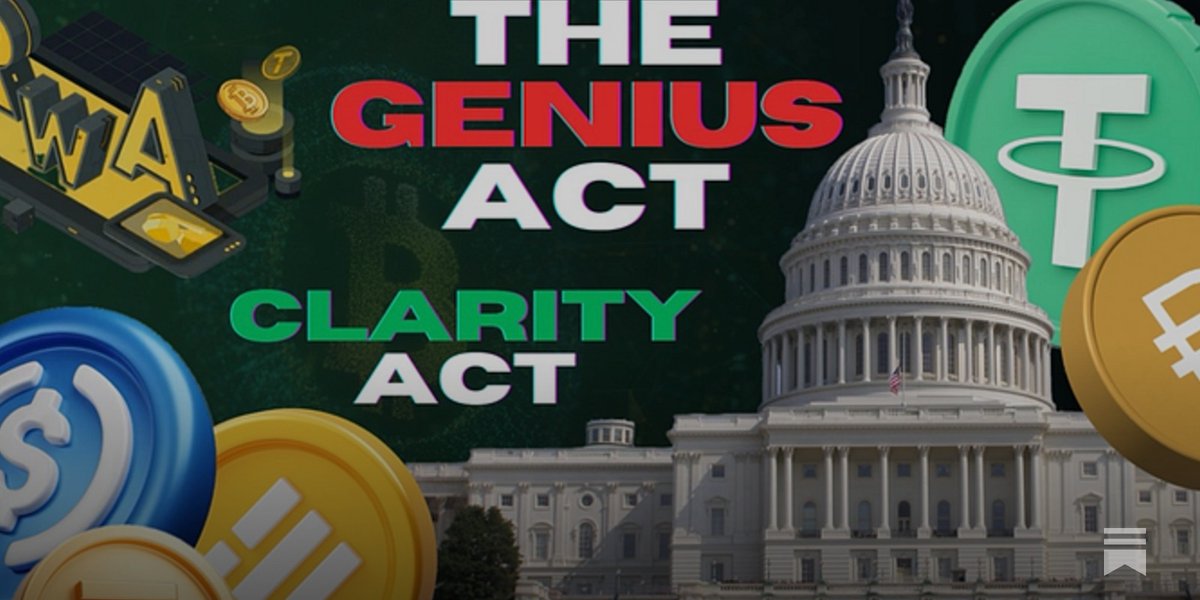
The GENIUS Act banned issuers from sharing yield. Now the Clarity Bill draft closes the remaining loophole by extending that prohibition to “Digital Service Providers.”
This outcome was always inevitable.
A yield-paying, widely accessible U.S. stablecoin is fundamentally incompatible with the existing banking system. If retail users could hold a risk-free digital dollar that directly passes through money-market or T-bill yield, deposits would drain from commercial banks at scale. That would contract bank balance sheets, constrain lending, and ultimately undermine the mechanics of fractional-reserve banking itself.
Once you accept that premise, the policy direction becomes obvious. Regardless of how hard crypto firms pushed for “yield on stables,” regulators were never going to permit a product that competes directly with insured bank deposits while sitting outside the banking perimeter. The GENIUS Act was the first clear signal of that reality. The Clarity Bill simply formalizes it by ensuring the restriction applies not just to issuers, but to anyone acting as an economic intermediary.
This isn’t primarily about consumer protection. It’s about protecting the structure of the financial system. Stablecoins are being allowed to exist, but explicitly as transactional instruments, not as yield-bearing savings vehicles.
That’s exactly why @stbl_official was designed with this constraint as a first-principles input, not a regulatory edge case to be arbitraged. Principal and yield are deliberately separated. The stable unit is built to function as money: liquid, transferable, compliant, and non-yielding. Yield still exists, but it accrues to a distinct instrument, with a clear economic role, defined access controls, and appropriate regulatory boundaries.
Trying to force yield into the stablecoin itself was always going to fail. The only sustainable path forward is to design systems that respect the immovable lines regulators have drawn, while still enabling capital efficiency, programmability, and innovation around them.
This isn’t a surprise. It’s the logical endpoint of how modern banking works. The faster the industry internalizes that reality, the faster we can stop fighting the system’s physics and start building durable financial infrastructure.