The selloff in $ETH ahead of @AnthropicAI $ANT IPO mirrors the ETH selloff ahead of $SPCX @spacex
IPO
- both periods saw ETH fall -39% in 8 weeks ahead of IPO
- in 2 weeks ahead of SPCX IPO, ETH fell -29%
- in past 2 weeks ahead of ANT IPO, ETH fell -28%
🚨 You can no longer trust any website, official or not.
You stopped visiting sketchy sites and clicking Discord DMs. You went straight to Ledger’s official site to buy a hardware wallet.
An A/B testing script there silently swapped your crypto clipboard and dropped an iOS zero-day exploit (DarkSword) on your iPhone.
178 corporate CDNs compromised in one strike. “Decentralized security” was just an unauthenticated analytics widget from 2014.
😊Experimenting with adding tearing to my interactive stockings demo. Here’s the earlier stretching demo 👇
Fanbox:https://t.co/F0jm5ypEUy
Patreon:https://t.co/PpbKmwwByB
Want the full project? Subscribe to my Fanbox or Patreon to download it!
#Unity#VFX#shader #realtime
Not your keys, not your coins?
Apparently, it's now:
Your keys, our RPC. Your coins, our permission.
A scammer sends 0.0001 dust to your wallet without your consent.
You didn't approve anything. You didn't interact with the scammer. You simply received an unsolicited transaction on a public blockchain.
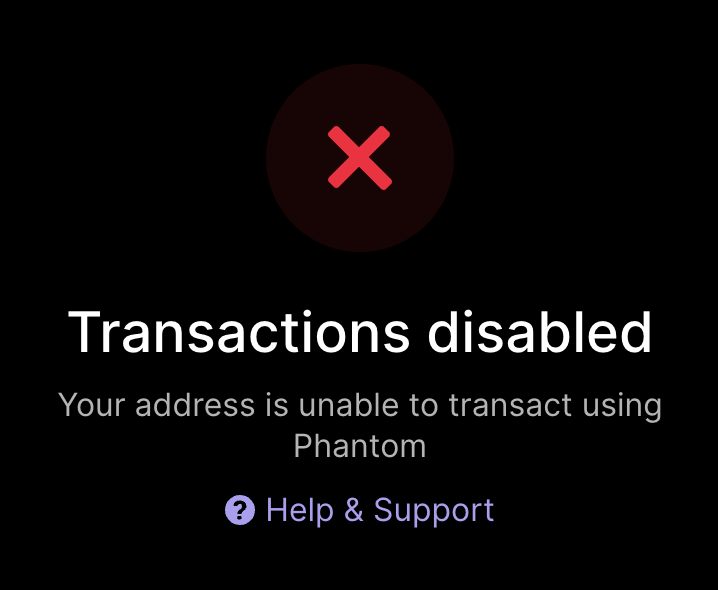
Then Phantom's compliance filter kicks in:
"Your address has interacted with a flagged malicious entity. Transactions disabled."
Wait. WHAT?
So a random scammer can poison my wallet address with dust, trigger your automated risk detection, and suddenly I can't use your wallet interface to move my own assets?
Welcome to self-custody, where you own the keys but apparently need corporate permission to use them.
The blockchain didn't freeze my account.
The centralized frontend did.
The irony is almost too good.
We built crypto to escape banks freezing our money, only to end up with fintech apps wearing a decentralization costume.
If a wallet can unilaterally disable your ability to transact because some random third party sent you dust, maybe it's time to rethink what "self-custody" actually means.
Not your keys, not your coins?
More like:
Your keys. Their rules. Their permission.
Peak Web3 UX. 🤡
The Binance $5.6B drain is a masterclass in modern EVM exploitation.
It wasn't a complex logic bug. It was an EIP-7702 delegation hijack:
1. Setup: Attacker funds 0x7c86 via Tornado Cash, deploys a sweep contract (0x63e8), and runs three live dry-runs on external wallets.
2. Execution: Attacker submits an EIP-7702 batch with 50 pre-signed authorizations (nonce n to n+49) to hit Binance 14's moving nonce window.
3. One authorization hits. Instantly, Binance 14 (an EOA) is reprogrammed to run the attacker's contract bytecode.
4. Execution looks totally organic: Binance 14 sweeps itself clean. Internal threshold alerts don't trigger because, from the nodes' perspective, the hot wallet is just executing its own transaction.
5. Binance 16 immediately auto-refills 28,000 ETH due to automated treasury rebalance scripts, feeding the exploit loop.
The cold truth: you cannot forge an EIP-7702 delegation list.
For this to execute, the attacker already held the raw private key or unconstrained signing access to Binance 14's HSM/KMS.
But hey, 5.64 billion drained across ETH, BTC, and Tron. 2.54 billion frozen by Tether, Circle, Ripple, and World Liberty within hours.
Code is law until the stablecoin admin keys log in.
Binance got bailed out by the very centralized choke points the cypherpunks warned you about.
Hardware wallets leak your home address.
Centralized exchanges leak the keys to the kingdom.
Self-custody on native, non-delegated chains remains the only honest baseline.
At least you know what to avoid.
Cloudflare open-sourced the security audit skill that seeded its own vulnerability hunting harness. Your coding agent can now run it on your code.
How it works, in 6 phases:
→ maps your codebase
→ hunts for bugs area by area so nothing gets skipped
→ sends every finding to a fresh agent that didn't find it, to confirm it's real
→ writes structured results
→ verifies each record again, independently
→ writes the final report
You get a findings file split into confirmed, needs validation and rejected, so you fix the real problems first.
Install:
npx skills add https://t.co/ptOfJggqQB --skill security-audit
Then open your agent in your project and type: "security audit this codebase"
MIT licensed, 31.3K stars.