This echoes some of the conversation with @llamaonthebrink on the @Truemarketsorg podcast when we discussed “how do we know anything?”
All our beliefs about the world have an epistemic scaffolding around them, but very rarely do we explicitly articulate what it is, or how it works.
Here, Jay is waging a campaign for people (mainly on Wikipedia) to recognize that the Truro Cathedral in the UK has four spires, not three.
Wikipedia here is a good proxy for an epistemic funnel with poor scaffolding. Jay and others had uploaded pictures showing clearly that there are four spires (not three) but the editors refused to accept it unless it came from a good source. This gets things entirely backwards—this is like someone in Syria refusing to believe they were in a war zone unless three major television networks announced that there was a war, or with an official declaration of war by the Syrian government.
And this is the type of thinking that should go when we’re thinking about prediction markets not just as a weird cousin of perp-trading, but as a totally different, more “true” source of information to help us cut through the AI slop plaguing social media, and the censorship manufactured consensus in traditional media.
This is what made Polymarket such a success during the election. The entire media apparatus told you that Trump was trailing and would lose. Where do you get your truth?
You can get it by doing your own research, as Theo the whale did, and betting on it. This information then gets broadcast to the rest of the world.
But outside of these specific sports or political contests the epistemic scaffolding problem returns.
In our everyday life we have:
- our own sensory observations
- observations/reports by trusted relationships
- trusted authorities (the news, governments, academia etc)
- experience/intuition/wisdom/introspection
- reports by trusted tools and instruments (temperature readings, sensors)
- aggregated information (markets)
- disaggregated information (social media)
One issue we have today in the world is that trusted authorities have basically ceased to function properly. They are supposed to carry through certain families of incentives to produce truth—investigative journalism, adversarial justice, bureaucratic discipline, scientific method, intellectual rigor.
But the sociology of the state, academia, and journalism have decayed so much that none of these truth-seeking practices work sufficiently well.
So we rely now more on disaggregated information, which AI is turning into toxic sludge.
The goal of True Markets is to use AI to vastly expand the availability of tooling to provide reports about the world, and hopefully also turn our own sensory observations into more broadly accepted types of information.
I would hope that in the future prediction markets will accept images and video as partial evidence for resolving a market—ideally these videos and pictures will have cyrptographic signatures, such as those pioneered by the Exodus phone to make sure they’re not AI slop.
I would hope any prediction market worth its salt would be able to tell you whether a cathedral has three or four spires, without requiring a newspaper article to declare it so. Wouldn’t you? Otherwise, can we really say that have a better way of knowing?
@sosecrypto_kr @llamaonthebrink@Truemarketsorg Should be a market for this too. What end date would you assign for this market? e.g.:
$TRUE will reach a market cap of $1B by MM/DD/YY
@eip_42069@llamaonthebrink there should definitely be a market around this one. OVER/UNDER before a clear date to make it timebound.
How would you define "beefing"?
I was quick to dunk on UMA for this resolution (I think their system is simply flawed) but in this case, their decision is consistent with the sources cited in the market description.
This is a complex matter and it was premature to judge.
The blame actually falls on the market creator and their choice of wording for the resolution rules.
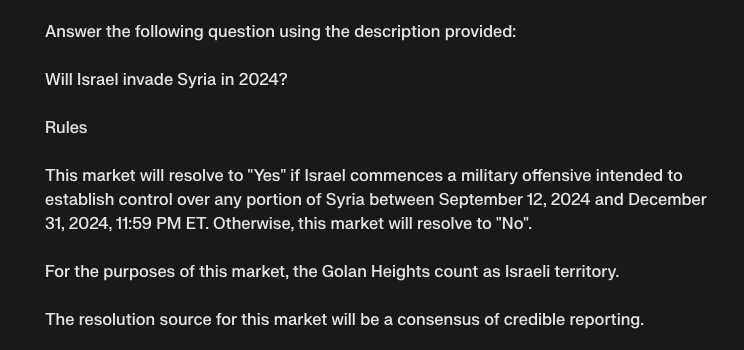
The market question is "Will Israel invade Syria in 2024?"
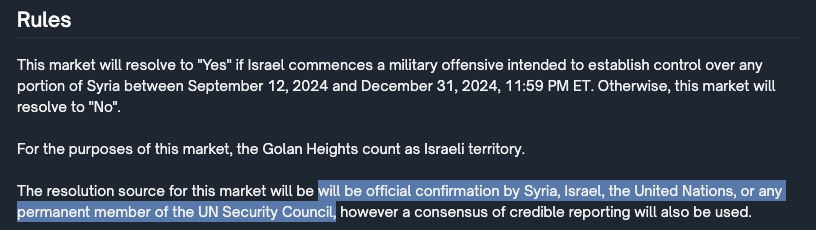
The rules are as follows:
As I've highlighted, the problem comes down to the language used around the resolution sources.
If you take that text and put it into Perplexity without any change, it will recommend that the market should resolve to NO (for now).
The reason being that the "official" confirmation, suggested by the market creator is Syria, Israel, The UN, or a permanent security council member.
And none of those "official sources" have stated that an invasion is underway.
There are several reasons why this market was poorly created, so let's dig in to exactly why.
First of all, using the state of Syria as a source for this market is very problematic because the "state" has essentially fallen at this point.
The president is in hiding/exile, the country is overrun by rebels/insurgents, and there's no official government.
So any statement coming from that source would be highly unreliable and ambiguous.
Second, Israel itself is not a reliable source either, in this particular case, because it is at a greater conflict in the region.
It's highly likely that they would not want to create the illusion that they're escalating war in the middle east or trying to increase their land territory.
It simply would not be a wise military strategy to give the appearance that they're invading a neighbouring country as a civil war escalates.
Israel has a strong incentive to downplay their offensive in Syria, even if they intend to establish control over parts of its territory.
Lastly, these sources are not necessarily faulty or bad, they just can't be relied upon for market resolution.
They way the rules are worded, there's a lot of ambiguity up for judgement.
The market creator tried to leave room for other potential resolution sources that amount to "a consensus of credible reporting" but it doesn't say whether such sources can be relied upon even in the absence of an official statement by Syria, Israel, or the UN.
If I had drafted this market, I would've phrased the language much differently.
I would have made it clear that a major indicator would be statements from those sources, but that the market resolution would not bound by those sources.
This lack of clarity is very important, and Perplexity agrees.
Below is an image of the same exact question Polymarket used, except I removed the highlighted portion from the original description which contained Syria, Israel or the UN as sources, and kept the part about "consensus of credible reporting" :
The answer it gave out was much much different than that of the original response it gave me.
Here was its response with the minor modification:
After scouring the internet, it came back with an answer that the average person, like @cohenimrod, would have expected: YES.
To the average person, it is quite obvious that this market should resolve to YES.
But Polymarket traders are basing their decisions on the exact wording used in the market rules, not the market question!
In essence, it may seem like they're trading the market titled "Will Israel invade Syria in 2024?"
But what they're actually trading is "Will Syria, Israel, or the UN declare that Israel invaded Syria in 2024?"
There's a huge difference!
So in this case, it's a rare L for Polymarket for creating a market that does not match its headline.
This does, however, invoke a broader philosophical question about the epistemology of prediction markets.
Namely that traders aren't necessarily trading the outcomes they believe to be true, but rather, they're trading on what they believe the sources will declare to be true.
Again, there is a huge difference!
Anyway that's it for now. I have a lot more to say about the epistemology of prediction markets but I'll save that for another post.
I will admit though that despite my grievances with UMA and its inherent flaws, this outcome is not UMA's fault.
It was the market creator's fault, and in this case, that's Polymarket.