@Route2FI Would recommend adding EPU (economic policy), WUI (holistic) and TPU (trade policy) indexes to your toolkit. They are measurably higher compared to previous decade.
@aeroxyz predictive allocation has to be the dumbest feature update ever that might be a net negative rather than positive for the following reasons:
1- Token operators cannot predict volatility and volume. Similar to IV-RV spread, you inadvertently create an implied-realised fees spread which will push active managers to unstake more often.
2- The 47-hour cooldowns create mechanistic lag friction towards efficient emission routing. Stocks & crypto have muted weekend volatility, so LPs will likely be under-rewarded in weekly open when they need it the most and then later get leeched by single tick farmers in Mon overnight session.
3- EU open, US open and close is already a net loss for most of the LPs due to adverse selection & toxic flow; the weekly emission model had pockets of +EV zones, which will be less discernible due to 1 & 2
If the protocol is so goddamn fixated on matching emissions to fees, just reward real fee contribution with an hourly delay. Boom, problem solved.
1- Christian expansionism and Western colonialism has a similar history of converting Roman, Pagan, Hindu sites into Christianised sites, many such beautifully preserved sites in Rome and the Vatican, I don't see you labelling that as historic abuse or apply the same intellectual standard to Islamic sites in the Balkans 2- Israel is not a Western nation nor a recent winner; its foundation story is a mix of British colonial weakness being capitalised by Zionist colonialism and victim-card maximisation. 3- Stick to things that you're good at - like shilling GP & other vapourware.
Imho, it'd be a major blunder to view historical gold PA as representative of current regime ever since a) Russian assets got frozen b) deglobalisation & multi-polarity gaining traction c) EM having a lot of catching up to do with advanced economies in terms of gold exposure d) US non-AI growth being lacklustre given its debt profile. Therefore, 15-20% allocated to BTC and gold is a no brainer. I'm personally bearish on AI, which is eerily similar to crypto's L1 meta of prev. cycle. Bullish on tactical momentum bets in crypto rn.
@MohnishPabrai Stop spewing BS about Turkiye’s tech adoption if you don’t want to be perceived as a temu Buffett. Both e-commerce and mobile banking are heavily saturated markets and way ahead of EU & MENAT in terms of tech, adoption and UX. Read up TBB’s report on mobile banking (May, 2026).
Today, Drift is announcing a collaboration with @tether and other partners totaling up to nearly $150 million to support our commitment to a relaunch with USDT at the center, and a path to user recovery.
These funds encompass a $100M revenue-linked credit facility, an ecosystem grant, and loans to market makers, designed to fund a dedicated user recovery pool.
Learn more 👇
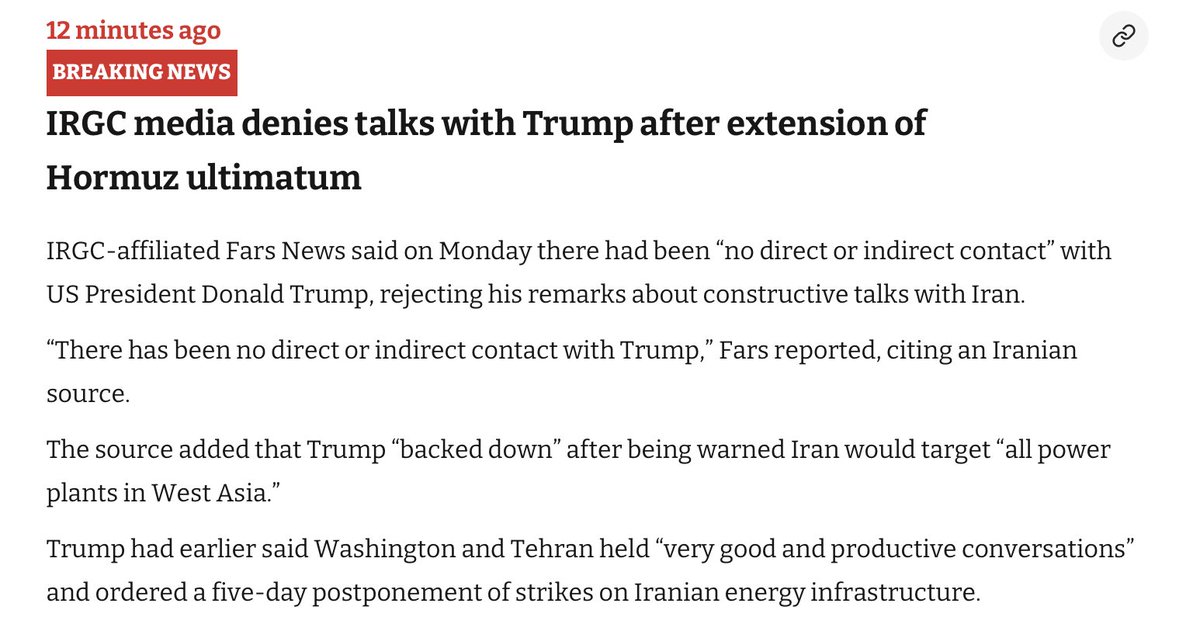
>IRGC affiliated Fars News denies talks (direct or indirect) with Trump.
>Israel launched fresh strikes after Trump announcement
>No confirmation from Qatar or Turkiye's FM offices about their efforts in mediation
Be cautious with the TACO trade. Stay safe.
Some valid points from @ghoshworld, but his FP piece still falls into the same trap common in Washington foreign policy commentary. While arguing that Türkiye should not be treated as the “new Iran,” the article still frames Ankara’s strategic autonomy through a U.S.-centric lens, repeatedly describing Türkiye as a “headache” or a “difficult ally.” The toxic implication is that the natural baseline for regional strategy is alignment with U.S. and Israeli preferences, and that any deviation from that line constitutes a nuisance.
This framing fails a basic reality check. Regional actors such as Türkiye have deeper geographic and economic exposure, stronger historical ties, and far greater security stakes in Middle Eastern conflicts than external powers. When Ankara diverges from Washington, whether on Iraq in 2003, the empowerment of Kurdish elements in Syria, or the risks of reckless Balkanisation attempts in neighboring states, it is responding to immediate regional consequences rather than engaging in ideological obstructionism.
Ironically, while Bobby warns against threat inflation and self-fulfilling narratives, both very real risks, he still subtly reproduces the same Washington–Israel-centric hierarchy of strategic authority and ultimately concludes that “the goal should be to manage and constrain Turkish ambitions.” That conclusion reinforces the same arrogant strategic mindset.
Yet it is the U.S. and Israel that have quantitatively introduced far greater systemic instability and uncertainty into the region. Which raises a simple question. Whose ambitions actually need managing?
The assumption that a nuclear strike would shock an adversary into capitulation is misguided at best. Japan was already military defeated, faced imminent invasion & Soviets entered the war. If US dropped anything upto the ~15 kt range, Iranian regime would escalate the war even further.
If you are feeling anxious about the Iran War & the impending global economic crisis, check out @elonmusk's profile, dude is putting on a Kaufmanesque performance where 28th Feb never happened. Faith in parallel universes restored.
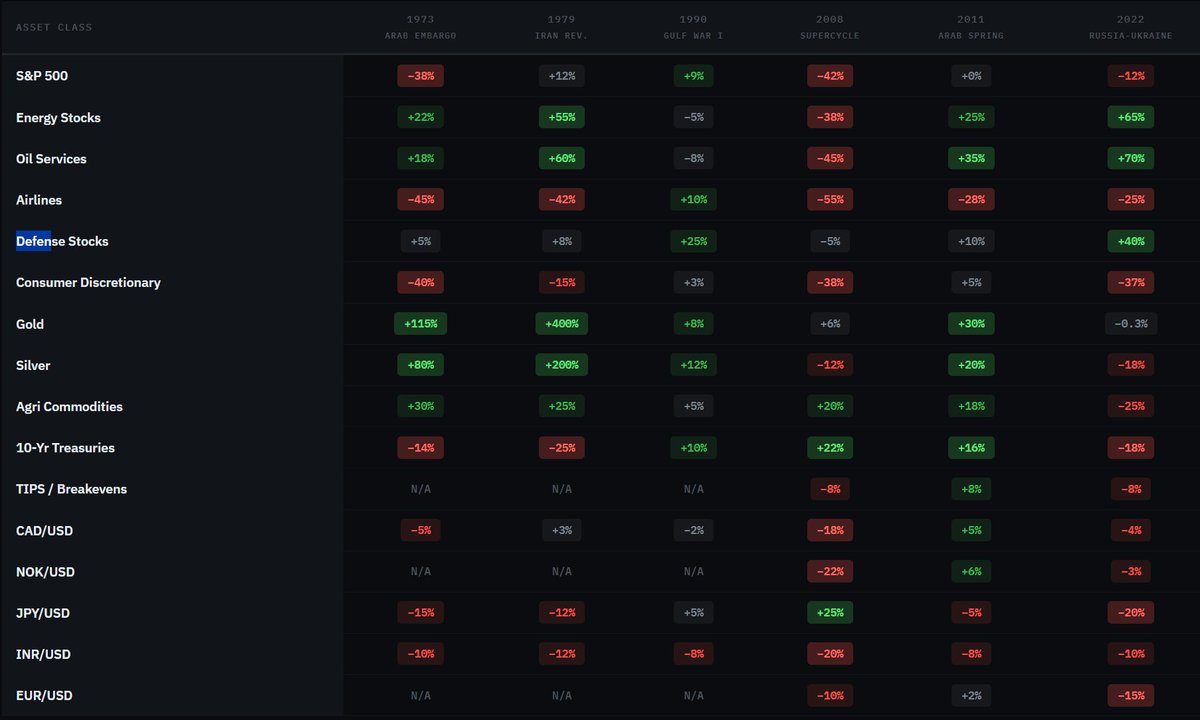
Interesting data on cross-episode 12m total return asset performance across all six oil shock episodes. Energy stocks perform best in the first 3-6 months & Airlines reliable shorts at 1-6 months. Gold's performance comes when the inflation narrative becomes more entrenched. 5/6 wins.
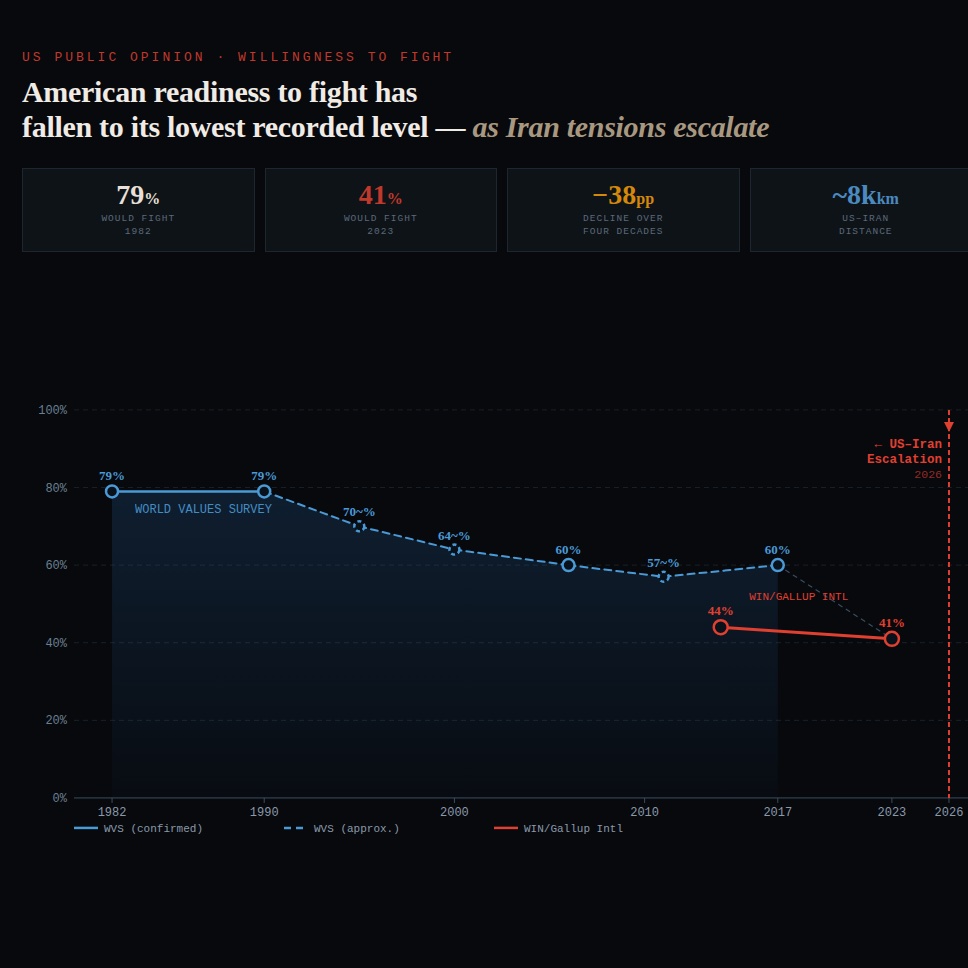
5/ Bottom line: Trump administration went into this w/o a catalysing event and at 56% disapproval. The cringe memes & pop-culture infused @WhiteHouse@DeptofWar war propaganda won't magically manufacture US will to fight.
4/ The caveat that matters.
A direct strike on the US soil can temporarily override this - as 9/11 showed. But post-Iraq data shows those spikes decay fast (73% support > 32% within two years)
The irony that is lost on this junior pen-for-hire @ByBradleyMartin is both Israel and Iran are revisionist middle powers that aim to disrupt the regional status quo with unilateral security doctrines, ideological state identities, intelligence and proxy-centric domination tactics.
Turkiye on the other hand is a status quo middle power that pushes for regional stability both as a founding principle & due to its service-based economy & energy-dependent profile. Turks often joke that being energy-poor is actually a gift as it makes corruption & political toxicity transient (time will tell).
Best option to force Trump to actualise a face-saving Iran off-ramp is to push S&P below 200 SMA & let CTA/TTA strats & then retail to do the rest.
Liquidate your Trump & WLFI tokens for double whammy.