@levelsio i'm not sure loneliness is something you should fight. not everything needs to be stitched together and optimized. once it's a routine, you lose the novelty that makes it interesting to be around people
Universal Paperclips, with real markets and a Hetzner bill.
I wanted a fleet running experiments while I slept, with trading winnings going straight back into making it bigger.
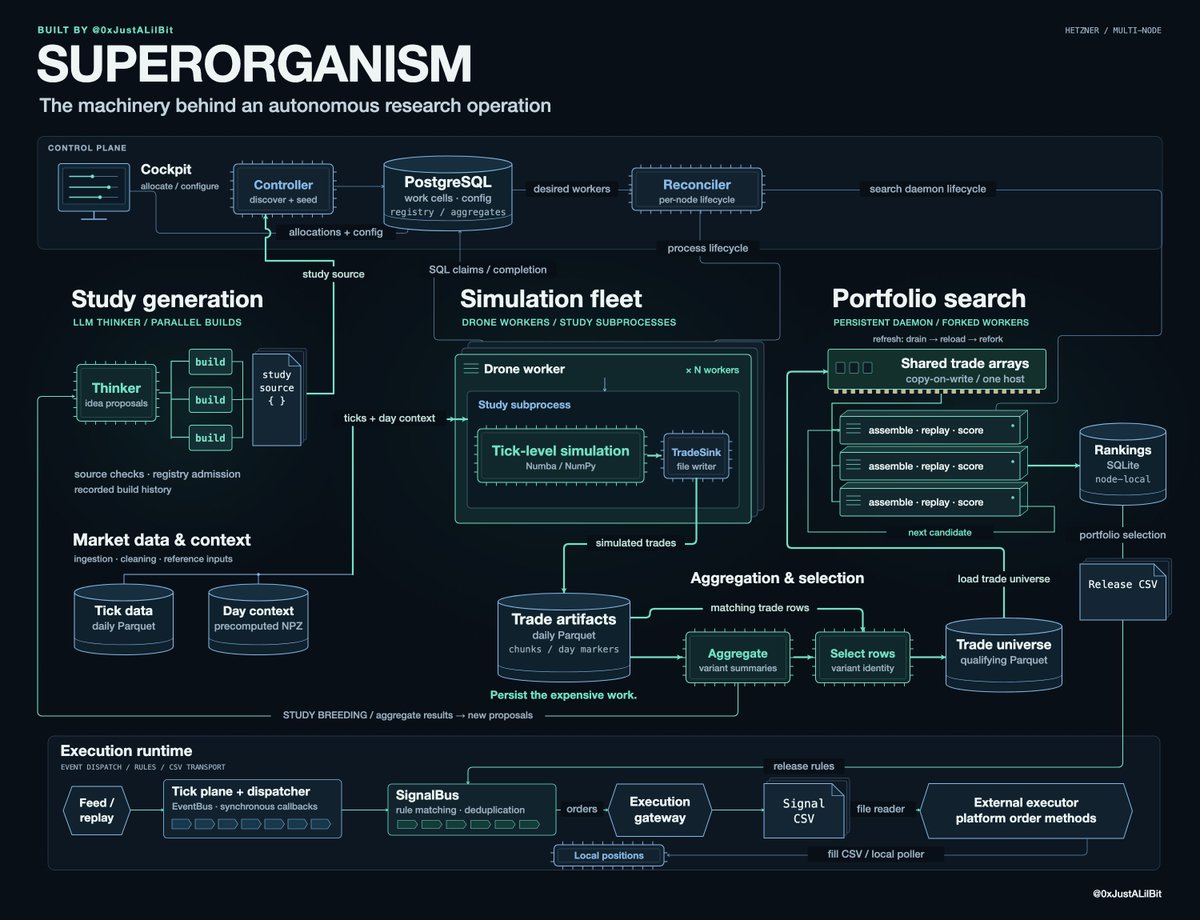
Nothing I found offered the autonomy and control over the internals I wanted, so I built Superorganism: a distributed engine for autonomous strategy research, tick-level backtesting and live execution.
From the cockpit, I can redirect the Hetzner fleet between study generation, simulation and portfolio search. Results feed subsequent research, and I can intervene at any stage.
Studies I write join the same pipeline as LLM-generated studies, recombinations and cross-instrument transplants. Drones sweep their parameter grids against tick data and persist the simulated trades.
Portfolio workers search combinations of those outcomes, sharing trade arrays loaded once per host.
Statistical validation addresses selection bias across trials. Playbooks that clear validation and parity checks promote automatically into the same event-driven engine used for replay. Platform adapters exchange signals and fills through a common contract, keeping strategy logic independent of where it executes.
Hope this gives anyone with similar ambitions a few ideas. If you see a better way to build part of it, I want to hear it.
@ronak2551481@jfsrev Contraction screen first, then an ORB above the prior N-day high, with failed breakouts included; the aim is to test the core idea with as few rules as possible. I’m keeping the exact settings and trade list private, but happy to discuss methodology.
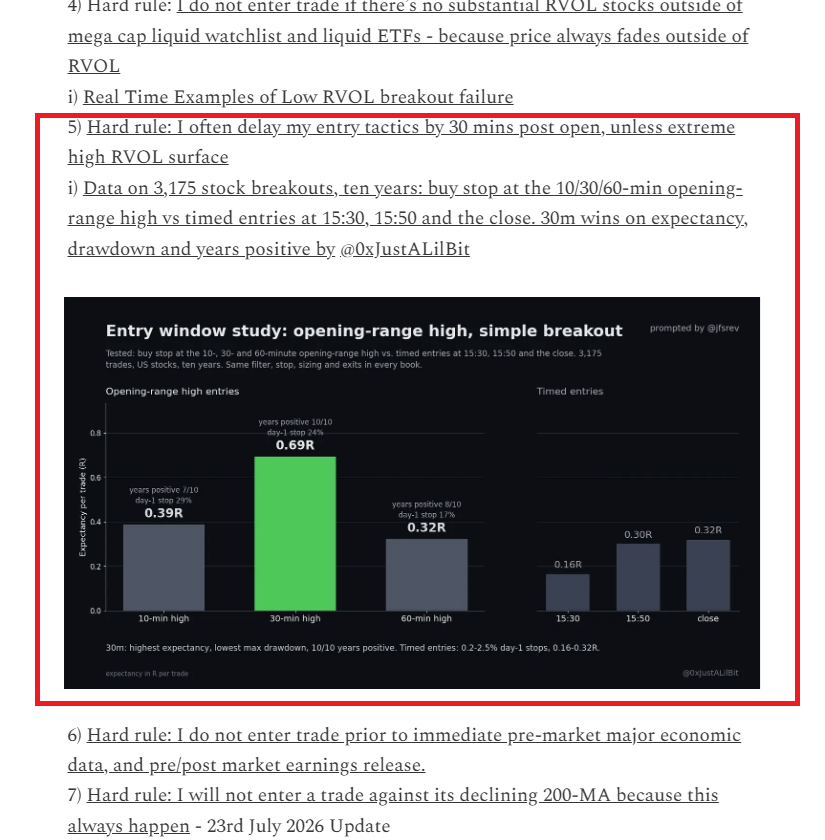
I assumed @jfsrev's 30-minute rule was folklore (as you should). Ran it through 3,175 stock breakouts, ten years: buy stop at the 10/30/60-min opening-range high vs timed entries at 15:30, 15:50 and the close. 30m wins on expectancy, drawdown and years positive. He's right.
A simple 30-Min ORH + LoD distance > 60% has avoided many ideas from stop losses over the past two months,
while any executed trade on a 3-layer stop strategy would reduced each 1R loss by 33% to 0.67R
'Chapter 6.2 - I developed the 3-stop strategy prior to the T+3 framework — it’s since been widely adopted, including by several quant funds.'
https://t.co/F7sH4bn30E
@MetallRain_@fayzoqt@jfsrev I wanted the volume check tied to entry, using the same window on prior days as the baseline. I’ve kept this version deliberately simple for demonstration, and we’ve already improved on it by incorporating more of Jeff’s approach
@gfc4 Use a basic playbook and standard risk per trade but remove your profit target and double position size every time the extra risk is financed by gains. Give yourself enough bullets to have a reasonable chance of being present during an anomaly.
I'm going to be sick... mentioned here is the Mexican Grey wolf, of wish there are only a mere 300 remaining. Not that the few thousand Grey wolves are far removed. We worked so hard to bring them back from near extinction, this is awful
Trading education asks for a suspicious amount of faith for a subject where you can actually calculate things.
In a fair random walk, blind entries with a closer stop than target have zero expectancy before costs. Add a tendency for successive moves to continue, however slight, and expectancy turns positive, even with zero directional drift.
Yes, you can have an edge with a coin-flip entry.
Now explain what I’m supposed to acquire from a thousand hours of chart study, and how we’ll know I’ve acquired it.
On high-reward setups, a point of win rate dominates trade frequency. Buying the 10-minute high gets you 40% more trades than the 30-minute high and costs three percentage points of win rate, 17% vs 20%, same stop, same size of winner.
Three points is the difference between a −63R drawdown and a −184R one over ten years, and between a worst losing streak of 30 trades and 60.
I assumed @jfsrev's 30-minute rule was folklore (as you should). Ran it through 3,175 stock breakouts, ten years: buy stop at the 10/30/60-min opening-range high vs timed entries at 15:30, 15:50 and the close. 30m wins on expectancy, drawdown and years positive. He's right.