There have recently been some discussions on the ongoing role of L2s in the Ethereum ecosystem, especially in the face of two facts:
* L2s' progress to stage 2 (and, secondarily, on interop) has been far slower and more difficult than originally expected
* L1 itself is scaling, fees are very low, and gaslimits are projected to increase greatly in 2026
Both of these facts, for their own separate reasons, mean that the original vision of L2s and their role in Ethereum no longer makes sense, and we need a new path.
First, let us recap the original vision. Ethereum needs to scale. The definition of "Ethereum scaling" is the existence of large quantities of block space that is backed by the full faith and credit of Ethereum - that is, block space where, if you do things (including with ETH) inside that block space, your activities are guaranteed to be valid, uncensored, unreverted, untouched, as long as Ethereum itself functions. If you create a 10000 TPS EVM where its connection to L1 is mediated by a multisig bridge, then you are not scaling Ethereum.
This vision no longer makes sense. L1 does not need L2s to be "branded shards", because L1 is itself scaling. And L2s are not able or willing to satisfy the properties that a true "branded shard" would require. I've even seen at least one explicitly saying that they may never want to go beyond stage 1, not just for technical reasons around ZK-EVM safety, but also because their customers' regulatory needs require them to have ultimate control. This may be doing the right thing for your customers. But it should be obvious that if you are doing this, then you are not "scaling Ethereum" in the sense meant by the rollup-centric roadmap. But that's fine! it's fine because Ethereum itself is now scaling directly on L1, with large planned increases to its gas limit this year and the years ahead.
We should stop thinking about L2s as literally being "branded shards" of Ethereum, with the social status and responsibilities that this entails. Instead, we can think of L2s as being a full spectrum, which includes both chains backed by the full faith and credit of Ethereum with various unique properties (eg. not just EVM), as well as a whole array of options at different levels of connection to Ethereum, that each person (or bot) is free to care about or not care about depending on their needs.
What would I do today if I were an L2?
* Identify a value add other than "scaling". Examples: (i) non-EVM specialized features/VMs around privacy, (ii) efficiency specialized around a particular application, (iii) truly extreme levels of scaling that even a greatly expanded L1 will not do, (iv) a totally different design for non-financial applications, eg. social, identity, AI, (v) ultra-low-latency and other sequencing properties, (vi) maybe built-in oracles or decentralized dispute resolution or other "non-computationally-verifiable" features
* Be stage 1 at the minimum (otherwise you really are just a separate L1 with a bridge, and you should just call yourself that) if you're doing things with ETH or other ethereum-issued assets
* Support maximum interoperability with Ethereum, though this will differ for each one (eg. what if you're not EVM, or even not financial?)
From Ethereum's side, over the past few months I've become more convinced of the value of the native rollup precompile, particuarly once we have enshrined ZK-EVM proofs that we need anyway to scale L1. This is a precompile that verifies a ZK-EVM proof, and it's "part of Ethereum", so (i) it auto-upgrades along with Ethereum, and (ii) if the precompile has a bug, Ethereum will hard-fork to fix the bug.
The native rollup precompile would make full, security-council-free, EVM verification accessible. We should spend much more time working out how to design it in such a way that if your L2 is "EVM plus other stuff", then the native rollup precompile would verify the EVM, and you only have to bring your own prover for the "other stuff" (eg. Stylus). This might involve a canonical way of exposing a lookup table between contract call inputs and outputs, and letting you provide your own values to the lookup table (that you would prove separately).
This would make it easy to have safe, strong, trustless interoperability with Ethereum. It also enables synchronous composability (see: https://t.co/9jy6v1X6Fw and https://t.co/gZmu3YjebM ). And from there, it's each L2's choice exactly what they want to build. Don't just "extend L1", figure out something new to add.
This of course means that some will add things that are trust-dependent, or backdoored, or otherwise insecure; this is unavoidable in a permissionless ecosystem where developers have freedom. Our job should make to make it clear to users what guarantees they have, and to build up the strongest Ethereum that we can.
going to add my two cents here
i believe ppl are generally upset with base because you guys pick & choose what you want to support onchain, because you never know what is going to work and what isnt going to work so it isnt as simple as objectively determining what is positive sum beforehand
for example, base did a big push on creator coins, you even directly bought balaji's coin, but base was not as supportive of memecoins, especially the ones that were doing a lot of volume onchain and could have benefitted from exchange listings earlier, but the creator coin & memecoin charts ended up looking near identical, with most of the creator coin charts not doing nearly as well as a lot of the largest memes on base - i personally think there are some unique reasons for why they didnt work and will work in the future but thats for another post
from my pov there are two different ways to value crypto assets, one is based on the fundamentals of the underlying business, and the other is more intangible value determined by the community of users of the network and driven by attention/momentum/belief etc
hyperliquid is a great business that makes real revenues and is valued in part because of those revenues, but it also trades at a premium because of the collective belief that their users have in the network and their future plans to execute on that vision
bitcoin on the other hand, makes no revenue, but is the largest crypto asset by market cap because it trades purely on the collective belief that it is a better store of value than depreciating fiat currencies and the network grew so large that it became a self-fulfilling prophecy
ethereum is somewhere in between in that it does make real revenues but if you simply valued it purely off of those revenues as you would a tech stock it would trade 95% lower, ethereum also has some intangible value determined by the network of cypherpunks who are majority stakeholders of the network, and they believe that its value as an asset is more than what you would come to conclude on based off of purely p/e ratios
tokenization, stablecoins, perpetuals, and prediction markets have been crypto's greatest success stories to date, tokenization in particular has been so successful because it is one of the only ways to accurately put a dollar value on this intangible value of culture and attention
memecoins are denigrated by a lot of the corporate entities in crypto, but i think what a lot of people fail to realize is that the same intangible value that drove bitcoin and ethereum to be the #1 & #2 largest assets in crypto is the same intangible value that attracts retail to speculating on memecoins, doge sits at $11B and has outlasted a majority of coins over the past decade, its value is purely derived from how internet natives value culture and memetics on the internet
do i think its important to uplift and support protocols in defi/rwas/consumer etc etc? yes, but its just as important to recognize what your users are interested in trading, the best analogy i can make is that if you are a mayor of a city and you have patrons who want to go to nightclubs or go to the casino or go to bars, you would not exclude this activity because you only want people to build businesses like banks, restaurants, corner stores, bookstores etc etc. - for an L1 to thrive it needs to have a diverse ecosystem of all things, and it is clear from the data that onchain trading volumes directly positively impact the native blockchain, whether thats in bringing more attention to the chain, or increasing fee revenues, or increasing revenues of underlying infra providers, or attracting new builders to create new products - best example of this is how bonk revitalized solana at the lows & was a very core reason that trading activity came back onchain + the main reason the first set of solana mobile phones sold out
all L1s & L2s are social networks with their own ecosystems and their own culture, with permissionless networks you cannot control what people build or trade, but you can find ways to provide support across the board and contribute to ideating on how to make trends more sustainable
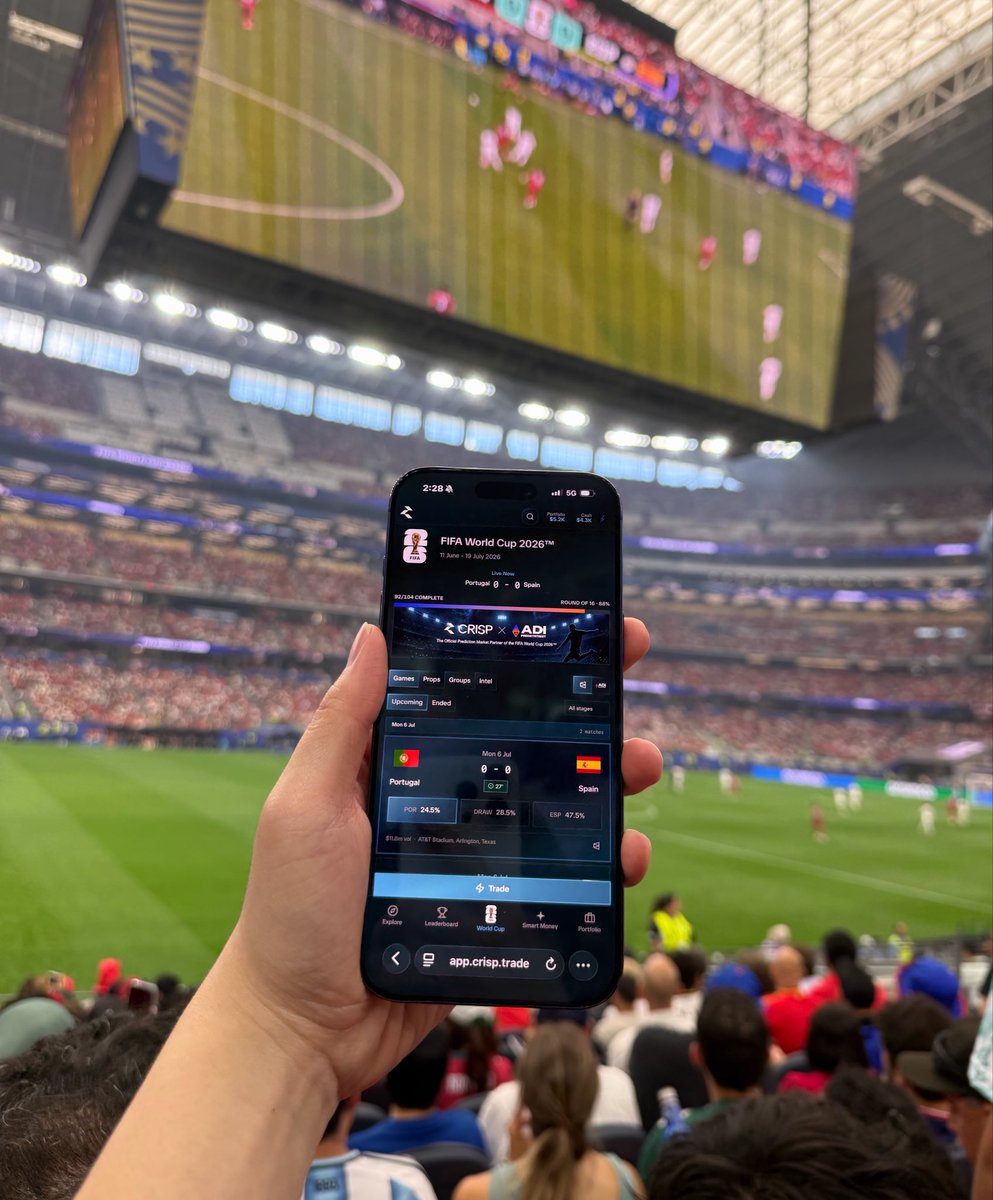
I placed a prediction on @Predictstreet using @CrispPredict at the World Cup.
The funny thing is when we announced our partnership and integration for the World Cup, I did not expect to be doing this at all.
Life can get so crazy. You can just do things. Shoutout @Morefious_!