@azzabazazz@ImmutableLawyer Avalanche is doing fine. It just has a lot less payment activity than Polygon, Tron, Celo and Solana (and probably Base too).
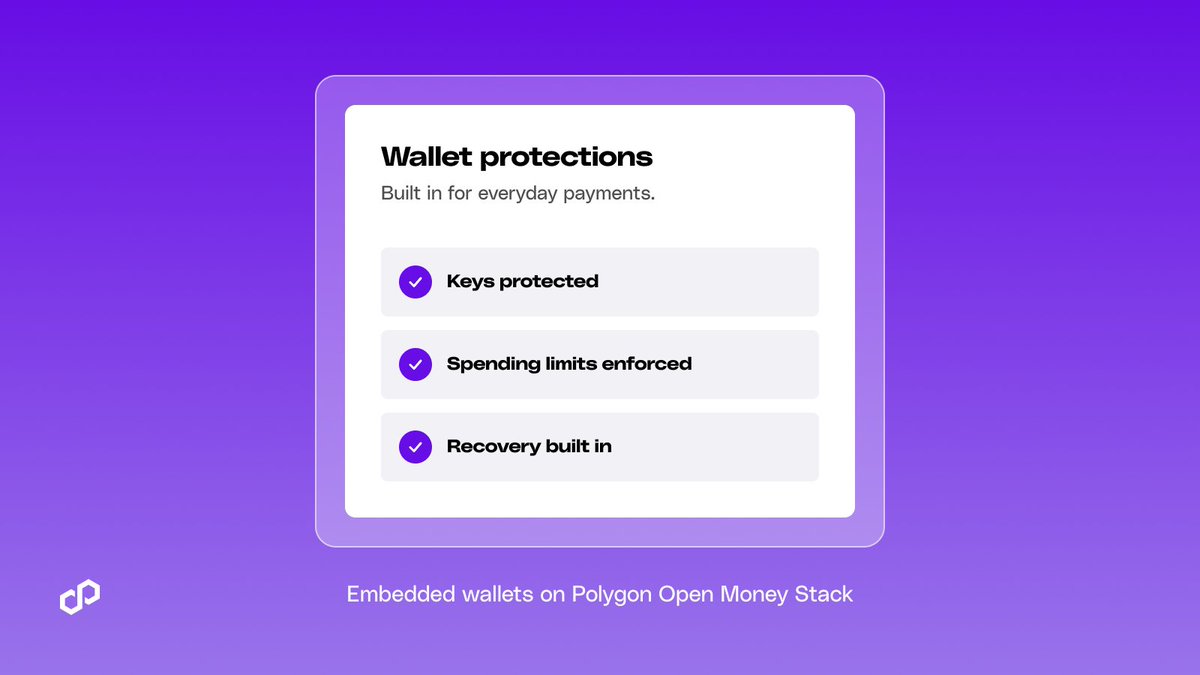
Secure wallets for everyday payments.
Your users want to make a payment and trust their money is protected. Embedded wallets on Polygon Open Money Stack bring that protection into the payment experience.
Because wallet security should hold up even if one layer fails.
💸 What if cross-border payments were as easy as sending a message?
Marc Boiron of @0xPolygon joins @lifesgt on Around The Coin to discuss stablecoins, agentic payments, and the future of global finance.
🎧 Full episode below ⬇️.
#AroundTheCoin#Fintech#Payments
New open role at polygon: forward deployed engineer, payments
The role: Your job is to cut integrations timeline from weeks to days, even hours. You design it, build it with the customer, and find what breaks in the logs before it reaches our core engineers. What you build for one customer becomes the SDKs, docs, and agents that make the next one faster.
Senior IC, no reports. Remote from the US, Canada, or LATAM.
Other benefits include:
- $1500 home office stipend
- unlimited ai spend with all the latest tools
- $200 for AI personal use
- remote, global team (no need to go into an office)
- unlimited vacation policy (dont tell our ceo this)
Know someone? Send them our way.
Apply here:
https://t.co/LF0alwn9xL
1. They want to control and customize the entire environment with a centralized sequencer. I don't think there is a single major bank who is not working on a chain, whether it is actively developing it or scoping it out as a possibility.
2. They don't have enough control. Whatever validators do is done and they can't do anything about it. Everything done on top of a chain adds latency and cost. Privacy being the most obvious example.
3. Banks are slow. There are at least 10 announced publicly. Many more next year IMO. I also think success looks very different. I'm guessing a bank like JPM would consider Kinexys successful but you never hear about it.
Yes and no.
AggLayer is intended for institutions who need the highest degree of security in cross-chain transactions. It is not intended (today) for all cross-chain transactions.
We believe that nearly every institution will want to use AggLayer because they all care about interoperability and all want their own chains. We also believe that the need for your own chains is greatest in the institutional space because of the need to control the environment.
When you have nearly every institution using AggLayer, it’ll become the default interoperability solution.
So AggLayer can still become the biggest interop solution while not trying to chase the whole market.
The AggLayer intersects with OMS in a few ways:
1. AggLayer being part of Trails and Trails being in OMS means you can execute transactions on AggLayer via OMS.
2. AggLayer is a wedge into a broader OMS relationship.
3. AggLayer hopefully can get adopted enough to generate fees in the future for POL.
4. Until AggLayer can directly benefit POL, it is a way for OMS to generate revenue for Polygon Labs, which reduces Labs’ reliance on POL/chain for funding.
It's a single announcement, but this reflects months of work from a team I am so proud of.
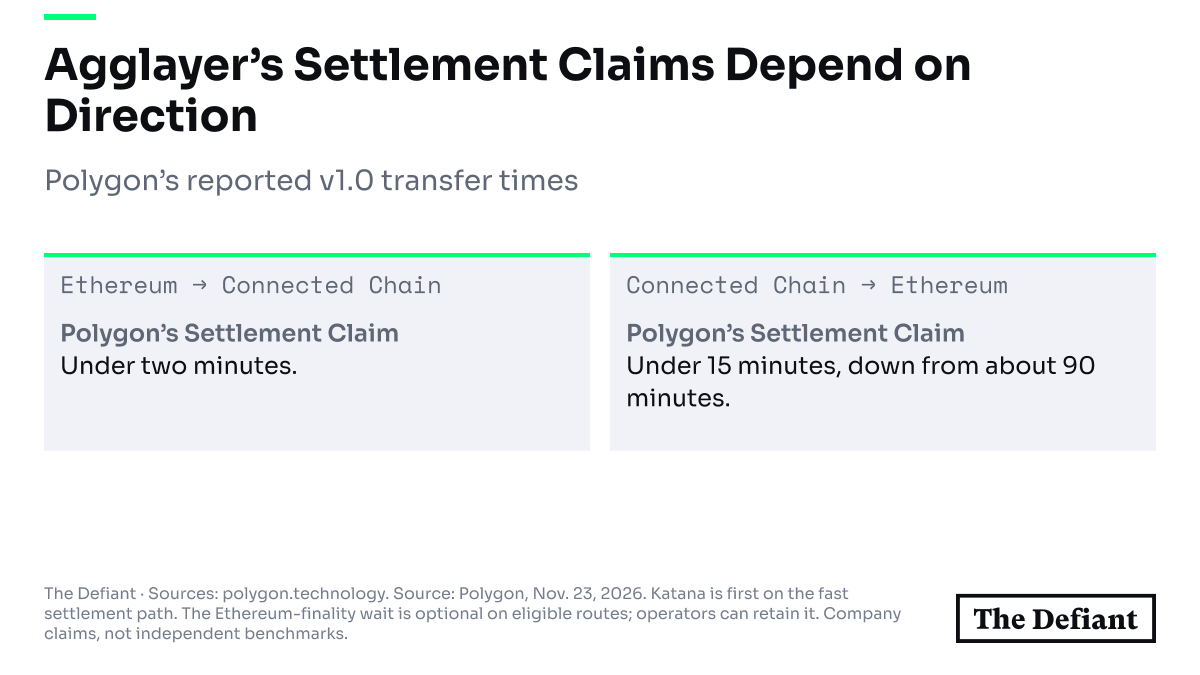
Agglayer now can connect any chain to Ethereum mainnet with real time zk proving. Longest bridge route takes 16 mins, most under 3 mins.
This is the holy grail of cross-chain interop.
AGGLAYER V1.0 IS LIVE: @0xPolygon SAYS ITS FAST PATH CUTS TRANSFERS BACK TO @ethereum TO UNDER 15 MINUTES FROM ABOUT 90.
@katana is first on the path. Times are company claims, not independent benchmarks.
Read more here:
https://t.co/Sj8QWRGkiM
Excited to have @BennuApp live using Polygon Open Money Stack. They offer great product for their customers, and I love how dedicated @alexsicart is to delivering a better payments experience to his customers.
NEW: @BennuApp is live on Polygon Open Money Stack, connecting stablecoins to bank payments.
Members can hold money in stablecoins and pay people who want a bank transfer, all within Bennu and without going through an exchange.
Institutions need security and speed when moving money between chains. Agglayer v1.0 delivers both.
The fastest ZK-verified interop layer in production, with proof-based settlement in minutes.
Polygon Agglayer v1.0 is now live.
It's the fastest ZK-verified interop layer in production, with proof-based settlement in minutes. Institutions no longer have to choose between security and speed.
I told the whole company today that their goal should be to replace themselves with AI.
If your job can be automated and you refuse to automate it, you’re actually just making it clear you shouldn't have the job.
I just think we need to separate what we control and don't control. Social media is the worst invention in human history. Yet, it will not go away.
AI is similar. It is powerful and amazing in many ways. In the long run, it will be horrendous for humans.
In both cases, you can learn to use it and thrive in our pretty pathetic world as it exists or you can hate them, ignore them, and struggle in life.