DAOs are dead because they were never alive.
What we called DAOs were mostly an attempt at regulatory arbitrage over the "Common Enterprise" aspect of the Howey test. The industry swung the pendulum too hard and created something shitty.
When they were created with this goal in mind, tokens never had a chance to become what they should have been all along: a mechanism for decentralized security, programmatic control of a treasury, and a place where every revenue lever ultimately flows.
DAOs are not: countries, cities, governments, communes, coops, or any of this other inefficient crap that polysci larps try to tell you they are. DAOs are businesses.
It is fine if centralized actors sit between the DAO and certain protocol parameters.
It is fine if operators run the day to day.
It is fine if there is a core team.
What matters is simple: token holders must have programatic rights to replace those actors. They must have programatic rights over the valuable assets on hand that pay those actors bills. And they must have programatic rights over the upgradeability/security of the protocol.
Tokens create perpetual, programmatic ownership of revenue in a way no historic corporate structure ever has.
DAOs are not dead. The name is. The function is only now beginning to come alive.
Don’t let our FAT app or illustrious crates distract you from the fact that @infinex is a wallet. We even have an extension now (and it’s amazing).
We want you to import wallets because we want to make it easy for you to come and use it.
You can always just fund your account, and If you’re concerned about security read here https://t.co/hMg60u4xUM
Did I mention that the @infinex extension is now fully public? You can login or create an account with passkey and connect to your favourite dApps TODAY!
It's weird using two x accounts that see complete opposite sides of the platform. Opposite communities (crypto vs artists & game developers) and complete opposite opinions on most issues.
Not something I intended, but it makes me hyper aware of the online bubbles i'm in.
.
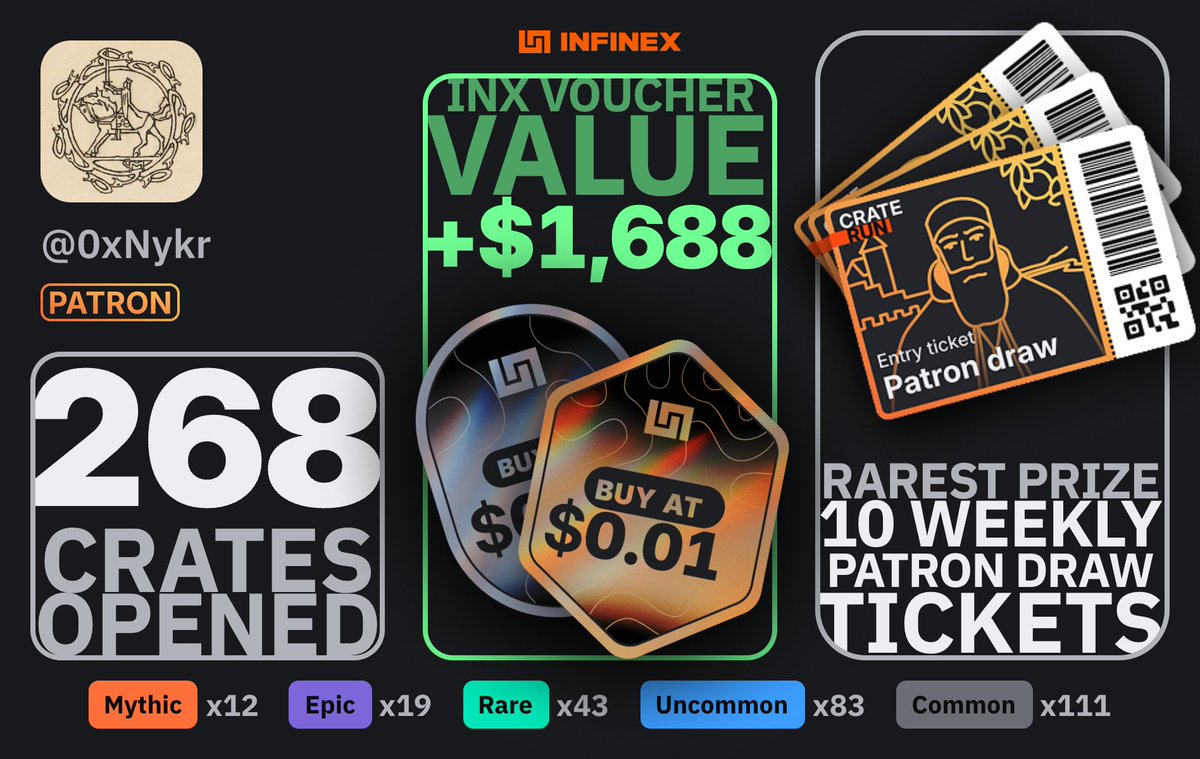
Craterun is the most egalitarian thing we've ever seen. it's insanely ambitious, and if it works, can really reshape the fabric of society.
I have gone bald and lost the will to live
analyzing thought patterns generally requires some type of visual metaphor.
one of my favorites is that certain concepts or events are the equivalent of releasing a few drops of ink into a clear tank of water. in its default state, the water is clear, it looks like it’s doing nothing. but once you put a colored liquid into it, suddenly you can see how the water is flowing. it was already flowing this way, but now you can see it.
another liquids metaphor is that going deeply into certain topics is like pouring water out onto a seemingly flat surface. almost no surface is really flat, and if you do this, you see the water naturally find the lowest point, and pool there - even if its several feet away, at the edge of the surface, somewhere you never would have expected.
this second example is one i use quite often, as going very deeply into certain topics often leads to an unexpected place. this unexpected place isn’t random - it’s some type of “lowest point”, and once you find it, you can see people’s varying intellectual paths somehow just seem to end up there, over and over.
one example of this you see online a lot is any type of radical or skeptical politics somehow ending up at nutrition and alternative medicine. these two fields seems totally unconnected - but they’re not. apparently once you start getting curious about power and people telling you what to do, that intellectual water you spilled out happens to flow and pool up around what you’re consuming. this kind of makes sense - what you put into your body and why is, in a way, the most direct and imminent manifestation of society telling you what to do, and what to think.
in this way, many of my personal interests seem to flow towards and pool up around the concept of images. religion, esoterica, magic, shamanism, theology - whatever you want to call this cluster of topics as a field - if you think about one of them for a while, you’re going to find yourself circling the concept of images, and asking yourself what images really are.
our culture has a strange and unique theory of images at this time. in my opinion this is partially due to photography, and it’s presently undetermined how AI images will fit into this understanding.
to swiftly explicate this cultural understanding, you can just ask yourself what an image is. literally, what is it?
an image represents something. okay, what does it mean to represent something? it’s right in the word: it re-presents something: it presents it to you again.
this seems obvious, but the slip up is that we actually do not think of photography in this way. a painting of an angel is clearly a representation of an angel, and you would, even casually, call it this: a representation.
but our engagement with photography scrambled this. if you have a photo of yourself at a friend’s wedding, you would never say, “this is a representation of me at the wedding”. we don’t see it as a representation.
we say, “this is me at the wedding”. in our mental model, the photo isn’t re-presenting you at the wedding. it’s not a representation. we talk about it as though it just “is” you at the event.
you would never show someone a photo of your sister and say, “this is a representation of my sister”. but that’s literally what it is.
the AI image, as subset of photographic images, takes this view of photography and accelerates it wildly - as, it is, literally, a re-presentation of photographic images. it is re-presenting information from other photos to you, as a photo.
its unclear how a culture that already failed to see photographs as representations will parse this: literally (very im 15 and this is deep) re-presentations of representations.
thats part of why those fields i mentioned above all have a paranoia about images.
i was once doing a lesson about a highly geometric and symbolic form of religious art. a student asked, “is this real?”, referring to the painting. its impossible to answer that. its neither, and both. its an image.