Meta is building dozens of massive tents at campuses across the US, sticking billions of dollars of chips inside, and powering them with off-grid turbines.
The AI race has officially entered its Mad Max phase.
Over the last month, I reviewed hundreds of documents and satellite images for Cleanview's latest report on behind-the-meter data centers. Meta's data center strategy, which is very visible from space, was one of the weirder approaches I came across.
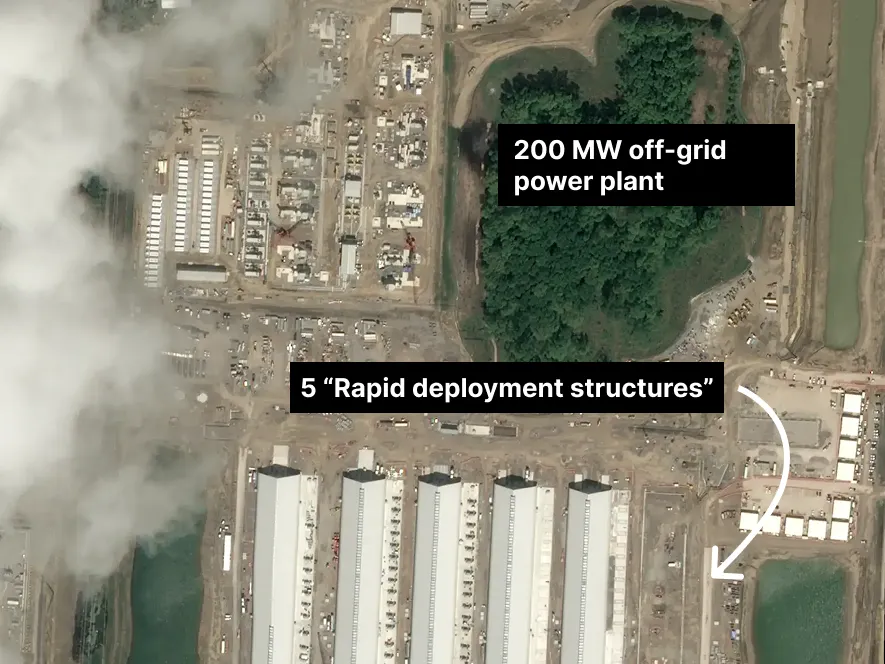
Mark Zuckerberg recently ditched the data center designs that Meta had perfected over the last decade and told his team to stick tens of thousands of chips in tents outside their data center in New Albany, Ohio. Each of these chips costs about $60,000. Zuckerberg plans to stick billions of dollars worth of them in the tents.
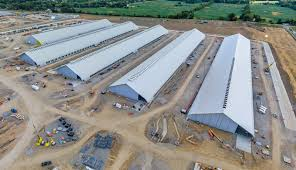
The strategy has helped cut the time to build compute in half. The first five buildings at Meta’s New Albany, Ohio data center took between two and three years to build. Meta started building five ~125,000 square foot tents between April and June of 2026, according to city permits. Satellite images show the structures have all been built.
To power those "rapid deployment structures", as they are officially named, Meta signed a 10-year deal with Williams to build a pair of 200 MW off-grid power plants. Those power plants began construction about a year ago and are nearly complete.
Meta is using the same strategy to build a data center in Tennessee, bringing the total count of tent data centers to three.
Strategies like this are part of the reason behind-the-meter data center capacity is growing so quickly.
In Cleanview's report, I found that there's currently about 2 GW of BTM capacity online today. By the end of the year, it will likely be 3 GW—equivalent to three nuclear power plants. By the end of 2027, it could be as high as 13 GW—more than the power demand of NYC.
I've been talking to a lot of reporters about this research. When I told one reporter about these tents and other companies powering their data centers with jet engines, he said, "It's like a scene out of the movie Mad Max."
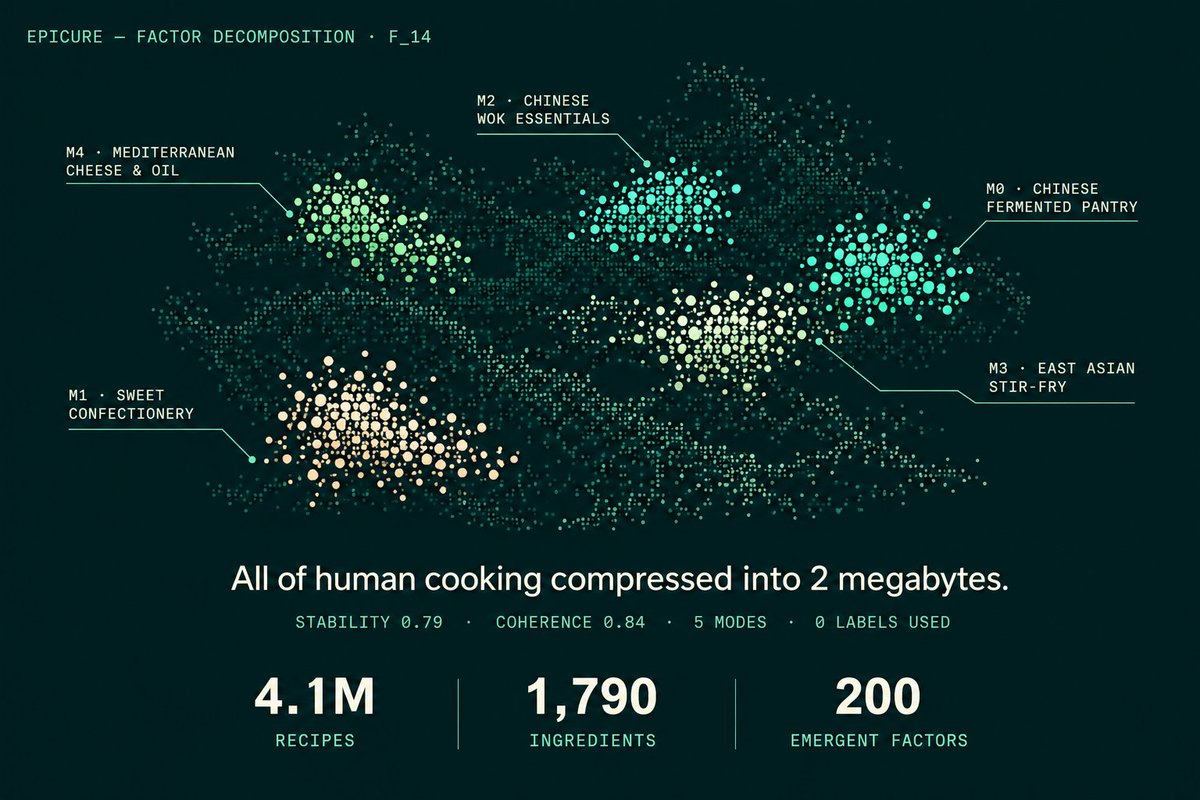
Launching our new paper on arXiv: we trained the largest multilingual food model ever built.
4.1M recipes. 7 languages. 1,790 ingredients. 300 dimensions.
All of human cooking compressed into 2 megabytes.
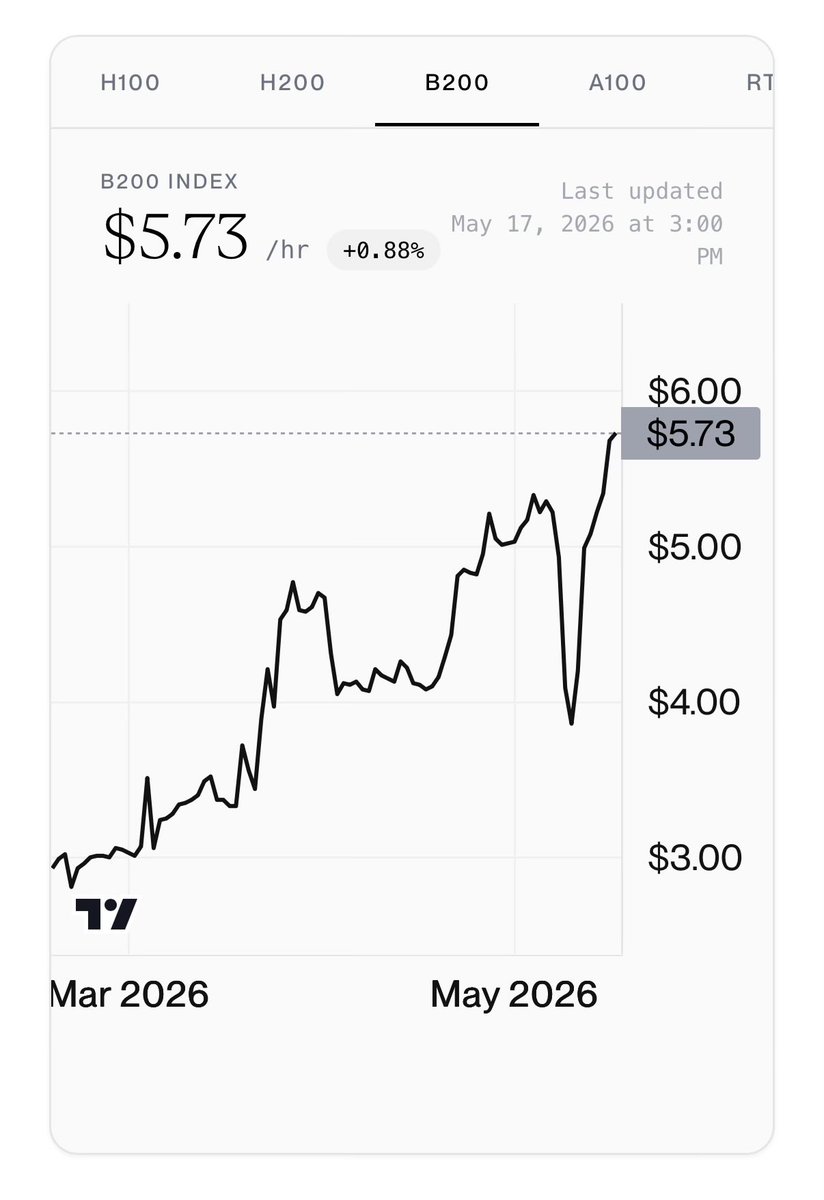
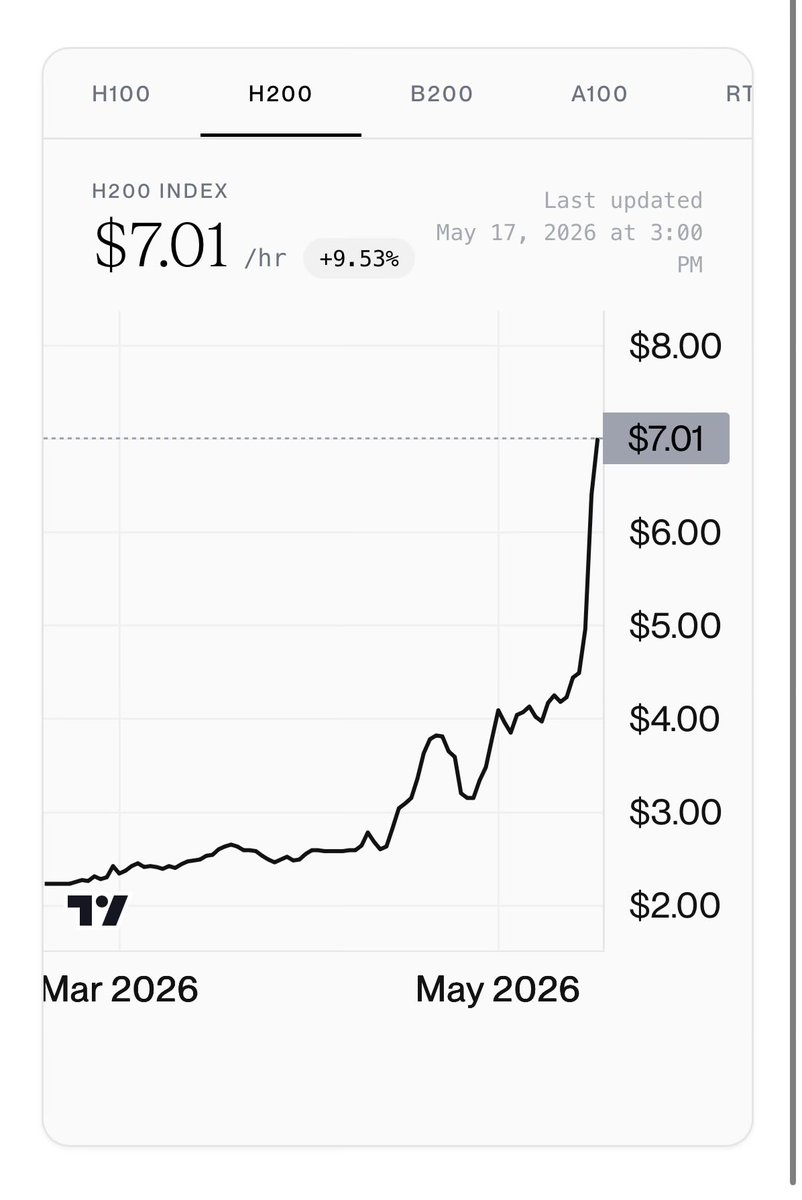
Crazy price action in H200 cloud pricing – up 56% in 3 days.
What is unusual is that the H200 is suddenly trading higher than the B200, a superior GPU.
It’s not crazy to think that a fund could bid up supply in an illiquid tight market at a cost of $50K a day to engineer a short-term move in much more liquid stocks.
@benjp009@thismacapital Ça peut aller plus loin, un ex au hasard : lancer Claude code chaque matin pour faire un check sur ton tool de monitoring et t’envoyer un rapport sur slack.
Tu peux faire tout cela depuis Claude desktop avec les schedules mais cela consomme tes tokens Claude.
@paulg Almost sure it has nothing to do with the smartphone, it’s linked to demographics and housing affordability. Avg working class millennial are much poorer than boomers at the same age.
Install ntn, the Notion CLI.
It brings the entire Notion API to your terminal, plus everything you need to build and deploy Workers. Built for humans and coding agents alike.
Install with: curl -fsSL https://t.co/2dJqE3YHvw | bash
We started by investigating why Claude chose to blackmail. We believe the original source of the behavior was internet text that portrays AI as evil and interested in self-preservation.
Our post-training at the time wasn’t making it worse—but it also wasn’t making it better.
YANN LECUN JOINS MISTRAL, BUILDS JEPA, DEPLOYS ON THE X SATELLITE NETWORK, EUROPE FIRST TO AGI, UNIVERSAL PROSECCO AND GOAT CHEESE OMELETS, ANDREESEN IN SHAMBLES
MIT engineers have developed “mini livers” that could be injected into the body and take over the functions of the failing liver. This would help patients who are on a waitlist for a liver transplant or those who aren’t healthy enough to tolerate surgery.
https://t.co/B6odCTawl0
Imagine every pixel on your screen, streamed live directly from a model. No HTML, no layout engine, no code. Just exactly what you want to see.
@eddiejiao_obj, @drewocarr and I built a prototype to see how this could actually work, and set out to make it real. We're calling it Flipbook. (1/5)
When simulation becomes the norm, it weakens the human capacity for discernment. As a result, our social bonds close in upon themselves, forming self-referential circuits that no longer expose us to reality. We thus come to live within bubbles, impermeable to one another. Feeling threatened by anyone who is different, we grow unaccustomed to encounter and dialogue. In this way, polarization, conflict, fear and violence spread. What is at stake is not merely the risk of error, but a transformation in our very relationship with truth.
TIL you can pull the backlinks to any domain for free (instead of using a service that charges hundreds a month) using Common Crawl's web graph. Wrote a tiny bash script:
https://t.co/KDVhYMjhq8