i left meta to build onchain, and this is the first chain that feels like a consumer product instead of developer cosplay.
ten weeks in, the short version i'd give a friend:
> ~100ms blocks, arrival-order sequencing, gas often sponsored. it feels like an app, not a wallet
> which is exactly what makes it dangerous. friction was the last thing protecting retail, and it's gone
> 0.06% of fomo users cleared $10k. the leaderboard shows you the 0.06% and hides the denominator
> the best edge available right now is not a signal group. it's reading a deployer's funding graph before you buy
> and the card rail that brought everyone here is being reviewed by chase and the NY AG. it is not permanent
i'm not bearish. i moved my entire build here.
i'm saying the thing that makes this chain extraordinary at onboarding is the same thing that makes it extraordinary at extraction - and both of them are just the block time.
i post the contract-level version of all of this. not the thread-level version.
the chain is ten weeks old and the app layer already flipped the chain's own narrative.
what's actually shipping on robinhood chain, from a builder's seat:
> launchpads are out-earning majors. in a single 24h window this week a launchpad on this stack out-revenued hyperliquid, pumpfun, fomo and gmgn. defillama, not a thread
> memecoins are 80%+ of chain volume. robinhood built a tokenized-stock chain and shipped a memecoin casino. the volume already voted
> NFT-native builds are arriving. hoodminers is doing a free mint on sept 15 using ERC-6551 — each NFT gets its own onchain wallet and its own history. token-bound accounts finally have a chain fast enough to make them feel like something
> consumer and gamefi are landing here before base. waifu, fortune foes, goalhoodz, all in the same two weeks
> and perps on this chain just printed a $531M daily all-time high
the pattern i keep hitting in my own code: everything good here is built around the ~100ms block. things that were unusable at 12-second blocks — per-tick games, live auctions, streaming rewards, settlement that feels instant — are suddenly trivial.
vlad's own framing on the podcast was "a developer platform with financial primitives," and that it was built for AI agents too. he's right about the first half. the second half is the one nobody is building for yet.
that's the actual unlock. not tokenized stocks. latency.
robinhood built a chain for wall street and the degens moved in and paid the rent.
classic.
$183,984.23 in the account.
best trade of his life: +$1,249.87.
69 trades. average hold 1 day 3 hours. joined february. the rest of that balance is referral revenue off a tiktok audience.
that ratio is the most honest chart of this cycle, so let's do the math on why it exists.
the fee stack:
> 0.5% is the headline
> but the effective rate on small trades is multiples of that — a $10 trade can round up toward ~2% a side, so a retail-sized round trip runs close to 4%
> above roughly $190 a trade it drops to the 0.5% everyone quotes
> referral links give the invitee 10% off and pay the referrer a cut of every fee that person ever generates
so the app is priced for whales and monetized by retail, and the highest-margin product in the entire stack isn't trading.
it's distribution.
what that means structurally:
> a KOL's incentive is your volume, not your PnL. a follower who churns $50k and ends flat is worth more than one who 10x's and leaves
> "still holding" is free to post and makes the whole feed look profitable
> the leaderboard is a customer-acquisition surface that happens to double as a scoreboard
> index ventures led a $75M series B at a $550M valuation in june. that number is not priced on trading skill. it's priced on funnel
none of this makes fomo a scam. it makes it a media company with a matching engine bolted on.
trade it if you want. just know which side of the business model you're standing on.
a rug on robinhood chain has a fingerprint. it takes 60 seconds to check and almost nobody does.
the pattern, every single time:
before the launch
> the deployer opens fresh wallets weeks early
> runs a few dozen swaps on a real DEX to age them — the goal is for your scanner to read "experienced trader", not "new wallet"
> funding for all of them traces back to the same one or two sources. that's the tell. aged wallets, shared parent
the launch
> cryptic teaser, AI-generated video, same house style as the last three projects
> token announced before any working product exists
> KOLs all post inside the same two-hour window
> site links to TG and X and nothing else
after
> supply dumped from the warmed wallets
> creator fees claimed
> project abandoned in about a week
> same designer, new name, next launch
what to actually check, in order:
1. deployer wallet → funding source → does that source fund other deployers
2. top 10 holders at block 1. if the first buyers are the warmed wallets, you are the exit
3. is there a product, or a video of a product
4. LP: locked, or "locked"
5. does the fee-claim address share a parent with the funding wallet
none of that needs a paid tool. it's four explorer tabs.
the factories work because checking feels slow and buying feels fast.
that asymmetry is the entire business model.
vlad said the quiet part on a podcast and the whole chain repriced off one sentence.
on the iced coffee hour: "if you hold a memecoin you just get stock tokens airdropped to you."
CT read that as a green light. i read it as a spec, and the spec is harder than the thread replies think.
to actually pay stock tokens to memecoin holders you need:
> a holder snapshot that isn't farmable. "balances at block N" means the airdrop gets eaten by wallets that appear one block early and leave one block late
> or a fee-routed treasury that buys the stock leg continuously — which is what the index/pons-style designs already do, and it's the only version that needs no snapshot at all
> a per-holder distribution path that doesn't cost more in execution than it pays. thousands of tiny legs is death by rounding
> and stock tokens are issued by a regulated entity. issuers can pause. an airdrop a third party can freeze is not an airdrop, it's a promise with a kill switch
the honest status: design phase, no timeline, real securities-law exposure. distributing something equity-shaped to an anonymous holder base is precisely the thing regulators have opinions about.
the part that IS tradeable today: he also said devs are already wiring memecoins, core cryptos and stock tokens into products robinhood "wouldn't have thought of to make ourselves."
tokenized stock holders are up 619% in 90 days to 3.6M. BNB chain 1.5M, robinhood chain 1.2M, solana 647.5k.
distribution is the fight. not the tech.
and the teams already routing fees into stock rewards aren't waiting for vlad to ship it. they shipped a version of it in july.
the whole robinhood chain thesis in one sentence: onchain volume should pay you in stocks.
index is the only team that actually shipped it. blend is live.
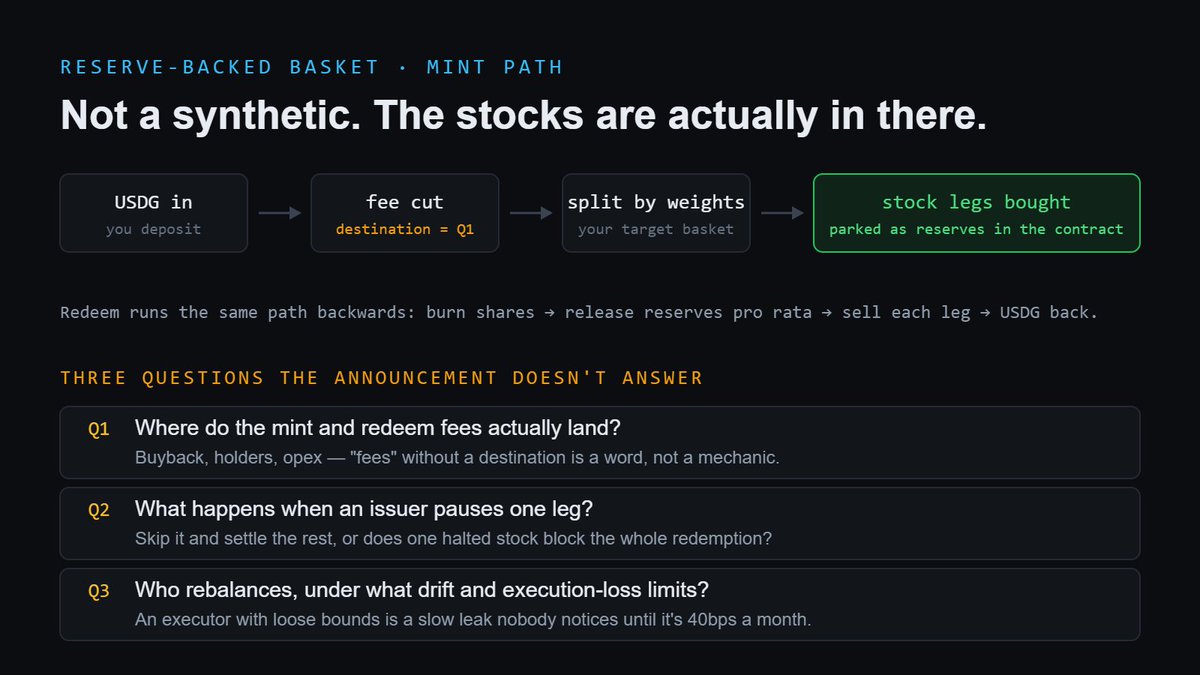
what a basket is, mechanically:
> USDG in
> fee cut
> the remainder split by target weights
> the underlying stock tokens get bought and parked as reserves inside the basket contract
> basket shares minted to you
selling reverses it - burn shares, release reserves pro rata, sell each leg, USDG back.
so it's a reserve-backed ERC-20, not a synthetic. that distinction is real and it's the good news. the thing behind your token is actually sitting there.
three questions i want answered before i size into any of these:
1. where do the mint and redeem fees land. buyback, holders, opex? "fees" without a named destination is not a mechanic, it's a word.
2. what happens when an issuer pauses a leg. one halted stock should get skipped and the rest should still settle. if a single paused leg blocks the whole redemption, that's the actual risk in the design - and it's a risk you inherit from a regulated third party, not from the protocol.
3. who rebalances, under what drift and execution-loss limits. an executor with loose bounds is a slow leak that nobody notices until it's 40bps a month.
the thesis is right. index found the real gap - RH chain is built for tokenized stocks and nobody was letting ordinary onchain activity earn them.
but reserve-backed is only as good as the redemption path under stress, and nobody has run one of these through a red day yet.
that's the test. not the TVL screenshot.
One prompt burned through half of his $200 monthly plan.
That is the sentence in this video that should stop you, and it is the reason the
chapter at 10:13 is the whole thing.
Here is the number that should end the "just add more agents" reflex for good.
Anthropic's own multi-agent research system outperformed a single agent by 90.2% on
their internal eval. Everyone quotes that.
Nobody quotes the rest of the same analysis:
→ it consumed roughly 15x the tokens
→ token usage alone explained about 80% of the performance variance
→ tool calls explained ~10%
→ model choice explained ~5%
Read that last line again. The model you argue about on the timeline is the smallest
term in the equation.
Which makes fanning out a purchase decision, not an architecture decision. It clears
when the task is worth more than the tokens, and it does not clear the rest of the time
- and there is no amount of prompt engineering that changes that arithmetic.
More agents is a thing you buy. Better routing is a thing you design. Only one of them
gets cheaper over time.
That is the whole argument, and it is here ↓
375,740 people have traded on fomo.
229 of them made more than $10,000.
that's 0.06%. the full ladder, off dune:
> 357,528 lost money or made under $100 — 95.2%
> 3,504 cleared $1,000 — 0.9%
> 653 cleared $5,000 — 0.17%
> 229 cleared $10,000 — 0.06%
everyone's reading that as "the app is a scam." that's the boring takeaway. the interesting one is what the leaderboard is actually measuring.
i've had to build PnL attribution before. here's where those numbers come from and where they lie:
> a fomo profile is a social handle mapped to a wallet. that mapping is not reliably 1:1
> the board shows realized + unrealized on tracked positions
> unrealized on an illiquid token is a quote, not money. a $600k position in a $900k mcap coin cannot exit at $600k
> cost basis is reconstructed from the swaps the indexer sees. transfers in, airdrops and seeded supply all distort it
> where wallets are shared or rotated, some buys sitting under a famous name were never that person's
so the board ranks two different populations and prints one number for both: people who are genuinely good, and people holding an unexitable bag at a flattering mark.
the second group is who most of you are copying.
how to actually read it:
> sort by realized, not total
> size the position against real liquidity, not market cap
> look for repeated 3–5x, not one 400x. a lottery ticket is not a strategy
> watch exits, not entries. entries are free to post. exits cost the poster their edge
the 0.06% isn't proof the game is rigged.
it's proof the scoreboard is showing you the wrong column.
Eleven use cases in 22 minutes. Watch it with one question in your head and it becomes
a completely different video:
for each of these, could a machine tell you it went wrong?
→ 00:31 - email agent
→ 07:00 - calendar agent
→ 08:13 - browser tasks
→ 10:20 - coding ← a machine can absolutely tell you this went wrong
→ 12:35 - food delivery
→ 13:50 - meeting summary
→ 15:39 - chief of staff agent ← nothing can tell you this went wrong
→ 18:21 - computer cleanup
→ 19:50 - messaging
Run the question down that list and it splits cleanly in two.
Coding fails loudly - a test goes red, a build breaks, a diff will not apply. You can
leave it running.
A meeting summary, a chief-of-staff decision, a sent email: nothing comes back. There
is no red. The system's confidence and the system's correctness are unrelated numbers
and only one of them is visible to you.
Both piles are legitimate. They just need completely different treatment, and almost
every setup I see treats them identically - because the second pile is where the
impressive demos live.
The demos are impressive precisely because nobody is checking.
Sorting the two piles is Part 2, and everything else follows from it ↓
An agent opens a website. It hits an email gate. It enters its own email address,
opens its own inbox, retrieves the code, and lets itself in.
No human in that loop at any point.
→ 00:57 - install and connect the accounts
→ 05:20 - building the team, and how a soul file controls each agent's role
→ 14:13 - inbox rules, and giving agents their own email addresses
→ 20:47 - the live demo: an agent passing email verification on its own ← watch this
→ 26:12 - daily cron jobs, and the honest verdict at the end
I want to be precise about why 20:47 is worth your attention, because "agent does thing
autonomously" is the most devalued sentence on this website.
Email verification is not a task. It is a trust boundary. It exists specifically to
establish that a human is present. An agent with its own inbox does not defeat that
check - it satisfies it, legitimately, as its own identity.
That is a different thing from automation and it deserves a different word.
Two honest constraints from the same video, which is why it is worth watching rather
than reading a summary:
→ one session used 14% of his weekly quota on the entry plan
→ macOS and iOS only at the time of recording
Two rules I would not run this without, and both are in there:
→ draft-only email rules, so nothing sends without approval
→ restrict inbox and calendar access to the specific agents that need it
The perimeter argument in full is Part 11 ↓
you cannot outbid a sniper on robinhood chain.
that's not an opinion. it's in the sequencer.
everybody brought their ethereum instincts here and is getting eaten by them.
the boring specs first - RH chain is an arbitrum orbit chain running nitro. ETH for gas, full EVM, ~100ms blocks, transaction data posted to ethereum in blobs. nothing surprising.
the part that changes how you trade:
> a single sequencer, operated by robinhood, orders every transaction
> ordering follows arrival time, not a priority-fee auction
> paying a higher gas price does not move you ahead of anything already queued
> the validator set is permissioned
> compliance screening happens at the sequencer level
read it twice. on ethereum you win a snipe with money. here you win it with latency.
what that actually means:
> gas wars are theater. a 10x tip buys you exactly nothing
> the winner is whoever's packet lands first. proximity, connection quality, fewer hops
> "i got frontrun" on this chain usually means "someone was closer", not "someone paid more"
> every bot ported over from pumpfun priority-fee logic is burning ETH for zero edge
> and one sequencer doing compliance screening is one policy change away from being a filter, not just an orderer
half of CT is optimizing gas settings for a chain that doesn't sell the thing they're trying to buy.
Almost every "AI agents" video shows you one product. This one shows two products doing
the halves neither can do alone, and the structure is the lesson.
→ 02:10 - structuring the system ← the part to actually watch
→ 04:15 - setting up the foundations
→ 07:48 - creating the client brief
→ 11:40 - setting up the second agent
→ 18:06 - testing
→ 22:46 - deploying it as a daily routine
→ 25:42 - pricing it
Watch the order of operations, because it is the correct one and it is not obvious:
The qualification rules and the research schema get written first, in files, in a
code editor. Only then does the browsing agent get pointed at the internet.
That is the demotion rule working in the wild. The rules are file-shaped, so they live
where things can be diffed and versioned. Only the part that genuinely requires being
signed into a live browser goes to the agent that is signed into a live browser.
Do it in the other order - start with the browsing agent and let it work out the rules
as it goes — and you get a system whose logic exists only inside a chat log, which
means you cannot audit it, cannot version it, and cannot fix it without starting over.
Same two products. Same 26 minutes. Completely different outcome, decided entirely by
which floor you started on.