I’m Turtle. 🐢
Crypto moves fast.
Narratives change.
Charts move.
Everyone wants the next ticker before the next person.
I prefer to slow down and ask a few harder questions.
What is this project actually building?
Who really needs the product?
Is there real adoption or just incentives and attention?
Where does the money flow?
And most importantly:
Does a good product actually create value for the token?
That’s what I want TurtleC to be about.
I research projects from the inside out:
Product → Adoption → Economics → Token → Market.
Some posts will be deep dives.
Some will be thesis updates when new data appears.
Some will break down concepts, market moves, tokenomics, or the part of a project that I still don’t understand.
I won’t always be bullish.
I won’t always get everything right.
But I’ll try to make one thing clear every time:
What is confirmed.
What is claimed.
What is still unproven.
And what could change my view.
No need to chase every candle.
There will always be another one.
Slow research in a fast market. 🐢
Welcome to TurtleC.
Personal research & opinions only.
Nothing here is financial advice.
#TURTLEC
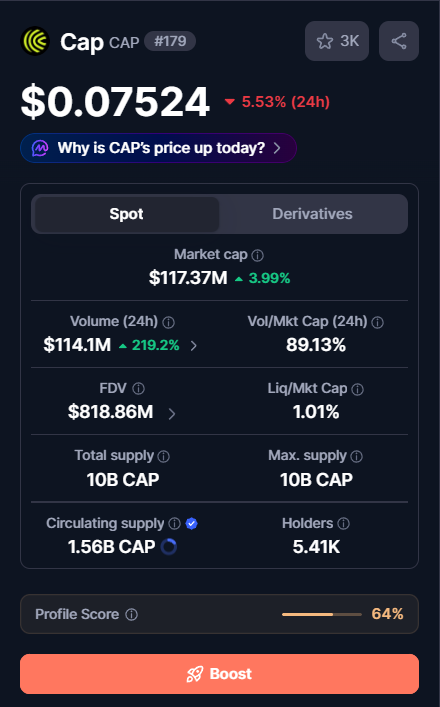
$CAP just printed a new ATH.
That’s not the part I find most interesting.
Under the hood, Cap’s credit engine is actually improving.
Loans outstanding were $41.9M at the end of Q2.
Today they’re around $55.4M.
That’s roughly 32% growth in deployed credit.
But there’s another side to the story.
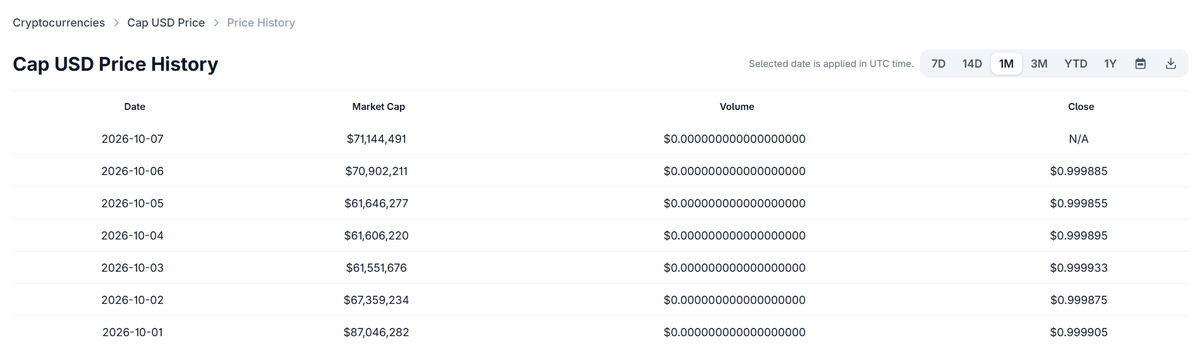
cUSD supply fell from roughly $87M on Oct 1 to $71M today, while CAP token holders still receive $0 in protocol revenue.
So this isn’t a simple “price up, fundamentals up” story.
Borrow demand is improving.
Deposits and token value capture haven’t caught up yet.
To me, the market is pricing the future version of Cap faster than the current balance sheet can prove it.
If loans keep expanding and cUSD/stcUSD start growing again, this ATH begins to look like a real fundamental re-rating.
If price keeps running while deposits and value capture stay behind, that gap becomes harder to ignore.
I’m watching the gap, not the candle.
NFA. Research first.
#TURTLEC #CAP
TOPIC TODAY: SOLSTICE (solana:SLXdx4BUt2v9uJQNzWqSfzTJ9UKLUDsvxHFMEEdrfgq )
_____________________________________________________________
Solstice: Good Protocol ≠ Good Token
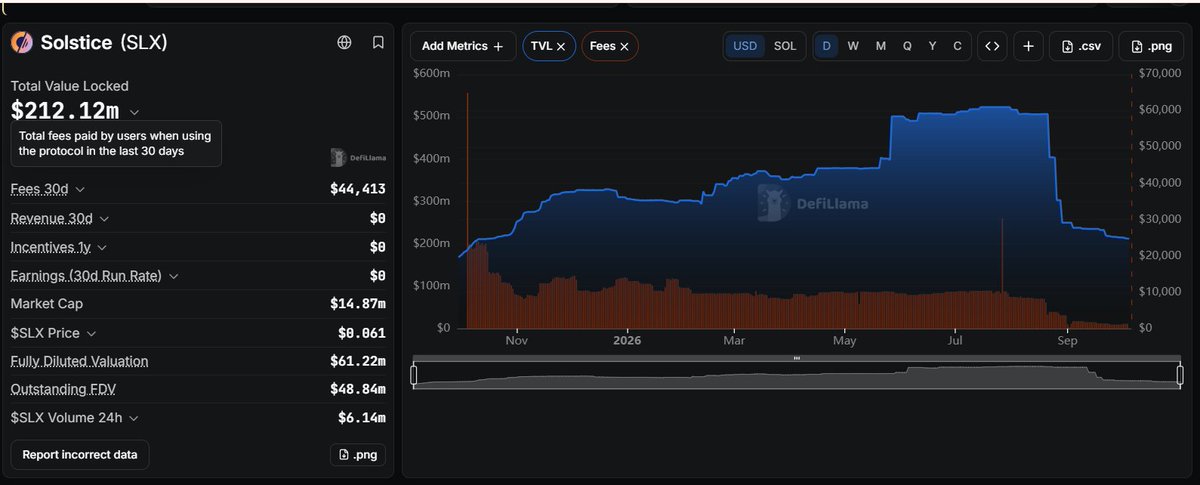
Solstice has ~$212M in TVL.
solana:SLXdx4BUt2v9uJQNzWqSfzTJ9UKLUDsvxHFMEEdrfgq has a market cap of only ~$15M and is down more than 90% from its ATH.
Cheap?
Maybe.
But after digging deeper into Solstice, I think there is a much more important question than price:
Is Solstice becoming more valuable… and does that value actually flow back to solana:SLXdx4BUt2v9uJQNzWqSfzTJ9UKLUDsvxHFMEEdrfgq?
Because these are not the same thing.
Solstice is not just a narrative.
USX and eUSX are live. There is real capital inside the ecosystem, institutional infrastructure is being built, and Deus X Capital has been deeply involved from the beginning.
But solana:SLXdx4BUt2v9uJQNzWqSfzTJ9UKLUDsvxHFMEEdrfgq is not equity.
Holding SLX does not mean you own part of Solstice revenue or profits.
The token works more like an access key.
Stake SLX → receive stSLX → gain priority access to vaults, credit markets, Instant Unlock, governance and other ecosystem benefits.
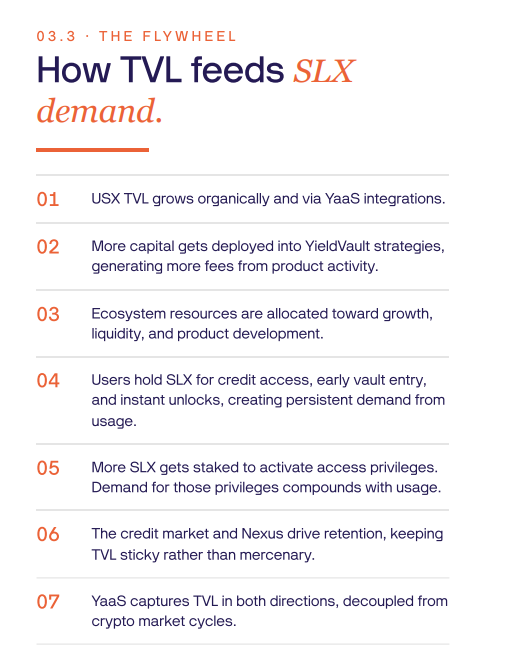
So the bull thesis is actually quite simple:
More Solstice usage
→ more demand for access
→ more SLX needs to be bought and staked
→ less liquid supply
→ stronger structural demand for SLX.
The model makes sense.
The problem?
We still need to prove that this flywheel is actually happening.
There is also another side of the equation: supply.
1B SLX exists.
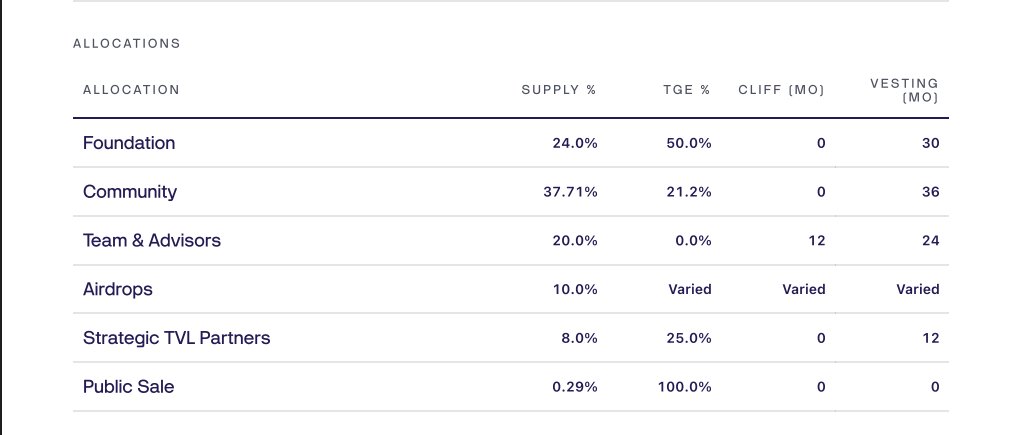
Foundation, Team & Advisors, Community and Strategic TVL Partners still control large allocations, with more tokens continuing to unlock over time.
And then there is Deus X.
Deus X didn’t simply invest in Solstice.
They funded it, supplied meaningful launch capital, share senior people across the ecosystem, and operate businesses covering trading, liquidity and credit.
That can be a huge advantage.
But it also creates an important research question:
How much of Solstice’s TVL comes from truly independent users and institutions…
and how much is related to the Deus X ecosystem itself?
This is why I currently separate the thesis into two parts:
Solstice the protocol: interesting.
solana:SLXdx4BUt2v9uJQNzWqSfzTJ9UKLUDsvxHFMEEdrfgq the long-term investment: still needs to prove itself.
Before I build real conviction, I want answers to 3 questions:
Who owns the TVL?
Who controls the supply?
And most importantly:
Does protocol growth actually create real, measurable demand for solana:SLXdx4BUt2v9uJQNzWqSfzTJ9UKLUDsvxHFMEEdrfgq?
If the answer to all three becomes clear, today’s valuation could become very interesting.
Until then, I’m not interested in calling SLX “cheap” just because it is down 90%.
I’d rather understand why it deserves to go back up.
NFA. Research first.
#TURTLEC #SLX
UPDATE: Cysic (CYS)
_____________________________________________________________
I went back to base:0x19e8d59ff3d7a31289e0dc04db48d43b02c7ffa6 expecting another “project still building after a 90% dump” story.
But the latest updates are more interesting than that.
Cysic is starting to show what “ComputeFi” actually means.
Not one product.
A stack.
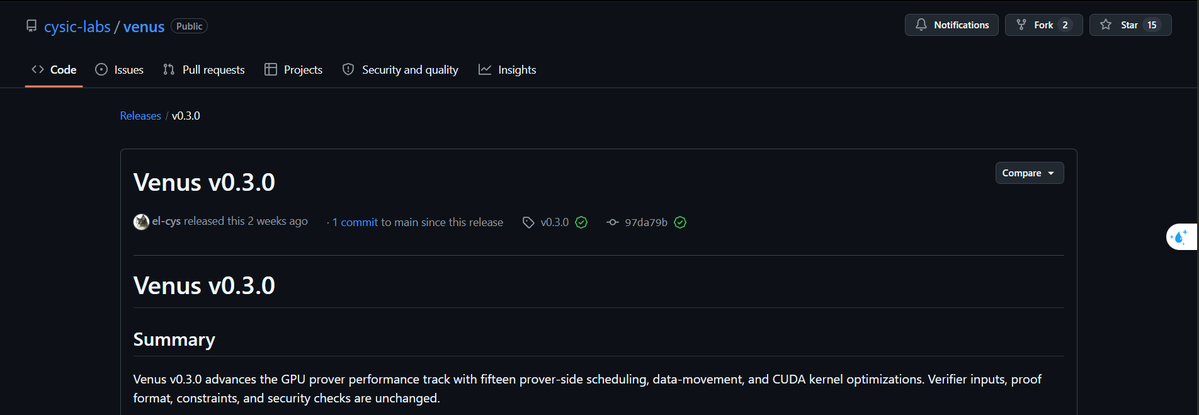
Venus v0.3.0 just shipped with 15 new GPU prover optimizations, delivering up to 6.6% faster proving on Cysic's Ethereum mainnet benchmarks.
That is the ZK layer.
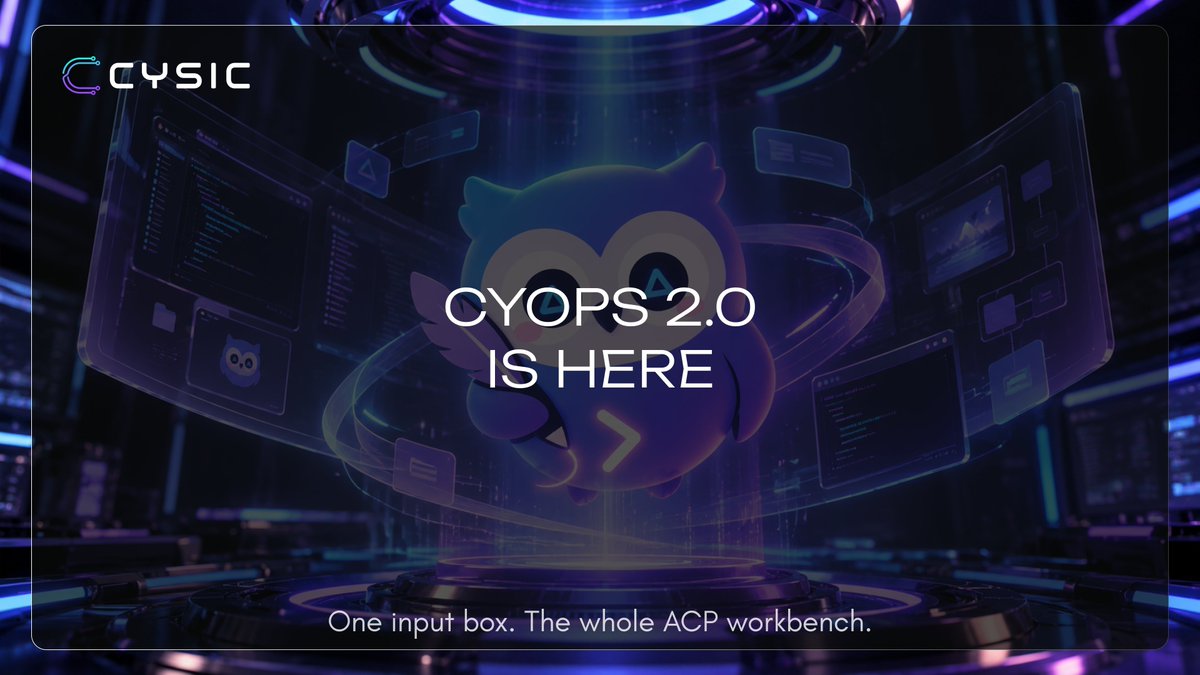
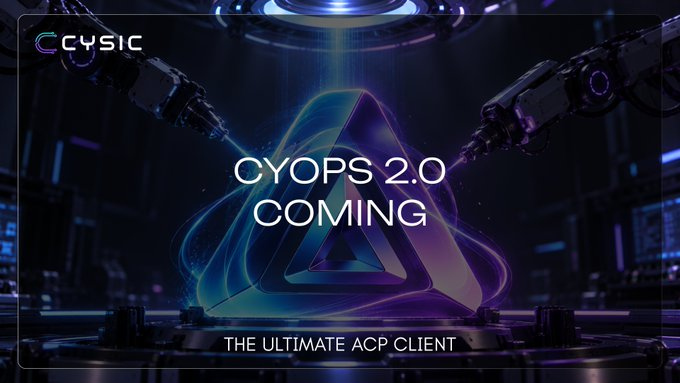
CyOps 2.0 is next.
It is being rebuilt as an ACP client where users can bring their own agents, choose models and create custom workflows from one interface.
That is the AI layer.
Then there is DogeServer.
20 compute cards inside a professional 2U system, combining DOGE/LTC mining with participation in the Cysic compute network.
That is the hardware layer.
Put them together and the Cysic thesis becomes much clearer:
Hardware supplies compute.
Venus makes verifiable computation faster.
CyAI turns that compute into AI inference.
CyOps gives users and agents a way to consume it.
And base:0x19e8d59ff3d7a31289e0dc04db48d43b02c7ffa6 sits in the middle of the economy.
This isn't completely theoretical either.
Cysic says its network has already produced 10M+ ZK proofs and served ecosystems including Scroll, Succinct, Boundless and ETHProof. Boundless previously confirmed Cysic as a prover on its Mainnet Beta.
Yet the token tells a completely different story.
base:0x19e8d59ff3d7a31289e0dc04db48d43b02c7ffa6 is around $0.16.
Roughly $26M market cap.
Still around 90% below ATH.
And only 16.08% of the 1B supply is currently circulating.
That's why I'm not calling it “cheap” yet.
The interesting question isn't whether Cysic is still building.
It clearly is.
The real question is whether all these products eventually create enough REAL compute demand to absorb future base:0x19e8d59ff3d7a31289e0dc04db48d43b02c7ffa6 emissions.
If they do, the market may be massively underestimating what Cysic is becoming.
If they don't, great technology won't save weak token economics.
For now, I'm watching the gap between those two stories.
And that gap is getting interesting.
NFA. Research first.
#TURTLEC #CYS
TOPIC: Tria (ethereum:0x228bec415ade4b61d7caf0adf8c91eac587ba369)
The more I researched Tria, the less I cared about the card.
The real bet is whether a consumer crypto app can become the distribution layer for an infrastructure network.
Tria already lets users spend, trade, earn, use futures and move assets across chains.
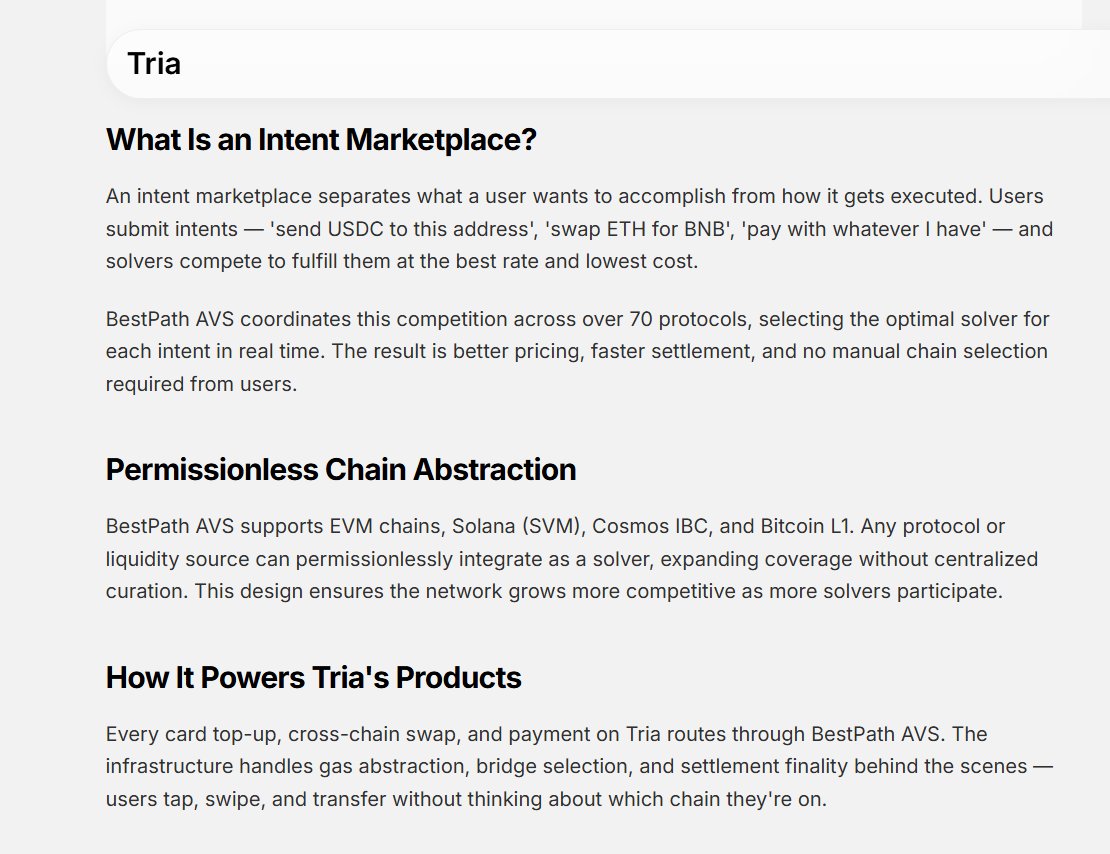
Underneath all of that sits BestPath, an intent-routing layer that Tria says coordinates execution across 70+ protocols.
Card top-ups, cross-chain swaps and payments can all become flows for the same infrastructure.
And that's what makes Tria interesting to me.
Most infra projects build the rails first and then spend years looking for users.
Tria is trying the opposite.
Build the users first.
Let the consumer product generate demand for BestPath.
Then open that infrastructure to everyone else.
If that works, Tria is no longer just another crypto card or neobank.
It becomes a distribution engine sitting on top of a chain-agnostic financial network.
And the team is still shipping.
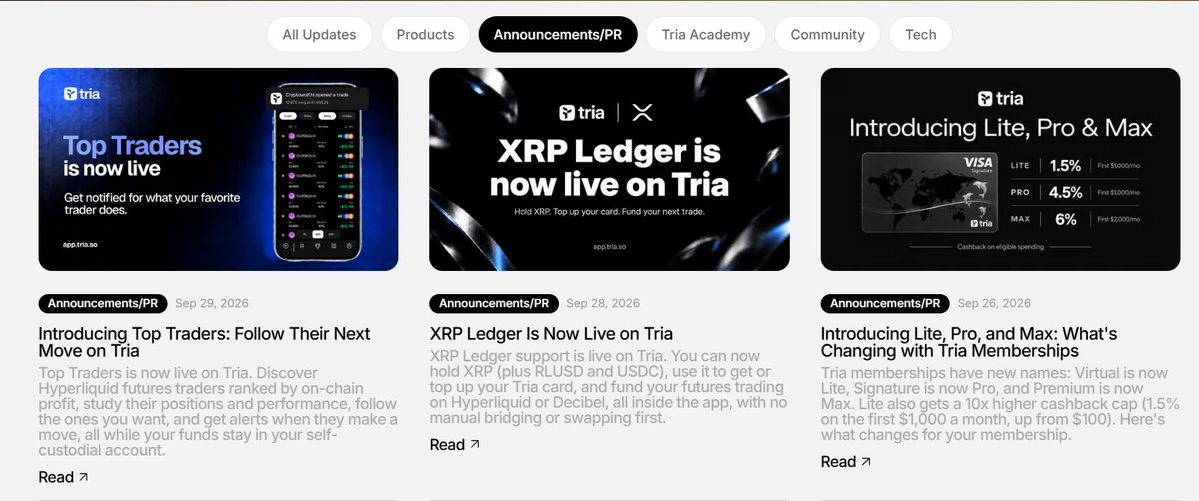
XRPL support went live on Sep 28.
Top Traders went live on Sep 29.
At KBW2026, Tria showed up as a Diamond Sponsor while Upbit was the Presenting Partner.
That is NOT an Upbit partnership or listing signal.
But it does tell me where Tria is trying to go next: Korea, institutions and third-party distribution.
Now comes the uncomfortable part.
ethereum:0x228bec415ade4b61d7caf0adf8c91eac587ba369 is still roughly 92% below ATH.
CMC currently puts it around an $11.7M market cap and ~$40.9M FDV.
Tria publicly raised $12M.
At first glance that looks absurdly cheap.
I don't think it's that simple.
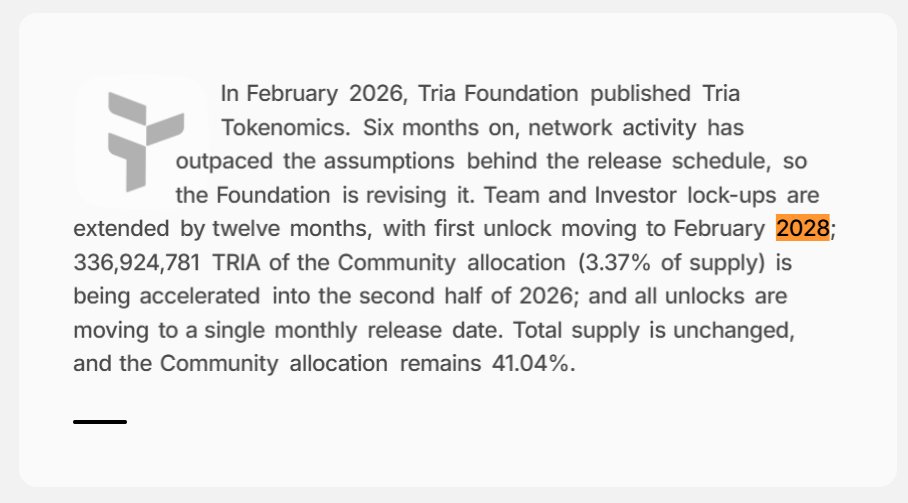
In August, Tria extended the Team and Investor cliff by another year.
Their first unlock is now February 2028.
That's a good signal.
But at the same time, 336.9M Community TRIA was pulled forward from 2027-2028 into H2 2026.
233.5M TRIA was scheduled for release on Sep 30 alone.
And this is the anomaly I care about most.
Tria's own revised schedule says supply remains at 54.47% until January 2028.
CMC currently counts only 28.54% as circulating.
That is a massive gap.
It could be reward reserves, treasury, staking, ecosystem contracts, liquidity inventory or tokens that are released but not actually liquid yet.
It does NOT automatically mean hidden sell pressure.
But until those wallets are reconciled, I won't treat the $11M market cap as a clean picture of TRIA's real float.
Then there is adoption.
Tria is aggressive with cashback, points, referrals, loyalty rewards and ecosystem incentives.
Again, that isn't automatically bad.
Subsidizing growth is how many networks solve the cold-start problem.
The question is what remains when the subsidies fall.
Because there are two very different versions of the Tria story.
The bullish version:
Consumer users create real BestPath flow.
External apps start using the infrastructure.
Pathfinders, settlement and staking create real demand for TRIA.
Fees and network activity finally give the token measurable value capture.
The darker version:
Token incentives create activity.
Activity creates impressive metrics.
Those metrics create more attention.
But external BestPath demand stays weak and emissions remain the engine keeping growth alive.
That is the part the market has not answered yet.
My view today is pretty simple.
Tria the product is stronger than TRIA the token.
I think the team is building.
I think the consumer product is real.
I think BestPath is technically interesting.
And I think the current valuation is compressed enough to deserve serious research.
But I still need four things before raising conviction:
Clean supply reconciliation.
External BestPath adoption.
Organic retention after incentives.
Measurable value capture for ethereum:0x228bec415ade4b61d7caf0adf8c91eac587ba369.
Research-worthiness: 8/10.
Token conviction: still around 6/10.
The interesting thesis isn't:
“TRIA is down 92%, so it must be cheap.”
It's this:
What if the market has priced the token like a failed project while the project itself is still trying to become something much bigger?
That's the gap I'm watching.
NFA. Research first.
#TURTLEC #TRIA
@OpenGradient has already built more than most AI x crypto projects ever get to.
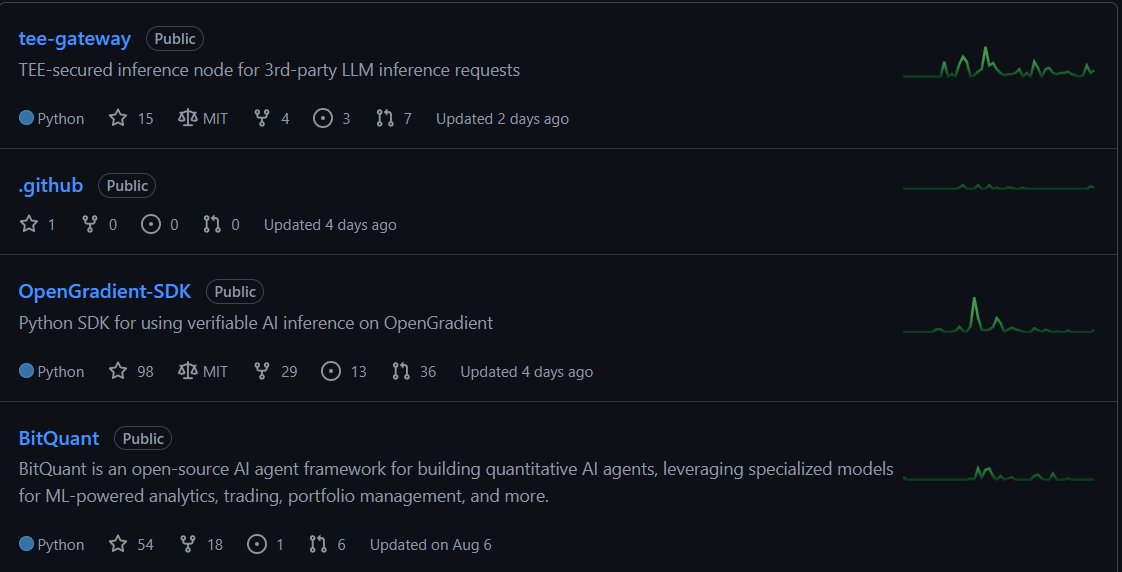
A working Model Hub.
A public SDK.
TEE-secured inference infrastructure.
x402 payments using base:0xfbc2051ae2265686a469421b2c5a2d5462fbf5eb.
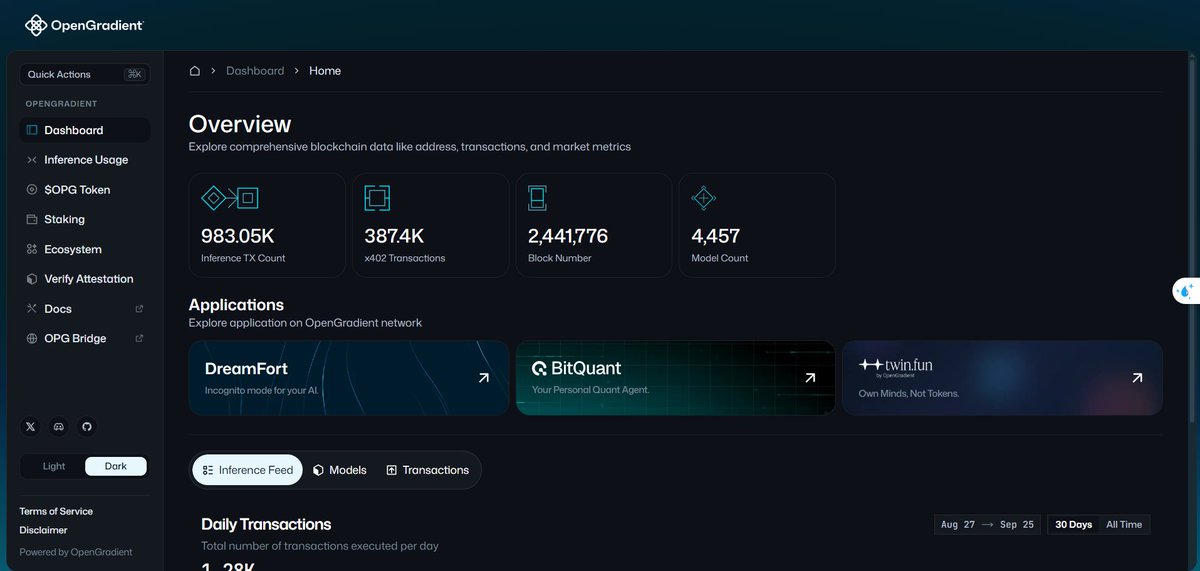
Consumer products like DreamFort and BitQuant.
And the latest dashboard snapshot I checked showed nearly 1M inference transactions, 387K+ x402 transactions and more than 4,400 models.
The interesting part is that development didn't slow down after TGE either.
Their TEE gateway was updated again in September. The SDK was still being worked on. DreamFort shipped MiniMax H3, Extend Video and Edit Video within the same month.
So when I looked deeper into OpenGradient, the first thing I found wasn't a dead AI token trying to survive on narrative.
It was a project that is still building.
But that is only half of the story.
Because the deeper I went, the more obvious the gap became between what OpenGradient has built and what the network has actually proven.
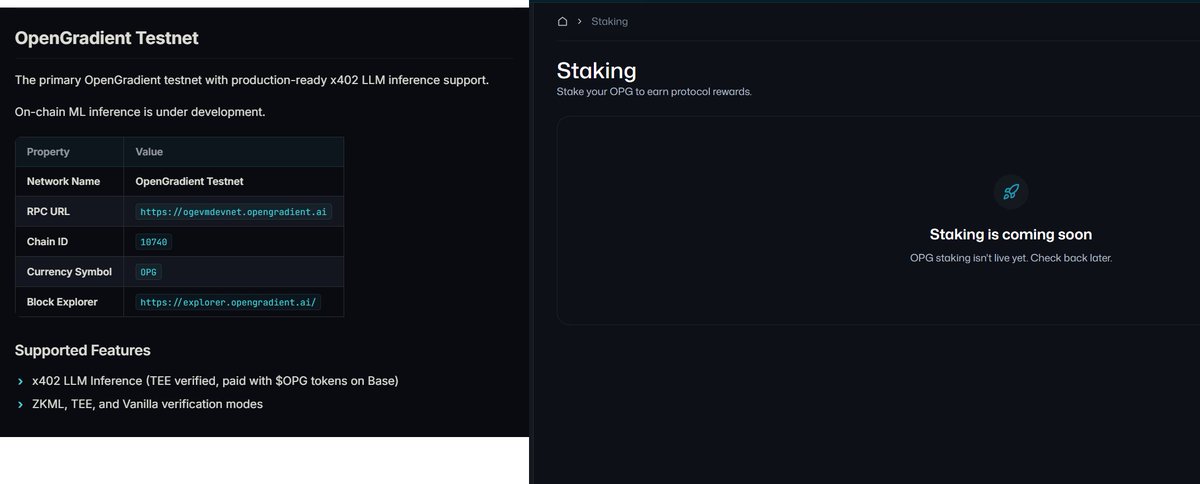
Their own documentation still describes the core network as Testnet.
Onchain ML inference is still under development.
And even though the Foundation previously said all five base:0xfbc2051ae2265686a469421b2c5a2d5462fbf5eb utilities were operational at TGE, the staking portal still says:
"OPG staking isn't live yet."
That contradiction matters.
Then there is adoption.
OpenGradient has real inference activity, but the latest app distribution I could verify was roughly:
DreamFort: 54%
BitQuant: 45%
Other: 1%
That means around 99% of tracked inference is still coming from products inside the OpenGradient ecosystem itself.
I don't think that makes the activity fake.
Actually, I think the strategy makes sense.
Build your own applications first.
Create demand for your infrastructure.
Use that demand to bootstrap the network.
The real test comes after that.
Can OpenGradient turn first-party usage into third-party demand?
Because if "Other" goes from 1% to 10%, then 20%, then 30%+, OpenGradient starts looking very different.
At that point, it is no longer just a team building good AI products on top of its own infrastructure.
It starts becoming infrastructure other developers actually need.
And that is where the token thesis becomes much more interesting.
base:0xfbc2051ae2265686a469421b2c5a2d5462fbf5eb already has something many AI tokens still don't have: utility connected directly to usage.
Its x402 inference flow can use OPG as payment.
But utility alone isn't enough.
What I still want to see is how much economic value that usage actually creates.
How much OPG is being paid per inference?
How much reaches validators or operators?
How much is captured by the protocol?
How much gets locked instead of immediately returning to the market?
Those numbers are still the missing piece.
Then tokenomics starts to matter.
The current unlock pace is around 8M OPG per month, but April 2027 is the date I care about more.
That is when contributor and investor cliffs begin and monthly unlocks increase significantly.
So OpenGradient is effectively racing against its own supply schedule.
It needs external adoption, staking and a more mature network before dilution becomes heavier.
And only after looking at all of that does the current valuation become interesting.
base:0xfbc2051ae2265686a469421b2c5a2d5462fbf5eb is trading around the $0.12 area, with a circulating market cap of roughly $29M, after spending months far below its post-TGE highs.
So the setup isn't simply:
"OPG is down, therefore it is cheap."
My thesis is different.
The project has progressed faster than the token thesis.
The technology is real.
The team is still shipping.
The infrastructure is being used.
The token already has a usage-linked payment function.
But external adoption is still weak.
Staking isn't fully live.
The native network is still not at the maturity level I want.
And heavier dilution is coming.
For me, three things would materially change the thesis:
Mainnet.
Live staking.
Third-party inference adoption.
If those three arrive before the April 2027 supply regime change, I would raise my conviction on base:0xfbc2051ae2265686a469421b2c5a2d5462fbf5eb significantly.
Until then:
Project > token.
And that gap between what OpenGradient has already built and what base:0xfbc2051ae2265686a469421b2c5a2d5462fbf5eb still needs to prove is exactly why I'm watching it.
NFA. Research first.
#TURTLEC #OPG
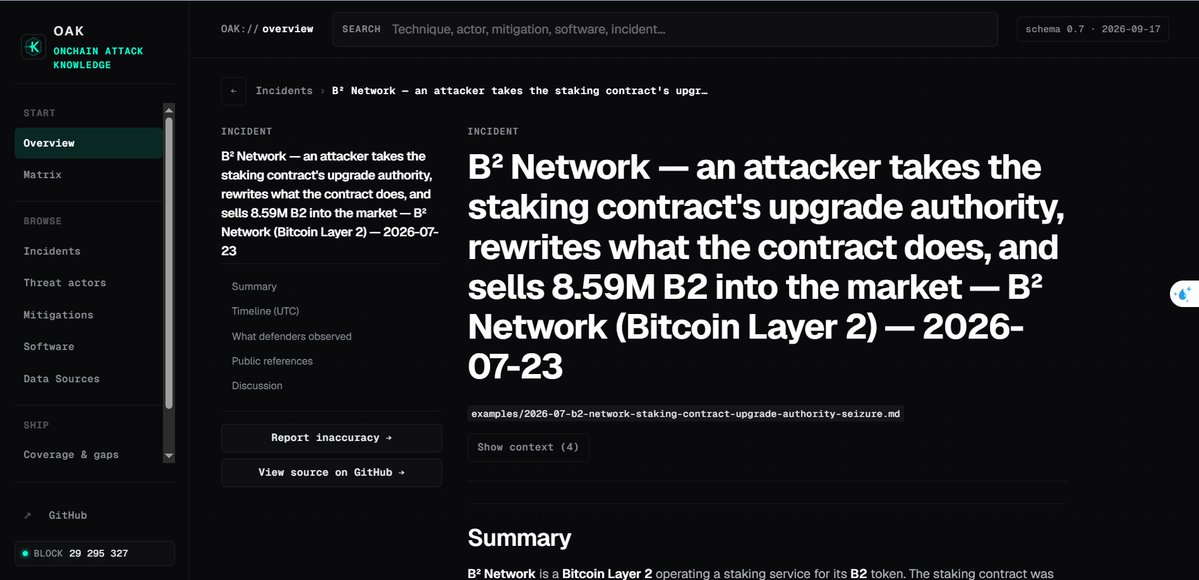
What if the most interesting part of the B2 hack wasn’t who sold 8.59M tokens?
What if it was who bought them?
Watching B2 suddenly move from the $0.4s toward $0.8 made me go back to the July exploit. The deeper I looked at the timeline, the more interesting it became.
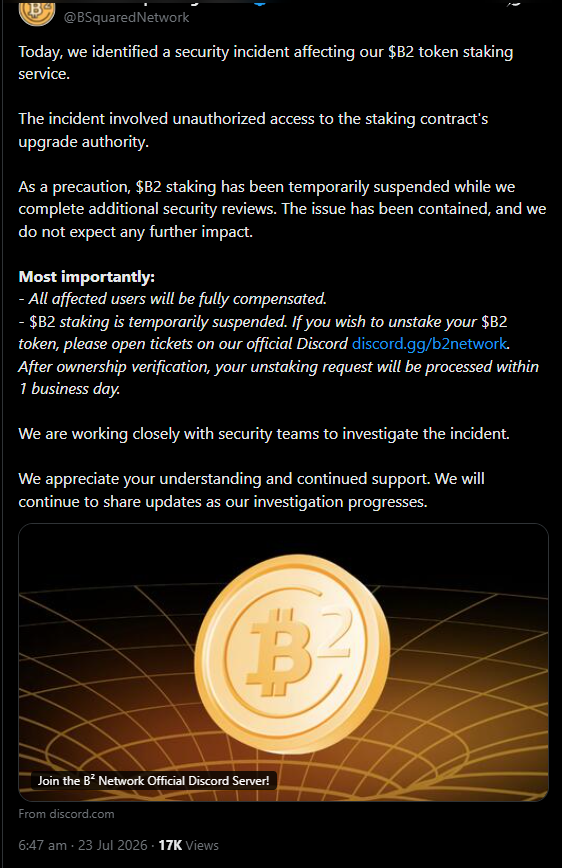
On July 22–23, someone gained unauthorized access to the upgrade authority of B2’s staking contract. This wasn’t simply someone finding a normal withdrawal bug. They gained access to a permission capable of changing how the contract behaved.
Then 8.59M B2 were drained, worth roughly $3.86M at the time. The attacker didn’t slowly exit either they dumped the position into the market for around 5,409 BNB.
Because liquidity was thin, they reportedly realized only around $3M. Nearly $850K disappeared through slippage and price impact alone.
B2 crashed toward $0.31.
Normally, after a multimillion-dollar exploit and a forced dump like that, you would expect the market to stay broken for a while.
But that’s not what happened.
Roughly one day later, B2 was already closing back above $0.42. Within about a week, it was trading around $0.47 again.
That’s the part I keep coming back to.
Someone absorbed the panic.
Someone absorbed the forced supply.
And there’s another detail that makes this case even more interesting. Security researchers reported that the wallet involved in the drain had held a privileged role connected to the contract since 2025, and that role was reportedly revoked only after the tokens were already gone.
We still don’t publicly know exactly how that privileged access was obtained.
Now, I want to be careful here: I have no proof that the B2 team engineered the exploit. An external compromise, stolen credentials, or another security failure is completely possible.
But there’s another scenario worth thinking about.
The exploit happens. Millions of B2 are forced into a thin market. Retail sees a multimillion-dollar security incident and panics. Price trades into the $0.30x.
At the same time, participants with deeper liquidity, stronger conviction or simply better information suddenly get access to supply at prices nobody wanted just hours earlier.
And now, roughly two months later, B2 suddenly moves toward $0.8 while I still can’t find one obvious public catalyst that cleanly explains the entire move.
Maybe it’s momentum. Maybe it’s a short squeeze. Maybe the market is front-running something that hasn’t been announced yet.
Or maybe the people who absorbed the July panic simply understood the setup better than everyone else.
I don’t know the answer yet, but I think we may have been looking at the wrong wallet.
Everyone followed the hacker.
I want to know who bought the fear.
Who accumulated B2 after the exploit? Where did that capital come from? Are those wallets still holding? And are any of them moving tokens now that B2 is trading near $0.8?
That’s the trail I want to follow next.
The hacker is already known.
The buyers are more interesting. 🐢
Personal research and speculation. This is not an allegation of wrongdoing or financial advice.
#TURTLEC #B2 $B2
Most people looking at base:0x19e8d59ff3d7a31289e0dc04db48d43b02c7ffa6 only see one thing:
$1.78 → ~$0.15.
More than 90% wiped out.
I see something a little different.
The price got destroyed, but Cysic didn't stop shipping. In fact, product velocity is starting to accelerate right around the lows.
CyOps 2.0 is officially coming.
Not just another UI update. Cysic is turning it into an ACP Client where you can bring your own agents, choose your models and build your own workflows from one interface.
At the same time, Venus v0.3.0 just shipped with 15 GPU prover optimizations and up to 6.6% faster proving vs v0.2.5.
They're already pushing toward better 4-GPU performance.
And now DogeServer is coming too, packing the power of 20 DogeBox1s into one machine.
CyAI is already live.
Then there is one piece I'm NOT counting as confirmed yet: CyPal.
Cysic teased CyPal before as an AI-powered companion. If we suddenly get a real CyPal update together with CyOps 2.0, that would give Cysic something much more interesting than another ZK infra narrative:
AI products + agents + verifiable compute + physical hardware + base:0x19e8d59ff3d7a31289e0dc04db48d43b02c7ffa6 utility.
Now look back at the chart.
CYS is sitting around $0.15 with roughly a $24M market cap after trading at $1.78 only a month ago.
The recent low around $0.12 has held so far.
This is why, for the first time in weeks, I think the $0.12–$0.15 area is actually an interesting zone to think about entries.
Not because “down 90% = cheap.”
That's terrible logic.
The thesis is that the market has already priced in a massive amount of failure while development is still moving in the opposite direction.
If $0.12 holds, CyOps 2.0 ships well, and the next product catalysts actually arrive, CYS could start being repriced from:
“the token that pumped after listings and round-tripped”
to
“a ComputeFi ecosystem that is still shipping.”
And if CyPal enters that equation?
That's where this gets much more interesting.
There is still one major risk I wouldn't ignore: only ~16% of CYS supply is circulating, so future dilution matters.
That's why I'm not calling the bottom.
I'm saying the asymmetry finally looks interesting.
Defined downside around the recent low.
Multiple catalysts ahead.
A valuation completely reset from the ATH.
This is the kind of dip I pay attention to.
#TURTLEC #CYS
$2.5M worth of $ZEC just moved out of Binance.
1,754 ZEC left a Binance hot wallet → external address.
15m total outflow: ~$2.53M.
This doesn't automatically mean someone is accumulating, but it's a more interesting signal than an internal exchange transfer.
Less ZEC sitting on Binance.
Now I'm watching if more withdrawals follow.