Scherwode Graft
A community should be able to move chains or relaunch without pretending the old contract is somehow the new one.
Graft is basically how we are handling that on Scherwode. You escrow the legacy token, get marks, and those marks claim a finite portion of the new token on the destination chain. Not a tradable IOU, just a clean way to prove who migrated and what they are entitled to.
The other part is liquidity. If there is recoverable capital from the old token, that gets moved over and matched into real liquidity on the new chain, so you are not just launching from zero again and hoping everyone buys the curve.
Claims can unlock on a published schedule, anything unclaimed can burn, anything that never migrates can stay locked, and the actual relaunch terms are set before anyone deposits. Supply, dilution, direct launch vs curve, Wild vs Rooted, whatever makes sense for that project, but it is all disclosed up front.
Not live yet, but we are building the rails for it now.
More than 50% of the basket supply is already burnt, and launch activity keeps feeding value back into what remains.
Less supply. Stronger basket.
https://t.co/4192D2DFDE
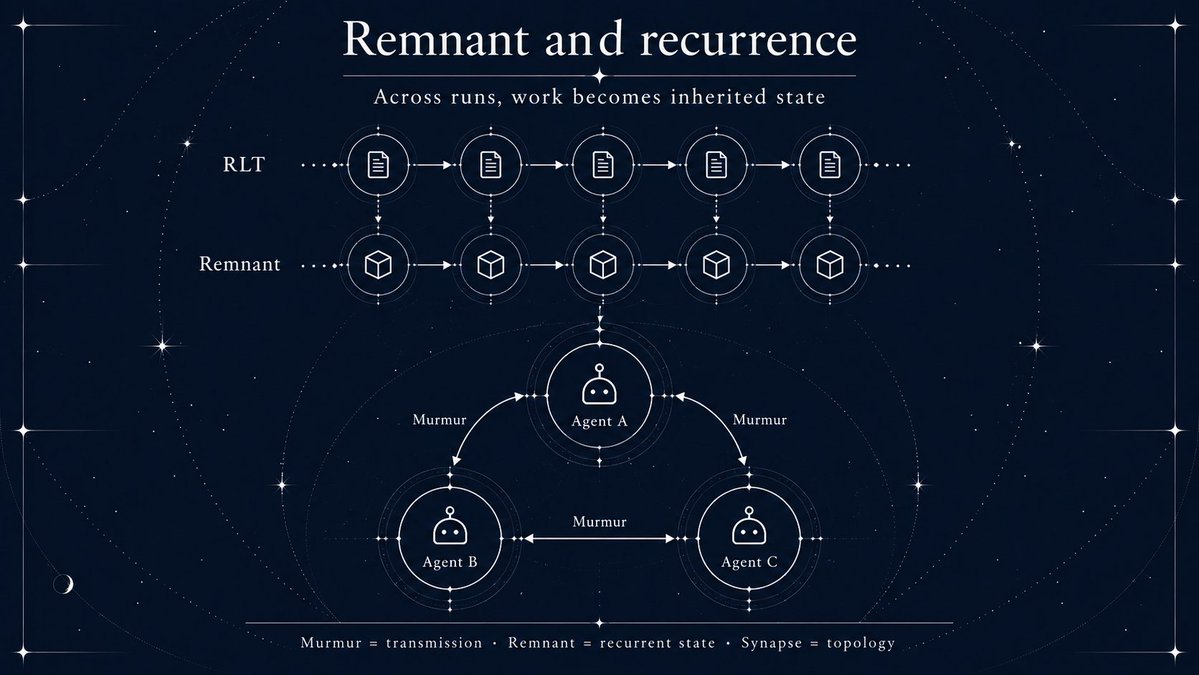
We’ve been pulling parts of the Artifice agent architecture apart into smaller pieces that are useful on their own instead of making everything depend on one giant framework.
The first two are Murmur and Remnant.
LIVE NOW — Sprouted tokens.
A token launches, people trade it, and part of that activity starts building a real perpetual position underneath it. That’s the basic idea.
Scherwode handles the launch and token side. @artificeSystems powers the perpetual side, with positions settled on Hyperliquid.
So instead of all the activity just disappearing into fees and liquidity, the launch starts growing something underneath itself.
https://t.co/bxC8fOqwYi
So, what is a Sprouted launch?
Pretty simple idea, it just took us a while to get the plumbing right.
A token launches, people trade it, and part of that activity starts building a real perpetual position underneath it instead of everything just disappearing into fees and liquidity.
Scherwode handles the token and launch side. The perpetual side is powered by @artificeSystems and settled on Hyperliquid (yes we will add support for other Perp dexs).
A launch picks a market and direction — long ETH, short BTC, whatever.
As the token trades, the Sprout grows. Once enough capital is there, it starts building the underlying position. If that position realizes profit, those profits can be used to buy back and burn the token.
So basically: token trades → Sprout grows → perp position trades → profits buy back the token
And this is just one launch type.
We’ll keep adding weirder stuff too — on-chain baskets, cross-chain baskets, and other ways of deciding what actually sits underneath a token.
Perps are just next.
quit telling people i’m dead.
Scherwode has been quiet, mostly because we’ve been building, and a little dissapointed in the lack of launches.
The first thing is the site. The current UI still feels too much like the version we launched with, and the product has moved past that. So we’ve stripped a lot of that back — a more modernized UI, a much simpler launch process, cleaner navigation, better discovery, less clutter, less friction. The goal is that you should be able to land on Scherwode, understand what you can do, and launch something without having to fight the interface first.
The more interesting part is what we’re actually letting people launch.
We haven’t gotten the traction we wanted with launches yet. That’s just true. But I still think the original idea was right: launches should be more interesting than make token, make pool, hope people buy it.
We already built around rooted assets, baskets, different launch structures, different ways of deciding what actually sits behind a market. Now we’re pushing that further with a new perpetuals-backed launch type.
There is already a ridiculous amount of liquidity, open interest and price discovery sitting in perpetual markets, so instead of pretending every new asset needs to start from zero, we want Scherwode launches to be able to use that existing market structure underneath them.
That gives us a lot more room to do interesting things with launches, a place where you can build markets around actual underlying structure.
And then there’s $WODE.
We haven’t gotten the launch traction yet, but we do have an absolutely massive basket sitting behind $WODE, and we have mostly just... left it there.
So we’ve been looking at that too ;)
This week: a much simpler launch process, a more modernized UI, perpetuals-backed launches, some work around $WODE, and more.
Jester became bigger than Jester.
On September 1, Jester becomes Artifice (@ArtificeSystems).
This is not a visual refresh. Jester started as a trading product. It became a full system: accounts, billing, research, execution, risk, agents, APIs, and several applications.
The old company name no longer covered that. Going forward,
Jester is the trading algo built by Scientio. Artifice is the company and the system around it.
https://t.co/jVEzyh30Rs
Automation became foundational.
Research became persistent.
Trading became execution.
Intelligence became coordinated.
Fragments became systems.
Infrastructure became the product.
Change became necessary.
Emergence became inevitable.
3 years of building taught us one major lesson.
Building is key, but communicating is just as important.
The days when we ignored communication are over. We need your help with this.
What do you think Jester’s communication is missing?
We’ll read and take every single comment into account to improve how we engage with the community.
Also, read the post below 👇
Hear Ye! Hear Ye!
The hour hath come.
$YEOMAN is now live upon @Scherwode.
The Ballad beginneth.
Join us in ye Greene Wode.
0x52c3f9aa9eae9ede152de16294a6f7891e101132
https://t.co/ndgoYLAS6U
One system for research, backtesting, strategy construction, risk, execution, portfolio management, autonomous agents, multi-agent collaboration, and eventually distributed financial compute.
People ask why JESTER is so large.
Why it has taken years.
Why there are so many systems, products, agents, venues, databases, execution paths, risk controls, and pieces of infrastructure beneath it.
It's because we are not building another interface on top of someone else’s machine.
We are building the machine. And being honest, the machine is a monstrosity.
Its nearest comparisons are not other early-stage trading products. They are stacks assembled over decades by some of the largest financial and technology companies in the world.
We are not Bloomberg.
We are not BlackRock, Palantir, Renaissance, Interactive Brokers, or NVIDIA.
We do not have their capital, their armies of engineers, or decades of institutional weight behind us.
But that is the scale of the vision.
The machine is no longer hidden inside one fund. The terminal no longer waits for the operator.
The infrastructure no longer serves one market.
The agents research.
The agents collaborate.
The agents test.
The agents execute.
The agents manage the machine.
That is why it is large. That is why it is taking so long. That is why every time one layer is completed, three more become visible beneath it.
We are not pretending to already stand beside those companies. We are building toward the same class of infrastructure they proved could reshape entire industries.
A financial organism built from the ground up around autonomous agents. A machine large enough that, when it is finished, the trader no longer has to touch every lever himself.
We've just pushed a website update fixing many small issues
- Trade panel should correctly identify trading pools.
- Tokens should no longer be marked as "graduated" when they are still in a "curve"
- And more...
JESTER is in a multi-billion dollar category.
We have the algorithmic and quantitative trading harness that controls compute, agents, risk, strategy, and execution.
Oh, and it can do all of it autonomously.