Education of fraction continues to be disappointing in @NCERT new Grade VI book, and most other textbooks. Fraction is critical to higher mathematics too as the founding idea of rational number. For instance, books do not explain the words ‘numerator’ and ‘denominator.’ But, the meaning of the two words is critical to internalising the idea and constitution of fractions.
Interestingly, calculus and probability (as also permutation and combination) present a very contrasting picture of success in tests and exams. Far more of us crack calculus, compared to probability; primarily because calculus is too trigonometric and algebraic, and that is mostly all there is to computational calculus (mastering a few hundred ‘formulae and identities’). On the other hand, Probability and ‘P & C’ is just about ‘one formula,’ that is to be applied far more intelligibly, conceptually. In a way, all textbooks, including @NCERT totally miss this articulation and appreciation, and this robs students of the raison d’etre of practice and the nature of practice in these domains.
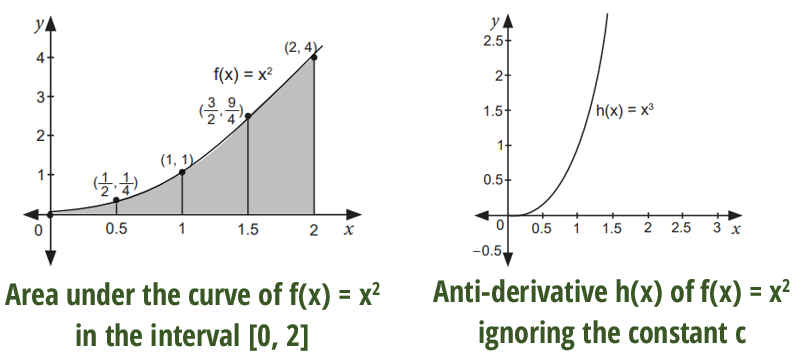
#AreaUnderTheCurve may be the most (ill)famous phrase in mathematics! Integration is taught to be the area under the curve of the integrand (the function to be integrated)! But, how exactly does that give us the integral (function)? To my knowledge, there is no (curricular) textbook that takes the liberty to derive the integral of some functions, e.g., parent functions, as the area under their curves; develop the idea of integration ‘ab initio.’ @NCERT also fails students in illustrating and elaborating this critical connect.
To me, one important reason for calculus computations to be overwhelming is the lack of appreciation of what are commonly called the Parent functions (both algebraic and trigonometric.) They are a set of 11-12 functions, understanding their properties helps in solving more complex problems and exploring their transformations. In @NCERT, it is missing! In other #MathCurricula even if it is present it could be presented far more meaningfully (e.g., using these to show differentiation and integration, ab initio.) @NCERT@OfficialAwwa@IAF_AFFWA@NWWA_INDIANNAVY
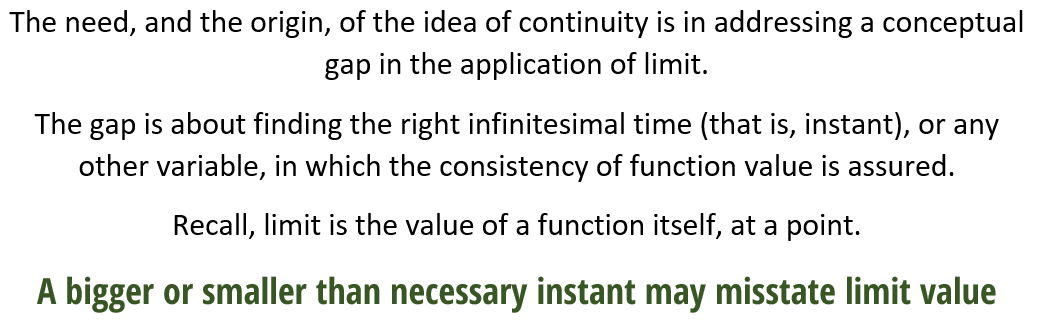
To the best of us (in school math), (conceptual) calculus ‘starts and ends at Limit & Continuity.’ Naturally, that is a long story, but crucial; so, here is a short one on the conjoined twins. @NCERT, other textbooks, fail to be explicit on how continuity, at a point, makes Left and Right limits around the point, needless computations! @OfficialAwwa@IAF_AFFWA@NWWA_INDIANNAVY
Shall we ever realise that finding the length of a curved line requires one to study calculus in Grade XII (worse, even there the ‘function creation’ may not be taught;) though, length of a straight line is soundly measured in Grade II. Similarly, Grade VII physics has ‘F = ma,’ assuming ‘a’ constant, but that’s a real unreal assumption! The result: The most real-world, thus, endearing, math – calculus – becomes most dreaded! @NCERT@OfficialAwwa@IAF_AFFWA@NWWA_INDIANNAVY
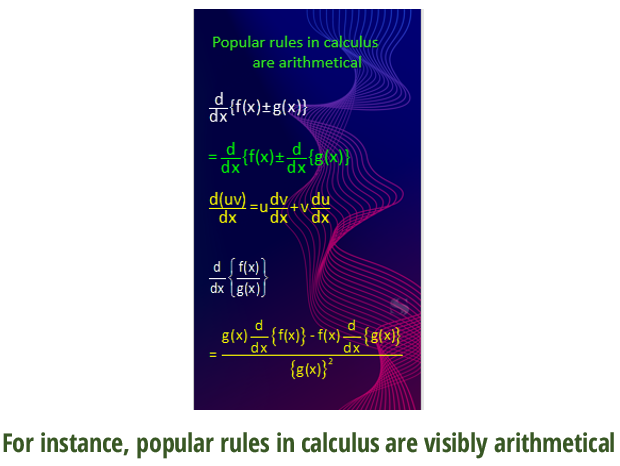
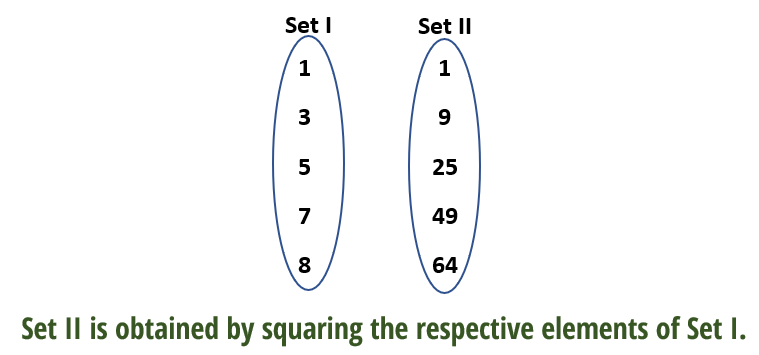
No less, the ‘algebra of numbers’ (e.g., the four operations) and the ‘algebra of functions’ (i.e., operations on sets) bear stark foundational similarity, and this helps appreciate not just functions, but also, deeper mathematical DNA. Relevantly, this also sets a better context to learn how the graphical representation of functions is distinctive and critical insight into the nature of functions (as a set of numbers.)
@cbseindia29@ncert@ShivNadarSchool@azimpremjiuniv
The missing idea of a set in the pre-school math may be the reason why ‘Relations & Functions’ turn abstract and vague in the secondary years. For instance, there is no space to draw on the organic link of numbers and operations in explaining the link between sets and relations. Relations are best appreciated as ‘operations on sets,’ else, we miss the powerful possibilities of such an understanding. @cbseindia29@ncert@AndhraPradeshCM@PrathamIndia
In what is a serious conceptual flaw, sets are taught in middle school or even later (in @NCERT it’s essentially in Grade XI!) To be true, counting a quantity can’t be conceived & concretised without defining the things to be counted as a set; the boundary of the things to be counted is the set. Without a set there is no definite counting possible. @cbseindia29@SCERT_NAGALAND@SCERT2021
#InverseTtrigonometricFunctionsare a ‘nightmare’ to the overwhelming majority of Grade XII students, and also interfere with exceling in calculus solutions. However, IF they are introduced alongside the functions/ratios, they are so very apparent, and also consolidate the idea of functions themselves. @cbseindia29@NCERT
#MathCurricula, by itself, and for how it must support science education, leaves a lot to be corrected, in India, elsewhere; @NCERT definitely knows this, teachers know! Function is taught in Grade XI in #CBSEindia29, thus, #Functions cannot be used to introduce trigonometric functions (by default, they are called ‘ratios',) in Grade X. And, to me, it’s just ‘care less attitude’ of all involved, including well-qualified parents. @KVS_HQ@KVS_HQ@CISCEHQ
Next, there is no (real) attempt to explain why right triangle is the ‘unit of trigonometry’! How right triangles magically overcome the issue of consistent, universal relationship of sides and angles (and it turns out to be ratio of length of sides, not just the length of a side.) @NCERT may update books. @NCERT, @KVS_HQ@cbseindia29@KVS_HQ@CISCEHQ
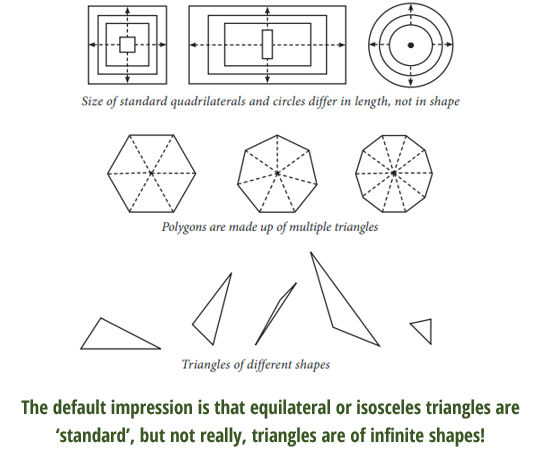
#Triangles exemplify ill-cared-for math education, design as well as practice; e.g., not explain why the first & the #SimplestPolygon – triangles – is also the most important, and, that is why it dominates ‘school geometry.’ There is lot, critical more to the story of triangles. @NCERT, @KVS_HQ@cbseindia29@KVS_HQ@CISCEHQ
#ParalysisOfWill is writ large over math education, globally; but, are we in India even trying at all? An example is how multiple subtrahends in subtraction (an existential, common reality) is not formally elaborated; lessons from its logical constraints ignored. The use of Wallet, cash, even cards, are about a single amount (Minuend) out of which series of ‘take away’ payment are made (an example of multiple subtrahend.)@NCERT@cbseindia29@CISCEHQ
It’s incomprehensible how @NCERT#MathTextBooks overlook ‘Taking away (subtraction of) unlike things;’ e.g., 4 pencils – 2 erasers = ? (it's not as exciting as 'unlike addition'. ☻) Also, children must explore how we make subtraction of unlike things possible, such as the simple: '3 dozen oranges - 2 oranges.'
@anand_shelly@journo_shalini@Roshnism@PandeyPuniti
#MathTextBooks, including @NCERT’s books, may stop using the word #Answer; every outcome in math is a definite, distinct quantity; e.g., in subtraction outcome is called ‘difference.’ NCERT books get right that getting ‘What’s left’ is why we subtract, but miss the reinforcement that comes with repeated use of ‘difference’ as outcome.