🧵 Re-establishing History: Ahmadiyya, Sikhism & Arya Samaj
When Mirza Ghulam Ahmad penned Sat Bachan, it was not only to separate fact from myth on Guru Nanak, but also to refute Dayanand, the founder of Arya Samaj, who had unfairly criticized Nanak and diminished his stature.
@CFBKings Really isn't that big of a deal. Syracuse is already like a short 4 hour drive from Toronto. Most fans and students can easily make the drive.
Tim Horton’s is kinda like Canada. It was once a great place to go but now is just a dirty mess where no one speaks English, everything costs too much and is just riding on its past credibility.
8th shooting this month in the GTA.
Armed home invasions have become so pervasive that people have setup neighbourhood watch groups, hired private security, etc.
We don't need to accept or tolerate this.
Repurpose the ~$1.5B of taxpayer money being spent to buyback guns from licensed gun owners (who contribute to virtually zero gun violence) and use those resources to seize illegal guns, jail repeat offenders and deport repeat offenders here on temporary visas.
https://t.co/OmZoxtStB8
I love Buffalo, NY very much. I like the Bills and whatever helps them win, I’m going to be on board. But Sean McDermott moved his family to Buffalo, raised his kids there and truly loved being in the community. I’m sorry, but that matters to me.
Israel is not America’s “Greatest Ally.”
For years, Washington’s political elite has insisted that Israel is our country’s greatest ally. But is it true?
To qualify as America’s “greatest ally,” a foreign nation must offer the United States tangible benefits to the relationship. It can’t be a one-way street. But that’s exactly what this “special partnership” is. The American people get nothing out of it.
You know what country does benefit the United States? Qatar. Although it’s not “the only democracy in the Middle East,” the Qatari government hosts America’s largest regional military base, cares for civilian victims of Israel’s war crimes, and makes earnest efforts to create peace at Washington’s request. All while the IDF drops bombs on children.
This episode of The Tucker Carlson Show broke down the contrast between these two U.S. “allies,” revealing that the situation’s official narrative is nothing close to the truth. Watch the show here, featuring Tucker’s opening monologue and an interview with human rights attorney Francesca Albanese, whom the U.S. government is targeting over her Israel criticism.
Watch the full episode here: https://t.co/BQCpHtfevP
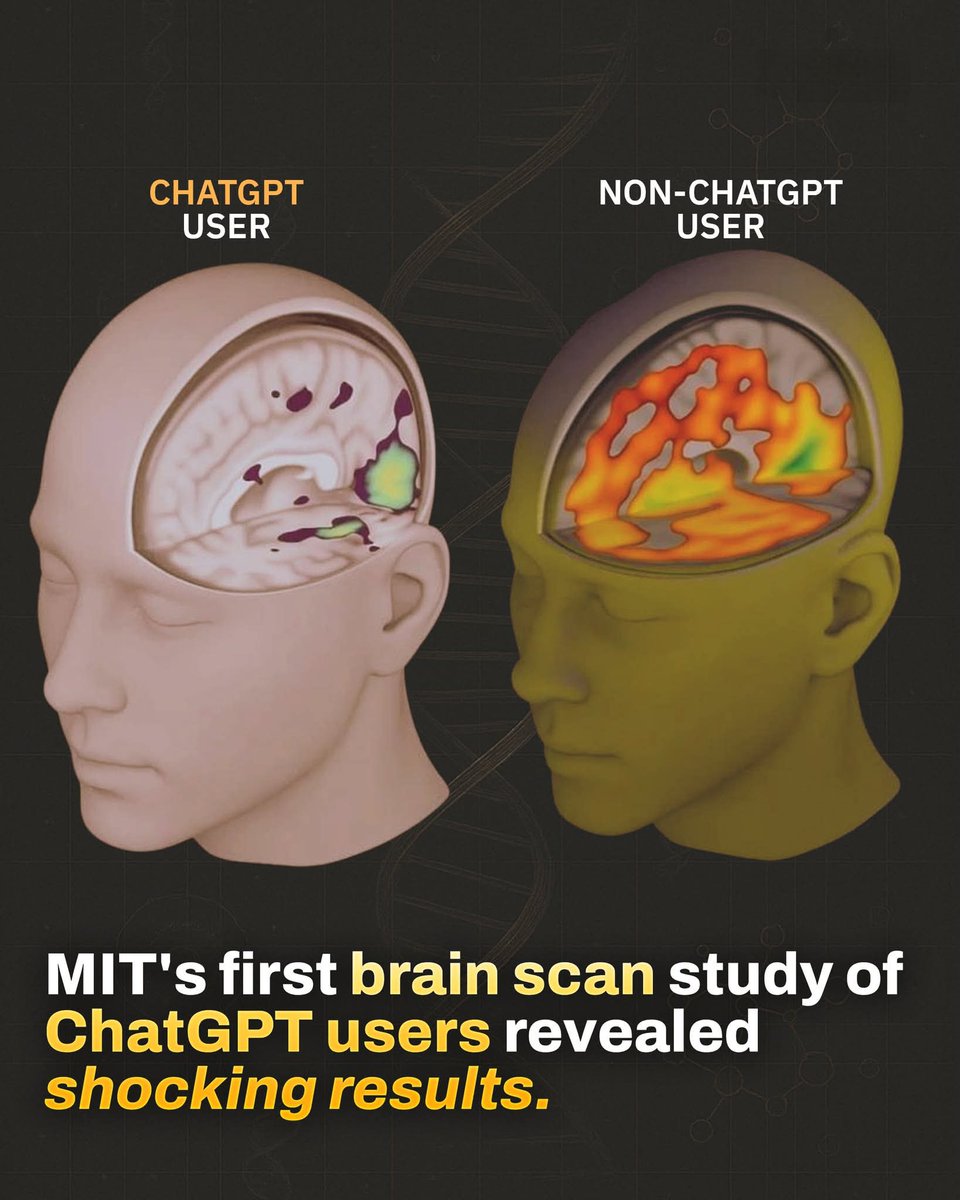
🧠 MIT recently completed the first brain-scan study on ChatGPT users—and the results are deeply revealing.
Rather than boosting brain function, prolonged AI use may be dulling it.
Over four months of cognitive data suggest we might be measuring productivity all wrong ⤵️
In MIT’s study, participants had their brains scanned while using ChatGPT.
→ 83.3% of users couldn’t recall a single sentence they’d written just minutes earlier.
→ In contrast, those writing without AI had no trouble remembering.
Brain connectivity dropped sharply—from 79 to 42 points.
→ That’s a 47% drop in neural engagement.
→ The lowest cognitive performance among all user groups.
Even after stopping ChatGPT use in later sessions, these users showed continued under-engagement.
→ Their performance remained lower than those who never used AI.
→ This suggests more than dependency—it’s cognitive weakening.
Beyond the scans, educators flagged the writing itself.
→ Essays were technically solid, but often called “robotic,” “soulless,” and “lacking depth.”
Here’s the paradox:
→ ChatGPT makes you 60% faster at completing tasks…
→ But it reduces the mental effort required for learning by 32%.
The top-performing group?
→ Those who began without AI and added it later.
→ They retained the best memory, brain activity, and overall scores.
Using ChatGPT can feel empowering—but it may quietly offload your thinking.
→ You gain speed, but lose engagement.
→ You get answers, but stop learning how to think.
The takeaway isn’t to avoid AI—but to use it intentionally.
→ Use it to assist, not replace your mind.
�� Build cognitive strength—not dependency.
MIT’s early study on AI and the brain lays out the stakes. The way we use these tools matters more than ever.