@WARDENRULES@JLas43_ Yeah I think his position on the team is debatable. RHH, but it's not like he hits LHP well - he's been better vs RHP over the past few years. Clogs DH spot, if he doesn't hit a home run he's a liability on the bases.
@Mitch_Rupert So part of the perception here is Painter’s FB is at the same level as it was in ‘22, and since then a lot has changed and he hasn’t really developed the pitch despite going from single A to MLB. An elite fastball at single A in ‘22 isn’t exciting at MLB level in ‘26.
@Mitch_Rupert Another factor is the league has gotten better from ‘22 to ‘26. FB velo and spin rate is up. The fastballs Painter is throwing rank dead average in MLB on my stuff+ score in ‘26, but graded against the ‘22-‘23 environment, they’d have been ~60-65th percentile, solidly above avg
@YankeeReport_ Fascinating case. It's no surprise he regressed vs '25 as he clearly got a bit lucky. But his swing decisions and ability to make contact seem only a touch worse in '26 vs '25, while his damage on contact has fallen off a cliff - but not because of bat speed, at all.
@Mitch_Rupert@jackphilly1053 Interestingly, if you go back to the limited data available on 2022 (when he was in FSL) his fastball velo/shape didn't look much different than when he pitched again in FSL on rehab in 2025. So the idea that he just lost his stuff post-surgery doesn't really fit the data.
His actual ERA is 6.27. Roughly, data suggests ~1/3 of that gap is he's getting less whiff / fewer Ks than his physical stuff predicts. Unclear if that's luck or something real the model doesn't capture. The other 2/3 is probably luck - more HRs / hard contact than expected.
Skubal's Stuff+ and Pitching+ have declined in 2026 vs 2025, although still rank elite. In addition to lower velo, there have been physical changes in '26. Arm angle on his change up is 4 deg lower than in 2024 or 2025, along with changes in horizontal release pt & ext.
Tarik Skubal had good stuff tonight, led by his change-up, and he has showed an uptick in velo in his 2 starts with the Dodgers. Tonight he struggled to locate, however, with Location+ well below avg and the 2-run homer he surrendered coming on a slider right down the middle.
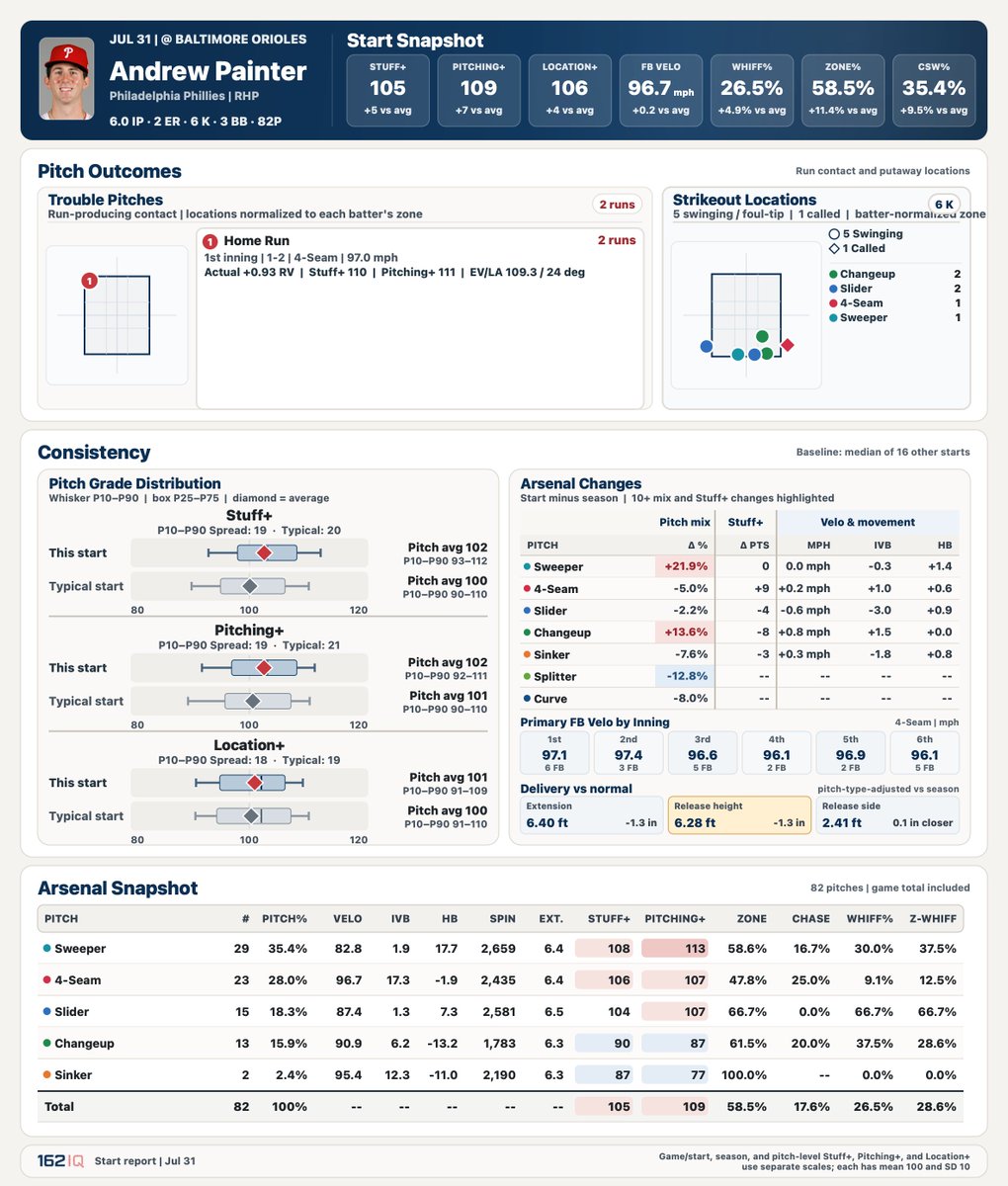
For reference on the 4-seamer, here is his July 31 report card. It is a pretty perplexing drop in 4-seam shape quality between July 31 and August 10. Meaningfully lower rise, meaningfully less spin.
Andrew Painter's return from AAA has been encouraging in terms of results, but mixed on whether his underlying performance has improved. Key concern is his 4-seamer - it seemed improved in his Jul 31 start back, with 106 Stuff+ and 17.3" IVB / 96.7 MPH. Today, it was 14.4" IVB / 96.1 MPH, a far inferior profile. It was 15.1" / 95.6 in his Aug 5 start vs Washington.
The biggest difference for Painter has been his change-up usage, which has surged to be his #1 pitch tonight. His sinker may also have changed a bit - in his last AAA appearances and his 3 MLB starts since the call up, we're seeing ~2" more drop and a bit more run than prior.
@rationalyankee xwOBA is simple-ish and good at predicting true skill. Q is what adds value on top of that, especially for hitters w/ high sample size (regulars). If you add bat speed on top of xwoba, it adds some value for predicting next year's xwoba, and it's one of the few traits that does.
For what it’s worth, I’ve found it harder to add value on hitting. The decision+ swing value metric I’ve developed is interesting, but if you already know a hitter’s xwOBA, adding decision+ doesn’t help predict their future performance. Same with SEAGER it seems (I just tested that now - using annual data at least).
@_24kin I haven’t made the website I’m developing public yet, but probably will in the next week or so. Will be all free, I’m just doing it for fun as a side project. I’m mostly interested in pitching but trying to develop more hitting coverage, including this swing decision model.
I don't want to say too much about someone else's metric like SEAGER especially without being intimately familiar with the calc and construction. But SEAGER seems to have flaws that may reduce its value for evaluating the specific value of a hitter's swing & take decisions:
1. If a hitter starts swinging less, even if they swing at the same proportion of "pitches they should have" and "pitches they shouldn't have", their SEAGER score can rise. SEAGER can reward swinging less in and of itself, even if the hitter didn't have any change in their decision quality. This is part of the Wells score change. In other words, SEAGER isn't symmetrical - at least starting with Wells' pre-July 8 swing %, SEAGER appears to reward being passive more than being aggressive.
2. SEAGER moves substantially w/ pitch mix. If you have two hitters who each make near perfect swing vs take decisions, but one is thrown a bunch of junk and the other gets pitches thrown right down the middle most of the time, the hitter thrown a bunch of junk will have a much higher SEAGER score, even though they're both making the right decision an equal % of the time.
@SongLyrics643@YankeesFanEarl Schlittler - 7th rd, likely going to win the CYA in his 1st full season. Ben Rice - 12th rd, one of the better hitters in MLB in his 2nd full season. Weathers & Warren are notable successes. There have been frustrations, but overall they have a solid record.
The clear thing for Wells' is he is making contact a higher % rate when he does swing and the value of the contact is higher. xwOBA on contact is 120pts higher post-July 8. Barrel rate, EV, etc. all much better. Now is that because he's swinging at the right pitches now vs. before? My model suggests he's not adding any more value there, but that's isolating swing decisions by using what pitches are valuable for the avg MLB hitter to swing at or take. It's plausible Wells' is different and he's making the right calls for him.
My Decision+ has similarities with SEAGER, but SEAGER I think decides whether it was favorable or not to swing and then it's binary whether the hitter swung or not, whereas I am focused on est. run value of each decision (i.e., I retain the magnitude of the value the decision added/subtracted). I'm taking the pitch type, location, handedness, count, and estimating the typical value of a MLB hitter taking vs swinging.