@TradingKing13@CounterStrike How do you make an anti cheat that doesn't make your PC lag, doesn't infeltrate your system really deep and can detect any cheat?
That's the funny thing with everyone not knowing how to fucking drive these days.
They'll ride your ass on straight aways but they're terrified to rock slightly in their seat so they'll brake around the softest of corners lol
@InevitableChina@disclosetv I strongly dislike people such as you. As a Chinese nationalist, why would you wish death upon your own people? People always losers in a war, regardless of who signs the capitulation.
@ChrisCold16@bilichito@BeeNubian@zoomafrika1 They just not advanced enough to commit those crimes on that scale, if 10% of population can cause that much damage to other ones, it's just implies they are stronger. Unless you talking about religion, no one gonna show sympathy to those undeveloped nations
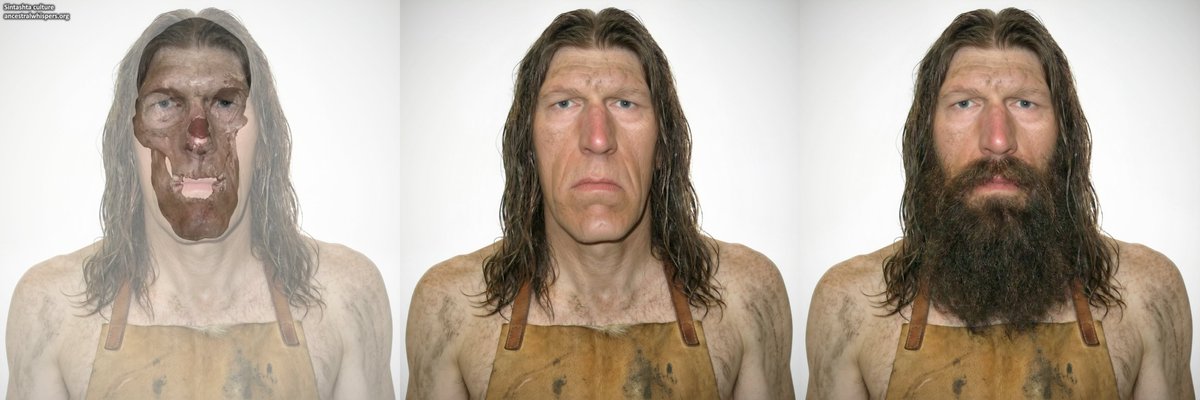
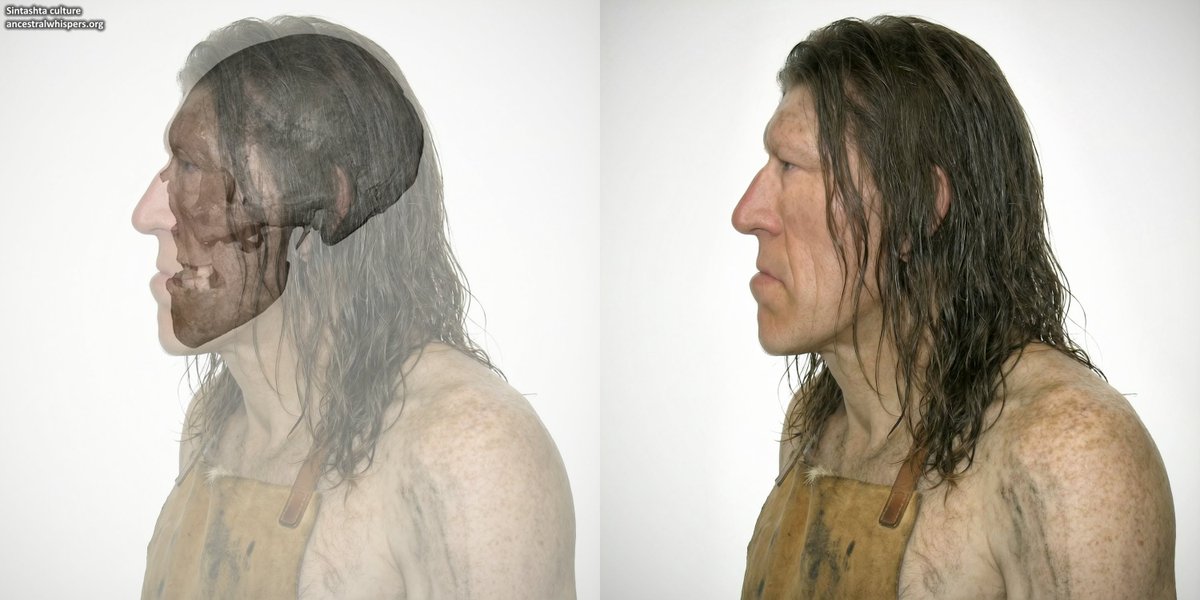
Facial reconstruction of a 3,750-year-old acromegalic Aryan smith from Chelyabinsk
He belonged to the proto-Indo-Iranian Sintashta culture, which traces its origins farther to the west in Europe.
In the late 1970s, archaeologists discovered a fortified settlement of the Sintashta people in the Troitsk district of the Chelyabinsk region, which was named Chernorechye-III. A few years later, not far from it, researchers also identified the ancient cemetery of Krivoe Ozero, where its inhabitants may have been buried. In the third grave of barrow number ten, archaeologists found the skeleton of an adult who had been buried on his side with bent legs and arms, with the hands positioned close to the face. Alongside the skeleton, scientists found ceramic vessels, animal bones, metal objects and fragments of them, as well as pieces of ore and slag.
Anthropologists determined that the skeleton belonged to an adult man approximately 164-167 cm tall, who died at an age of over 50. On his bones they identified signs that during his life he had performed heavy physical labor, with more strain on the arm muscles than on the legs. Together with the finds of ore, slag, and metal items, this suggests, according to the researchers, that the burial most likely belongs to an ancient metallurgist who worked in processing copper ore, forging bronze tools, and possibly frequently pumped air into furnaces using bellows. In addition, anthropologists noted this man’s atypical appearance, which differed significantly from the general Sintashta population. Apparently, he suffered from acromegaly - a pituitary disorder that leads to the enlargement and thickening of cranial bones.
Moreover, the analysis of ore from this man’s grave showed the presence of material from gold-copper-porphyry deposits. The nearest such deposit with evidence of ancient mining is located in the Ural-Mugodzhary mining-metallurgical center - roughly 300-350 kilometers south of the cemetery. This likely indicates contacts between the Sintashta people and inhabitants of more southern regions.
The paleoanthropological material from the site was described by G. V. Rykushina (Rykushina 2003), unfortunately only at the individual level. The author noted the presence of morphologically different skulls in the sample - Europoid (kurgan 1, burial 3; kurgan 10, burial 3; kurgan 10, burial 34), gracile Europoid (kurgan 9, burial 7), and a Europoid skull with equatorial features (kurgan 10, burial 6). Based on the study of pathological markers (such as mastoiditis, cranial infections, and diseases of the dental-jaw system), the author suggested that this group had immigrated from a different climatic zone (Rykushina 2003: 360). A particularly specific skull that should be noted is from kurgan 10, burial 3, which is characterized by overall maturization, dolichocrany, a high cranial vault, a large facial skeleton, and moderate horizontal profiling with a strongly projecting nose. One must agree with G. V. Rykushina’s observation of signs of hormonal disorders that led to the development of acromegaly (Rykushina 2003: 352). This likely caused changes in the size of the facial skeleton, primarily in height and width. However, even without considering these pathologies, this skull is quite distinctive. (E. P. Kitov, A. A. Khokhlov, P. S. Medvedeva 2018)
The man had a medium-large cranial length of 182 mm, a medium-small cranial width of 135 mm, and a broad cheekbone width of around 145 mm.