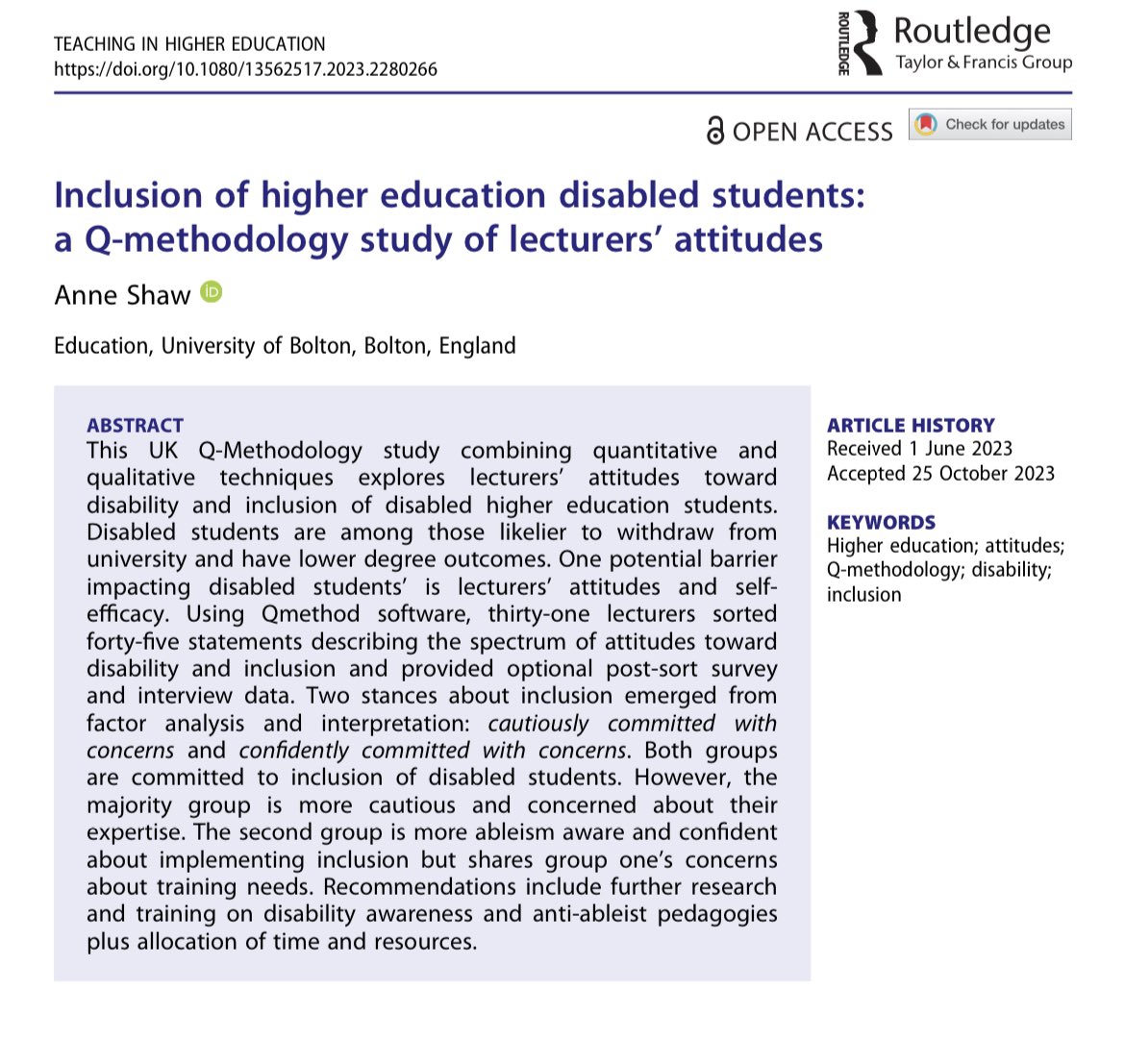
My study “Inclusion of higher education disabled students: a Q-methodology study of lecturers’ attitudes” in @TeachinginHE! The findings have implications for training on disability awareness and anti-ableist pedagogies.
https://t.co/1Iy5MgCmAS
#HigherEd#Disability#Inclusion
Pleased to see my article ‘Inclusion of higher education disabled students: a Q-methodology study of lecturers’ attitudes’ published in this new issue of TiHE. The findings have implications for training on ableism awareness and anti-ableist pedagogies.
The new @TeachinginHE issue is out! Volume 30, Issue 4 is now available here:
https://t.co/7B8YHiVSDK
16 articles, one Points of Departure piece! ✏️
The topics cover #GenAI, trauma-related course content, student inclusion, belonging and well-being... and much more!
The podcast series of @TeachinginHE has been launched! 🚨
Our podcast series 'Teaching in Higher Education: Critical Conversations' kicks off with author interviews based on our recent Special Issue 'Getting critical about critique'. See the link to the first podcast below! ⬇️
NEW on Wonkhe: A detailed national dataset on the disabled student experience paints a bleak picture of progress on enabling access to education. Jim Dickinson tries to find the light. https://t.co/P2YqzWsFQL
📢 The 2024 Annual Disabled Student Survey Report is here!
Discover what disabled students had to say in our annual survey. Download the full report now and explore their experiences, challenges, and recommendations.
Link to the report: https://t.co/MV5UqTVY6S
My latest blog summarises my recent conference talk on AI issues in learning, teaching and assessment. It's a wide-ranging ramble, includes skills for the future, AI and SoTL, and ways to navigate AI uncertainty (and more ...) https://t.co/Qpg1PJSXrz
Hi all,
Mr Johnson went on a course where he learned displays are distracting and should be removed. Miss Johnson did similar where she learned displays are essential to the learning experience. We’re leaving it up to you. Just hope you get observed by the right one.
Thanks x
It is vitally important that we collaborate and get people talking. Early Years Educator Wellbeing matters and too many of the workforce haven’t received appropriate skills, training or support.
That has to change.
#EYWellbeingWeek#EYWW2024
Check out this little comedian. 🥸
Not long ago I fielded a question about how to interpret a newborn’s smiles and laughter - noting that (at three days old) these behaviors were probably more reflexive than intentional.
In doing so, I also made a promise: that meaningful smiles and laughter would be just around the corner. And that once they arrive you really couldn’t miss them.
Which brings us to this little joker.
You only get a quick glimpse of the game he’s playing with his grandfather, but what you’re watching is the pair using rapid changes in their facial expressions to make one another laugh.
And boy, is it effective!
Watch as our hero goes from delighted to completely straight faced at the drop of a hat. His serious face makes grandpa laugh and this brings out some of the biggest baby grins you’ll ever see.
It’s clear that this little guy is engaging in humor on purpose - and takes real pleasure in making his family laugh.
He’s just the right age as well.
At about 9 months, babies begin developing “theory of mind” - or the ability to begin envisioning a situation from the viewpoint of another.
I’d say he has a pretty good sense of what will make his grandpa guffaw. Wouldn’t you agree?
This amazingly expressive little guy was shared to IG by thatbabyluv.
Are you studying with an energy limiting chronic illness?
In this short video from DSUK consultant Pippa, we explore how university staff can support students with chronic illnesses.
What useful tips would you include as part of this video?
https://t.co/CTvzRJkwPy
To understand a child we have to watch him at play, study him in his different moods; we cannot project upon him our own prejudices, hopes and fears, or mould him to fit the pattern of our desires.
Krishnamurti
#child#understanding
So many arguments about teaching styles but at the end of the day, when a 17yo lad spends his wages from his washing up job and turns up at the school he left 7 years ago because he’s heard you’re retiring, your style, whatever it is, was enough 🥹