@TheEXECUTlONER_ Both are out because the order of tags.
Even if lead runner stayed at first and fielder touches second base he is out. First base is irrelevant to lead runner because he is forced to second.
But had he put batter out first then he is not forced so safe. He did it right order.
@TerryGlavin The punditry I've read is amazed that an actual war time leader had the ability to tell a 5x bone spur award recipient and a novelist to shove their weak attempt at military diplo-thuggery to place unknown.
#welldoneZenenskyy
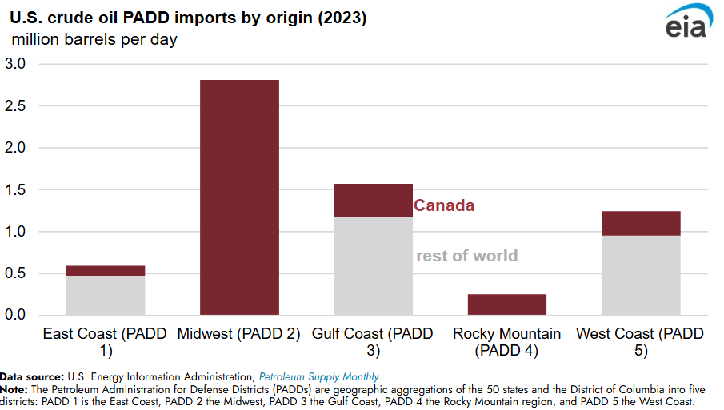
@Big_Orrin@myer80066 The reliance on Canadian crude in PADD 2&4 is understood by the EIA. And these locations have little infrastructure (ports and pl) to get new supply.
It would be empty gas stations in MidCont/West without Cdn crude.
And is there supply of medium sour available in size. Well not really. The natural next suppliers are Mexico, Venez, Colombia, etc. They aren't on great terms with the Don right now. There is always KSA, but I suspect OPEC feels worked by the last iteration of Trump. 3/ #oott
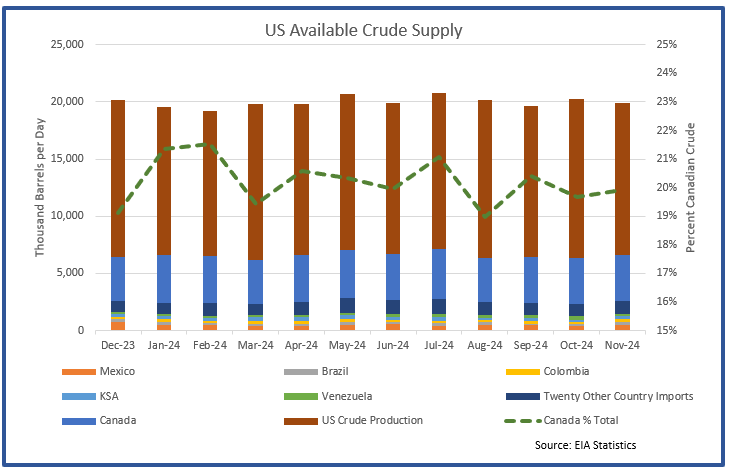
The US is very vulnerable to Canadian imports of crude oil. Not just because Cdn crude (CC) represents 20% of refinery runs input in the US, but the CC supply reps a much higher percentage in the non-coastal part of the US (PADD 2&4). This is a major...1/ #oil#tariff#oott
threat to US energy supply and is not easy to replace. Why? Because there are no natural ports or harbors or pipelines that flow crude to the Ohio/Colorado/Utah territory in size. Yes volumes can be moved or not sent out but there is not 3.6 MM bpd available... 2/ #oott
@IliaBouchouev Again an EFS leaves you with paper barrels. Refineries need physical and where is PADD II getting 3 MMbpd of physical barrels.
If you’re just speculating on heavy diff just trade that.
https://t.co/HYmZ6L1xNi
When a partial meltdown of Ontario's Chalk River Nuclear Power Plant occurred in 1952, one of the 150 Americans brought in to help dismantle the parts of the reactor was Jimmy Carter.
He was lowered into the reactor in 90 second shifts, which was enough time to remove one bolt.
@clawrence@jasonandrade Conversion efficiency rates of primary fuels are all low. Nat gas 40-60%, wind 50%, nuclear 30-45%, solar 22%, etc. It’s not inconvenient just the nature of the primary source.
@jasonandrade@clawrence You’re right Jason that there are losses at every stage. The point was prime mover generation still nets positive MWs after losses. That is not the case for batteries (or any commodity storage) and equivocating as such is problematic. Note I am fully behind BESS as an asset.
@clawrence Its definition is “A power plant is an industrial facility that generates electricity from primary energy”.
Power plants have conversion losses from prime mover to electricity. Batteries do not convert energy types, merely ac-dc-ac. Not the same.
@JessePeltan If you’re trying to explain the “prime mover”, call it such. Batteries are secondary sources that net de-generate energy, but are essential to timing MWs.
Losses/efficiency by prime mover; wind 50%, solar 78%, nat gas 56%, nuclear 33%, etc. plus conversion losses with IBR gen.
@janrosenow If I understand your conclusion, you are stating that generation assets that have no dispatchability and run 21% and 33% of the time are more dependable than assets that run 60-92% of the time and are dispatchable. No grid operator anywhere believes this to be true.