The Solt Transmitter: Broadcasting on 540 kHz in the medium-wave (MW) band, the station operates with an output power of 2,000 kW.
It transmission line known as a cage line consists of an inner circle of parallel wires that carries the radio-frequency (RF) energy, surrounded by an outer circle of grounded wires that acts as a shield. Located near Solt, Hungary.
The Heaviside Layer: A region of Earth's upper atmosphere where ionized gases influence the propagation of radio waves. Beginning approximately 30 miles (50 kilometers) above Earth's surface and extending toward the exosphere, it lies across the upper mesosphere and thermosphere, playing an important role in how radio signals travel over long distances.
The Ultra-Low-Noise Maser (ULNA): X-band receiver designed to detect incredibly weak microwave signals returning from deep space. A radio signal traveled millions of miles, touched the surface of a distant asteroid, and came all the way back to Earth. The secret to receiving it was extreme cold.
It could listen to signals that ordinary receivers struggled to detect. Inside the system, liquid helium cooled the maser to temperatures approaching absolute zero. Powerful vacuum pumps lowered the pressure, bringing the helium temperature below its normal boiling point of 4.2 kelvin.
@n4hpg While the 2:1 SWR stays on the line, the tuner's conjugate boundary re-reflects returning wave energy back in phase so net power transfers to the antenna.
PA0FRI Homemade Pi Filter ATU (14–30 MHz). ATU (Antenna Tuning Unit) used to match the impedance between a radio transmitter (or transceiver) and an antenna system so that maximum power is radiated and minimal power is reflected back into the radio.
Radio signals can travel in different ways. Some follow the Earth's surface as ground waves, others travel through the ionosphere as skywaves, and still others travel along line-of-sight paths or through satellites as space waves.
Two important properties determine how these waves behave: frequency and wavelength. Lower frequencies generally have longer wavelengths, while higher frequencies have shorter wavelengths.
This phenomenon is precisely what makes long-range amateur radio so compelling: Under the right conditions, a signal transmitted from a modest HF station can travel thousands of kilometers and reach another operator on the other side of the world.
@n4hpg An ATU does far more than prevent PA foldback; it creates a conjugate match that re-reflects returning wave energy back up the line in phase with the forward wave so it radiates.
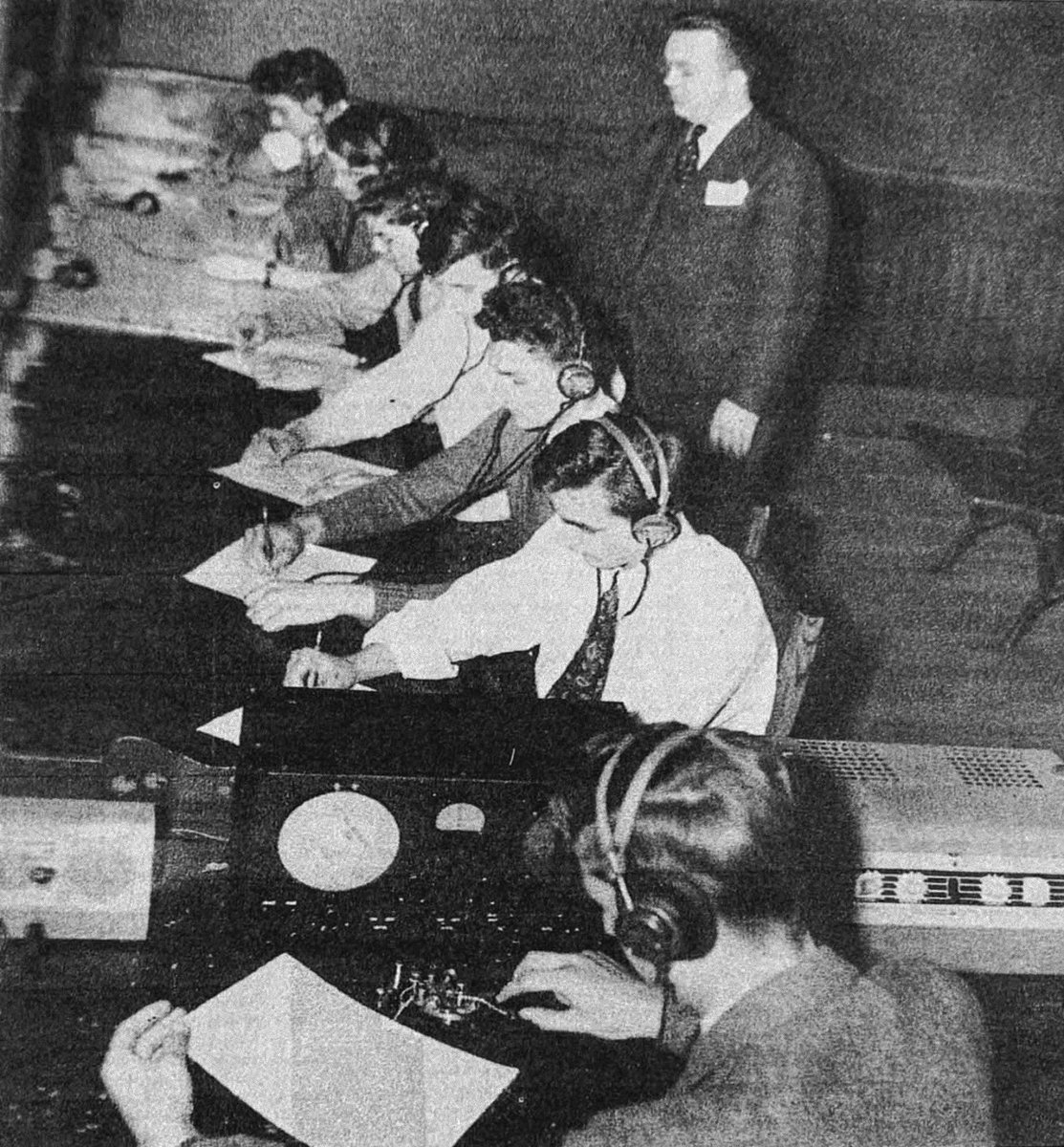
Boys Learning Morse Code for Military Service: In 1944, a group of students learned to send and receive Morse code at 15 words per minute. Their training began with recorded signals. Eventually, they moved on to actual sending, using telegraph keys and headphones.
The boys couldn't know exactly where these skills would take them. But they were learning a language that could open doors to military service, aviation, navigation, and a lifetime of communications. This was not simply an extracurricular activity. It was practical preparation for a world in which radio communication was essential.