$AGX builds the thing everything else depends on: the power plant itself.
Data centers don’t run on promises — they run on reliable 24/7 generation. And only a handful of firms can build large, complex combined-cycle gas facilities. Argan is one of them.
~$2.9B backlog (up from $1.4B a year ago).
~6 GW of generation under contract.
$895M cash, zero debt, 25% gross margins.
Aging thermal fleets, surging AI load, and years of underinvestment are forcing a buildout — and Argan sits exactly where the spend lands: the physical foundation of the electric economy.
When the energy-infrastructure trade works, AGX compounds with the grid itself.
Not a headline trade.
A regime trade.
While the market chases chips and power names, $EME sits at the convergence point — mechanical, electrical, and energy systems inside data centers, hospitals, high-tech manufacturing, and mission-critical facilities.
This isn’t a story stock.
It’s a $15.6B backlog growing 33% YoY, $4.6B in quarterly revenue, and a balance sheet with ~$900M cash and effectively zero debt.
AI, reshoring, grid, and healthcare don’t just need designs — they need contractors who can build, integrate, and energize at scale. That’s EMCOR.
When XLI, PAVE, and ITA work, EME is the name that compounds with actual earnings behind it.
Not speculation.
Execution.
$POWL is where the power has to physically flow.
Switchgear, control systems, and custom-engineered electrical equipment — the gear that sits between the grid and the data center, the LNG terminal, the utility substation.
The order book tells the story:
$490M in new orders last quarter (+97% YoY).
$1.8B backlog (+33%).
Then a single data center award north of $400M after quarter-end — the largest in company history.
This is no longer an oil & gas equipment shop. It’s a power-distribution play sitting at the intersection of AI, LNG, electrification, and grid reliability.
When the electrification trade works, names like POWL quietly compound.
Not a headline.
A regime.
Everyone is staring at U.S. white-collar weakness and calling it structural.
Dollar shorts just hit a 14-year extreme.
Consumer Staples just had one of the strongest 5-week runs since 1990.
Software got liquidated on “AI disruption” fear.
That’s not a trend.
That’s cross-sectional momentum at exhaustion.
Now layer this in:
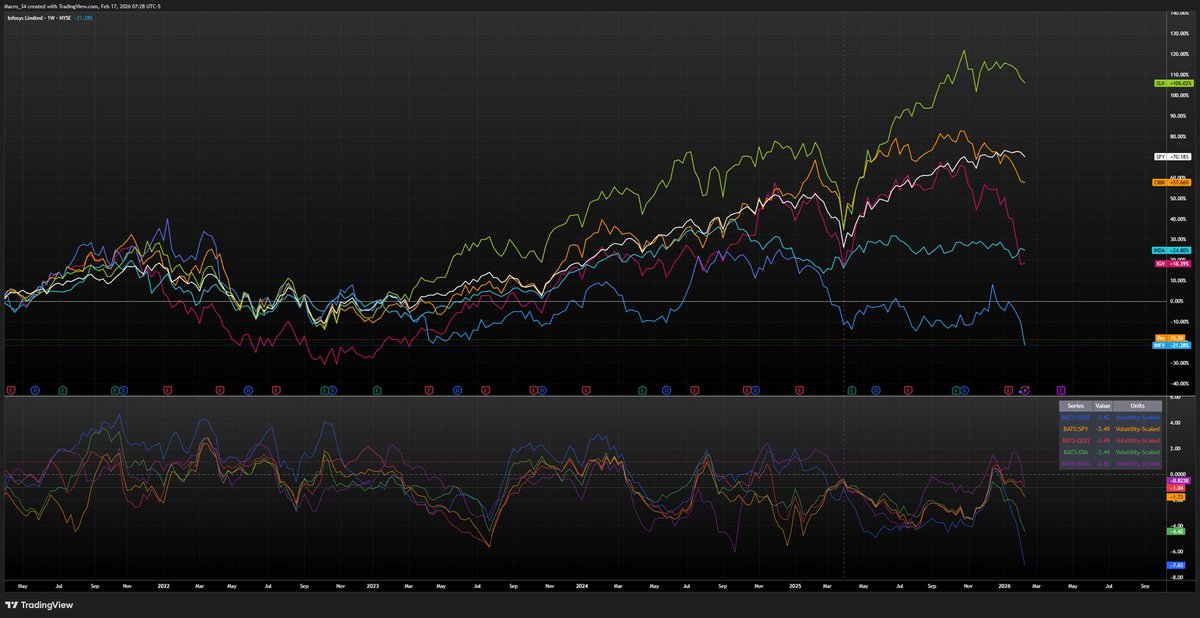
INFY just integrated AI into its services stack at scale — 500+ agents live, embedded into 90% of top clients, generating 28M lines of code.
While U.S. software is being sold on near-term margin fear, Indian IT is quietly monetizing the build-out.
If AI spend is accelerating (Wedbush + JPM), and tech selloff is “overdone,” then the market is mispricing the service layer of AI — not the chip layer.
When positioning, sector rotation, and macro fear all cluster at extremes, the next move isn’t linear.
It’s violent and mean-reverting.
INFY isn’t a defensive trade.
It’s an AI services leverage trade hiding inside global macro dislocation.
Watch cross-asset confirmation.
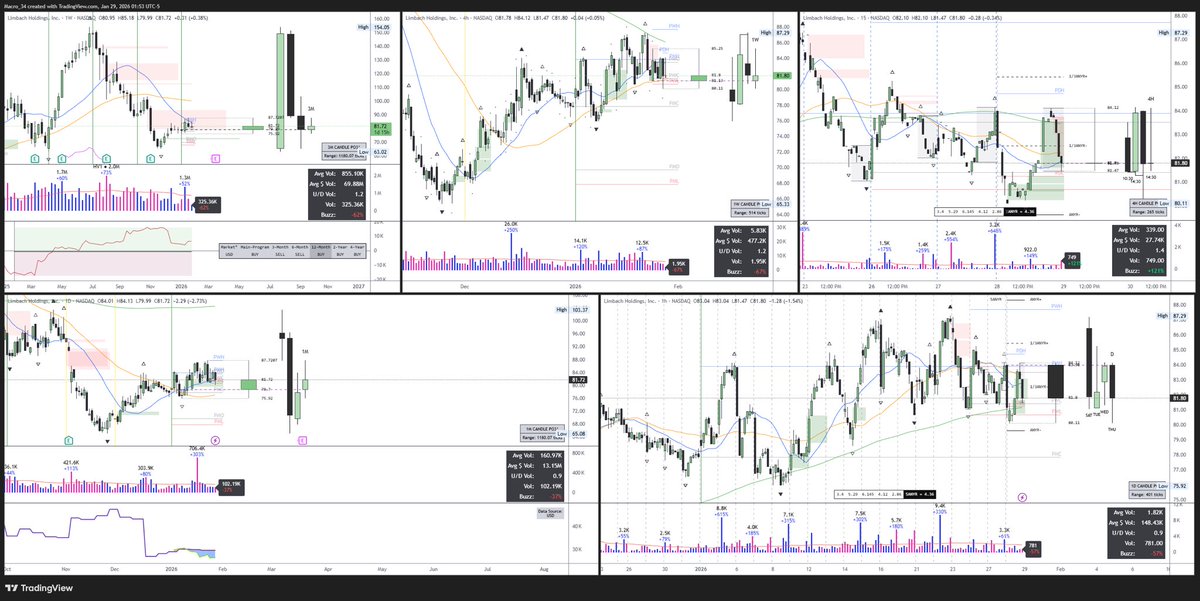
$LMB fits the macro better than most realize.
As capital rotates into industrials, infrastructure, and real-economy execution, Limbach sits where the spend actually lands: mechanical, electrical, and energy systems inside data centers, hospitals, defense facilities, and mission-critical buildings.
This isn’t speculative growth.
It’s backlog-driven, cash-flow-backed demand.
AI, defense, grid upgrades, and reshoring don’t just need chips or steel — they need installation, retrofitting, and systems integration. That’s where LMB operates.
When XLI, PAVE, and ITA start working, names like LMB quietly compound.
Not a headline trade.
A regime trade.
New Thesis – AOS
Most investors still view A. O. Smith as a housing cyclical.
I think that’s outdated.
AOS is driven by:
• Replacement demand
• Pricing power
• Energy-efficiency standards
• Electrification of heating & water systems
That creates earnings durability, not discretionary growth.
As AI, data centers, and industrial electrification increase heat + water intensity, demand becomes less cyclical and more infrastructure-like.
Margins hold.
Cash flows repeat.
Drawdowns compress.
This is how former “cyclicals” quietly become leaders.
Conclusion (Core Insight)
Copper is no longer a commodity. It is a strategic asset. It cannot be printed, recycled at scale, or substituted without sacrificing performance. As defense consumption, AI infrastructure, and geopolitical competition accelerate simultaneously, copper becomes the limiting reagent of global power.
The race isn’t just for technology or energy.
It’s for the metal that makes both possible.
Thesis: Copper as the Hidden Constraint in the Global Power Race
Executive Summary
Across defense, industrials, energy, and next-generation communications, a single physical constraint keeps reappearing: copper. What initially appeared as separate rotations—industrials (XLI), infrastructure (PAVE), defense (ITA), energy geopolitics (Venezuela), and strategic metals—are in fact expressions of the same underlying reality. Copper is no longer just an input; it is a non-recyclable, non-substitutable bottleneck in modern power projection. Whoever controls copper supply controls the speed, scale, and durability of military, AI, and communications dominance.
5. Why This Explains the Rotation
The convergence across:
•Industrials (XLI)
•Infrastructure (PAVE)
•Defense (ITA)
•Energy geopolitics
•Strategic metals
is not coincidence. It is capital repositioning around a physical scarcity problem. Markets are not chasing growth narratives; they are pricing constraints.
This chart dates back to 12/28/25 when I intended to post this here but for some reason it didn’t happen. Priced dropped a lot lower to form the bottom than I expected, but these past couple days of price action is adding more support to the overall thesis. Took an early options position on 12/30/25 and will be looking to add on to it.