I'll add to the Piketty dunking in one small way.
His plan is to plunder valuable assets from the USA and hand them to less productive regions until outcomes are equalized.
But, for the USA, he allots 0.115% annual growth (4590->5000/74 years).
I'm sure he's aware that those assets are valued, generally, by the net present value of future free cash flows. And that by capping growth so low destroys the value he hopes to steal. And that baking this error into his model invalidates all the math that follows.
It's difficult to steelman Piketty's arguments. By all indications, he's simply an anti-human zealot, neurotically and wrongly guilt-driven, with extinction as his goal.
This is coming from a famous economist, so it's probably worth clarifying that there's no economics in this report showing that their degrowth pathway is either an ideal or likely decarbonization path. It's an opinion they work backwards from.
Things this crime survey excludes but have gone up:
Shop lifting
Money laundering
Public order offences
Possession of illegal weapons
Immigration offences
Fly tipping
By Fraser's logic these are examples of immigration leading to a crime surge?
It's not just the exploitation of a tragedy.
JD Vance's picture of Britain - where migrants have led to a crime surge - is the opposite of the truth.
https://t.co/y5El5FUj7v
@cjsnowdon Fair. It's also saying you've underestimated Fever Tree EPR cost of £500,000. Apparently they've updated their estimate since the levy came in to force and the actual cost is 5x higher! I presume you used their estimate before the levy came to be
Well done, you mouth-breathing cretins. And well done to all the pricks on social media who have done nothing but race-bait over this tragedy. Shameful across the board.
As a psychologist, I’ll bet you £100 this is what happened with poor Henry Nowak. Cops suffer from empathy burn out. 90% of the time they deal with nothing but scum. It doesn’t make it right, but that cynicism will have come into play, here.
They get a 999 call saying, “A Sikh has been attacked.” They arrive at the scene, there’s a Sikh saying he’s been attacked and someone (Henry) acting strangely. The weapon has been hidden. They will have immediately thought ���drink or drugs’, and they see no obvious wounds. The murderer laid on exactly the scene the police would have expected to see, had the complaint been genuine.
These are pure human confirmation and anchoring biases at play: the cops saw what they expected to see from the info they had going into the situation. They were tricked. Humans make mistakes.
Where the cops royally fucked up was not following normal procedures when someone says they have been stabbed, and checking them all over including skin. They should lose their jobs over that negligence alone and for allowing their biases to override their training.
I guarantee you “I can’t breathe” inadvertently made things worse as that’s what every single scumbag says when they get arrested, since George Floyd.
This absolute tragedy is a sad combination of confirmation and anchoring biases, excessive cynicism, and a criminal failure to follow correct procedures, not to mention a lying, murdering piece of shit and his piece of shit family doing everything they could to confuse the police and muddy the waters. It has nothing to do with diversity.
Henry Nowak should not have died at all, but he would have died whatever the police did. However, in these circumstances he should have died with someone holding his hand, trying to save him, and telling him it would be ok, not in handcuffs being read his rights. The police officers who made this dreadful error should lose their jobs and will have to live with that for the rest of their days.
Final point: well done to the Hants Police detectives who shredded the murderer’s story and secured a conviction.
Unit Labour Costs in the UK have gone from some of the most competitive in the G7, to the worst since the introduction of the National Living Wage in 2016 (and amplified by employer NICs, and the recent ERA). Yet politicians trumpet it as one of their signature achievements. The overall package has made employing young people increasingly unattractive for employers.
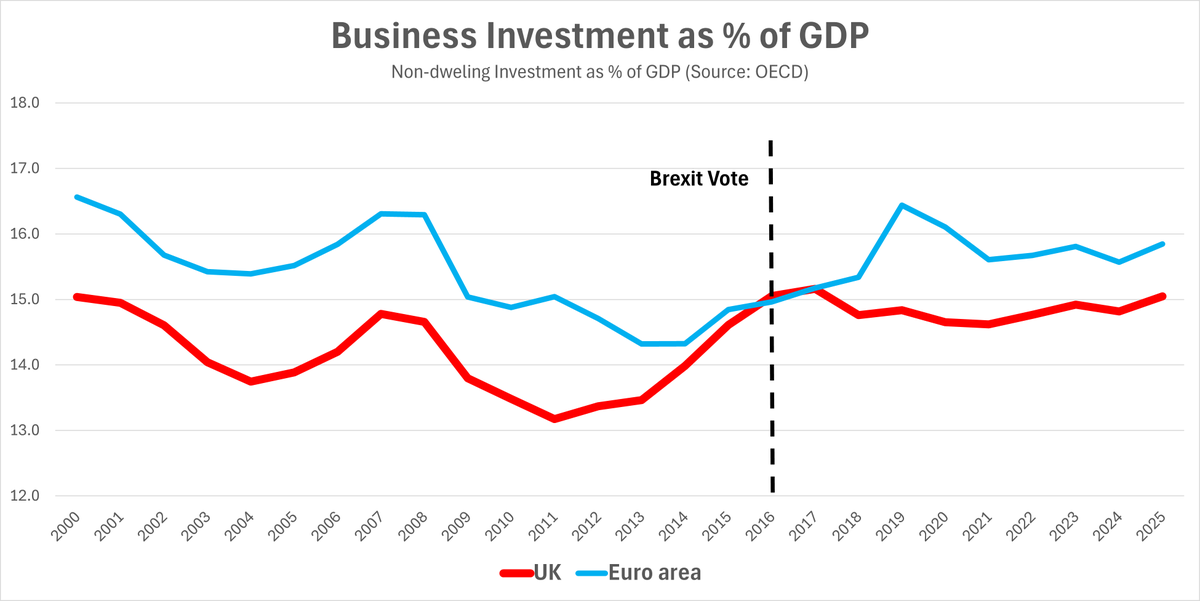
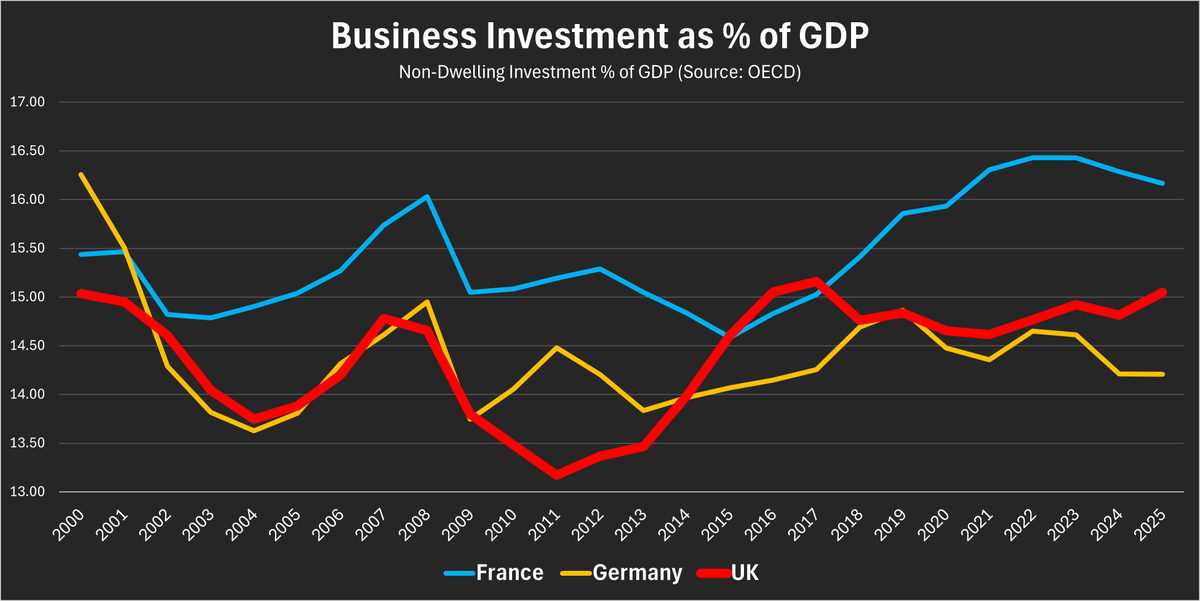
@NewLeftEViews You're cherry picking the data by only comparing us to the period after the GFC.
Zoom out and Britain's investment is now higher than the peak of the 2008 boom
@NewLeftEViews You're cherry picking the data by only comparing us to the period after the GFC.
Zoom out and Britain's investment is now higher than the peak of the 2008 boom
You say we never compare Britain to Netherlands, Denmark or Sweden. OK then...
Only Sweden has risen since 2016, UK is higher than Netherlands. There's no Brexit damage here.
OK let’s have a look at three ways this chart is trying to hide Brexit damage by manipulation.
First, if you take 2016 as your start year at 100 you start the clock at the shock itself, thereby obscuring the pre-existing trajectory. That’s how you hide the fact that business investment was growing at ~6%/yr before the vote and then stalled. It’s essential to the pro-Brexit argument to hide or deny strong pre-2016 growth.
Second, a favourite of those trying to hide Brexit damage is to pick weak comparators that the 🇬🇧 was traditionally stronger than. That’s why they are so keen to show🇫🇷🇩🇪, the latter with its specific energy and industrial shock. They never want to show you 🇬🇧 economy against trade and services-driven economies like 🇳🇱🇸🇪🇩🇰 which are better comparators in some ways. Against a proper 33-country synthetic control group 🇬🇧 business investment is 12-18% below where it would have been had we remained by 2025. The result is 🇬🇧 now has the lowest investment share of any G7 economy at 17.9% of GDP.
Third, the metric used here is another way to obscure Brexit damage. Gross Fixed Capital Formation combines business investment and government capital spending, which flattens and hides the private sector signal. A government infrastructure can lift the aggregate while business investment which is what actually reflects private sector confidence stays feeble. That’s exactly what happened in 🇬🇧: a study by economists at Stanford University, the Bank of England and the National Institute of Economic and Social Research found that by 2024, business investment in other advanced economies was up around 25% on 2016 levels. In 🇬🇧 it had risen by just 4%.