Great news!
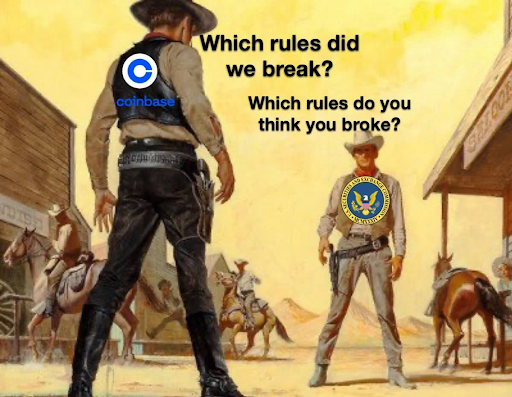
After years of litigation, millions of your taxpayer dollars spent, and irreparable harm done to the country, we reached an agreement with SEC staff to dismiss their litigation against Coinbase. Once approved by the Commission (which we're told to expect next week) this would be a full dismissal, with $0 in fines paid and zero changes to our business.
This is hugely vindicating, especially because many people questioned my decision to engage in litigation with the SEC on this matter in 2023. People told me the courts would give a lot of leeway to the government. They said public market investors wouldn't like it. They said it would take years and cost us tens of millions of dollars in legal fees (which it did). They said the agency would use mafia tactics like trying to pressure other companies not to work with us while the lawsuit was underway (which they did).
But I knew a few truths that helped make it an easy decision to fight them in court:
1. The SEC was wrong on the law.
They were exceeding the authority given to them by congress by asking us to delist a number of assets that were not securities. We had taken a conservative approach to ensure we weren't listing any securities, and the SEC itself had allowed us to go public in 2021 after reviewing our listing standards in depth. We tried to “come in and register” but it turned out it was a fake offer, as every crypto company discovered. Regulators are supposed to enforce the law, but they can't make up new laws on the spot if they don't like the current ones, or weaponize a lack of clarity in the law.
2. Caving to their demands could have killed the crypto industry in America.
The SEC made it clear to us that the only way to avoid litigation was to delist the many assets they falsely claimed were securities. It was a bullying tactic, pure and simple, driven by Gensler's own political agenda. And if we had caved, it would have dramatically limited the scope of which crypto assets were allowed in the US, and pushed the industry further offshore, into the shadows. Never forget how close a few activists in government came to unlawfully killing an entire industry in America! It could have easily gone the other way. Thank goodness the founding fathers created the judicial branch, as a check and balance on executive power.
3. It was the right thing to do for our customers and the industry.
At the end of the day, it didn't matter what our chance of success was. I had to stand up for our customers’ and our industry’s rights. I also knew it would serve as a deterrent for future bad actors around the world we may have to engage with, for them to know that we won't be bullied or pressured. We are comfortable engaging in litigation across multiple fronts, indefinitely, while continuing to build. This is business as usual. As Bain in The Dark Knight says, "you merely adopted the dark; I was born in it".
Growing up I had a naive view that regulators exist to hold companies accountable. What I realized in this ordeal is sometimes, companies must hold regulators accountable who are painting outside the bounds of the law, to preserve freedom. Accountability can actually happen both ways. At Coinbase, our mission is to increase economic freedom, and I initially thought we could achieve this solely through our crypto products. But I'm increasingly realizing that we can move the needle on economic freedom in the courts and through our policy efforts as well, when we see bad actors in government around the world. We plan to do more of this.
I have to give credit here to the Trump administration, for winning the election, and for the departure of the activist head of the SEC, Gary Gensler, who orchestrated this unlawful action along with Elizabeth Warren, and a handful of their lackeys in congress. I feel confident we would have won this case in the courts either way, given our facts were so strong, but it certainly helped accelerate the process and drive accountability. I called out the sketchy behavior of the SEC back in 2021, and I believe this comment turned out to be prescient.
I want to give a shout out to all the other crypto companies who fought back with their own lawsuits (we certainly were not the only ones).
I want to give a shout out to all the crypto startups who couldn't afford the legal fees, and went bankrupt due to the administration's abusive tactics. Your company may have died, but crypto lives on. Don't stop building.
I want to give a shout out to both Democrat and Republican members of congress, who are working hard to ensure America leads on crypto. I know that Gary Gensler and Elizabeth Warren do not represent the entire Democratic party.
And I want to give a shout out to all the crypto holders in the US who elected pro-crypto candidates, on both sides of the aisle, to make sure your rights were preserved. It turns out the crypto voter is real, and showed up in the millions.
Finally, I expect we'll continue working productively with the SEC on any number of items over the years, just as we do with every agency around the world where we operate. I look forward to the SEC being reformed under Paul Atkins, Mark Uyeda, Hester Peirce, and DOGE, and new more sensible personnel coming into leadership roles. I commend the new leadership that is already in place for working to right this wrong - it's a great step in the right direction, and took courage. Now let's get some crypto legislation passed in the US to finally clarify the rules, and really kick off this next phase of building.
Here’s a broad overview of the regulatory and institutional changes afoot in the crypto industry thanks to the Trump administration. Exciting progress….
https://t.co/3LQjrINHCF
We just provided some information for a nation state asking about Bitcoin ETFs.
Considering moving some exposure from foreign currency govt bonds into BTC.
Bitcoin is entering a new chapter —
How Libra Was Killed.
I never shared this publicly before, but since @pmarca opened the floodgates on @joerogan’s pod, it feels appropriate to shed more light on this.
As a reminder, Libra (then Diem) was an advanced, high-performance, payments-centric blockchain paired with a stablecoin that we built with my team at @Meta. It would’ve solved global payments at scale. Prior to announcing the project, we spent months briefing key regulators in DC and abroad. We then announced the project in June 2019 alongside 28 companies. Two weeks later, I was called to testify in front of both the Senate Banking Committee and the House Financial Services Committee, which was the starting point of two years of nonstop work and changes to appease lawmakers and regulators.
By spring of 2021 (yes they slow played us at every step), we had addressed every last possible regulatory concern across financial crime, money laundering, consumer protection, reserve management, buffers, and so much more, and we were ready to launch.
We had worked on a slow rollout of a limited pilot that some members of the Fed’s Board of Governors were supportive of. At last, Chair Jay Powell was ready to let us move forward in a limited way. The story, as I heard it, is that Jay Powell was told by Treasury Secretary Janet Yellen at one of their biweekly meetings that allowing this project to move forward was “political suicide,” and she would not have his back if he let it happen. I wasn’t in the room when this conversation happened, so take these words with a grain of salt, but effectively this was the moment Libra was killed.
Shortly thereafter, the Fed organized calls with all the participating banks, and the Fed’s general counsel read a prepared statement to each of them, saying: “We can’t stop you from moving forward and launching, but we are not comfortable with you doing so.” And just like that, it was over.
One essential point is worth making here. There was no legal or regulatory angle left for the government or regulators to kill the project. It was 100% a political kill—one that was executed through intimidation of captive banking institutions. That was the hardest part of this story for me personally. Not that we had failed, but that America, this country I immigrated to and became a proud citizen of because of its rule of law and value system, behaved in such a way for political reasons. It was a very tough pill to swallow.
The bright side of the story, though, was the many learnings from this wild ride. By the end of the project, we had made so many concessions to get a thumbs-up that the whole design of the network became a Frankenstein of our initial ambitions.
We also learned the biggest lesson of all, which is that if you’re trying to build an open money grid for the world—eventually moving trillions of dollars a day, designed to be here 100 years from now—you have to build it on the most neutral, decentralized, unassailable network and asset, which, hands down, is Bitcoin.
And now this is what many of us who went through this scarring journey are building together at @Lightspark. And this time, we won’t stop until we get it done!
We’re ready to call it.
Voters have elected a majority (218+) of pro-crypto candidates to the U.S. House of Representatives, even with many more seats still left to be called.
The next Congress will be the most pro-crypto ever. Follow along at: https://t.co/hdwLitcTDC
Immutable has received a Wells notice from the SEC, the latest in their de facto policy of regulation by enforcement. We received this within hours of our first ever conversation, on a timeline clearly accelerated to land before an election.
Sadly, stories like this are becoming less surprising each time. We’ve seen an increasing number of companies like @Coinbase, @Consensys, @Uniswap, @OpenSea, @cryptocom face SEC escalations, many in the last two months. With this latest move against Immutable, the SEC’s overreach continues and expands into gaming.
Immutable is well capitalized with a large war-chest to build for the future of gaming, and if needed, we will stand up and fight to defend digital ownership for gamers. But the SEC’s approach hinders every startup trying to innovate in an already difficult industry. Read our full statement here: https://t.co/PUD1Ef3CdK
Under the current administration, the SEC has filed (and lost) a string of lawsuits, seeking to regulate crypto via enforcement rather than policy.
Last year, Ripple won a “landmark victory” where Judge Torres found that XRP was not a security. After publicly stating Ethereum was a commodity, the SEC secretly opened an investigation into ETH. They shut this investigation down after Consensys sued them to defend Ethereum’s ecosystem in June of this year. Last year, Grayscale sued the SEC to open the floodgates for institutional adoption of crypto. They won, with the court finding the SEC’s denial of Grayscale’s proposal "arbitrary and capricious.” In recent weeks we’ve seen the SEC’s overreach continue to expand with the livelihoods and freedoms of musicians, artists and other content creators now under threat in light of the SEC’s move against NFT platform OpenSea.
The industry desperately wants clear guidelines for compliance, and instead companies are forced to spend millions of dollars in legal fees to even get off the ground. At the end of the day, this hinders the many companies in crypto trying to build real products.
Immutable has been building since 2018 to bring digital ownership to the $110B+ of in-game items sold each year - we are not here to play short-term games. It’s business as usual for our team, products and services. We are confident in our position, in the value digital ownership can bring to 3.1 billion gamers across the world, and in the power of blockchain to create a better internet. If required, we will fight for these rights, and those of our industry, vigorously.
In the words of dissenting commissioner Hester Peirce: “Leaving crypto to be addressed in an endless series of misguided and overreaching cases has been and continues to be a consequential mistake”.
Until that changes, we will fight for game developers, players, and creators for digital ownership.
And we will keep building.
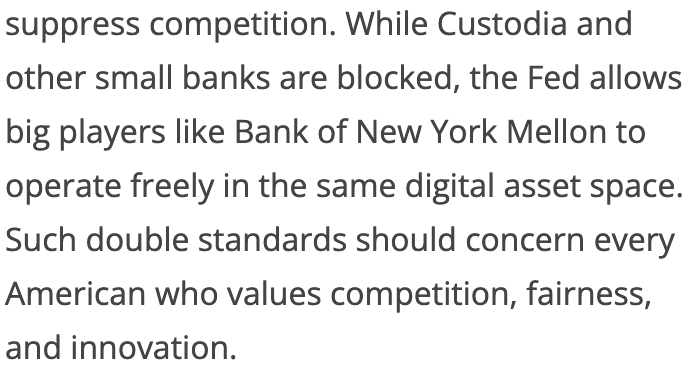
THANK YOU for speaking out, Rep. Daniel Singh.🙏 WONDERFUL op-ed abt protecting financial sovereignty & defending freedom against the @federalreserve's attack on #Wyoming. "Custodia’s fight is about more than one bank; it’s a fight for fairness & autonomy"
https://t.co/6JMhJfjjf0
This is a brazen example of the SEC’s use of lawfare to chill innovation.
Under the guise of investor protection, dubious legal theories are being used to curtail use of NFT platforms and scare artists and creators away from the space.
What’s going on here 🧵
BREAKING: Democrat politicians have written a letter to the DNC, asking the party to pivot away from the anti-bitcoin policies of Elizabeth Warren.
This is likely in response to polling data, the GOP pro-bitcoin policies, and President Trump speaking at @TheBitcoinConf
Hester Peirce would be excellent for SEC Chair, because she isn’t a Bitcoin maxi—she’s a Rule of Law maxi. Read her dissenting opinions on the SEC web site. Every one is well-written, substantive, and about how the SEC can do a better job.
https://t.co/5lM508SmgY ⤵️