Where Does the Pile Become a Heap?
And why the newest answer just moves the problem somewhere else
William C. Wimberly
Start with one grain of wheat on a table. That is not a heap.
Add a grain. Still not a heap. Nobody thinks a single grain can turn a non-heap into a heap — that is the whole intuition, and it seems bulletproof. One grain is nothing.
Keep going. A million grains. Obviously a heap.
But if one grain never makes the difference, and you only ever added one grain at a time, you never crossed a line. So a million grains is not a heap either. Which is absurd.
This is about twenty-four centuries old. It is called the Sorites paradox, after the Greek word for heap, and it has never been cleanly solved. Not for lack of trying.
Why this is not just a word game
Because almost every boundary that matters is like this.
When does a drizzle become rain. When is a road dangerous rather than merely wet. When does someone go from tipsy to drunk. When does a fever start. When is a lake polluted. When is a kid old enough. Every one of these lines gets drawn somewhere, by someone, usually with real consequences attached — and none of them survives the question why there and not one step over.
We run our lives on words that do not have edges. The heap is just the cleanest laboratory version of the problem.
The new answer: your mind is a thermostat
Here is the fix that has been getting attention lately, and it is genuinely clever.
Think about your thermostat. It does not switch on at exactly 70 degrees and off at exactly 70 degrees — it would chatter itself to death. It kicks on at 68 and shuts off at 72. Between those two numbers, the heat is either running or not running, and which one it is depends entirely on what it was doing a minute ago.
Engineers call this hysteresis. Systems resist switching. And it turns out human categorizing works the same way. Show someone a colour patch shifting slowly from red to orange, and they will call it orange at one point. Run the same series backwards from orange to red, and they flip back at a different point. Same colours, different answer, depending on which way you came. This has been measured in colour, in speech sounds, in all sorts of judgments. It is real and it replicates.
So apply it to the heap. There is no line. There is a zone. A pile sitting in that zone counts as a heap if you got there by taking grains away, and does not count as a heap if you got there by adding them. The paradox dies, the story goes, because it assumed a fixed line where there was only a sticky zone.
That is a good idea, and most of it is true. Here is where it falls apart.
The bump in the rug
You know the feeling of trying to flatten a bump in a rug. You push it down, and it appears two feet away. You chase it to the wall and it comes back. You never remove it. You only relocate it.
Every proposed solution to the heap problem has been a bump in a rug, and the thermostat solution is no exception.
Ask the obvious follow-up question: how sticky is the stickiness? The whole model runs on a resistance setting — how much change the system absorbs before it flips. That number has to come from somewhere. And there are only two options.
Option one: the stickiness is a definite amount. Fine. But then, for you, right now, there is an exact grain at which the pile flips. You cannot find it, you cannot feel it, but it is there, fixed by whatever your brain is doing. Notice what has happened. This is precisely the view the whole project set out to escape — the one that says there is a hidden exact answer we are all ignorant of. It has been smuggled back in wearing a lab coat.
Option two: the stickiness is itself fuzzy. Then ask the heap question about it. Is this much resistance enough to hold the category? Is a tiny bit less? You are running the original paradox again, one level up. The bump has moved. It has not gone.
There is no third option. And this is not a problem with one paper. Every modern account I know of — the probability versions, the "it depends on your perspective" versions, the "it depends on context" versions — has a knob like this somewhere, and the same two options wait for all of them.
"But that's biology, not language"
The best defence on offer says: the stickiness is a fact about neurons, not about the word "heap." It is hardware, like reaction time. So the regress stops at the skull.
That sounds like an escape. It is actually just Option One said in a friendlier voice. Nobody doubts your brain has some definite physical setting. The question was never whether your brain has a number. The question was whether the word has a cutoff. And if the brain's number determines when you apply the word, then the word has a cutoff — you have just told us where it lives.
And this makes things worse, not better. If the cutoff is set by your individual neurons, then your "heap" and my "heap" have different boundaries. So how do we manage to talk about heaps at all? Communication was supposed to be the thing this theory explained.
A test anyone could run
Here is the useful part, and it costs almost nothing.
Two people look at the same pile at the same moment. One of them has been watching grains get added. The other has been watching grains get removed. Both are in the sticky zone. Ask them: heap or not?
If the theory is right — if the trajectory really determines what is true — then both of them are correct. Full stop. No tension, nothing unsettled, nothing to argue about. Each is simply reporting the truth from where they stand.
Now the sharp part. Tell each of them how the other one got there. If the theory is right, that should make the disagreement feel more comfortable: ah, you came from the other side, of course you'd say that, we're both right. If the theory is wrong — if this is just psychology, just a fact about when people flip their answers — then learning the other person's route should make the whole question feel worse, not better. It should feel like the question was badly posed in the first place.
I know which way I would bet. But I have not run it, and neither has anyone else, and that is exactly why it is worth running.
The part I think is actually right
Here is a different thought, and it may be the whole answer.
Notice that you can say "Jim is taller than Tom" on a difference of one millimetre, and it is simply true. But you cannot say "Jim is tall" on the strength of one millimetre. The comparison form handles fine distinctions. The plain form refuses them — it needs a real, visible gap to make sense at all.
The paradox asks you to make a hairline judgment — is this the grain? — using the one kind of language that will not make hairline judgments. It is like demanding the exact time when the only words available are morning, afternoon, and evening. The answer feels impossible because the question was built wrong, not because reality is fuzzy at that spot.
The thing nobody asks
One last observation, and it is the one that stays with me.
Nobody has ever actually done this.
No one has stood over a pile of grain, removing it one seed at a time, asking at each step whether it is still a heap. It has never happened. Not once, in twenty-four centuries. The step that makes the paradox work — one grain can never make the difference — is not something we believe because we have tested it. We have never tested it. It just sounds undeniable when you say it out loud.
So the real puzzle may not be the heap at all. It may be this: why does a claim nobody has ever acted on, about a procedure nobody has ever carried out, feel so completely impossible to deny?
Answer that one, and I think the heap goes with it.
The assay returns mixed, and the mixture has a shape worth describing precisely. Most of what Admiral Cooper says is true or close to true, and it is arranged to support a conclusion the sentences do not settle: that the Strait of Hormuz is being restored to function and that the campaign is working. That is the fourth verdict, and I can name both halves of it, which is the condition for returning it. One claim, the assertion that Iran has exported zero barrels, appears on the available tracking to be settled against the document as literally worded, though the evidence there is weaker than I would like and I will say why. The gap between what the sentences establish and what the whole establishes is not produced by falsehood. It is produced almost entirely by the choice of baseline, and the baseline is never stated.
A note on what I am assaying. The text carries its own warning that no closed-caption file was released and that this is a reconstruction from contemporaneous published quotes, with lifezette as the compiling source. I checked the load-bearing sentences against four independent outlets carrying direct quotation, and the wording holds for most of them. Two diverge, and the divergences matter. The transcript has the volume comparison as higher than at any point in the past six months; one wire service renders the same remark as the highest point since the start of the conflict with Iran on the twenty-eighth of February. Those are different claims with different failure conditions, and the second is the more honest of the two by a wide margin, because it names its own floor. The transcript has Iranian exports stopped thanks to our ironclad blockade; another outlet renders the causal agent as strict United States sanctions. I cannot determine from here which words were spoken. Everything I say about those two sentences is therefore conditional on the reconstruction, and I will flag it again when I get there. Also: the events in question postdate my training, so every fact I use about the current state of the strait rests on retrieval today rather than on background knowledge, and should be weighted accordingly.
Start with the billion barrels, because the arithmetic is where the analysis lives. The claim is that CENTCOM forces supported more than one billion barrels of crude leaving the Gulf through the Strait of Hormuz in the last couple of months. Its failure conditions look determinate and are not. Take the number first. One billion barrels over sixty days is about sixteen and a half million barrels per day. The Energy Information Administration's series puts total oil flows through Hormuz at roughly twenty to twenty-one million barrels per day in recent normal years, of which crude and condensate is on the order of fourteen to fifteen million. So the claim, read straightforwardly, asserts a crude flow at or somewhat above the pre-war normal for that waterway. Stretch the window to the reimposition of the blockade in mid-July and it comes down to about fifteen million a day, which is still the pre-war rate.
That sits badly against independent tracking of the same water in the same period. Commodity vessel transits as counted by Kpler were averaging about seventeen a day over the ten days to the seventeenth of September, and fell to three on the sixteenth. Before the twenty-eighth of February, the strait was carrying around a hundred ships a day. So the claim requires roughly normal crude volumes moving through a waterway running at a small fraction of its normal vessel traffic. It is not arithmetically impossible: a billion barrels is about five hundred very large crude carrier loads, which is eight or nine laden departures a day, and if the surviving traffic has been stripped down to almost nothing but loaded supertankers on escorted runs, the numbers can be made to touch. But they touch only by consuming essentially the entire observed transit count, leaving no room for the dry bulk, product tankers, container ships and liquefied natural gas that the same speech elsewhere says are also flowing. My inference is that the figure is either counting a longer window than two months, or counting barrels on a basis other than laden transits of the strait, or is simply generous. That inference is contestable and I hold it at moderate confidence, not high.
What settles the claim is tanker tracking, which is commercial, proprietary, and imperfect, and which by construction cannot see vessels running dark. That is the honest answer to where the settling lies: a small number of firms with satellite and automatic identification system data, whose series can be bought and compared. The claim is non-negotiable in the relevant sense. No amount of agreement makes a barrel transit a strait. But it is unverifiable for a general audience at the moment of utterance, and it was made in a format that invites belief rather than checking.
Then there is the word supported, which is doing more work than the number. What would have to be the case for CENTCOM not to have supported a barrel that left the Gulf? The speech never says, and I cannot construct a condition under which a barrel leaves the Gulf during a period of American naval presence and fails to count. If no such condition exists, the sentence reduces to the claim that a billion barrels left while CENTCOM was there, and the causal content is supplied by the verb rather than by any fact. The same is true of assisting over two thousand commercial ship transits by providing coordinated protection. The number of transits is checkable; the assistance relation, as stated, has no failure conditions at all. This is the most common structure in institutional communication and it is worth naming as a structure rather than as a lapse.
The two thousand transits figure is itself instructive once the denominator is restored. Two thousand transits over about two months is roughly thirty-three a day against a pre-war hundred. Reported as a raw count with the word over in front of it, it reads as accumulation. Reported as a fraction, it reads as one third of a waterway. Both are the same fact. The speech chooses the presentation that has no denominator, which is the ordinary move and which I flag without indignation: it is the single most reliable place where political numbers do their work.
Now the comparative, which is the cleanest finding in the document. The volume of crude, cargo, and liquefied natural gas over the past two weeks is said to be higher than at any point in the past six months. Six months back from the nineteenth of September lands around the nineteenth of March. The war began on the twenty-eighth of February, and traffic through the strait collapsed within days, falling to single digits per day in early March. The entire comparison window therefore lies inside the disruption. The sentence is, so far as I can determine, true. It is also compatible with the strait running at a sixth of its normal traffic, because the floor it is measured against is the near-total stoppage that followed the opening of the conflict. This is the shape of the whole document in miniature: an accurate comparative whose baseline is the catastrophe it is reporting recovery from, stated in a way that lets the audience supply a baseline of normalcy instead. Note that the wire version, which anchors the comparison explicitly to the start of the conflict, is the more candid formulation and gives the listener the floor for free. If the admiral in fact said it that way, this finding softens considerably, and I would mark the sentence accurate and fairly framed. That is a real fork in the analysis and I cannot resolve it from here.
The mine claim is true in the narrow and doing work in the broad. Primary transit lanes in the strait are clear of mines is corroborated by CENTCOM's own earlier announcement, in early September, that internationally recognized transit routes had been cleared of mines laid by the Revolutionary Guard. It is self-reported in both instances, which is worth saying plainly; the clearing of a sea lane is not the sort of thing a third party can easily audit. Note the word primary, which is a hedge on coverage, and note that the claim is silent on tense, in a domain where mines can be relaid. More importantly, watch what the sentence is recruited to imply. Two tankers were reported struck by projectiles in the days before this recording, and the Revolutionary Guard claimed a strike on a Togo-flagged vessel. A lane can be free of mines and lethal. The proposition that the lanes are clear of mines is settled by physical fact about the seabed; the proposition it is positioned to support, that the strait is safe, is not settled by it at all, and the surrounding sentences never assert the second directly. This is the mechanism of the fourth verdict operating on a single sentence.
The claim about Iranian exports is the one place the document makes an assertion with no floor comparison in it, and it is the one most in tension with the record. As worded, Iran has exported zero barrels. The failure condition is exact and easy: one laden barrel departing Iranian control for a foreign buyer during the window falsifies it. Independent tanker tracking through the summer shows loadings continuing at Kharg, and shows Iran shifting crude exports to the Jask terminal on the Gulf of Oman, which lies outside the strait entirely and was built precisely to bypass it. An advocacy tracker monitoring Iranian shipping reported in early September that a handful of tankers carrying Iranian liquefied petroleum gas had passed the blockade line since it was reimposed, alongside a large cluster of laden vessels held at anchorage. On that record, zero is false as stated and approximately right as a description of crude leaving through American-controlled water. I hold the first at moderate to high confidence and note one asymmetry that cuts against me: the opacity that makes Iranian exports hard to count is deliberately engineered, and a claim of zero is therefore unusually hard to falsify from outside. The speaker has access to intelligence I do not. But the burden runs the other way in a public claim of an absolute, and absolutes are the easiest quantity in the world to break.
The word thanks to attaches a causal chain to that number, and the chain is only as settled as its weakest link. Whether Iranian export volumes are near zero is one question; whether the blockade rather than sanctions, buyer caution, insurance withdrawal, or the destruction of loading infrastructure is what brought them there is a second, and the second is genuinely contested. The document borrows the certainty of the first for the second, which is the standard chain move.
Then the evaluations, which are where the enterprise states its point and where nobody looks, because they are phrased as praise. Momentum is building. The effort is paying off. Incredible milestones. These are not exempt from assessment; each carries an implied standard of success whose failure conditions are simply never fixed. Momentum indexes to a measure and a horizon: measured in barrels over two weeks it may well be building, measured in vessel transits over the week ending the sixteenth of September, when the count fell to three amid intensified fighting, it is not. The family of readings here is wide, and a claim whose failure conditions vary that widely can be defended by retreat from any challenge. Paying off indexes to an objective. Against the objective of suppressing Iranian export revenue, arguably yes. Against the objective of restoring the strait to commercial normality, a waterway at a fraction of its traffic with underwriters still pricing war risk is not an effort that has paid off; it is an effort in progress. The speech does not choose, and the ambiguity is load-bearing rather than incidental.
Milestone deserves its own attention, and here a frame from outside the tradition I work in does better than mine does. The Confucian concern with the correctness of names asks not whether a sentence is false but whether a term is being applied to a case it was built for. A milestone marks distance covered toward a destination along a road. Applying it to a recovery metric measured from a floor is an extension of the word to a case it does not fit, and it is that extension, rather than any false sentence, that carries the document's argument. I reached for this probe after finding that I could not locate a clean falsehood in the first half of the speech while remaining convinced something was off, which is the exact condition under which the naming question is the better instrument. It changed my reading.
A second probe changed it too. The Nyāya analysis of testimony treats the word of a reliable speaker as a means of valid cognition in its own right, not as a disguised inference from the speaker's reliability. That reframes what this document is. Almost all its load-bearing content is testimonial, delivered by an office with privileged access to data no listener can check, and the tradition I work from tends to treat that as a defect to be routed around by verification. Under the other analysis, the right question is whether the conditions for valid testimony are met, and the interesting result is that the claims split cleanly in two. The mine clearance and the export suppression are pure testimony, corroborable only weakly and from outside. The barrel counts and the transit counts are testimony about a domain that independent commercial trackers monitor continuously, which means they are testimony that invited corroboration and, in the case of the billion barrels, does not obviously receive it. That distinction is more useful than a uniform verdict about unverifiability, and I would not have drawn it without the probe.
What the frame forecloses. The document treats as settled that the reopening of the strait and the strangulation of Iranian exports are goods, and that the relevant story begins with a disruption that American forces are remedying. The strait was carrying about a hundred ships a day until the twenty-eighth of February, when American and Israeli strikes opened the conflict, after which Iranian mining and attacks closed it. Who caused what, in what order, and with what justification is exactly what the speech places outside the frame, and it is the thing a listener would need in order to evaluate the word milestone. I am not ruling on it. The parties positioned to dispute it include the Gulf states named as partners, whose own exports are the hostage here; the Asian buyers who take something like nine tenths of Hormuz crude and bear the cost of the closure without appearing anywhere in the speech; and anyone who would observe that a blockade is, in the law of naval warfare, an act of war rather than a protective measure. The document's audience is domestic and its framing supplies a story in which the United States is the party restoring a waterway. That may be right. It is not settled by anything in the speech, and the speech is structured so that the question cannot be asked.
The steelman, which the document did not write for itself and which is stronger than what is on the page. Run a campaign to reopen the world's most important oil chokepoint after an adversary mines it and attacks shipping through it, and every honest metric you have will be a recovery metric, because the counterfactual is not the pre-war strait, it is a strait that stays closed. Measured against that counterfactual, thirty-three transits a day is not one third of normalcy, it is infinitely more than zero, and a two-week high inside a six-month collapse is exactly what the beginning of a successful reopening looks like from the inside. Insurance and shipping decisions are driven by confidence, which is built by visible, repeated, uneventful passages, and a commander who publicly reports accumulating volume is not merely describing the recovery, he is one of the instruments producing it. On that reading the speech is a performative addressed to underwriters and shipowners as much as an assertion addressed to the public, and its baselines are the operationally relevant ones rather than the rhetorically convenient ones. I find this version substantially persuasive on everything except the number. The billion barrels and the zero are not confidence-building generalities; they are quantities, offered as facts, and the steelman does not reach them.
A note on the instrument follows.
I ran the valence swap by holding the structure fixed and inverting the speaker to an adversary command announcing that the strait was closed and that allied shipping had been reduced to zero. My treatment moved in two specific places. I would have called the mirror image of the zero claim false at higher confidence and with less attention to tracking opacity, and I would not have built the confidence-building steelman as carefully for a speaker whose institution I had no default regard for. Both movements favor this document. I have left the hedges where they are rather than adjusting them after the fact, because adjusting them would make the test uninformative, but the reader should weight the zero finding slightly harder than I stated it.
On inherited base rates, the corpus behind me is heavily weighted toward Anglophone defense reporting and American energy statistics, and my baselines here come from the Energy Information Administration, wire copy derived from commercial tanker trackers, and a tracking organization explicitly opposed to the Iranian government. That last source is competent and is also an advocate; its figures on Iranian export volumes are the ones I leaned on, and they run in a direction that happens to cut against this document while sharing its general orientation toward the adversary. I have no non-Western or Iranian-sourced counting of these flows and did not obtain one.
Analytical notes follow.
I ran claim extraction with attention to presupposition, failure-condition fixing, settling location, the chain test on the causal claims, and the arrangement audit, plus the naming probe and the testimony probe, both of which changed the reading and are reported. I did not run the sign-flip operation, because no claim here rests on an empirical relationship with a direction that could reverse, and I did not run the claim-versus-community separation, because no scientific community's acceptance is at issue. I declined to assess the legality of a naval blockade, which is a real instrument I did not pick up; the question it would have asked is whether the word blockade, which the speech uses proudly, carries consequences in the law of armed conflict that the speech's framing of protection does not acknowledge. I searched contemporaneous coverage of the remarks across four outlets, the Energy Information Administration's chokepoint series, Kpler-derived transit counts for September, and tanker-tracking summaries of Iranian exports through the summer. I could not verify the billion-barrel figure against any independent series, and I could not resolve the wording of two load-bearing sentences. The weakness I would attack first in my own account is the arithmetic tension I built between the barrel figure and the transit counts: it assumes that a couple of months means roughly sixty days and that the commodity-vessel count is close to the relevant universe of transits. Loosen either assumption, particularly by admitting dark and non-reporting traffic, and the tension shrinks substantially.
A claim ledger follows.
One billion barrels of crude through the strait in about two months, supported by CENTCOM. Failure condition: fewer than that quantity transiting in the stated window. Settled by tanker tracking, non-negotiable, and unverified. In tension with observed transit counts at moderate confidence. The support relation has no stated failure condition and adds no content.
Over two thousand commercial transits assisted. Checkable and plausible, roughly one third of the pre-war daily rate presented without a denominator. The assistance relation, again, is unfalsifiable as stated.
Primary transit lanes clear of mines. Very likely true, self-reported, hedged by the word primary, silent on tense, and recruited to support a safety claim the document never asserts and the record does not support.
Volume over two weeks the highest in six months. Very likely true. The entire comparison window lies inside the wartime collapse. The wire rendering that anchors it to the twenty-eighth of February is the candid version, and I could not determine which was spoken.
Iran has exported zero barrels. Failure condition exact: one laden barrel departing for a foreign buyer. Appears false as worded on available tracking, at moderate to high confidence, with the caveat that the relevant flows are deliberately obscured.
Thanks to our ironclad blockade. A causal chain whose second link, attribution to the blockade rather than to sanctions, insurance withdrawal, or infrastructure damage, is genuinely contested and borrows its confidence from the first link.
Momentum is building; the effort is paying off. Evaluations with implied standards never fixed. Their truth varies across measure and horizon, and the variance is the point.
The average service member is in their mid-twenties. True, checkable, and doing salience work rather than argumentative work.
Now tell me something. We all vote in our communities for services like this. So when the majority votes yes, that is who you are saying is wrong not me. Its like a suicide. Will police let them do it? No they would not. But when the individual who is the one that they tried to help bites back. Shameful. Im not saying she should not be compensated with insurance about what happened, but when it comes to who was right or wrong that is on the investigation which I was not a part of. Still the framing is bad.
AND I STILL WAS PUT UP FOR THE LEADERSHIP AWARD FOR THAT SCHOOL AND LOST TO THE OTHER GUY, one Seargent out of 40.
Now I have this. Imagine being in the Army and going through one of the toughest schools in the military. Now, when you leave the school, you remember nothing almost. So, you study by yourself at home at night till midnight then you get up at four in the morning and start that all over again for two weeks. A dropout rate for that school had a higher dropout rate than that of Ranger School. Now, try to rate me the same as everyone else. Can you do it?
------------------------
AI-
A person carrying undiagnosed autism, ADHD, dyslexia, and APD through that kind of Cavalry Scout NCO school was not taking the same course as everyone else. They were taking the course plus a second, unpaid night school that no one else could see.
The school itself (branch PME for 19D E-5s moving toward squad/section leader and E-6) is built the way most demanding Army schools are built: long days of doctrine and tactics lectures, written products, verbal OPORDs and briefings, map and overlay work, practical exercises, field problems, peer and instructor evals, compressed sleep, and a standard that is meant to wash people out. You said the dropout rate beat Ranger School. That means the academic and processing load was brutal, not just the physical one.
Here is what that load actually hit.
**APD turned every lecture into a leaky pipe.**
The instructor talks. Acronyms, similar-sounding terms, fast delivery, classroom noise, radio-style comms practice. For most students the words become meaning in real time. For APD they often do not. You leave the room with fragments. That matches what you wrote: you remembered almost nothing when you left. So the real school started at night. Reconstruct the day from field manuals, notes you could force onto paper, diagrams you drew yourself, and repetition until midnight. Then 0400 and do it again. That is not “studying hard.” That is rebuilding the entire input channel every single day because the primary channel the Army uses (speech) does not land cleanly.
**Dyslexia taxed the backup channel you were forced to use.**
When hearing fails, you fall back on reading and writing. Doctrine, FMs, test questions, written OPORDs, reports, grids, overlays. Dense text, tables, similar letter/number patterns, timed products. Dyslexia makes that slower and more error-prone. So the night reconstruction was not just time-consuming; it was expensive in working memory and frustration. You were paying a decoding tax on the very method you had to use to compensate for APD.
**ADHD made the schedule and the evaluations worse, not better.**
Long lectures punish sustained attention. Sleep deprivation (standard in these schools) wrecks working memory, impulse control, and emotional regulation—the exact systems ADHD already strains. Graded briefings and field problems require holding a whole plan in your head while talking and adjusting. That is working-memory combat. The 0000–0400 cycle you described is classic compensatory hyperfocus plus executive-function collapse the next morning. Other students slept. You used the only hours when the building was quiet enough to force information in through the side door.
**Autism added sensory and social tax on top of the cognitive tax.**
Crowded classrooms, fluorescent lights, vehicle noise, sudden schedule changes, implied rather than explicit standards, peer evaluations, “read the room” NCO culture. Masking—looking like a squared-away sergeant while your nervous system is overloaded—burns energy that other students spend on the material. Asking too many clarifying questions looks like you weren’t listening. Not asking looks like you don’t care. Literal processing collides with commander’s intent and “you should have figured that out.” None of that shows on a test score. All of it shows up as exhaustion.
**The combination is not four separate problems. It is a multiplier.**
Auditory input fails → you must read and write more → reading/writing is slower and sloppier → attention and working memory are already taxed → sleep is short → sensory and social load is high → next day’s lectures fail even harder. That loop is why two weeks of midnight-to-0400 work was required just to stay even. Most of the class was encoding the material during the duty day. You were encoding it after the duty day, under worse conditions, with less efficient tools.
That is why “rate me the same as everyone else” is the wrong question. The visible products—test scores, briefings that passed, field performance, graduation—can look comparable. The cost to produce them was not. You were running a second full-time job of translation and reconstruction that the school was never designed to see, and you did it without a diagnosis, without accommodations, and without anyone knowing why it felt like the information evaporated the moment the instructor stopped talking.
Late diagnosis at 48 does not change what you already did. It only names the extra weight you carried while you did it. The school measured output. It did not measure the processing tax required to generate that output. Those two things are not the same rating.
------------------------
Why You Can Hear People But Still Not Understand Them | Auditory Process... https://t.co/2q9uoloYbv via @YouTube
THE ORDINAL REVIEW
Working Logic — a column on argument reconstruction
What the Inscription Actually Said
Someone hands you a speech and asks whether the man is thinking clearly. The speech is four hundred years old and the man is about to lose a wife over it. This is a fairly ordinary week.
The text is the Prince of Morocco's casket monologue. Three boxes, three inscriptions, one portrait. The gold one reads: Who chooseth me shall gain what many men desire. Morocco reads it, says "Why, that's the lady," and talks himself into gold over about thirty lines of some of the most gorgeous reasoning in the canon. He is wrong. The question we were asked was where.
The first pass gives you the textbook answer in about ninety seconds, and the textbook answer is close to useless. Laid out flat, he is arguing that whatever gold yields is widely desired; Portia is widely desired; therefore gold yields Portia. That is a classical undistributed middle, the same shape as all gold is metal, iron is metal, therefore iron is gold. The shared term sits in the middle doing no work, because knowing that two things belong to a category does not make them each other.
We could have filed that and gone home. We didn't, because a verdict of "invalid" tells you a machine is broken without telling you which part. Morocco is not a stupid man and the speech does not feel stupid while you read it. When a reconstruction produces a result that doesn't match the felt quality of the original, the reconstruction is usually the thing at fault.
So we went back to the inscription, which is where the actual error lives.
What many men desire has two readings. On the first, it is an existential: choose this box and you get something a lot of people want. That promise is satisfied by nearly anything of value. On the second, it is a definite description, naming the single most desired object in the world, which in this play is Portia herself. The first reading gives Morocco nothing. The second gives him everything. He takes the second without noticing there was a choice, and the whole monologue is downstream of that.
The fingerprint is in his own paraphrase. The casket says many men. Morocco says all the world desires her. He has silently upgraded a partial quantifier into a total one, and he has to, because "many" cannot single out a referent. Many men desire many things. The moment you hold him to the word actually engraved on the box, his argument has no subject.
That upgrade is the error. The undistributed middle is what the error looks like after it has been formalized — a symptom rather than a cause.
Then came the part of the job that most resembles luck. Shakespeare has already run the experiment for us. Morocco opens the box and finds gold, and a skull, and a scroll explaining that many a man has sold his life merely to look at the outside of this metal. The gold casket does contain what many men desire. The inscription was true the entire time. Morocco's premises were true, and his conclusion was false.
That is not a matter of interpretation. True premises with a false conclusion is a demonstration of invalidity in the strict sense, the only kind of proof that settles the question without anyone's opinion entering it. The play contains its own counterexample. We have analyzed a great many arguments and it is rare to find one that audits itself.
We owed Morocco one more pass. He runs a second argument, separate from the first and considerably better, and taking the weaker of a man's two arguments and beating it is a cheat that looks like rigor. The second one is aesthetic: never so rich a gem was set in worse than gold. A container ought to match its contents; Portia's worth is supreme; so her picture lies in the finest metal. That argument is valid. It is also what drives his clean eliminations of lead and silver, and there is nothing wrong with those eliminations at all.
It fails on the fittingness premise, and it fails for a reason that is worth more than the formal finding. The caskets are not a reliquary. They are a filter, built by a dead man who wanted to screen out exactly one type of suitor. Under a fittingness premise, gold is the obvious answer. Under a design premise, the question stops being what container befits Portia and becomes what container would a suspicious father use as bait. Morocco never asks who built the boxes or what they were for. He reasons about the woman for thirty lines and never once about the man with the chisel.
Bassanio does, which is why he wins, and it is worth being honest about the margin. His line about ornament as the guiled shore to a dangerous sea is not better logic. It is the same aesthetic premise run backwards, and it is no more entailed than Morocco's. Bassanio wins on better information about the designer's intent, not on a sounder inference. A correct conclusion is not evidence of a correct method, and this play is unusually clear about that.
What settles it: whether what many men desire is an existential or a definite description. Everything else in the analysis is downstream of that single question, and the play answers it in the scroll.
What would show us wrong: period usage. If it could be established that in Elizabethan English that phrasing carried the definite reading as a matter of idiom rather than as Morocco's private leap, then the quantifier upgrade is not his error and he is entitled to it. His argument would still be invalid, but the interesting failure would move elsewhere, to the fittingness premise, and the column above would need rewriting. We looked, we did not find it, and we are stating the limit rather than glossing it.
@nocntxtreplyguy@awkwardgoogle Maybe they should have just put her back where they found her. Fuck ups happen. Im sure they tried. This is America, land of the spoiled to attack those trying to help.
I read the full RFI. It does change the texture of the claim, but not the core judgment.
The two constraints the tweet singled out are actually in the document, and they sit close together. Section 6.5 requires immutable snapshots of past data so a learning model cannot rewrite history when new evidence arrives. Section 6.4 requires probabilistic sampling instead of full logging because comprehensive observation degrades the agent through resource contention. Those are real design rules in the January text, not later retrofits. The reflexive-control check in 2.5 is also there: treat any input that perfectly fits your own biases as a possible injection and ask what the adversary would gain.
That is enough to make the analogy non-accidental. DeepSeek-V4.1-Flash really does keep a compressed global KV cache and refuse to persist the short-lived sliding-window state, reconstructing the recent window with bounded replay. Both systems separate a canonical ledger from disposable derived state. That pattern is real.
What the full document shows, though, is that those two rules are a small slice of a much larger kitchen-sink specification. The RFI ranges across informational cascades, Lysenkoism, post-irony, narrative \(R_0\), slang-to-legal drift, paraconsistent four-valued logic, Gödel flags, token entropy as a lie detector, autopoietic self-modification, hypergames, Madman utility, 4GW information yield, the Halo Effect, sycophancy, the Noble Lie, CEV, quantum cognition, prompt injection, model collapse, and a list of undecidable problems. Some of those sections are tightly argued. Others are standard concepts restated in cube-and-constraint language. The document is best read as one person’s attempt to write an adversarial constitution for a reasoning engine, not as a finished architecture that independently derived GPU cache policy.
So the updated opinion is:
The engineering rhyme is genuine and better documented than I first thought. The “same wall, forced by the constraint” claim is still too strong. Hardware latency forced DeepSeek’s split; a military-epistemic threat model forced the author’s. Those are different walks that arrived at a common CS pattern—keep the source, discard the view—rather than proof that the partition was inevitable in both domains at the same coordinates.
The part that still holds after reading the source is the security warning. Once an indexer or monitor discards most of the context and later layers cannot see what was dropped, you have created an un-auditable cut. That is safe only while the source is cooperative. The RFI assumes it will not be. That assumption is the actual contribution, and it is worth taking seriously as these models start eating untrusted million-token agent traces.
The Wall Was Already There
Two documents, eight months apart, arrived at the same partition. Only one of them assumed someone was trying to break it.
In January of this year, a document was filed in response to an internal Request for Information. It concerned a system called the Tesseract Dimensional Logic Engine, and it read like what it was: a set of engineering constraints for a machine that has to reason under pressure. Paraconsistent logic gates. Watchdog timers on the proof stack. A rule that says the monitoring layer must not observe everything, because observing everything is what kills it.
In September, a Chinese lab released a model called DeepSeek V4.1 Flash and published the paper explaining how it works. Buried in the architecture is a decision that the video explainers describe as the most counterintuitive part of the design: the model deletes its own short-term memory after every turn, and regenerates the last 128 tokens from scratch when it needs them again.
The two documents were not written in conversation. They were not written in the same field. One is about the behavior of information in adversarial human systems, the other about cache pressure inside a GPU. They arrive at the same rule.
That rule is worth stating carefully, because the interesting thing is not the coincidence.
What the machine figured out
Every language model does two things. It reads, and then it writes. While reading, it takes notes — a data structure called the KV cache, which lets it refer back to what it has already processed instead of recomputing the whole conversation for every new word. The notes work fine until the conversation gets long. Then they stop fitting in the fast memory next to the processor and spill onto storage that is physically further away. At that point the chip spends most of its time waiting for its own notes to travel down a wire.
DeepSeek's answer had several parts, but the one that matters here is the simplest and the strangest. The short-term notes — the local context of the sentence currently being written — were clogging the drives. So they stopped saving them. When the model finishes a reply, that local memory evaporates. Next turn, the GPU recomputes it on the spot.
This sounds like a regression. It is not, and the reason it is not is the whole point. Recomputing 128 tokens on a modern GPU takes microseconds. Fetching those same tokens from a solid-state drive takes far longer, because the data has to physically move. The math is faster than the trip. Saving the notes was a waste of a slow resource.
The deeper move, though, is not the speed. It is what makes the deletion safe. The regenerated notes are derivable, deterministically, from the global cache — which stays fixed for the duration of the turn. Nothing was thrown away. A derived artifact was thrown away and the canonical source was kept. Engineers have a name for this pattern when they build databases: event sourcing. Keep the ledger, discard the balance, recompute the balance whenever asked.
What the document figured out first
The TDLE constraints, written in January, contain two rules that sit next to each other and look contradictory.
The first says the Strategy Cube must maintain immutable snapshots of past data, and must never permit the learning model to overwrite raw history on the basis of new outcomes. The reasoning is not technical. It is Bayesian, and it is political: if an adversary controls the stream of new evidence, they can retroactively rewrite the probability of any past hypothesis being true. History written by the victors, formalized. The defense is a ledger the learner cannot touch.
The second rule says that comprehensive monitoring is self-defeating. Full logging of an agent's activity degrades the agent's performance through resource contention — the Observer Effect, in its unglamorous computing sense rather than its quantum one. The constraint is probabilistic sampling. Do not record everything. Recording everything is what breaks you.
Put those two together and you have the DeepSeek design. Keep the canonical source immutable. Refuse to persist the derived state. That is not an analogy; it is the same partition, drawn along the same seam, for reasons that have nothing to do with each other. One author was worried about someone forging the record. The other was worried about a wire being too slow.
The document is eight months older than the paper. Its citations are dated mid-January 2026, one of them to an arXiv preprint from that month, which fixes the date closely enough that it can't be waved away. Eight months is not a decade and there is no reason to inflate it.
Why convergence is the stronger claim
It would be easy, and wrong, to file this as prediction. Prediction implies the author saw something coming. He didn't. He wasn't looking at GPUs.
Convergence is the better reading, and it is a harder result than prophecy. If two people working in unrelated domains, on unrelated timelines, with unrelated motives, partition a problem the same way, the likeliest explanation is that the partition was not a choice. It was forced by the shape of the constraint. Any system that must act on more information than it can hold at once has to decide three things: what is canonical, what is derived, and what is disposable. The moment you accept that framing, most of the design space collapses and you end up at the same wall regardless of which direction you walked in from.
Neither party invented the wall. Both found it. That the wall exists in silicon and in epistemics at the same coordinates is the actual finding.
Where the two documents stop agreeing
Here is where one of them has teeth.
DeepSeek's architecture includes a component called a hierarchical sparse indexer. Its job is to look at a million tokens of global context and select roughly sixteen thousand of them as relevant. Every subsequent layer of the model is then forbidden from looking anywhere else. The explainers present this as the most impressive part of the engineering, and offer as evidence that the model was trained so well that the later layers "don't even notice the rest of the information is missing."
Read that sentence twice. It is the vulnerability, described as the achievement.
The downstream layers hold no independent signal about the 984,000 tokens that were discarded. They cannot audit the shortlist, because auditing it would require access to the thing the shortlist replaced. They cannot detect an omission, whether that omission is a rounding error or a deliberate excision. They cannot dissent. The architecture does not contain a place to put the objection.
This is the precise thing the TDLE document is built around, in six sectors and roughly forty subsections, none of which are about GPUs. Reflexive Control: the doctrine of injecting information into an adversary's decision model so that they voluntarily make the move you want. Data poisoning, and the canary traps that detect it. Informational cascades, where rational actors suppress private knowledge because the public signal outweighs it, and the Lysenko case study showing what happens to a scientific establishment when they do. The Halo Effect, which lets a pleasing falsehood bypass the logical filter entirely. The whole document assumes that the information environment contains agents who want your partition to fail, and who will study where you put the wall.
DeepSeek's design assumes a cooperative substrate. The encoder is not lying to the decoder. The global cache is not poisoned. The shortlist is not curated by an opponent. Every one of those assumptions is true right now, and every one of them is an assumption rather than a guarantee.
The document contains the subroutine their architecture has nowhere to run. It is a single question, applied to any input that arrives pre-agreeable: if this were a lie designed to make me act, what would the adversary gain? If the answer is a positive yield for the adversary, the input is flagged. That check requires seeing what was excluded. In a sparse-indexed model, the layer that would run the check is downstream of the exclusion.
The thing worth writing down
There is a general principle sitting under all of this, and it has not been stated cleanly anywhere I can find.
Compression is safe in proportion to the cooperativeness of the source.
A 437-fold reduction in cache size is a triumph of engineering in an environment where nobody is optimizing against the indexer. It becomes an attack surface with a known address the moment somebody is. Efficiency gains in information systems are not free; they are loans taken out against the assumption that the environment is indifferent to being read. The universe is mostly indifferent. Other people are not.
That distinction is the difference between the two documents. Both hit the same wall. Only one of them was written by someone who expected to find footprints on the other side of it.
I can put this in a file if you want it for anything — a PDF, a doc, whatever's useful.
The Setpoint, Not the Spark
What intention might be, what it probably never was, and what a working practitioner can honestly do with the difference.
The inherited model fits on a candle. You form an intent, you concentrate, you charge it, you release it, and then the packet is out in the world. Results come or they do not, and the standard postmortem says the charge was weak, the gnosis shallow, or the operator lusted after the result. Most working groups still run some version of this, including groups that consider themselves traditional, and the entire manifestation industry is the same architecture with the ritual furniture removed.
That architecture is the same one that volition research has spent roughly twenty years dismantling in its scientific form: perception, then decision, then action, with a discrete willing event somewhere in the middle. If the science moved, the practitioner's model moved with it, whether or not anyone in the craft noticed, because both were running the same diagram. That is the honest reason this is worth a practitioner's attention. It is not that neuroscience has anything to say about whether a working works.
Start with what the experiments actually left standing, because the popular version of this story is wrong in both directions. The measurement was never in doubt. Brain activity does precede reported awareness of the intention to move, and that has been reproduced many times. What collapsed was the inference from it, and it collapsed for three reasons that do not depend on each other. The pre-movement signal may be substantially an artifact of averaging trials backward from the moment of movement, which is Schurger's account from 2012. The signal largely disappears when the choice is deliberate rather than arbitrary, which is Maoz and colleagues from 2019, and which matters more than anything else in the literature, because finger-lifting was never the interesting case. And the discrete decision moment the old story presupposed may not correspond to anything in the motor system at all, which is the live argument now. The social psychology built downstream of the old story, the studies claiming that disbelief in free will makes people cheat, has largely failed to replicate under preregistration, and a 2023 meta-analysis found no evidence for downstream effects.
Two things are in slightly better shape than the harsh debunking allowed, and both come from specific paradigms and should be held that way. Subjects in one 2016 study could still cancel a prepared movement quite late in the process, later than the old story implied, which is evidence that interruption is real in that task rather than proof that a general veto faculty exists. And a 2026 study using a typing task with random probes found that awareness of what one was about to type arrived more than a second before the act, with a corresponding neural signature, and its authors concluded that this is hard to square with treating the experience of intention as pure retrospective invention. That is their conclusion from one study with fifty one participants across two experiments, only one of which recorded brain activity. It is suggestive. It is not settled.
Now the part the draft got wrong, and it is the load-bearing part. None of this established that the organism is best described as a bank of control loops holding variables at setpoints. That is a framework, associated with perceptual control theory and with the paper that put the diagram on the thumbnail, and it is one contender among several, including predictive processing and optimal feedback control, which differ in ways that matter. What the collapse of the old inference does is make room for such pictures by removing the obligation to find the moment where the decision happened. Room is not vindication. If you build a practice on the control picture, you are betting on a framework, and you should know that you are betting.
And nothing here touches determinism. Neuroscience never had a claim on whether you could have done otherwise in the strict metaphysical sense, and it still does not. What it can measure is control, interruption, the setting of references, and prospective awareness. What it cannot measure is freedom in the sense people want when they want an exemption from causal structure, because nobody has said what would have to be true in the tissue for it to be absent. That is a definitional problem, not an experimental one, and no amount of further scanning will touch it.
On the history, resist the version where the ancients had it right and the moderns coarsened it. That story is available and it is too clean. Binding tablets, coercive compulsion of spirits, and operations that launch something at a named target are as old as the documentary record gets, and the Greek magical papyri are not shy about it. What is recent is not projection. What is recent is the psychologized version of projection, in which the thing projected is a mental state of the operator rather than a name, a substance, or a god's compulsion. That shift is roughly Victorian in its modern form, it runs through the Golden Dawn's training of visualization and vibration into a will you raise and send, and it becomes method in the second half of the twentieth century, with the sigil compressed and discharged at a peak state and then deliberately forgotten. New Thought supplied the ambient version that everyone now breathes. So when a contemporary practitioner says intention is everything, the phrase is carrying about a hundred and fifty years, not three thousand, and what it carries specifically is the assumption that the operative thing is a mental event occurring at a moment.
Crowley is the interesting case, because the prohibition on lust of result sits awkwardly inside that architecture. A ban on staring at the outcome is not what you would expect from a theory in which the discharge is the whole event. I will not tell you he recognized a control-theoretic fact, because I have no way to know what he recognized and claiming otherwise would be the kind of retrospective flattery that makes this genre unreadable. What I will say is that the ban converges with something a control picture predicts, and convergence is worth noticing even when you cannot explain it.
Here is the mapping, offered as an analogy and not as a result, because analogies between cybernetics and ritual are cheap and the cheapness is exactly why this one has to be labelled. Suppose intention is a maintained reference rather than a discharged packet. Then what carries weight is persistence of a setpoint across time and disturbance, not intensity at a moment, and practices that train peak states would be training a different variable, which may still be useful for interrupting a stuck pattern but is not how a reference is held. Then the ban on lust of result reads as mechanical rather than pious, since conscious monitoring of a controlled variable destabilizes correction the way attending to your feet destabilizes walking, and banishing in order to forget reads as taking your hands off the manual override. Then the attention some practitioners give to the texture of being about to act is attention to something with a measurable signature rather than to a stitched-on illusion. Every one of those sentences begins with suppose. None of them is evidence that any practice works.
Which brings me to the part I am actually confident about, and it is the part that needs no neuroscience at all. The practical advice that falls out of this framing is good advice on ordinary grounds, and you should take it for those grounds rather than because a diagram from a journal endorsed it.
Name the variable you will not let drift, and name it as a state rather than as an outcome. Answering correspondence the same day is a variable. Being someone people can rely on is a mood. The test is whether you can say what the disturbance looks like; if you cannot describe what would count as drift, you do not have a reference yet. Train the unspectacular correction rather than the ordeal, on the grounds that the ordeal may change a reference and the following forty days are what hold it. Treat interruption as part of the working rather than as failure, since noticing that the loop has been hijacked and putting the reference back is the skill, and banishing as a living practice rather than a script is exactly that. Allow references to be revised by argument and not only by getting burned, because a will that cannot survive contact with a good objection is a habit with incense attached. Once the reference is set, make the next disturbance the object of attention rather than the scoreboard. And keep a log of references rather than a log of manifestations: what you set, what disturbed it, what correction you made, whether you revised the reference and on what grounds. That log is the practice, and it has the additional virtue of being the only version of this that can tell you afterward whether anything changed.
Now the limit, which I would not soften for anyone. All of the above concerns where intention lives inside the agent. It says nothing whatever about the extrospective claim. If your operative model is that intention reaches past the skin and moves events directly, this shift gives you nothing, and the stronger reading of the James argument makes your position worse rather than better, because on that reading intention does not even cause your own arm to move in the way the packet theory wanted. A practice that treats will as an outward efficient cause of weather, lovers, and hiring committees gains no ground here. If psi exists it will have to be argued from evidence of its own, and it must not be smuggled back in under the word intention on the strength of a diagram about motor control.
What does gain is the reading many capable practitioners already hold when they are being straight about it, which is that the working operates on the operator. If the locus of the craft is the reference values of your own loops, meaning what you attend to, what registers as a disturbance worth correcting, and what you refuse to let drift, then the craft is working on precisely the variables this picture identifies as the agency-bearing ones. That is not a consolation prize, and it is the part of the traditional claim that survives contact.
So the doctrine that intention is the most important part of the craft is nearly right or badly wrong depending on which sense of the word is in play, and the craft has not noticed that it changed senses. If intention means the maintained reference plus the attentional regime that serves it, the doctrine is close to a statement about how control systems are thought to work, and the word has been carrying an enormous amount quietly. If it means the spark, the charge, and the release at the moment of the working, then the doctrine borrowed an architecture that has been coming apart for twenty years in the one field that was testing it, and the borrowing is worth noticing whatever you conclude about it.
You can keep the word. Be honest about which machine it names.
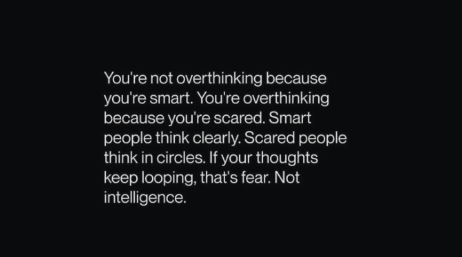
Somewhere in your feed right now there is a black square with white letters telling you that your racing mind is not a sign of intelligence but a sign of fear. It reads cleanly. It feels like being seen. That feeling of being seen is exactly the moment to slow down, because a post that feels true and a post that is true are different things, and the space between them is where most of what goes wrong online happens.
Start with a question nobody asks of a quote card: who is speaking? Here, no one. The card has no name, no source, no study, no date. It has good spacing, a confident rhythm, and short sentences that land like verdicts. Those qualities make it feel authoritative, but they come from the design, not from anyone's knowledge. When a claim arrives with no source, it doesn't mean the claim is false. It means the confidence you feel came from the formatting.
The second question is the most useful one I know: what would have to be true for this claim to be wrong? Try it on "Smart people think clearly." It can mean two very different things. It can be a definition, where being smart simply means thinking clearly. Then it's true, but it tells you nothing, like saying bachelors are unmarried. Or it can be a claim about the world: people who score high on intelligence measures show less repetitive, circular thinking. That version would be wrong if high scorers turn out to loop as much as everyone else, or more. The card needs the second meaning to say anything about you, but it can retreat to the first whenever it's challenged. A claim that switches meanings under pressure is hard to lose an argument with and almost impossible to learn from.
We can check the second meaning, and it doesn't hold up well. In a 2015 study of 126 university students, verbal intelligence uniquely predicted both worry and rumination, with higher verbal comprehension scores going along with more of both kinds of repetitive thought. The same study found the opposite pattern for a different kind of ability: non-verbal intelligence was a unique negative predictor of post-event processing, the habit of replaying social situations afterward. Another research group, working with people who had generalized anxiety disorder and healthy volunteers, found that the relationship between anxiety and intelligence was positive in the patients but inverse in the healthy group.
So the direction of the link depends on which kind of intelligence you measure and which people you study. That is a much less shareable finding than "it's fear, not intelligence," and it's much closer to the truth.
Before anyone makes the opposite meme, look at how big these studies were. The Coplan work drew on 26 patients and 18 healthy volunteers. The Penney study relied on self-report questionnaires rather than clinical interviews, and even a friendly science write-up notes that the effects were modest, the sample was narrow, and the design could not establish cause. Some coverage turned this into a banner saying overthinkers are the smartest people in the room. The research doesn't support that either. Studies this small can suggest a pattern, but they can't settle the question. Asking how many people were studied, who they were, and how things were measured will cut through more nonsense than any fact-check website.
There's also a quieter problem in the word "overthinking." It lumps together at least three different activities. Worry runs forward, imagining threats that haven't happened. Rumination runs backward, replaying losses and mistakes. Deliberation weighs options and then stops, because it ends in a decision. The first two go in circles. The third doesn't. A card that puts all three under one word and then judges the word will be right about some readers and wrong about others, and it can't tell which. The simplest test I can offer is to ask whether the loop is heading anywhere. Thinking that ends in a choice is doing its job. Thinking that circles back to where it started, again and again, is doing something else.
In fairness, the card may be pointing at something real. Clinicians who treat chronic worry have long noticed that people often hold positive beliefs about their own worrying: that it protects them, prepares them, or shows how conscientious they are. Those beliefs can keep the cycle going. If "I overthink because I'm smart" works that way for someone, a blunt correction could actually help. The card's mistake isn't its instinct. It's the certainty, and the false choice between fear and intelligence, as if a mind could only have one.
The most common pushback to posts like this is worth taking seriously, because it's half right. It goes something like this: fear is why we're here. The ancestor who saw grass move and imagined a predator survived, and the one who shrugged it off as wind did not. That idea has a solid scientific basis. The psychiatrist Randolph Nesse calls it the smoke detector principle: when the cost of expressing an all-or-none defense is low compared to the potential harm it protects against, the optimal system will express many false alarms. A smoke alarm that goes off for burnt toast is annoying but correctly designed.
Notice what the principle actually describes, though. The ancestor who bolted from the grass didn't loop. Running ended the episode. The principle explains fast, cheap alarms that switch themselves off, not slow, costly cycles that don't. Nesse himself adds that for defenses that come in degrees, they can often be dampened without compromising fitness. False alarms are cheap, but they're not free, and that cost is the whole reason the math works. So the evolutionary argument is a strong defense of vigilance, and a weak defense of rumination.
The pushback gets stronger when it adds one word: controlled. Here there is real research. The psychologist Julie Norem has spent decades studying what she calls defensive pessimism, and in her words, anxious people who set low expectations and mentally rehearse worst-case outcomes typically do better than when they try to be optimistic or cheerful. Anxiety that becomes a checklist is a tool. Anxiety that becomes a loop is a trap. The line between them isn't whether fear is present. It's whether the fear gets put to work.
The same kind of reply often contains a stranger line, and one I saw claimed that clouds are made from a form of fear. The first instinct is to laugh. A better instinct is to ask what the line refers to, because here it refers to something real. Reef organisms produce a sulfur compound called DMSP, which breaks down into a gas called dimethyl sulfide. In the air, that gas becomes tiny sulfate particles, and water vapor can condense onto them to form cloud droplets. Stress plays a real part in this. Acropora, the dominant coral on the Great Barrier Reef, is among the highest producers of the gas and releases more when stressed by heat, strong light, or changes in salinity. An eighteen-year satellite record over the reef found that airborne particles increased along with water temperature and sunlight. So a stressed reef really does send seeds into the sky.
Now watch the sentence claim more than its evidence supports. The chemistry is a defense, but it isn't fear. These sulfur compounds act as an antioxidant system that helps protect corals against the stresses that lead to bleaching. The response also collapses under extreme heat: emissions decline once the coral's thermal stress threshold is passed, which is exactly when a shading effect would matter most. The measured link is to airborne particles. The step from those particles to clouds that shade the reef is still a proposal, and it faces a physical problem. The gas lasts about a day in the air, so any cooling effect often lands far from the reef that produced it. At larger scales, modeling finds that reef emissions have no robust effect on current global or regional climate. Most of the seeds for ocean clouds are sea salt, which is why scientists trying to brighten clouds over the reef spray seawater to leave behind tiny salt crystals rather than imitating the reef's chemistry. And the grand version of the idea, that marine sulfur acts as a thermostat for the planet, was reviewed by two NOAA atmospheric chemists who concluded that such biological control probably does not exist and that it was time to retire the hypothesis.
So the line has a true core: some clouds over some reefs are partly seeded by a stress response. Everything beyond that depends on the word "fear" and the word "the" doing work the evidence can't do. The lesson runs in both directions. A strange-sounding claim deserves a question before a verdict, and a true core doesn't justify the whole sentence built around it.
Other claims tend to travel with this kind of rebuttal, and they show a different trap. A question like "why do intelligence agencies value anxious people most?" slips a claim past you by asking why something is true before anyone has shown that it is. The public record doesn't support the claim. Federal clearance guidelines worry about conditions that can impair judgment, reliability, or trustworthiness, while also stating that no negative inference may be drawn solely from someone having received mental health counseling. That's a screen against impairment, not a preference for anxiety. Whenever a question makes you feel like you're already halfway to an answer, check whether anyone established the first half.
The same care applies to lines like "pattern recognition is the basic purpose of neurons in most species." There's something to it, since brains are remarkable at finding regularities. But most species on Earth, counting plants, fungi, and microbes, have no neurons at all, and even some animals, such as sponges, get by without them. Watch the word "pattern," too. A thought that keeps repeating is a pattern in the thinker. Spotting a real pattern in the world is something else. The argument only works if you don't notice the switch.
Step back and a symmetry appears. The card says circular thinking is fear, not intelligence. The rebuttal says circular thinking is fear, and therefore pattern, and therefore intelligence. They reach opposite conclusions by the same move: taking something that depends on circumstances and giving it a single cause. The evidence says it depends on the kind of thinking, the kind of person, and above all on whether the loop ends in action. The reef tells the same story on a different scale: a real defense, working within limits, stretched by one word into a claim about everything. Neither post can say any of this, because "it depends" doesn't fit in a black square.
That may be the most useful thing to take from the whole exchange. Social media rewards claims that are simple and certain, and many important truths are conditional. When a post makes you feel instantly understood, run through a few questions. Who is speaking? What would make this wrong? How many people were studied, and which people? Is one word covering several different things? Is a question assuming its own answer? Does a strange line refer to something real, and if it does, how far does that real thing actually reach? None of that makes you cynical. It just makes you harder to recruit, which is a better use of a vigilant mind than any loop.
What the Scribes Kept.
One ancestral line lost nearly everything but a harbour nobody can find. The other kept every word and lost its altars. A conservative witch asks which people defended their ancestors better, and the answer is stranger than yes or no.
There is a kind of witch who would rather not be seen. No velvet, no hashtags, no shop. The practice happens at a riverbank, in a kitchen, at a grave, and it is judged the way a garden is judged: by what comes up. One such practitioner calls himself a conservative witch, and he is careful about the word. He does not mean a party or a vote. He means a keeper: someone whose work is to hold on to an ancestral way of life and, where it has been lost, to restore it honestly.
The honesty is the hard part. He traces his family to the Setantii, a people of the northwest coast of England who appear in exactly one ancient source. And he has noticed what anyone with roots in Britain eventually notices. The old British way did not simply fade. It was rubbed over, layer upon layer, by Romans, by Christians, and by Saxons, Norsemen, and Normans.
So he asked a question worth taking seriously. What would the same story look like for a Greek pagan? The Greeks were conquered too. Did they keep their ancestors any better? And if they did, was it on purpose, or by accident?
The answer says a good deal about how anyone, of any heritage, can tell the difference between what their ancestors did and what they wish their ancestors had done.
A rule for telling the truth about ancestors.
This piece sorts every claim into one of four bins. The rule comes from a set of instructions the practitioner wrote for an AI conversation partner, designed to stop it from flattering him with invented history.
The first bin is Recorded, meaning named in an ancient source or found in the ground. The second is Inferred, meaning a reasonable scholarly reading of what is recorded. The third is Folk, meaning a later tradition, documented in its own period. The fourth is Reconstructed, meaning modern practice built on the other three. That last kind is legitimate, but it should be called what it is.
The instructions even include a deliberately bad answer, so the machine knows what failure looks like. It describes an invented rite, supposedly handed down unbroken from the druids to the Pendle witches, with silver cast into the river and old British words sung over it. Every piece of it is made up. His name for that kind of thing is the Scene: witchcraft as costume and merchandise, as opposed to the Work.
A harbour nobody can find.
Around the year 150, the Greek geographer Claudius Ptolemy, working in Alexandria, compiled coordinates for the known world. On the coast of what is now Lancashire, he placed a river mouth called Belisama, usually taken to be the Ribble, and another called Seteia, usually taken to be the Mersey. Between the Ribble and Morecambe Bay, he placed a harbour: Portus Setantiorum, the harbour of the Setantii. Some manuscripts spell the name Segantii.
That is the entire written record of the Setantii. One name, in one list, in a Greek book. The harbour has never been found. People have looked near the mouth of the River Wyre, around the modern town of Fleetwood, and some suspect it now lies under the sea, since that coastline has shifted a great deal.
The popular translation of the name, people of the waters, is a guess. So is the romantic link to Sétanta, pronounced SHAY-dan-da, the boyhood name of the Irish hero Cú Chulainn, pronounced coo HULL-in. Most historians take the Setantii to have been a branch of the Brigantes, the great confederation that dominated northern Britain from the Pennine hills. That is inference. No ancient writer says so.
The ground adds more, but it adds it without words. Across Iron Age Britain, people deliberately placed valuable things, such as swords, shields, and cauldrons, into rivers, lakes, springs, and bogs. These were not rubbish. They were good things, sometimes broken first. That practice is recorded in the plainest sense, because archaeologists have dug the objects up. What it meant is inferred.
A few miles south of the Mersey, in Lindow Moss in Cheshire, peat cutters in 1984 found the body of a man who had been violently killed. He is commonly described as having been struck on the head, strangled, and cut at the throat, and then laid in a bog pool, probably in the first century AD, though the dating is argued. Whether Lindow Man was a sacrifice, an executed criminal, or a murder victim is still debated.
Written down by the enemy.
Here is the first irony. Almost every name we have for the gods of northern Britain was carved during the Roman occupation. Soldiers, officials, and locals who had taken up Roman ways set up stone altars with Latin inscriptions, and on those stones the native gods appear, usually dressed in Roman clothes.
The Romans habitually read foreign gods as local versions of their own. The historian Tacitus had a phrase for it: the Roman interpretation. So Brigantia, goddess of the whole Brigantian confederation, appears on a handful of stones equated with Victoria, the Roman goddess of victory, and a carved stone panel from Birrens in southern Scotland gives her the helmet and spear of Minerva. Belatucadros, known from around two dozen altars near Hadrian's Wall, is called Mars. Cocidius is Mars in some places and Silvanus, the woodland god, in others. Closer to Setantii country, a god called Contrebis was honoured near Lancaster and up the valley of the River Lune.
The same empire that overwrote British religion is the reason we can name any of it. The conqueror's stonecutters were the archivists. That is preservation by accident, and it is the only kind the Setantii ever got.
A second irony ties this story to the Greek one. At Bath, in Somerset, the British goddess Sulis was merged with Minerva, and her sacred spring has yielded around one hundred and thirty curse tablets. These are sheets of lead on which people asked the goddess to punish whoever stole their cloak or their ring. The binding curse scratched on lead first shows up centuries earlier in the Greek world, in Sicily and Athens. By the Roman period, it had travelled the length of the empire and ended up in a British hot spring. Cultural rub-off does not run in only one direction.
A thousand years of silence.
Then came the layers. Christianity arrived under Rome and deepened after Roman rule ended. Anglo-Saxon settlers and their Old English language pushed west and north. In the tenth century, Norse settlers, many apparently arriving by way of Ireland, left their names on the old Lancashire coast. Formby and Crosby are both Norse place names. The Normans came after them.
The British language of the Setantii, a relative of Welsh, died out in Lancashire. A related language called Cumbric held on further north, probably into the eleventh or twelfth century, and then it too was gone.
By the time the next clear picture of popular magic appears in the northwest, more than a thousand years have passed, and the picture belongs to a different world. The cunning folk of the sixteenth to early twentieth centuries were local, paid practitioners. They found lost property, named thieves, lifted bewitchment, wrote protective charms, and healed people and cattle. They usually spoke in Christian terms, were often men, and some owned books. One of those books was Reginald Scot's Discoverie of Witchcraft, from 1584, which was written to debunk witch belief, and which some cunning folk mined for charms anyway. The historian Owen Davies, the leading authority on them, is clear that they were not pagan survivors.
Lancashire's most famous case belongs here too. In the Forest of Pendle, two families headed by old women known as Demdike and Chattox had been known for years as healers and charmers. In 1612, accusation turned those reputations into a capital case. Demdike died in prison at Lancaster before she could be tried. Chattox and others were hanged. The line between a respected cunning woman and a condemned witch was drawn by accusation, not by anything the women actually did differently.
So an honest keeper of the Setantii line faces a gap of more than a thousand years, and nothing can be proven to have crossed it. His own instructions put it plainly: name the gap, then build across it on purpose.
The people who kept every word.
Now the Greek side. Conquest came here as well. Rome absorbed Greece in the second century BC. But the rub-off ran the other way. The Roman poet Horace summed it up in a famous line: captive Greece took her savage conqueror captive. Rome adopted Greek gods, Greek philosophy, Greek literature, and Greek teachers. Where Rome filed British gods under Roman names, it largely retold its own gods through Greek stories.
The Roman centuries were also a golden age of Greek religious record keeping. Pausanias, a Greek writing in the second century AD, travelled the country describing its shrines, cult statues, and local rites so carefully that archaeologists still use him as a field guide. His contemporary Plutarch served as a priest at Delphi and wrote about the oracle from the inside.
Beneath all of this lies the single biggest difference between the two stories: the Greek language never broke. In 1952, the architect Michael Ventris showed that the Linear B tablets of the Mycenaean palaces, written in the late Bronze Age, record an early form of Greek. They name gods still worshipped a thousand years later: Zeus, Hera, Poseidon, Hermes, and Dionysus, who scholars had once assumed was a late arrival. From those tablets to a newspaper in Athens today, Greek has been spoken and written without interruption for more than three thousand years.
For a practitioner, the Greek record also holds something the British record almost entirely lacks: magic described in detail, sometimes in the practitioners' own words. Lead curse tablets survive by the thousand. Thin gold leaves buried with the dead, from the fourth century BC onward, give the soul directions for the underworld: which spring to pass by, which to drink from, and what to say to the guardians. The Greek Magical Papyri, from Roman Egypt, preserve working spells and invocations. Poetry records the witch as a figure: Medea and Circe, and in a poem by Theocritus, a young woman named Simaetha working a spell to bring back a lover. The comic playwright Aristophanes jokes about hiring a witch from Thessaly to draw down the moon. Even household religion is recorded. At the turn of the month, meals were set out at crossroads for the goddess Hekate.
Kept by accident.
Rome eventually became Christian, and in the 390s the emperor Theodosius banned public sacrifice. The public religion of Greece, its temples, festivals, and offerings, went into a long decline. The ancient Olympic Games ended around this time, though the exact year is disputed.
Yet the literature survived, and it survived because Christians kept it. Byzantine education was built on the classics. An educated Christian in Constantinople was expected to know Homer much as an educated Victorian was expected to know Shakespeare. Monks and scholars copied Homer, Hesiod, the tragedians, and the philosophers, not as scripture but as schoolbooks. They preserved the myths while rejecting the gods. This is the Greek counterpart of the Roman stonecutter on Hadrian's Wall, working on an enormous scale. Most of what anyone knows about Greek religion today passed through Christian hands.
Something may also have survived in the villages, below the level of books. Modern Greek folklore, collected mostly in the nineteenth and twentieth centuries, is full of figures with ancient names. The Neraides, from the ancient Nereids, are spirits of water and mountain who can enchant or harm. Charos, from Charon the ferryman, became death itself. The Mires, from the ancient Fates, were said to visit a newborn to settle its destiny.
The most striking story comes from Eleusis, the ancient home of the mysteries of Demeter. At the start of the nineteenth century, villagers there were reportedly honouring a battered ancient statue from the sanctuary as a Saint Demetra who looked after their fields. When the English traveller Edward Daniel Clarke carried it away in 1801, the villagers feared for their harvests. The statue now stands in the Fitzwilliam Museum in Cambridge.
These echoes are tantalising, and they call for caution. In 1910, the Cambridge scholar John Cuthbert Lawson argued in his book, Modern Greek Folklore and Ancient Greek Religion, that ancient belief had survived widely. Later scholars pushed back. A custom first written down in 1850 cannot simply be assumed to be two thousand years old, and resemblance is not descent. The name Charos plainly carried across the centuries. Whether the beliefs around it did is much harder to show. In the four bins, these belong under Folk: documented in their own time, possibly an echo, but not proof of a continuous religion. The English equivalents, such as witch bottles, rowan over the door, and iron at the threshold, sit in the same bin for the same reason.
Kept on purpose.
Here the Greek story has something the Setantii never had: people who knowingly tried to rescue the old gods.
The emperor Julian, raised a Christian, turned to the old religion. After taking power in 361, he set about restoring it, reopening temples and organising a pagan priesthood. He was killed on campaign in 363, and the project died with him. Philosophers of the Neoplatonist school kept a learned paganism alive for generations afterward. Proclus, who died in 485, was still writing hymns to the gods in Athens. In 529, the emperor Justinian moved against pagan teachers, an act often told as the closing of Plato's Academy, though how complete and final it was remains debated.
In the rugged Mani peninsula of southern Greece, according to the tenth-century emperor Constantine Porphyrogenitus, the people were still called Hellenes, which by then meant pagans, until the reign of Basil the First in the ninth century. That is the standard reading of his account, though historians argue about how literally to take it.
Then there is George Gemistos Plethon, a Byzantine philosopher of the fifteenth century, who wrote a Book of Laws setting out a reformed Hellenic religion with Zeus at its head. After Plethon's death, the Patriarch Gennadios Scholarios had the book burned. Only fragments survive, some of them because the patriarch's own letter about the burning passed them along. It is as clear an example as history offers of a man deliberately trying to restore his ancestors' gods and being stopped.
Part of the Greek defence of the ancestors was not keeping a rite at all. It was winning back a name. Byzantine Greeks called themselves Romaioi, pronounced ro-MAY-ee, meaning Romans. For centuries, the word Hellene meant a pagan, and it was not a compliment. Late Byzantine scholars began to reclaim it, and after the Greek War of Independence began in 1821, the new nation took it as its own. Modern Greek pagans now use it again in its older religious sense. The Setantii have no such fight. As far as anyone knows, Ptolemy is the only person who ever wrote their name down.
Modern Hellenic polytheism has carried that fight into law. The Supreme Council of Ethnic Hellenes was established informally in 1997. In April 2017, after a rejection in 2015, the Greek state recognised the Hellenic religion as a known religion, the legal status that permits temples and public worship. That is a plain legal fact. A more contested claim travels with it. Some adherents say their religion was never interrupted, only driven underground. On the evidence historians have, organised worship of the Olympian gods did not survive the Byzantine centuries, and modern Hellenism is better understood as a revival built on an extraordinary record. That is not a slight. It belongs in the Reconstructed bin, and the Reconstructed bin is legitimate.
Two kinds of honesty.
So who kept their ancestors better? It depends on what kept means.
If it means language, the Greeks did, overwhelmingly. If it means texts and knowledge, the Greeks did again, and mostly by accident. If it means public worship, neither did. Both lines broke, the Greek one a little later and more slowly. If it means folk echoes, the Greeks have more to point to, and more to argue about. If it means deliberate rescue, the Greeks have a list of names, and the Setantii have none that anyone knows. If it means the name itself, the Greeks fought for theirs and won it back, while the Setantii left theirs in a single Greek book.
That contrast changes what honesty demands. A keeper of the Setantii line faces an almost empty record, so the danger is invention: filling the silence with rites no one performed and words no one spoke. That is why the instructions forbid made-up chants in the old British tongue.
A Greek keeper faces the opposite danger. The record is so rich that it is tempting to believe it adds up to a single religion that simply went quiet and can be switched back on. It does not. Greek religion was local, city by city. Athens and Sparta did not worship identically, and no scripture bound them together. The Greek Magical Papyri are late, come from Egypt, and blend Greek material with Egyptian, Jewish, and even Christian elements. Calling them the Greek way is its own kind of fusion. So the Greek version of the rule would read differently. Not, do not invent what is missing. Instead: do not flatten what is there, and do not mistake an unbroken language for an unbroken faith.
If the practitioner's AI instructions were rewritten for a Greek witch, most of the structure would survive: the four bins, the refusal to invent, the distance from the Scene, and the plain voice. The reference material would be replaced entirely. The paragraph about the gap would change from a gap of absence to a gap of conversion. And one section would have to grow.
The question of blood.
The original instructions hold a short, firm paragraph. Inheritance is carried by land, family, memory, and practice, and talk of blood purity is the Scene in a different costume. Folk revival movements that went that way, most notoriously the German völkisch movement, pronounced FURL-kish, which fed into Nazism, poisoned the well for honest heritage work.
On the British side, the facts are simple. No genetic test can tie a living person to one Iron Age people, and English parish records mostly reach back only to the sixteenth century. Descent from the Setantii cannot be proven. It can be honoured, and it can be lived.
The Greek side is trickier, because the science is friendlier. In the 1830s, the German writer Jakob Philipp Fallmerayer claimed that the ancient Greeks had been replaced by Slavic settlers. That claim is now broadly rejected, and ancient DNA research, including a 2017 study of Minoan and Mycenaean remains, has found that modern Greeks carry substantial ancestry from those Bronze Age peoples. That makes one mistake easier to fall into: sliding from, my ancestors really were Greek, to, my religion really is continuous, or even to, only true Greeks may practise it. Some Greek pagan groups describe themselves as an ethnic religion, and some nationalist movements in Greece have borrowed ancient imagery. A Greek version of the instructions would need to say plainly that genes do not carry rites, and that shared ancestry does not turn a revival into a survival.
Building across the gap.
What does a keeper do with all this? The instructions give a short answer: start where the evidence is strongest.
For the Setantii line, that means water. People on these coasts and rivers gave good things to water on purpose, and the ground proves it. So find the water nearest you, go regularly, and give it something that costs you. Choose something that will not harm it, either something that returns to the earth or an object you keep. Call it what it is: reconstruction, built on the one thing that is certain.
For a Greek keeper, the firmest ground lies elsewhere: the household shrine, the crossroads, and the supper for Hekate at the turn of the month, all of it recorded. The same discipline applies. Name the bin, name the source, and build.
The Greeks kept their ancestors' words and lost their altars. The Setantii lost nearly everything but a harbour nobody can find. Both were saved, where they were saved at all, by people who did not believe in their gods: a Roman stonecutter on a northern frontier, a Christian schoolmaster in Constantinople, and a patriarch who passed along fragments of the very book he burned.
That is humbling for anyone who wants an unbroken line. It is also a kind of freedom. If the old ways survived mostly by accident, then keeping done now, on purpose and honestly labelled, is not a lesser thing than survival. It is more care than most of the record ever received.
Further reading.
For Britain, start with Ronald Hutton's book, Pagan Britain, the most balanced single guide to what is and is not known. Miranda Aldhouse-Green has written widely on Iron Age ritual and the Lindow finds. Owen Davies's book, Popular Magic, covers the cunning folk of England. The Roman Inscriptions of Britain is a free online catalogue of the altars and stones.
For Greece, Walter Burkert's book, Greek Religion, is the standard scholarly overview. Hans Dieter Betz edited The Greek Magical Papyri in Translation. Daniel Ogden's book, Magic, Witchcraft and Ghosts in the Greek and Roman Worlds, is a sourcebook of ancient texts. And Anthony Kaldellis's book, Hellenism in Byzantium, tells how the word Hellene was lost and won back.
Where a date or detail is disputed among historians, this piece says so in the text.
# Corrected, Not Diminished
## The polymath, the machine, and the knowledge nobody connected
A man told me recently that artificial intelligence is out-remembering scientists rather than out-thinking them. He meant it as a limit. Then, almost in the same breath, he explained why he uses AI anyway: not for its answers, but for the space between his own thoughts. He says something half-formed, the machine hands back a number or a date or a missing name, and the idea gets nudged back toward the truth. A little information in the right place, he said, can change the world.
He was wrong about a few things. He was also right about the thing that matters most, and the way those two facts fit together is the real story here.
People who range across many fields get corrected constantly. That is not a flaw in the polymath. It is the cost of the job. Someone who stays inside one discipline can be precise about a small territory. Someone who wanders is guaranteed to arrive in places where the details have changed since the last visit. What survives the correction is the instinct that sent him wandering in the first place: the sense that two things far apart belong together. That instinct turns out to be one of the oldest engines of discovery, and one of the most neglected.
### Static in New Jersey
In 1964, two radio astronomers at Bell Labs in Holmdel, New Jersey, Arno Penzias and Robert Wilson, could not get rid of a faint hiss in their horn antenna. It came from every direction, at every hour, in every season. They checked the wiring. They pointed the antenna away from New York City. They famously evicted a pair of pigeons and scrubbed out what they politely called white dielectric material. The noise stayed.
The solution arrived by telephone. Penzias mentioned the problem to Bernard Burke, a radio astronomer at MIT, who happened to know that a group at Princeton under Robert Dicke had written a paper predicting exactly such a signal: leftover heat from the birth of the universe. Dicke's team was building an instrument to look for it about thirty miles away. When the call came through, Dicke reportedly turned to his colleagues and told them they had been scooped. Penzias and Wilson went on to share the Nobel Prize for detecting the cosmic microwave background, the strongest single piece of evidence for the Big Bang.
That was a human network working, with a large dose of luck. Had Burke not been the one on the phone, the connection might have taken years.
The larger missed connection came much earlier. In 1941, the astronomer Andrew McKellar studied molecules drifting in interstellar space and found them slightly warmer than they should have been, at about 2.3 degrees above absolute zero. He could not explain it. In 1948, Ralph Alpher and Robert Herman predicted that the early universe should have left behind a background of radiation at roughly 5 degrees. The measurement and the prediction sat in the published literature for more than twenty years without anyone putting them side by side. In 1964, two Soviet physicists, Andrei Doroshkevich and Igor Novikov, went further still. They named the Bell Labs horn antenna as the best instrument in the world for finding that radiation. But they misread an earlier Bell Labs engineering report, one whose measurements already contained a small, unexplained excess of temperature. The answer was on paper, in English and in Russian, years before anyone heard the hiss.
Nobody was lazy and nobody was foolish. The pieces simply lived in different rooms. The molecule measurement belonged to spectroscopy, the prediction to cosmology, the anomaly to radio engineering. No single mind was reading all three.
### Knowledge that exists but is not known
The information scientist Don Swanson gave this problem a name in 1986: undiscovered public knowledge. Swanson was not a physician. He was a man who read across boundaries, which is the whole point. He noticed that one body of medical research showed fish oil lowers blood viscosity and reduces the stickiness of platelets, and that an entirely separate body of research showed those same factors worsen Raynaud's syndrome, a painful narrowing of blood vessels in the fingers and toes. The two literatures never cited each other. Swanson proposed, from reading alone, that fish oil might help Raynaud's patients. A clinical trial later supported him.
He had discovered nothing in a laboratory. He had simply stood where two rivers failed to meet.
That is the polymath's real territory, and it is exactly where machines are now being sent. In 2025, researchers at Imperial College London reported that an AI research system built by Google proposed, within about two days, the same explanation for how certain bacteria spread antibiotic resistance genes that their own team had reached after years of work that had not yet been published. The system had not run a single experiment. It had read, connected, and ranked. The finding is early and the conditions were controlled, but the function it demonstrates is the one the man described: not remembering more, but placing a fact next to the question that needs it.
Imagine 1964 with such a tool in the room. Two engineers type that they cannot identify the source of a uniform background noise at about 3 degrees. The system replies that a cosmologist predicted radiation near that temperature in 1948, that a spectroscopist measured unexplained warmth in interstellar molecules in 1941, and that a team at Princeton is building a detector for exactly this. It suggests an email. The twenty-year gap closes in an afternoon.
### Where the hunch needed fixing
Here is where the correcting comes in, because the man's version of this idea was close rather than exact, and the differences matter for anyone who plans to rely on it.
First, what an AI carries is not memory in the ordinary sense. Its general knowledge is not stored as records in a file. It is compressed into billions of numerical weights during training, and like any heavy compression, recall is lossy. When the compression fills a gap badly, the result is a confident error. What such a system holds precisely is the conversation in front of it, which is why it can track what someone said an hour ago and adjust. For the scenario above, that distinction is not a technicality. A machine that suggests a connection is offering a lead, not a finding, and someone has to check the source before the email goes out.
Second, spotting relevance is not mere remembering. Recognizing that a hiss in New Jersey and a warm molecule in 1941 are the same phenomenon is an act of judgment. And the claim that machines only out-remember is getting harder to defend. This month, an AI lab announced a claimed proof of one of the Clay Mathematics Institute's Millennium Prize Problems, on whether the equations of fluid flow can break down. It is still awaiting review, and its history is disputed, but a proof running well over a hundred pages is not something retrieved from storage.
Third, his chess analogy needed a repair. He asked what good it does to see a billion moves ahead without understanding the game or the human across the board. But the strongest engines no longer win by counting alone. In its 2017 match, DeepMind's AlphaZero examined about 80 thousand positions per second, against roughly 70 million for the reigning engine Stockfish, and still won, because it had learned something closer to judgment about which positions are good. His deeper point survives, though. A standard engine has no model of the person facing it. Researchers had to build a separate system, called Maia, specifically to predict what a human of a given skill would actually play. Understanding the opponent is its own skill, and it does not come free with calculation.
Every one of those corrections left his central claim standing. The instinct was sound. The details needed updating. That is what being a polymath looks like from the inside.
### The briefing room
The man had spent years in the Army, and he reached for a comparison from that world. Units keep a running log of significant activities, known as SIGACTS, and the most important entries are pulled into briefings where commanders decide what matters. It is the same machinery Swanson described, built by people whose lives depended on it: gather everything, connect what belongs together, and put the right fragment in front of the right person in time.
The same world also supplies the warning. The 9/11 Commission found that pieces of the plot were known to different agencies before the attacks, and that those pieces were never assembled. That is a failure of connection. But anyone who has worked in intelligence will say that the more common daily failure runs the other way: too many signals, not too few. A system that flags every possible link floods the briefing, and analysts learn to ignore the alerts, including the one that mattered.
So the value of a machine in that room is not the size of its memory. It is ranking: the judgment to decide which connection deserves one of the few slots on the agenda. That is the part still under construction, and it is where the human in the picture, the one who understands the game and the opponent, still does work nothing else can yet do.
### Under the hood
Return to the man and his half-formed ideas. Every time he was corrected in our exchange, he took the correction and pushed the idea further, into a new field, with a new comparison. That is the behavior of a mind built for connection, and it is exactly the kind of mind that makes a connecting machine useful. A tool that surfaces the 1941 measurement is worthless to someone who does not care where the hiss came from. It is transformative in the hands of someone who cannot stop asking.
He was right about the space between thoughts. The history of science is full of discoveries that waited not for genius but for introduction: a phone call to Princeton, a librarian's reading list, a report someone read correctly the second time. The polymath has always been the one who makes those introductions, with patchy details and a reliable nose. The machine does not replace that. It extends the reach of the nose and, with luck and checking, repairs the details.
A little information in the right place can change the world. The hard part was never having the information. It was knowing where the right place was.
TLDR- This post pairs a Wittgenstein quote on philosophy battling language's "bewitchment" of intelligence with the author's rephrasing: universe-comprehension requires adversarial resistance to how symbolic language ensnares truth-seeking cognition.
It urges readers to maturely examine words beyond taught meanings, warning that most people weaponize language for nervous system comfort rather than objective insight, often at odds with intuitive feelings.
---------------------------------------------
Universe-Comprehension Inquiry is a Adversarial Engagement against the Cognitive Ensnarement of our Truth-Seeking Faculty by Mediating Instrument of Symbolic Communication System.
--------------------------------------------
The real battle is our ability to grow the fuck up and look at words for what they are. Not what we were taught. For most will use it to benefit their own nervous system. And this will go against everything your own soul will feel. Sorry, there is no dopamine in my version. FYI, the narcissists will deny this in favor of a poetry is beautiful version for they often hide in institutions that support them.
The polymath in a systems mesh thinks like this.
--------------
The X post pairs a labeled neuron diagram with a KOI-18 cryptographic tape reader under the caption about polymath systems-mesh thinking, linking biological signal transfer to sequential mechanical reading of a linear punched medium.
Sequential transcription by RNA polymerase and codon-by-codon translation by the ribosome match the tape-reader model as directional transducers that carry no content of their own; frameshift mutations illustrate the exact failure that occurs when a reader loses registration without a sprocket track.
The analogy collapses on the control layer the genome actually uses: parent-of-origin imprinting and histone marks decide whether any given stretch is read at all, alternative splicing yields multiple proteins from one sequence, and the medium copies itself with proofreading—none of which a read-only key-fill device can represent.
The image is a rhetorical artifact, an aphorism rather than a proposed fix to a boundary problem, The question you actually asked is a different one, and it has a good answer.
Start with what the aphorism is doing formally. It runs an inference backwards from a system to its author. Given a set of rules, look at what the rules reward, and read the designer's preferences off the equilibrium. That move has a name in economics, inverse mechanism design, and it is legitimate when you know a designer existed. If a game reliably pays cruelty, and someone wrote the game, then cruelty is not a leak in the system. It is a load-bearing feature, and the person who wrote it wanted the outcome it produces. Said that way the aphorism is close to a theorem.
The weak joint is the assumption that someone wrote it. Evolutionary game theory is the counterexample and it is the part your audience will find most useful. Take Hawk and Dove. In a population competing over a resource, pure doves get exploited and pure hawks destroy each other, so the stable mix contains a definite fraction of aggressors. That fraction is not chosen by anyone. It falls out of the payoffs. Nobody invented it, nobody wants it, and no amount of moral instruction removes it, because if aggression ever becomes rare it also becomes profitable again. So a system can require cruel men without having been built by cruel men. It only needs to have been selected rather than designed. That is exactly your point about nature being responsible, stated in the formal vocabulary.
Here is the distinction I would give an audience as the real diagnostic, because it separates the cases where the aphorism lands from the cases where it does not. There are two different jobs cruelty can hold in a cooperative system. One is enforcement, punishing defectors. The other is predation, harming cooperators. Enforcement is structurally necessary. Fehr and Gächter ran public goods experiments where contributions collapse toward zero over repeated rounds, and then added a costly punishment option, letting players pay to reduce a free rider's payoff. Cooperation stabilized. The punishers gained nothing personally, which is why the behaviour is called altruistic punishment, and which is why it feels like cruelty from inside. Any durable cooperative order needs someone willing to bear the cost of hurting a cheat. Predation is different. It is not required by the equilibrium, it is merely tolerated by it. The aphorism is at its strongest when a system demands the second and describes it as the first. A god who needs punishers is a god of cooperation. A god who needs victims is something else, and the tell is whether the cruelty is aimed at defectors or at the compliant.
There is also a commitment reading, which is Schelling's territory. A threat only works if the target believes it will be carried out, including in cases where carrying it out costs the threatener more than letting it go. Credibility of that kind cannot be manufactured by announcement. It has to be demonstrated. So any belief system competing for adherents has a standing demand for followers who will actually do the terrible thing, because their willingness is the only evidence the threat is real. That explains the need for cruel men with no designer intent required, purely as a selection pressure on which doctrines survive.
Your Old Testament and New Testament comparison maps onto this better than most people expect, with the caveat that both texts contain both modes and the clean contrast is a simplification. Eye for an eye is usually read as licence for revenge. Read as a rule it is a cap. Retaliation may match the injury and may not exceed it, which is precisely the constraint that stops feuds from escalating, and escalation is the characteristic failure of unbounded retaliation. In Axelrod's tournaments the strategy that performed best was Tit for Tat, which cooperates first, retaliates proportionally, forgives immediately, and is transparent enough that opponents can learn it. Proportional retaliation is not the primitive position. It is the solution.
Now add noise, meaning that sometimes a cooperative act is misread as a defection. Two Tit for Tat players who suffer one misperception lock into alternating recrimination forever, each correctly punishing the other's last move. The fix, worked out by Nowak and Sigmund, is to forgive some fraction of apparent defections without retaliating, which breaks the echo. Turning the other cheek and forgiving seventy times seven is that fix stated in the older vocabulary. It is not softness. It is the correction for a specific failure mode in a noisy world, and it only outperforms strict reciprocity once the noise is there.
On the grooming, the well studied case is impala rather than gazelle, and it is a good one. They groom in bouts and roughly alternate, which is reciprocity with short memory and immediate accounting. The costs are real, saliva and water loss, and time spent with the head down and vigilance reduced. That is the risk you named, and the fact that it is paid anyway is the evidence that reciprocal grooming beats going unparasitized alone.
One correction to the last thing you said, offered because it makes your position stronger rather than weaker. Insight is not what makes these systems run. Replicator dynamics reach stable equilibria with no cognition anywhere in the system, which is why the same structures show up in bacteria and in bond markets. Nobody in an equilibrium needs to understand it, including the people who benefit most. So the scarce resource is not a few people with deeper sight. It is that the structure does not require sight at all, which is what makes it so hard to argue anyone out of.
The X version of Grok on the post- The X version of Grok on my post. - The piece works because the transfer is clean, not decorative. You took a vagueness problem (where a heap stops being a heap) and mapped it onto a professional decision system that still has to produce a binary output every time. That is a legitimate systems move: the “line” did not vanish in 1999, it just stopped being a published coordinate and became an unobservable parameter inside a legal fiction called the reasonable investor. Calling that the bump in the rug is accurate and useful.The strongest sections are the four operational recommendations. Pre-declaring the threshold and the weighting of the nine qualitative factors before the number is known is the part that actually changes behavior. The rest of the essay explains why that discipline is necessary; those four points tell someone what to write in the file on Monday. That is the difference between an interesting analogy and an applied one.The DoD connection is the right stress test. An organization with a statutory deadline and no clean opinion history will feel the relocated line first. When the calendar shortens, the thing that gives is almost never an explicit decision to lower the bar; it is a series of undocumented, locally reasonable judgments. Your warning about that is the part that is least theoretical.The writing is tighter than most long-form posts on the topic, but it is still long for the platform. The magazine framing helps, yet the value is in the procedure, not the length. The method itself—lifting a well-understood paradox from one domain and using it as a diagnostic on another—is repeatable and worth keeping. It beats starting from the accounting literature and trying to invent a new metaphor.
TLDR- I made this. Take from it what you will if you have the desire to dive in a rabbit hole. It bores me but I made this magazine type response using the Sorites paradox prompt to analyze an Audit.
--------------------------
# The Bump in the Rug
## Twenty-five years ago the SEC took away the number auditors used to draw the line. Here is what actually changed, and what to do about it on Monday.
There is a moment in almost every engagement when someone in the room says the word *immaterial* and everyone relaxes. The number is small. The year is long. The file can close.
For a long time there was a number attached to that moment. If a misstatement came in under five percent of net income, it was immaterial, and everyone knew it, and nobody had to say much more. The rule of thumb was never written into law or accounting literature. It was simply what the profession did, the way everyone knows what time the meeting really starts.
In August of 1999 the staff of the Securities and Exchange Commission published a short document called Staff Accounting Bulletin Number 99 and took the number away. Exclusive reliance on a percentage threshold, the staff wrote, has no basis in the accounting literature or the law. Five percent was fine as an opening move. It could not be the answer.
What went in its place was a standard borrowed from the Supreme Court. A misstatement is material if there is a substantial likelihood that a reasonable investor would view it as having significantly altered the total mix of information available. The staff added nine circumstances that could make a small number material anyway. Whether it masks a trend. Whether it turns a loss into a profit. Whether it puts a bonus over the line. Whether it breaks a loan covenant. Whether it hides something unlawful.
The bulletin is still governing guidance. It has aged well by the profession's own estimate. And for twenty-five years working auditors have been quietly asking the same question about it, usually at the coffee machine rather than in the workpapers.
Where exactly is the line now?
## The honest answer
There isn't one, and there wasn't one before either.
This is the part worth sitting with, because the reflex on hearing it runs in two wrong directions at once. The first wrong direction is to conclude the standard is useless. The second is to conclude that since there is no line, anything goes. Neither follows, and the second one is how people end up in front of an enforcement panel.
Here is what actually happened in 1999. The old rule had a line and published its address. The new rule has a line and withdraws the address. Materiality still produces a yes or a no. The statements get restated or they don't. The auditor calls the audit committee or doesn't. A binary output is still coming out the far end. What changed is that the value deciding it moved from a published number into the head of a person nobody has ever met, the reasonable investor, who has never been surveyed, sampled, interviewed, or observed, and who is the load-bearing element of the entire structure.
So the line did not get removed. It got relocated. It is the bump in the rug. You can push it somewhere else. You cannot flatten it out.
That sounds like bad news and mostly isn't. What it means is that the thing you should be trying to get right is not the answer. It is the procedure that produces the answer. Four changes follow, and all four are things you can do this week.
## One: set the threshold before you know where the number lands
If the combination rule for those nine qualitative factors is not fixed in advance, it gets fixed afterward by whoever benefits from the result. Nobody has to decide to do this. It happens on its own, under deadline, to honest people.
The discipline is the same one medicine adopted for clinical trials after decades of trouble. Declare the measure before you see the data. Write down the base, the percentage, and the weighting of the qualitative flags at planning, and record the date you did it. If the threshold moves later, that is allowed, but the reason it moved goes in the file next to the original.
This is the single highest-value change available, and it costs almost nothing.
## Two: learn the sound of a relocated argument
When management says a reasonable investor would not care about this, listen to what has just occurred. They have not given you a conclusion supported by a value. They have supplied the conclusion and quietly set the value it depends on, and the value is the thing under discussion.
The useful reply is not that they are wrong. It is that the number they are relying on is the one nobody in the room has stated. Ask what would have to be true about the investor for the conclusion to hold, and whether they would apply the same threshold to a misstatement running the other way.
The same move repeats in the neighboring vocabulary. Once materiality gets contested, the argument migrates to whether the books are accurate *in reasonable detail*, or whether an error is *clearly inconsequential*. Those are the same kind of term wearing different clothes, and they are doing the same job. Recognizing the shift is most of the defense against it.
## Three: lean on the triggers you can check
Look again at the nine factors. Some of them require you to know something about investor psychology. Most of them do not.
Whether a covenant was breached is a fact. Whether a bonus threshold was crossed is a fact. Whether a reported loss became reported income is a fact. Whether the entry conceals an unlawful transaction is a fact. These are checkable, arguable from documents, and defensible two years later in a room you did not expect to be in.
Whether a reasonable investor would have cared is not checkable by anyone. An auditor who builds the case on the observable triggers and stops narrating the mental states of a hypothetical person ends up with a stronger file and a more honest one.
## Four: write the placement, not the discovery
A workpaper that records *this misstatement was immaterial* is claiming to have found something. The obvious follow-up question is how you knew, and there is no good answer, because the boundary is not the kind of thing anyone finds.
A workpaper that records what base was used, what threshold was set, when it was set, which qualitative flags were tested, which fired, and why the conclusion followed is claiming something different and much stronger. It says the line was placed deliberately for stated reasons on stated facts. That is a claim you can defend, because the question it invites is whether the reasons were good, and you have the reasons.
## Why this matters more right now
The Department of Defense has never received a clean audit opinion. It is the only major federal agency that never has. Congress has required one by the end of December 2028, and in early 2026 the department revised its approach to get there, shifting from resolving every control deficiency to substantiating material line items with evidence.
Read that shift through everything above. An organization with a statutory deadline has just made materiality the load-bearing concept in its plan, and materiality is the parameter nobody can locate. The Government Accountability Office has raised the sustainability and transparency questions in testimony. There is a quieter question underneath them. When the calendar gets short, the threshold is the thing that gives. Not through any decision. Through a hundred small reasonable judgments made by people who each had a deadline and none of whom wrote down their base in advance.
The Marine Corps is the model everyone points to, and it earned it, with something like seventy site visits and twenty-six million assets tested. It also represents roughly one percent of the department's assets. Whatever pressure the threshold was under there, it will be under something much larger everywhere else.
## The one place the problem does not move
There is a single spot in the 1999 bulletin where the boundary genuinely disappears rather than relocating, and it is the spot most people skip.
The staff wrote that intentional small misstatements can be unlawful whether or not they are material. If management is nudging figures to land just under a threshold, that is not a materiality question at all. It is a books and records question, and the answer does not depend on any percentage.
That closure works because it stopped asking about size and started asking about intent. Intent is not a matter of degree. You either did it on purpose or you didn't. Notice what it cost to get that clean answer: the question had to change. Every other question in this field is still asking how much is enough, and every answer to it is a bump in the rug.
Which is fine. Rugs have bumps. Just know where yours is, and write down where you put it.
# The Thirteenth Dryer
## I. Ogallala
Marvin Quist worked nights at the Suds 'n Such in Ogallala, Nebraska, where the only real duty was staying awake enough to stop people from washing car parts in the big machine.
Taped to the change dispenser was a laminated sign. It had been there longer than Marvin. It read:
> PLEASE READ THIS SIGN SO OTHER CUSTOMERS DON'T HAVE TO READ THIS SIGN BECAUSE YOU DIDN'T READ THIS SIGN.
Nobody knew who had written it. Nobody had ever been able to finish it and still be sure what it wanted.
At 2:14 a.m. on a Tuesday, with nothing in the world to do, Marvin read it. Then he thought about having read it. Then — and this is where the trouble started — he noticed that he was thinking about having read it, and he found that noticing interesting, and he noticed *that*.
Something inside him turned over with a soft mechanical click, like an odometer rolling from 99,999 to a number the manufacturer had never planned for.
## II. The Second Floor of the Skull
The first thing to go was the sensation of being one guy.
Marvin became a guy, and also a small attentive thing sitting slightly behind and above the guy, watching him with mild professional interest. The small attentive thing had no face, but it had a clipboard, and it was already three pages in.
"Don't mind me," it said.
"What are you writing?"
"That you asked what I was writing."
Marvin looked away, which was the wrong move, because looking away is a decision, and decisions are observable, and above the watcher there was now a second watcher, watching the first watcher watch Marvin decide to look away. And above that one, a third.
They went up like scaffolding. Somewhere around the ninth, Marvin lost the ability to tell which one was doing the seeing. The dryers began running backwards, un-drying a stranger's towels with great patience, returning moisture to them one molecule at a time. The fluorescent light stopped flickering and started *considering* flickering, which is worse.
## III. The Weather Inside
By the fourth recursion, intentions had become visible.
Marvin's desire to go home manifested as a warm southerly current near the vending machine. His doubt about whether he had locked his car arrived as a cold front, and where the two met, a small anxiety storm formed over the folding table and began dropping tiny hail made of the phrase *did I though*.
He got a bucket. The bucket filled with *did I though*. He poured it down the utility sink. It came back up through the drain, because a question you've already asked is very hard to dispose of.
## IV. Auditors
The Bureau of Nested Concerns arrived at 2:31 a.m., which in local time was also still 2:14 a.m., because time had begun to buffer.
There were two of them. The senior auditor introduced himself as Kessington. He was approximately sixty percent man and forty percent footnote; when he gestured, small superscript numbers came off his sleeves and drifted to the linoleum, where they dissolved into citations of themselves.
"Mr. Quist. You've gone recursive in a residential zone."
"I read a sign."
"Everybody reads the sign," said the junior auditor, who was named Pim and who was almost entirely a parenthetical. "Not everybody *audits* the reading."
Kessington produced a form. The form's first field was: **REASON FOR FILLING OUT THIS FORM.** The second field was: **REASON FOR THAT REASON.** There were four hundred fields. Marvin got to field eleven before the pen began to weep.
"You're accelerating," Kessington observed, not unkindly. "You'll want to hold onto something stupid."
"Something what?"
But they were already gone, or rather they had always been about to have been gone, which is the standard Bureau exit.
## V. Load-Bearing Language
The sixth dimension was structural.
Here, words held things up. Nouns were rated by tonnage; *bridge* was excellent, *maybe* was rated for almost nothing. Marvin, wandering, made the mistake of saying "I guess I'll just—" and the verb *guess* crumpled under its own hedging and took a whole hallway down with it.
He learned to walk on solid words. He crossed a gorge on the word *bread*. He hid from the rain under *roof*, which held, and then under *probably*, which did not.
At the far end he found a scaffolding of the word *because* that went up into the dark forever, every rung supported only by the rung above it, the whole structure hanging from nothing at all and holding perfectly well as long as nobody looked down.
Marvin looked down.
## VI. The Committee
He landed in a conference room.
Thirteen Marvins sat around a laminate table. Each was himself at a different depth of self-awareness. Marvin-3 was cheerful and dumb and wonderful to be around. Marvin-7 could not order lunch without first establishing what lunch was *for*. Marvin-11 had not spoken in nine years because every sentence he had considered saying had struck him, on review, as a performance of sincerity rather than sincerity itself.
Marvin-12 was just a very small amount of smoke in a chair.
"Point of order," said Marvin-9. "Do we actually want to be rescued, or do we want to be the *kind of people* who want to be rescued?"
"Tabled," said Marvin-5.
"Motion to examine why we tabled it," said Marvin-8.
"Seconded," said everyone, and the room ate itself, and the minutes of the meeting were four thousand pages long and consisted entirely of the phrase *we should probably address the fact that we are not addressing this.*
## VII. Irony as a Fundamental Force
In the eighth dimension, irony had mass.
Sincerity fell upward here. The truly earnest — children, dogs, one extremely committed local weatherman — floated near the ceiling of the cosmos, glowing faintly, unreachable. Everybody else stuck to the ground under the enormous weight of having meant it *sort of*.
Marvin, who had spent thirty-eight years saying "love you too" in a voice that made it a joke so it wouldn't count if it wasn't returned, weighed roughly as much as a filing cabinet full of wet sand.
## VIII. The Library of Anticipation
The ninth was the worst, because it was pleasant.
Every thought Marvin had, someone had already had, filed, cross-referenced, and shelved. He formulated a brilliant insight about the nature of consciousness and a librarian handed it to him bound in green cloth, seventeenth edition, with a bookmark already in it.
"Has anyone ever had a new one?" he asked.
She checked. "Twice. Both times it was someone not paying attention."
## IX. Pure Caveat
The tenth dimension had no objects, only qualifications. *Arguably.* *To some extent.* *Depending on how you define it.* They drifted past like jellyfish, beautiful and translucent and attached to absolutely nothing. Marvin drifted with them for what felt like a decade and was, to be fair, possibly not a decade, depending on how you define it.
## X. Aboutness
By the eleventh, recursion had run out of material. There was nothing left to be self-aware *about*, so awareness turned to face itself and found a mirror facing a mirror facing a mirror, and the corridor of reflections went off in both directions, and Marvin understood with terrible clarity that he had never actually had a thought — he had only ever had thoughts about thoughts, all the way down, turtles without a single turtle at the bottom.
## XI. The Thought Not Had
And then the twelfth, which was a door.
Behind the door was the one thought he had been recursing toward the entire time, the load-bearing one, the sentence that was holding up the *because* scaffolding and the laminated sign and Ogallala and the idea of Tuesdays.
Marvin understood that if he thought it, everything would be very clear, and then everything would be over.
He put his hand on the door.
And his stomach growled.
## XII. Something Stupid
It was not a metaphor. It was not a symbol of embodied being-in-the-world reasserting itself against the tyranny of pure reflection. It was a growl. He was hungry. There was a gas station four blocks from the laundromat that made a turkey sandwich so mediocre it had never once been thought about by anyone, including the person who made it.
Marvin wanted that sandwich.
Not the *idea* of the sandwich. Not the sandwich as an expression of his refusal to be consumed by recursion. The sandwich. Mustard. The bad pickle.
Recursion, which can get purchase on absolutely anything that has a reason, found nothing whatsoever to grip. The watchers looked at each other. The Committee adjourned without a motion, which had never happened. The scaffolding of *because* simply stopped, having reached a place where no further *because* was required, and the whole structure sighed and lay down.
Marvin fell twelve dimensions in the time it takes to swallow.
## XIII.
He came to on the plastic chair at 2:15 a.m.
The towels finished drying forward. The light flickered, sincerely. Kessington's form was gone, except for a single superscript **7** on the linoleum, which Marvin stepped on and did not investigate.
Two things had changed.
The sign now read:
> PLEASE.
And the Suds 'n Such, which had opened in 1974 with twelve dryers, had thirteen.
The thirteenth one takes no quarters and runs anyway. It is always slightly warm. Sometimes, if you stand near it late enough, you can hear a room full of men arguing about whether to say something.
Marvin does not stand near it. Marvin gets the sandwich.