“Get used to it.”
That was the Chief Economic Adviser’s message on November 18 to investors worried about the shrinking gap between Indian and US bond yields.
But a stable rupee doesn’t mean India has escaped global tightening. When the currency absorbs less of the shock, the pressure can show up somewhere else, in what investors demand for holding long-term Indian government bonds.
Why does that matter? Because it can feed into corporate borrowing costs, private investment and, eventually, India’s debt dynamics. And the burden doesn’t fall equally on everyone.
V. Thiagarajan explains why India’s next macro challenge may be the cost of duration.
Read here: India’s Next Macro Challenge Is the Cost of Duration
https://t.co/OIJIXNfPpH
#BondMarkets #IndianEconomy #Rupee #InterestRates #TermPremium #PublicDebt #RBI #BasisPointInsight
📊 #BasisShorts
Cyient gets a Chip off the Foundry Block
Cyient Semiconductors, a subsidiary of Cyient, is getting an investor that can help turn its designs into chips. GlobalFoundries has agreed to invest $10 million in the custom silicon company. For Cyient, the attraction is not just money in the bank, but greater confidence that its chips can make it out of the factory.
The investment is priced at the same $490 million pre-money equity valuation as the recent Edelweiss-led financing round. The company puts the combined post infusion valuation at $510 million. GlobalFoundries is backing the business at the existing price, not paying a fresh premium for the strategic label.
Cyient wants to expand its turnkey custom-chip capabilities, taking customer projects from design through manufacturing, packaging and testing. It says the investment will strengthen access to manufacturing and long-term wafer supply, giving its growth plans something more substantial than another endorsement.
Cyient has given the foundry a seat at the table. The next test is getting more chips out the door.
#cyient #globalfoundries #cyientsemiconductors #semiconductors #customsilicon #indiasemiconductor #edelweiss #funding
📖 Your quick read on what’s happening in markets. More Basis Shorts here: https://t.co/QrzHHjvocK
📊 #BasisShorts
Mirae Asset MF hands TeamLease its Notice
#Mirae asset mutual fund has sharply reduced its stake in temp staffing company TeamLease Services. Two disclosures show the mutual fund’s holding falling from 4.12% to 0.20% through open-market sales on November 17 and 18. That is almost an exit, with a small forwarding address left behind.
The fund sold 214,164 shares on the first day, bringing its stake to 2.72%, and another 385,500 the next. The September backdrop makes the stake cut more striking. Mirae Asset Multi Cap Fund held 6.84% on September 30.
It cannot be immediately said whether the stake paring is profit-booking, portfolio rebalancing or a verdict on the business. Incidentally, the company is schedule to meet 15 institutional investors later in the month.
During the recent earnings call, analysts repeatedly asked whether TeamLease’s sluggish headcount growth reflected a deliberate exit from low-margin contracts or a deeper competitive weakness, particularly as peers were adding staff faster.
They wanted a clearer timeline for stronger hiring, revenue and margins, rather than further assurances that the business reset would eventually deliver.
#teamlease #miraeasset #mutualfunds #stakesale #staffing #hrservices #institutionalinvestors #stockmarket
Indian banks’ outstanding FCNR(B) deposits rose from $32.56 billion on June 5, 2026, to $60.55 billion on July 30. That is $27.99 billion in 55 days, or about ₹2.67 trillion. The money came to steady the rupee. And now, resident savers are paying for it.
In September, banks paid an average of 5.61% on fresh rupee term deposits. Fresh deposit rate fell by 28 basis points in July-August as bulk deposit rates fell on account of a surge in liquidity from mobilisation of FCNR(B) deposits. Over the same two months, the rate on fresh loans rose by 8 basis points.
At the same time, retail inflation reached 6.09% in October.
Read Sagari Gupta’s piece, “India Defended the Rupee With NRI Dollars And Now Resident Savers Are Paying for It” on BasisPoint Insight.
https://t.co/tyZtfTtgsF
#RupeeManagement #FCNRBDeposits #RBI #MonetaryPolicy #BankDepositRates #IndianEconomy
India’s economy is growing strongly. So why are consumers feeling increasingly pessimistic?
The World Bank has raised India’s growth forecast to 7.1%, merchandise exports have reached record levels, and foreign investors have returned to Indian equities.
Yet RBI consumer confidence surveys tell a different story.
In “Unpacking India’s Vibecession”, Deepa Vasudevan examines the growing disconnect between strong macroeconomic indicators and weakening household sentiment.
Could younger Indians, frustrated by limited opportunities, be driving this pessimism?
An analysis of RBI survey data by age group suggests something broader:
🔹Consumer confidence is declining across generations, not just among Gen Z.
🔹Younger consumers remain relatively more optimistic, although the gap with older groups is narrowing.
🔹Concerns about employment, prices and economic conditions are weighing on household sentiment.
The article raises an important question: Can economic growth remain resilient if households increasingly feel that their own circumstances are deteriorating?
Consumer confidence may be subjective, but it can reveal economic vulnerabilities before they appear in headline data.
Read Deepa Vasudevan’s column for BasisPoint: Unpacking India’s Vibecession
https://t.co/NG4bGEs3SV
@dvasusg
#IndiaEconomy #ConsumerConfidence #RBI #EconomicGrowth #GenZ #Consumption
In 2021, cybersecurity didn’t make the top ten of global risk perception surveys. In the latest one, it ranks first.
Four of the risks projected to be in the 2030 top ten, including AI adoption and disruptive innovation, weren’t on the 2021 list at all.
The risks are changing fast, but most banks are still managing them with frameworks built 25 years ago.
So what needs to change? What should the Chief Risk Officer’s role look like now? And how do you prepare for risks that no model can capture?
Dr. Rabi N. Mishra, former Executive Director of the RBI and Founder Director of its College of Supervisors, argues that banks must stop treating risk management as a compliance check and start using it to anticipate the next shock.
This is the first part of a new series on rethinking risk management in banking.
Read here: Banks Must Rethink Risk Management as the Nature of Risk Changes
https://t.co/xB5zfho5NW
#Banking #RiskManagement #CRO #Cybersecurity #BankingRegulation #AI #FinancialStability #BasisPointInsight
Winter is coming. The air is thicker and heavier – the kind that stifles, choaks and has you reaching out to buy an air purifier.
Air pollution in now is a pan-India problem and fast becoming a pan-year problem, and policy ineffectiveness shows in this rising spread of pollution and its toll.
Here is where the perverseness of the situation comes in, writes Ujval Nanavati on BasisPoint Insight in his piece.
The market penetration of air purifiers has surpassed 5% of urban households and the expected CAGR ranges from 15% to 30% making this a $1 billion market by 2030. Despite repeated calls from industry lobbies and citizens, air purifiers are still taxed at 18% GST.
On the other side, the government has made no moves to actively curb firecracker use, but instead, the GST Council reduced the GST rate on firecrackers to 18% in November 2017 and collections are recorded at over ₹70 billion from the organised sector alone.
Then there are the medicines and medical devices whose demand goes up as air pollution rises. Sales of respiratory medicines amounted to ₹19.50 billion in December 2025—up 10% YoY and 18% over two years.
The cycle of pollution, and its fixes and cures needs to be broken, and the solution needs to come from a government willing to fix it.
Read: The Perverse Economics of Pollution
https://t.co/hrjuufmFW9
#AirPollution #PollutionTax #GSTPolicy #CleanAir #PolicyFailure
When Andhra Pradesh’s current ruling alliance lost power, its successor scrapped the plan to build a new capital at Amaravati, even though land had been acquired and early designs were done. Investors who had counted on the project continuing were left exposed.
Now back in office, the state has proposed an Investment Protection Act to stop future governments from reversing investment commitments.
It sounds reassuring, but it raises hard questions:
▪️ Can one government legally bind the governments that come after it?
▪️ Would the Centre agree to carry the risk, given its experience with Enron?
▪️ Is a law even the right tool, or would something else protect investors better?
Sharmila Chavaly, a former civil servant who held key roles in the railways and finance ministries and who specialises in infrastructure, project finance and PPPs, looks at what the proposed Act can and can’t deliver, and suggests a different approach.
Read here: The Andhra Pradesh Investment Protection Act: Can Legislation Prevent Political Risk?
https://t.co/Y8sC8JEdaL
@SharmilaChavaly
#AndhraPradesh #InvestmentProtection #Amaravati #PolicyCertainty #Infrastructure #PPP #ProjectFinance #BasisPointInsight
📊 #BasisShorts
India Probes Some Aluminium Product Imports From Four Countries For Dumping
India has opened an anti-dumping investigation into some aluminium products from China, Malaysia, Vietnam and Thailand. Together, the four countries account for about 90% of imports under scrutiny.
The Directorate General of Trade Remedies launched the probe on its own under the Customs Tariff Act, after representations from an industry association representing 228 manufacturers, mostly MSMEs.
Domestic producers allege that cheap imports have undercut prices, squeezed profits and left capacity underused.
The probe covers products ranging from doors, window frames and railings to solar mounting structures, heat sinks and industrial profiles. The DGTR says it has found enough preliminary evidence of dumping, injury to domestic producers and a link between the two to investigate further. That is a case to examine, not yet a finding of wrongdoing.
The duty, if imposed, will be welcomed by the makers of the products, but would spell bad news for the users, especially MSMEs, of the downstream products.
#AntiDumping #DGTR #Aluminium #TradeRemedies #IndiaTrade #MSMEs #Manufacturing #Imports #China #TradePolicy #BasisPointInsight
📖 Your quick read on what’s happening in markets. More Basis Shorts here: https://t.co/IJTNVgTzp8
In the Atmanirbhar Bharat policy, brought out in February 2021, the government set lofty targets for divestment, stressing a ‘bare minimum’ presence in public sector enterprises. Five years on, much of the intent has not translated into reality. Air India’s sale in 2022 had raised hopes that the privatisation reform would motivate faster offloading of the government’s corporate stakes, but over the years, the revenues have remained woefully short of budgeted figures.
In her piece, ‘Disinvestment yet to meet Atmanirbhar Bharat goals’, Sharmila Kantha writes that PSE privatisation or even disinvestment has never been easy in India. Challenges relate to complex legal and regulatory processes, concerns about employment, and political resistance. However, with the spurt in disinvestment in the current financial year, it is possible that some of the first few teething issues in the lengthy and convoluted process may have become streamlined.
Privatisation of public sector enterprises represents a significant economic reform that India can undertake, unlocking vital assets and tardiness in addressing this objective will only widen the gap between the government’s announcements and achievements.
Read the column on BasisPoint Insight:
https://t.co/rWEv3HIhQZ
@IndiaEconomists
#divestment #privatisation #PSU #AtmanirbharBharat
📊 #BasisShorts
State governments are paying a bigger premium to borrow. The spread between 10-year state bonds and the benchmark gilt widened to 70 basis points on November 17, from 67 bps a week earlier.
The state bond yield rose to 7.95%, while the gilt yield climbed to 7.25%. Higher inflation and firm US Treasury yields are adding to pressure on borrowing costs.
October CPI inflation hit 6.1%, its highest in two years and above the RBI’s 6% upper tolerance level.
Nine states raised ₹232 billion on Nov 17, about 14% less than the amount indicated in the third-quarter borrowing calendar. Longer maturities made up around 67% of the issuance.
The wider gap means states are paying more relative to the Centre. If gilt yields stay high, that bill could rise further, especially for states with heavier borrowing needs.
#StateBonds #SDL #GSec #BondYields #RBI #Inflation #IndianEconomy
📖 Your quick read on what’s happening in markets. More Basis Shorts here:
https://t.co/IJTNVgTzp8
If inflation is driven by supply shocks, should the RBI hold back on raising interest rates?
Not necessarily, argues Vivek Kaul in his column for BasisPoint.
India’s retail inflation reached 6.1% in October, breaching the RBI’s upper tolerance limit. Food prices are a major driver, but the risks extend beyond supply disruptions.
Kaul highlights many reasons to make the case for a repo rate increase of at least 50 bps in December.
Click on link to know the reasons: Why Supply-Side Inflation Is No Reason for the RBI to Sit Still
https://t.co/gw9UokJ7F4
@kaul_vivek
#RBI #Inflation #MonetaryPolicy #InterestRates #Rupee #IndiaEconomy
Can the AI boom carry the weight of its own ambitions?
In 1907, the Quebec Bridge collapsed because engineers underestimated the weight of the structure itself.
More than a century later, a similar question hangs over the AI investment boom.
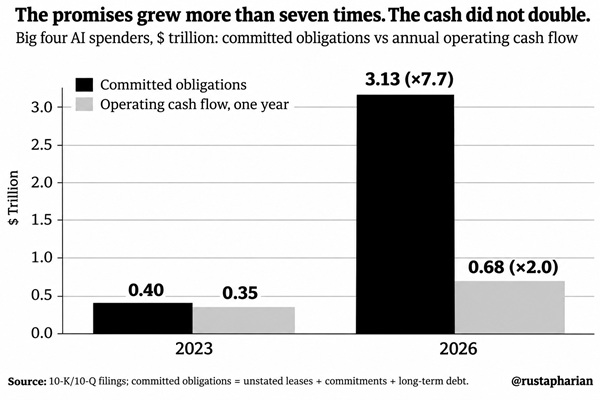
In “Dead Load: Can the AI Boom Carry Its Own Weight?”, Gaurav Rastogi examines the growing gap between Big Tech’s financial commitments and the cash flows supporting them.
The numbers are striking:
🔹$3.1 trillion in debt, leases and commitments across Amazon, Alphabet, Meta and Microsoft, up from roughly $400 billion in 2023.
🔹$677 billion in annual operating cash flow, less than double the 2023 level.
🔹A new Dead Load ratio of 4.6, compared with 1.2 in 2023.
These obligations stretch over several years, and none of the four companies is close to default.
But the analysis raises a different concern: What happens when an investment boom increasingly depends on fresh capital, rising share prices and customers whose own financing relies on the same ecosystem?
History offers a warning.
Read Gaurav Rastogi’s column.
https://t.co/qGjwYNDWm4
@rustapharian
#ArtificialIntelligence #BigTech #AIInfrastructure #CapitalMarkets #Nvidia #InvestmentRisk #GlobalMarkets
Bitcoin hit is a high of $86,979 on September 21, 2026.
Then it went into a freefall, bringing it to $62,100 on November 15, down about 29% in under eight weeks. The fall is best understood as a rates-and-positioning shock landing on a market whose marginal demand has weakened. And the immediate trigger for it was a hawkish Fed repricing.
Then, crypto-specific damage amplified the pressure. The Binance hack hit an already vulnerable market. Bitcoin’s divergence from equities added another complication when the former failed to participate in the equity rebound in November.
Adding to the mayhem, US policy shifted from an anticipated tailwind to an uncertain timetable. The CLARITY Act failed a September 15 procedural vote.
Also, greater uncertainty over the wider framework could delay additional institutional commitments and make the timing of fresh demand harder to judge.
In the medium term, concerns about US debt and an eventual easing of monetary policy could revive demand for Bitcoin as protection against currency debasement. A credible signal that the hiking cycle is ending would help, but sustained buying would still be needed to turn that relief into a recovery.
Read the full article by Yield Scribe, “Bitcoin’s Slide Tests the Strength of Institutional Demand” on BasisPoint Insight.
https://t.co/F7ppl0qVlK
#Bitcoin #BitcoinETF #CryptoMarket #FedPolicy #InstitutionalInvestors
April–September 2026 saw a striking $125.6 billion net increase in NRI deposits under banking capital liabilities. This figure, dominated by FCNR(B) deposits mobilised during the RBI’s special swap window, represents one of the largest such inflows on record. Additionally, there was an unprecedented $51.4 billion positive net flow under “ECB By India”—a category capturing net outward commercial lending and asset extensions by Indian entities.
V Thiagarajan, in his piece “The Other Side of the FCNR(B) Story” questions how much of the headline deposit growth reflects genuine, unleveraged NRI savings, and how much may have been amplified by leveraged structures.
Read the full article on BasisPoint Insight.
https://t.co/yhUdHCgXWE
#FCNRB #NRIDeposits #RBI #ForexFlows #BankingRisk #BoP
Neither party has ever won an Assembly seat in Uttar Pradesh. In the 2024 Lok Sabha election, together they polled about 1% of the vote.
Yet the new Azad–Owaisi alliance could still shape who forms the next UP government.
In 2024, the gap between the two big alliances in UP was only about 0.3 percentage points, and 107 Assembly segments were decided by fewer than 10,000 votes. In contests that close, a front that wins almost nothing can still decide who does.
So how many votes would the Samajik Parivartan Morcha need to make a difference? Which party would it hurt most? And will Muslim and Dalit voters choose representation, or vote tactically?
Amitabh Tiwari, Founding Partner at VoteVibe and a former investment banker, runs the numbers across three scenarios.
Read here: Spoiler or Spark? What the Azad–Owaisi Alliance means for UP 2027
https://t.co/9XgoTb8tT6
@politicalbaaba
#UPElections2027 #UttarPradesh #IndianPolitics #ElectionAnalysis #Elections #BasisPointInsight
Central banks made a costly mistake after the pandemic by treating rising inflation as temporary. When price pressures persisted and spread, they were forced into aggressive interest rate increases.
Former RBI Deputy Governor Dr Michael Debabrata Patra warns against repeating that experience.
India’s October inflation rose to 6.09%, breaching the RBI’s upper tolerance limit. Food prices remain a major driver, but pressures are also appearing in transport, services and core inflation.
Patra argues that while monetary policy cannot directly resolve supply disruptions, it must act when inflation becomes widespread and expectations begin to harden.
The challenge is to prevent temporary price shocks from turning into persistent inflation without imposing unnecessary costs on growth.
The question is not simply what triggered inflation, but whether policymakers can afford to wait once it begins to spread.
Read Michael Patra’s column for BasisPoint: The Supply Shock Alibi Is Back
https://t.co/b1KiKTHsCe
#RBI #Inflation #MonetaryPolicy #InterestRates #IndiaEconomy #CentralBanking
Can a regulator defend financial stability without compromising legal accountability?
The RBI’s decision to seek a review of the Supreme Court’s judgment in the Yes Bank AT1 bond dispute raises questions that extend well beyond the ₹84.15 billion write-down.
Srinath Sridharan examines what the dispute reveals about regulatory authority, legal safeguards and investor protection.
The case raises three important questions:
🔹Were the legal powers underpinning the write-down sufficiently clear?
🔹Should India consider a specialised appellate mechanism for challenging financial regulatory decisions?
🔹How can regulators act decisively during crises while remaining accountable for their decisions?
The author argues that regulatory independence and legal accountability need not be competing objectives.
The larger issue is whether India’s financial regulatory architecture provides enough clarity, expertise and timely scrutiny when decisions have far-reaching consequences.
The Yes Bank case may ultimately test more than the RBI’s authority. It may test the framework through which that authority is exercised.
Read: The ‘Yes Bank Test’ of Regulatory Authority
https://t.co/DFAxKjGcKU
@ssmumbai
#RBI #YesBank #BankingRegulation #FinancialStability #InvestorProtection #CorporateGovernance
Investors are moving money out of tech and back into bonds, hoping markets are returning to normal.
Mohamed El-Erian thinks that hope is premature.
AI hasn’t just driven the stock market. It has also been powering the wider economy, and it’s competing with governments for borrowed money, which has weakened bonds as a safety net. Even after the US midterms, too much of the market still depends on AI to treat this as a return to the old rules.
So if the old 60/40 playbook no longer works, what should investors do instead?
El-Erian is President of Queens’ College, Cambridge, and a professor at Wharton. In this piece, published via Project Syndicate, he explains why this is still an age of structural uncertainty, and how investors should position their portfolios for it.
Read here: Portfolio Regime Change?
https://t.co/dGt6ghzwzh
@ProSyn
#Investing #PortfolioManagement #AI #Bonds #AssetAllocation #Markets #MohamedElErian #ProjectSyndicate #BasisPointInsight