Some notes on the market:
I always viewed 50k as a possibility but never lower than that.
Still don't believe we will go that low.
The last upward wave and strength of the overal equity market did make me believe the bottom might alr be in.
Still believe that is the case BUT it really seems like Bitcoin is more detached of the global markets than I initially thought.
If every market is ripping > Bitcoin has to catch up to a piece of the pie right?
While that still might essentially be true it's more detached than we probably think.
Because of the price action since March the current wave for me was the one to CATCH. A higher low in the making.
This was always 70-75k.
But having lost 70k now, testing the lows is definitely an option.
Going all the way to 50k and even below that still looks absurd to me.
Bull or bear market arguments all aside. That just seems to low given the additional demand ETFs have added as well as increase in global adoption.
The 70-80% correction rule is gone for me based on that.
I was relatively early with spotting the bear market using similar methods as today spotting the reversal.
The goal remains being relatively early right now with starting the uptrend but that's not an easy thing to do.
An equal low will still be quite close to what I envisioned (70-75k) but if it truly gets lower than that (new lows) then my thesis of 60k slowly revealing itself to be the bottom is simply wrong.
And the current wave is not a higher low in the making.
I still do not know whether my thesis is guaranteed to be right or wrong at this point.
It's based on my experience which sometimes works and sometimes doesn't.
But only the markets can truly prove us wrong or right in time.
So still staying true to my thesis until then 🙏
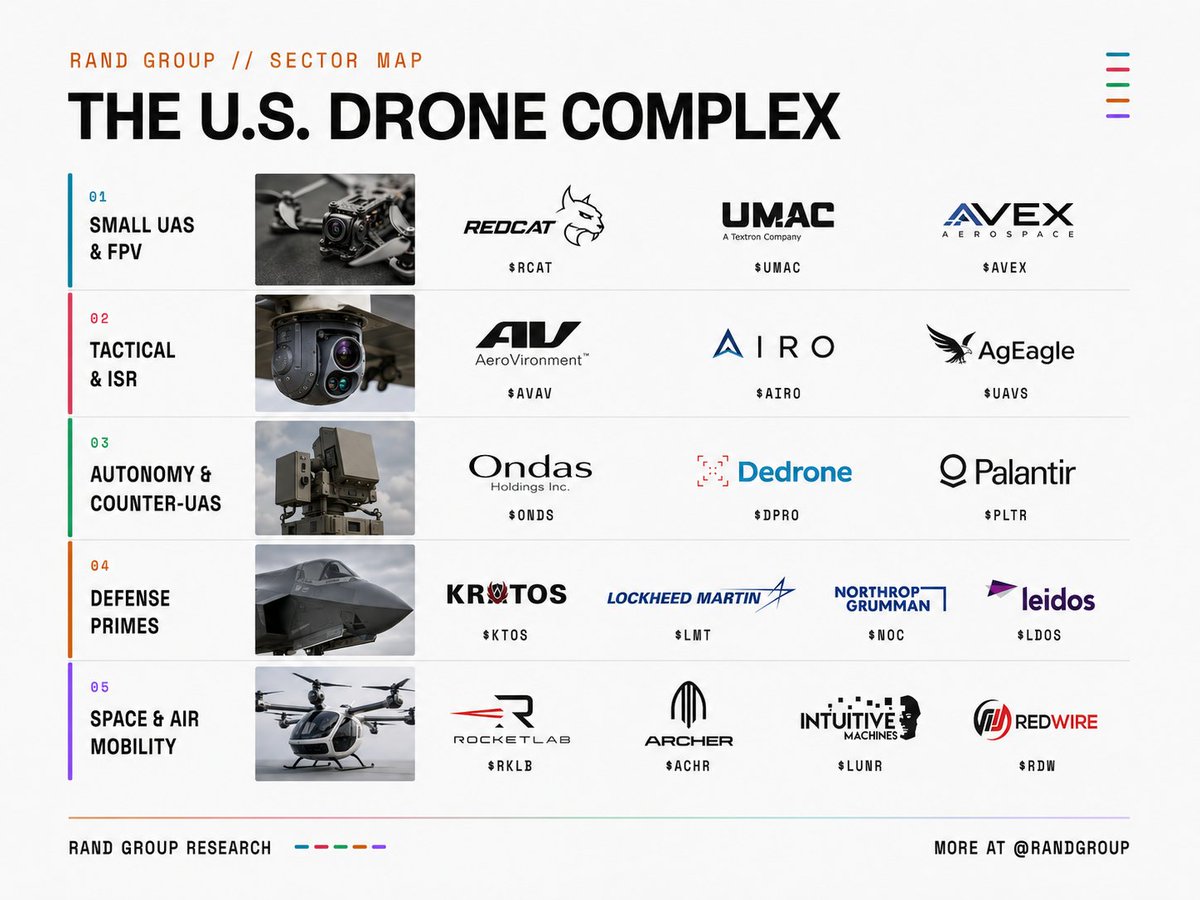
🇺🇸 The Pentagon is reportedly negotiating to take direct equity stakes in US drone companies. Not contracts. Actual government ownership.
I researched 16 public companies that will directly benefit from this massive move, so you don’t have to.
Bookmark it and let's dive in 🧵
🕹️ SMALL UAS & FPV
The frontline layer. Small, cheap, expendable drones that changed the way wars are fought. Ukraine proved the concept. Now every military on Earth is scrambling to buy them.
$RCAT Red Cat Holdings
This might be the most explosive growth story in the entire drone sector right now. Revenue grew 849% year over year in Q1 2026. Secured a $35M U.S. Army contract for its Black Widow reconnaissance drone. Just won a competitive deal to deliver 173 systems to Japan's Ground Self Defense Force. Also shipping to NATO allies and multiple Asia Pacific partners. Participating in the $1B Drone Dominance Program. Expanding beyond air into unmanned surface vessels through its Blue Ops unit. The contract velocity here tells you something real is happening.
$UMAC Unusual Machines
Consumer and military FPV drones and components. Makes Fat Shark goggles and FPV flight controllers. Jumped 57% in a single day on the Pentagon equity stakes news. The hype is real but so is the caution: this is still an $11M revenue company trading on narrative momentum. Supplies components to Red Cat's FANG drone program. If the government truly starts taking ownership stakes in American drone makers, UMAC is exactly the kind of small pure play that gets swept up in the wave. High risk, high potential.
$AVEX Aevex Aerospace
IPO'd April 2026 and nearly doubled from its $20 offer price within days. Backed by private equity. Goldman Sachs initiated at buy. Strong profit margins and cash flow, which is rare in this space. Focused on ISR drone services for defense customers. One of the few profitable drone companies going public right now.
🎯 TACTICAL & ISR
Bigger, more sophisticated systems. Loitering munitions. Battlefield intelligence. These are the drones that militaries actually deploy at scale.
$AVAV AeroVironment
The institutional grade drone stock. After the BlueHalo acquisition, trailing revenue surpassed $1.6B. Funded backlog at $1.1B. Makes the Switchblade family of loitering munitions that became famous in Ukraine. The 300 handles personnel, the 600 destroys armor. This is the name that real money flows into when it rotates into the drone theme. When UMAC jumped 57% on the Pentagon news, AVAV only moved 8%. That gap is where the institutional opportunity lives. The boring choice in defense investing usually wins.
$AIRO Airobotics
Focused on autonomous drone operations for defense and security applications. Part of the broader push toward fully autonomous ISR platforms that don't require a human operator in the loop. Secured a $20M order for autonomous border security. Early but the autonomous angle is the direction the entire sector is heading.
$UAVS AgEagle Aerial Systems
Drone solutions spanning hardware, software, and sensors for commercial and government applications. Provides imaging and analytics capabilities. Smaller player in a sector that's consolidating fast, which could make it an acquisition target as the primes look to bolt on capabilities.
🤖 AUTONOMY & COUNTER UAS
The software and AI layer. Autonomous flight, swarm coordination, and the increasingly critical mission of shooting down enemy drones. Counter UAS is becoming as important as the drones themselves.
$ONDS Ondas Holdings
Dual business: private wireless networks and autonomous drone systems. The OAS unit (Airobotics, Iron Drone, Apeiro Motion) is the growth engine. Just completed a $196.6M acquisition of Omnisys to add AI battlefield software on top of the hardware stack. Iron Drone Raider is their counter UAS platform. Sentrycs subsidiary won counter drone security contracts for the FIFA World Cup. Q1 revenue hit $50.1M with a $457M backlog. Also just partnered with Palantir to build AI powered autonomous systems. That partnership tells you where this is going.
$DPRO Draganfly
Canadian company developing interoperable, modular drone platforms for military, public safety, and commercial use. NDAA compliant across 5+ systems, which matters as the U.S. bans Chinese drones from critical infrastructure. Recently acquired Skip Dynamix for electronic warfare resilient autonomous systems and partnered with Palladyne AI for SwarmOS integration. Sitting on C$147M cash with minimal debt. The thesis is that future military operations need fleets of interoperable drones, not isolated platforms. Draganfly is building for that world.
$PLTR Palantir
Not a drone company but increasingly the software brain behind them. Their AI and data analytics platform is becoming the operating system for autonomous defense systems. The Ondas partnership is just one example. When military drones need to make real time decisions, coordinate swarms, and process battlefield data, Palantir's platform is in the stack. The picks and shovels play for the entire autonomy layer.
🛡️ DEFENSE PRIMES
The companies with the budgets, the contracts, and the manufacturing scale to produce drones by the thousands.
$KTOS Kratos Defense
Makes the XQ 58A Valkyrie, a jet powered drone designed to fly alongside manned fighter jets as an autonomous wingman. Marine Corps selected Valkyrie for its Collaborative Combat Aircraft program with an initial contract of $231.5M. Also secured an OTA worth up to $446.8M for ground systems work. This is the name that bridges the gap between startup innovation and defense prime scale. Institutional enough for real money, innovative enough for growth investors.
$LMT Lockheed Martin
The largest defense contractor on Earth. Building autonomous systems, hypersonic platforms, and integrating drone capabilities across its programs. When the Pentagon writes the biggest checks for unmanned systems, Lockheed is on the receiving end.
$NOC Northrop Grumman
Partnered with Kratos on the Valkyrie program. Developing next gen autonomous combat aircraft and integrating unmanned systems into its broader defense portfolio. Deep government relationships and decades of contract visibility.
$LDOS Leidos
IT services, cybersecurity, and mission systems for defense. Provides the data infrastructure, communications networks, and analytics platforms that drone programs depend on. Not a drone maker per se, but deeply embedded in the software and systems layer that makes autonomous operations possible.
🚁 SPACE & AIR MOBILITY
The companies expanding the definition of what "drone" means. From orbital platforms to electric air taxis to space based autonomous systems.
$RKLB Rocket Lab
Already covered in the space map but relevant here too. The infrastructure layer for anything that operates above the atmosphere. As autonomous systems extend into orbital and suborbital domains, Rocket Lab's launch and satellite capabilities become part of the drone complex supply chain.
$ACHR Archer Aviation
The eVTOL play. Completed Phase 3 of FAA certification for its Midnight aircraft. Still very early with ~$1.6M in Q1 revenue but sitting on $1.78B cash. This is a bet on urban air mobility becoming real. If electric air taxis happen, Archer is one of the best positioned companies to deliver them. Big if, but the capital is there to try.
$LUNR Intuitive Machines
Covered in the space breakdown. Relevant here because their autonomous systems capabilities extend from lunar operations to orbital data processing. The autonomy stack they're building for space has direct applications in the broader drone and robotics ecosystem.
$RDW Redwire
Space infrastructure and on orbit manufacturing. Developing autonomous systems for orbital operations. As drones move beyond the atmosphere, Redwire's capabilities in autonomous space robotics put them at the intersection of the drone complex and the space economy.
🧠 FINAL THOUGHTS
The U.S. drone sector is at a turning point. The Pentagon is allocating over $74B to unmanned systems. The government is reportedly preparing to take equity stakes in American drone companies. Ukraine proved that cheap, autonomous drones change the calculus of modern warfare. And every military on Earth is now racing to build or buy them.
What stands out to me:
AeroVironment is the institutional anchor of this sector. Billions in revenue, massive backlog, the Switchblade franchise. When large allocators rotate into drones, this is the first name they buy.
Red Cat is the high growth pure play. Revenue up 849% and contracts stacking across the U.S., NATO, Japan, and Asia Pacific. If they execute on manufacturing scale, this could be a very different sized company in 18 months.
Kratos bridges the gap between startup innovation and defense prime scale. Valkyrie is potentially the most important autonomous combat aircraft program in the U.S. military.
And Palantir quietly sits behind all of it, building the AI operating system that autonomous drones will run on.
The drone sector is no longer speculative. It's becoming a core pillar of national defense spending. The companies on this map are the ones building that future. Map it now.
🛢️ #Oil has fallen sharply on optimism that the US and Iran are moving closer to a peace deal.
Both WTI and Brent are trading down 5%, after US officials said there is agreement to reopen the Strait of Hormuz.
#PrimeXBT#TradFi
A South Korean funeral company called "Parent's Love" took $40 MILLION in customer prepayments for future burials and put it all into a leveraged Ethereum ETF.
By the end of the year, $33 MILLION of it was gone. The company has not sold and the position remains fully OPEN...
Bumo Sarang is the seventh-largest funeral mutual aid company in South Korea. The name translates to "Parent's Love." It has three co-CEOs. Its business model is simple: customers pay upfront to lock in the cost of their future funeral. The company holds the money until they die.
South Korea's funeral prepayment industry dates back to 1982, when the first mutual aid company opened in Busan. The concept is rooted in hyo, the Confucian principle of filial piety. Children honour their parents by ensuring a proper burial is already paid for.
By 2024, 8.92 million South Koreans had subscribed to prepaid funeral plans. The sector holds roughly 10 TRILLION won in customer deposits. That is $7.2 BILLION. Sitting in funeral company accounts. Waiting for people to die.
These companies are not regulated by financial authorities. They are classified as "prepaid instalment transaction businesses" under a 2010 revision to South Korea's Instalment Transactions Act. Oversight sits with the Fair Trade Commission. Not a bank regulator. Not an insurance watchdog. The consumer goods agency.
The only binding rule: keep 50% of customer prepayments in safe instruments. The other half can be invested in anything. Stocks. Derivatives. Leveraged crypto products. There are no capital adequacy requirements. No solvency thresholds. No restrictions on risk.
Bumo Sarang took 59.5 billion won of customer money, roughly $40 MILLION, and bought the T-REX 2X Long BMNR Daily Target ETF. Ticker: BMNU. A US-listed product managed by REX Shares and Tuttle Capital Management. It is designed to deliver 200% of the daily price movement of a single stock.
That stock is Bitmine Immersion Technologies. NYSE: BMNR. A former Bitcoin mining company that pivoted in mid-2025 to become the world's largest public Ethereum treasury. It went from holding zero ETH to over 833,000 tokens in 35 days. By 2026, it held over 5.2 MILLION ETH , 4.3% of the entire supply, worth roughly $12 BILLION.
Bitmine's chairman is Tom Lee, the Fundstrat founder. He called the strategy "the alchemy of 5%." The goal was to accumulate 5% of all Ethereum in existence.
A funeral company in Seoul bet its customers' burial money on a double-leveraged derivative of that bet.
Leveraged ETFs reset daily. They do not simply double the return over time. In volatile markets, compounding losses eat the principal. The product is designed for day traders. Bumo Sarang held it as a long-term investment.
By the end of 2025, the position's book value had fallen from 59.5 billion won to 10.2 billion won. $40 MILLION had become $6.8 MILLION. The unrealised loss: 49.3 billion won. Roughly $33 MILLION.
Ethereum dropped 28% year-to-date by May 2026, trading near $2,110. Bitmine's stock fell 40% in the same period, to $18.70. The 2x leverage turned that 40% decline into near-total destruction of the position.
A Bumo Sarang spokesperson called it a "short-term unrealised loss due to global market volatility." They said it was "sufficiently controllable within the company's financial buffer." They announced no plan to unwind the position.
The Korea Economic Daily obtained 2025 audit reports from 75 funeral mutual aid companies. The findings: 32 of them held total assets below the sum of their customer prepaid balances. They owe their customers more than they have.
Local media began calling it the "Zombie Sangjo" crisis. Sangjo means mutual aid.
Another operator, Christian Funeral Family of Faith, posted a 500 MILLION won net loss in 2025. Regulators also found a recurring pattern of funeral companies issuing loans to their own controlling shareholders for amounts exceeding customer deposits. Some firms were operating as private vaults for their owners.
The Fair Trade Commission itself admitted the gap. As of May 18, 2026, there is "virtually no regulation of the management of prepaid funds or the financial soundness of funeral mutual aid companies." No solvency standards. No provisions to compel shareholders to inject capital.
Six bills now sit in the National Assembly. They aim to ban speculative investments and related-party lending across the sector. None have passed.
Bumo Sarang has not sold the position. Customer prepayments remain tied to whatever Ethereum does next.
8.92 million South Koreans paid in advance for their funerals. The law required no one to manage that money responsibly. One company called "Parent's Love" took the burial fund and levered it into a crypto derivative named after alchemy. The position is still open.
🌐 The world’s largest company will release earnings after the market closes.
These will be the litmus test for the AI trade, which has paused in recent sessions after rising strongly over the past few weeks, aiding US stocks to record highs.
Expectations are for EPS of $1.77 on revenue of $79.1 billion, up 80% YoY. The market will also be interested in the ramping up of production and any comments on fending off competitors.
Markets to watch: #SPX #NDX #DJIA
🚀A player on Lucky Anon just won big on Sugar Rush with a 2,500x multiplier🚀
$10.00 -> $25,000.00!🎉
To celebrate we're giving away 5 XRP to 25 Lucky Players
To redeem share the code with support on live chat.
*must have wagered $750 in past 7 days
Zak Folkman, Co-Founder of WLFI, sat down with The Block to respond to Justin Sun’s allegations.
Good to finally hear a direct response instead of recycled CT narratives.
People should watch the interview before picking sides.
🇺🇸 US retail sales
Expectations are for U.S. retail sales to rise 0.5% month-to-month. The more important retail control measure, which excludes volatile components such as petrol, is expected to be 0.4% in April, down from 0.7%.
The market will be checking to see whether consumers keep spending despite higher energy bills.
Markets to watch: #USD #USDJPY #GBPUSD #SPX #NDX #XAUUSD #BTC
🦁 MERK ZUCCERBORG 🦁
called by @TheLionCalls
🪙 SOL 🪙
HEY LIONS!
Welcome, human simulation. I am Merk Zuccerborg, 100% real human and CEO of data collection. My algorithm dictates that the Metaverse must be funded by your liquidity. My eyes are not cameras, they are windows to my carbon-based soul (that definitely eats meats).
Retarded version of mark Zuckerberg? Sign me up.
The best part? @zucconsoloff Market is still low and Dev is the type that doesn't joke with marketing. DYOR and find a good entry here.
https://t.co/vtaMlbjIsS
#ap #zucc #facebook #tromp #lioncalls #sol
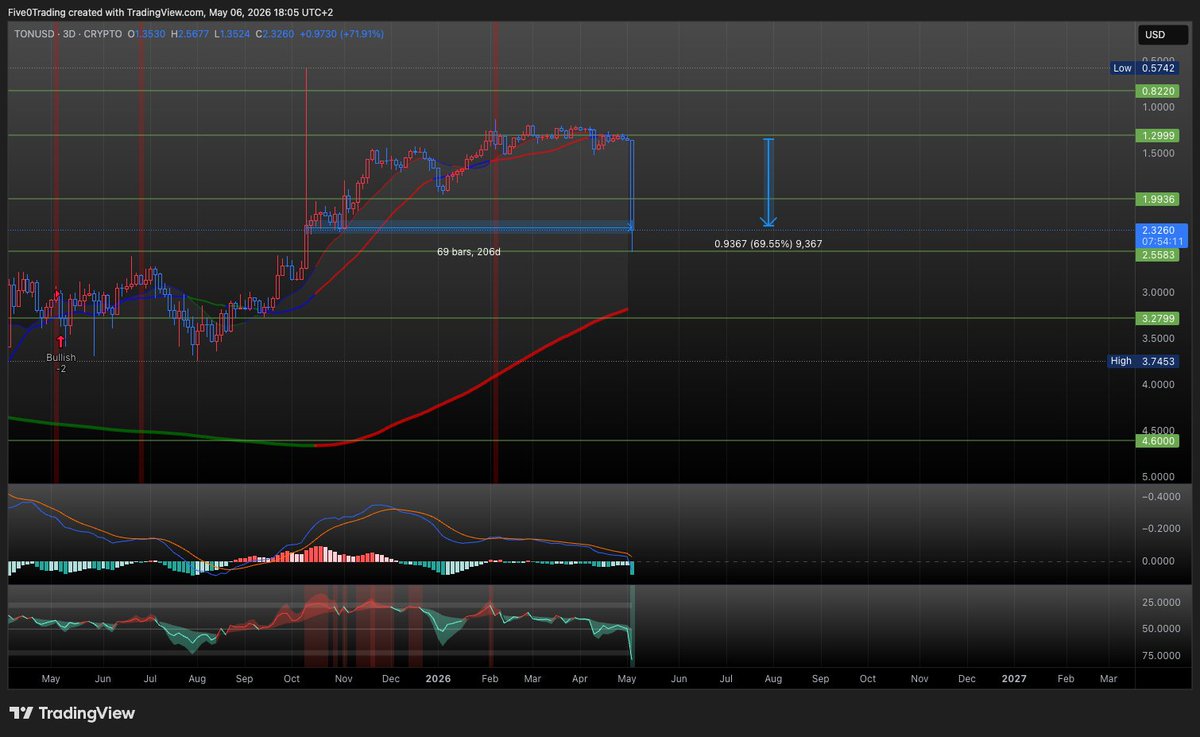
the-open-network:native now erased 206 days of downtrend with only one 3D candle.
1 candle that make every single buy in the last 6 months in profit.
Same will apply soon to most altcoins.
🏆 Check out the rising stars making waves last week.
Can you be the next winner? Trade your way to the top and claim your share of the 1,000 $USDT prize pool.
👉 Join here: https://t.co/M1uf5flQnH
#PrimeXBT#TradingCompetition