American Fuel & Petrochemical Manufacturers represents the makers of the fuels that keep us moving and the petrochemical building blocks for modern life.
Fresh from the AFPM Newsroom: We explain the high-level global dynamics at work in the diesel market, how we’re experiencing those things in the U.S. and what our refiners are doing to meet the moment.
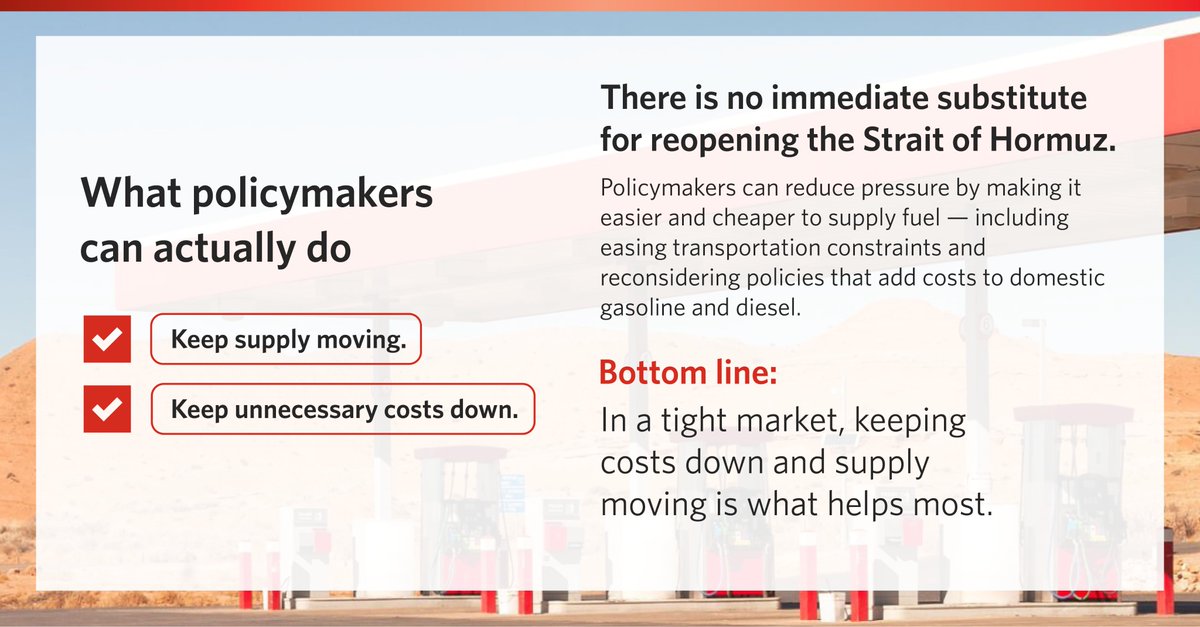
What else would help?
Policymakers should instead focus on removing barriers that unnecessarily raise costs and constrain infrastructure, investment and fuel movement within the U.S.:
- Reform the federal Renewable Fuel Standard
- Review state-level policies such as California's low carbon fuel standard
- Pass permitting reform and other policies to help expedite construction and approvals for critical energy infrastructure
- Continue Jones Act waivers
Out in Midland, Texas at one of the largest crude oil terminals in America, our oft-repeated line, “we make modern life possible,” rings truer than ever.
We caught up with Robert Nobles, VP of U.S. Facilities and Rail at Plains All American Pipeline, to learn more about the Midland terminal and how it helps move the crude oil used to make everyday products. Fun fact: Almost every American, at some point, has used fuel and materials that started out as oil moving through Midland.
https://t.co/MeRAeAwZSy
The U.S. wouldn’t have a strong manufacturing sector without our refiners and petrochemical manufacturers, and AFPM President and CEO @CThompsonAFPM is here to tell you why:
@ShopFloorNAM#NationalManufacturingDay
A diesel export ban could mean LESS U.S. fuel production and higher prices, but it could also INCREASE gas prices at the pump.
Hear from experts, analysts and a current administration official on why:
“A diesel export ban would raise prices. U.S. refiners currently produce about 5.3 million barrels of distillate a day against domestic demand of roughly 3.6 million. If exports are banned, refiners can’t just stockpile the surplus indefinitely. Instead, refiners would simply cut production. This would tighten supply, thus raising prices. Because gasoline and diesel are co-produced at the same refineries, cutting diesel output cuts gasoline output too. In this way, a policy sold as ‘relief’ would instead squeeze Americans more at the gas pump.”
— @IsabelleAliciaa, @taxreformer