INVESTOR ADVISORY: NIGERIA AGRICULTURE & FOOD SECURITY
MY ADVISORY APPROACH
When advising investors entering Nigeria's agricultural and food-security sector, I do not start with "What should I farm?"
I start with:
> Where is demand exceeding reliable supply, why does the gap exist, and can it be solved profitably?
Nigeria can simultaneously have high agricultural output, rising food demand, substantial imports and persistent food inflation. I see these inconsistencies as investment signals, not simply problems.
WHAT I ANALYSE
Production → Consumption → Supply Gap → Imports/Exports → Prices → Processing → Logistics → Policy → Security → Food Safety
I use these to identify:
Where demand is strongest
Where supply is inadequate
Why the gap persists
Who is already supplying the market
What infrastructure or capital is missing
Where investors can create competitive advantage
WHERE I LOOK FOR OPPORTUNITIES
I focus on commercially solvable bottlenecks across:
Processing | Storage | Logistics | Cold Chain | Mechanisation | Irrigation | Inputs | Feed | Aggregation | Food Safety | Export Processing
The investment target should be specific:
> Commodity + Location + Market + Bottleneck + Capital + Revenue Opportunity
IMPORTS & EXPORTS
Imports can reveal domestic supply gaps, but I do not automatically recommend import substitution.
I ask whether Nigeria can produce competitively on cost, quality and reliability.
Similarly, I look beyond raw commodity exports toward processing and higher-value African and global markets.
RISK & FOOD SECURITY
I assess:
Security | Climate | FX | Inflation | Input Costs | Infrastructure | Policy | Market Access
I also examine the full food chain:
Farm → Storage → Processing → Transport → Market → Consumer
A commercially attractive investment should ideally improve both business returns and food-system resilience.
2026–2030 OUTLOOK
I expect continued opportunities where:
Demand is strong + supply is constrained + the bottleneck is commercially solvable.
Priority areas include food processing, storage, logistics, cold chain, mechanisation, irrigation, agricultural inputs, feed, aggregation, food safety and export-oriented processing.
MY INVESTMENT TEST
Before recommending an opportunity, I ask:
Is demand measurable?
Is the supply gap real?
Why has it persisted?
Can it be solved commercially?
What capital is required?
What could undermine the investment?
Can the model scale?
MY ADVICE
Nigeria should not be treated as one agricultural market.
The intelligent investor looks for specific commodities, locations and value-chain gaps where demand, profitability and manageable risk converge.
> Don't follow the biggest agricultural number. Follow the biggest commercially solvable gap.
DATA → INSIGHT → OPPORTUNITY → INVESTMENT → IMPACT
AgInsight Africa:
Strategic Agribusiness | International Trade | Market Intelligence | Food Security Advisory
USDA JOB EXPERIENCE SERIES
[#1: My First Day at the U.S. Embassy]
I first visited the U.S. Embassy in Lagos in early December 1996, when it was located on Eleke Crescent, now Walter Carrington Crescent, to submit my job application. Until then, I had never been to the Embassy.
At the time, I was working as a Marketing/Business Development Officer in Surulere when I found a vacancy for an Agricultural Marketing Assistant with the USDA Foreign Agricultural Service (USDA/FAS).
The announcement had apparently been left on the floor of my office. I picked it up, applied, and was eventually shortlisted.
I was later told that more than 600 applications were received, with about 70 candidates shortlisted for a rigorous selection process involving written, oral, and multiple interviews.
Interestingly, my Marketing Manager and two senior colleagues were also shortlisted. We discovered this at the first interview and jokingly asked, “How did you get here?”
We had all left our offices during working hours, but fortunately, our simultaneous absence spared us from immediate questions from our employers.
As the screening progressed from December 1996 through January 1997, the number of candidates steadily declined.
I eventually completed about six rounds of interviews and was selected.
I resumed in the first week of February 1997.
The first three days were dedicated to orientation. Gloria, an American administrative officer, introduced me to Embassy departments and staff, as well as personnel at USIS, now the Public Affairs Section, and USAID.
On the third day, she took me to my workstation and pointed to the desktop computer.
She explained that it would be one of my most important tools because the position required extensive reporting.
There was only one problem: I had never used a computer!
Although computers were beginning to emerge in Nigerian workplaces, I had never operated one, typed a document, or even used a keyboard.
After Gloria left, I spent the afternoon staring at the computer and wondering how I would overcome the challenge.
At the time, security conditions allowed staff to remain overnight when necessary. I had also discovered there was a bathroom where staff staying overnight could freshen up.
That evening, I told my wife about my predicament and my plan to stay at the office for several nights to teach myself. She supported me.
For about three weeks, I worked during the day and spent much of the night practicing with the computer.
By the third week, I could operate it independently, although slowly. With continued practice, my confidence and proficiency grew rapidly.
That experience became an early lesson in my career: when opportunity presents itself, lack of experience should not become an excuse. Determination, discipline, and a willingness to learn can close the gap.
NIGERIA’S INFLATION PARADOX: Headline Relief, Food Pain and the Manufacturing Gap
Nigeria’s headline inflation eased to 15.43% in July 2026, but food inflation remained high at 20.31%, keeping pressure on household affordability.
With manufacturing at roughly 8–9% of GDP, gaps in processing, logistics, energy and agricultural supply chains remain significant.
For investors, these gaps represent major opportunities to build a more productive, resilient and competitive food system.
Nigeria's latest inflation data tell two different stories.
Headline inflation: 15.43% in July 2026, down from 15.91% in June.
Food inflation: 20.31%.
Adamawa: 51.36% year-on-year food inflation.
Lagos: 13.48% month-on-month food inflation.
The message is clear:
Nigeria may be winning part of the inflation battle, but households are still losing the food-affordability battle.
WHY IT MATTERS
Food inflation is not simply a monetary problem. It is increasingly a food-system and supply-chain problem involving:
• Farm production costs
• Fertilizer and agrochemicals
• Energy and diesel
• Rural roads and logistics
• Storage and cold chains
• Security and access to farms
• Working capital and FX
• Processing capacity
• Wholesale and urban distribution
The World Bank's analysis also shows agricultural losses from partial shocks increased from about 6% of plots in 2018/19 to more than 20% in 2023/24.
THE GEOGRAPHY OF FOOD INFLATION
Highest year-on-year food inflation:
Adamawa: 51.36%
Katsina: 30.84%
Zamfara: 30.65%
Lowest:
Borno: -0.31%
Nasarawa: 6.88%
Kebbi: 12.50%
This wide variation is more than a statistical curiosity.
It can signal opportunities for:
SURPLUS → AGGREGATION → STORAGE → PROCESSING → LOGISTICS → DEFICIT MARKETS
For investors, state-level price differences can therefore become market, infrastructure and arbitrage intelligence.
THE MANUFACTURING GAP
Nigeria has enormous agricultural potential and a huge consumer market, yet manufacturing remains around the 8–9% of GDP range.
That matters because agriculture cannot deliver maximum value without:
Farmers → Processors → Manufacturers → Logistics → Markets → Consumers
A weak processing base means:
• Less value addition
• Higher post-harvest losses
• Greater price volatility
• Lower farmer incomes
• More import dependence
• Fewer industrial jobs
• Less competitive exports
Nigeria's stated ambition to raise manufacturing to 20–25% of GDP by 2030 therefore requires more than policy announcements.
It requires measurable progress in power, finance, infrastructure, agricultural supply, technology, logistics and trade policy.
FOOD SECURITY IS BIGGER THAN INFLATION
FAO and WFP estimates indicate that about 35 million Nigerians face acute food insecurity in 2026, with the Northeast remaining a major hotspot.
Nigeria therefore needs a more integrated model:
Food Production + Processing + Finance + Logistics + Security + Market Access + Resilience
WHERE THE OPPORTUNITIES ARE
The structural gaps point directly to investment opportunities in:
>Food aggregation
>Storage and warehousing
>Cold-chain infrastructure
>Rice processing
>Tomato processing
>Poultry and livestock
>Animal feed
>Irrigation
>Agro-logistics
>Renewable industrial power
>Food packaging
>Export-oriented processing
>Digital market intelligence
The strongest opportunities are likely to be businesses that solve two problems simultaneously, such as:
Processing + farmer market access
Storage + price stabilization
Renewable energy + industrial processing
THE AGINSIGHT INVEST LENS
We assess agribusiness opportunities through six questions:
I — Investment Climate
Is the operating environment predictable enough for capital deployment?
N — National/Regional Policy
Do policies support the business model?
V — Value Chain
Where are the bottlenecks and margins?
E — Economics
Can the business achieve competitive unit economics?
S — Sustainability
Can it withstand climate, ...
Nigeria–South Africa Tensions: A Warning for AfCFTA
The latest Nigeria–South Africa clash over migration and xenophobia is more than a diplomatic dispute. It is a warning for AfCFTA, investment and Africa's food and trade supply chains.
At a recent Commonwealth parliamentary conference, Nigerian and South African lawmakers openly disagreed over whether attacks on African migrants should be formally described as xenophobia.
The numbers
- 1,490 Nigerians repatriated from South Africa following recent violence.
- Almost US$18 million reportedly spent by South Africa on migrant repatriation.
- US$15.1 billion: South Africa's agricultural exports in 2025.
- 53%: share of South African agricultural exports going to African markets.
- 1.4 billion people: AfCFTA's potential market.
- 45%: potential increase in intra-African trade from full AfCFTA implementation by 2045.
Why it matters
South Africa depends heavily on African markets. Nigeria provides a major consumer market and a gateway to West Africa.
Political tension can quickly become:
border disruption → higher logistics costs → supply delays → higher food prices → weaker investment confidence.
The impact goes beyond Nigeria and South Africa. It affects ECOWAS, SADC, the AU Free Movement Protocol, PAPSS, and AfCFTA.
Investment opportunities
The risk increases demand for:
Regional food processing | Cold chain | Logistics | Trade finance | Local sourcing | Market intelligence | Food-safety compliance
Policy priority
Africa needs secured borders without blocking legitimate trade, investment and movement.
Nigeria and South Africa should strengthen cooperation on migration, business protection, trade facilitation and food supply chains.
AgInsight Perspective
AfCFTA is targeting a 45% increase in intra-African trade. But removing tariffs is not enough.
Africa cannot build one market if political tensions prevent people, goods, services and capital from moving safely and predictably.
The Nigeria–South Africa dispute is therefore an early warning: Africa's integration strategy must address migration, security and trade together.
AgInsight Africa
Strategic Intelligence for Agribusiness, Food Security, Trade and Investment
BURKINA FASO'S FOOD-SOVEREIGNTY BET
[What the Numbers Mean for Nigeria and Africa]
Burkina Faso is testing whether aggressive domestic investment can improve food security under severe security and economic constraints. Cereal production reached 6.1 million tons in 2024, about 20% above the five-year average, and increased another 17.6% in 2025. Agriculture contributed 1.7 percentage points to 2025 GDP growth.
The lesson for Nigeria is not to reject imports or foreign assistance. It is to increase domestic productivity, reduce avoidable import dependence and build competitive food value chains.
The Numbers That Matter
Burkina Faso is strengthening food sovereignty through domestic production. Cereal output reached 6.1 million tons in 2024 and grew 17.6% in 2025, although over 2.7 million people still faced acute food insecurity in 2024.
Nigeria faces a larger demand-supply gap. 34.7 million people are projected to face acute food insecurity in 2026, while about 30% of food consumed is imported. This creates major investment opportunities in rice, wheat, maize, soybean, poultry, irrigation, mechanisation and food processing.
The opportunity is clear: increase productivity, reduce import dependence and convert Nigeria's food-demand gap into profitable agribusiness investment.
The Critical Fact Check
The widely circulated claim that Burkina Faso rejected a $450 million U.S. soybean aid package is not verified by credible evidence.
The documented $450 million U.S. commitment was a Millennium Challenge Corporation compact signed in 2020, primarily targeting energy, not soybeans. The U.S. paused the compact after the 2022 military takeover.
Burkina Faso's agricultural self-reliance programme is substantial. Government agricultural equipment and input support exceeded CFAF 78 billion (about US$124 million) in 2024, rising to CFAF 104 billion (about US$186 million) in 2025.
Nigeria's Strategic Lesson
Nigeria should target food competitiveness, not simply food self-sufficiency.
Priority value chains include:
Soybean→feed→poultry/fish→ animal protein
Maize → feed → poultry/livestock
Rice→milling→packaged food
Wheat→ flour→bread/noodles
Cassava→starch/flour→industrial products
Tomato/vegetables→processing→cold chain
With 34.7 million Nigerians projected to face acute food insecurity in 2026, food production is no longer simply an agricultural issue. It is an economic-security issue.
Investment Opportunities
The largest opportunities are increasingly around the farm, not just on the farm:
Irrigation | mechanization services | storage | cold chains | seed | fertilizer distribution | feed mills | processing | logistics | commodity finance | food testing and certification.
AgInsight Africa Perspective
Africa does not need a choice between foreign aid and food sovereignty.
It needs the capacity to produce competitively, import strategically, process locally and export profitably.
For Nigeria, the 2026-2030 objective should be measurable:
"Increase productivity faster than food demand, reduce avoidable import dependence, lower food losses and costs, and convert agricultural surpluses into competitive African exports."
Food sovereignty should ultimately be measured not by how much foreign assistance a country rejects, but by whether it can consistently produce safe, affordable food while generating profitable incomes for farmers and competitive returns for investors.
#FoodSecurity #AgribusinessAfrica #NigeriaEconomy #AfricaAgriculture #FoodSovereignty #AgriInvestment #FoodSystems #TradeAndInvestment #ClimateSmartAgri #EconomicDevelopment #EU #USDAUSA #UKUcheNzeka
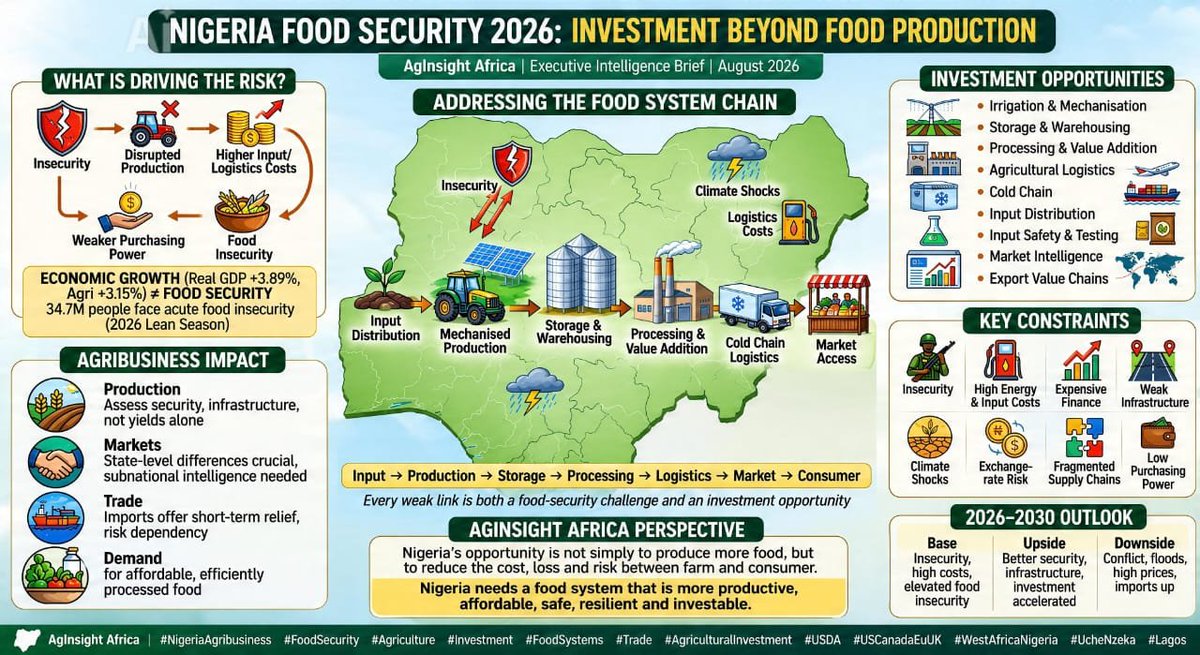
NIGERIA FOOD SECURITY 2026: INVESTMENT BEYOND FOOD PRODUCTION
AgInsight Africa.
Executive Intelligence Brief. August 2026
Nigeria's food-security challenge is increasingly a food-system and investment challenge, not simply a production problem.
34.7 million people were projected to face acute food insecurity in the 2026 lean season, while 21–22 million may require humanitarian food assistance through January 2027.
Yet real GDP grew 3.89% and agriculture 3.15% in Q1 2026.
The lesson: economic growth alone does not guarantee food security.
WHAT IS DRIVING THE RISK?
Insecurity → disrupted production → higher input/logistics costs → weaker purchasing power → food insecurity
Nigeria therefore needs to address:
Production + Security + Access + Affordability + Market Function + Food Safety
AGRIBUSINESS IMPACT
Production: Investors must assess security, input costs, infrastructure, water, logistics and market access, not yields alone.
Markets: National averages can hide major state-level shortages and price differences. Subnational intelligence is increasingly critical.
Trade: Imports can provide short-term relief but prolonged dependence can weaken domestic production incentives.
Demand: High food costs and weak incomes increase demand for affordable, efficiently processed food.
INVESTMENT OPPORTUNITIES
> Irrigation & mechanisation
> Storage & warehousing
> Processing & value addition
> Agricultural logistics
> Cold chain
> Input distribution
> Food safety & testing
> Market intelligence
> Export value chains
The $500 million World Bank AGROW programme signals growing institutional capital for agricultural value chains.
KEY CONSTRAINTS
Insecurity, high energy and input costs, expensive finance, weak infrastructure, climate shocks, exchange-rate risk, fragmented supply chains and low purchasing power remain major constraints.
Nigeria should not be treated as one agricultural market. Risk and opportunity vary by commodity, location and market corridor.
2026–2030 OUTLOOK
Base: Harvests improve availability, but insecurity and high costs keep food insecurity elevated.
Upside: Better security, infrastructure, finance and lower input costs accelerate investment.
Downside: Conflict, floods or input-price shocks increase food prices, imports and humanitarian needs.
AGINSIGHT AFRICA PERSPECTIVE
Nigeria's opportunity is not simply to produce more food, but to reduce the cost, loss and risk between farm and consumer:
Input → Production → Storage → Processing → Logistics → Market → Consumer
Every weak link is both a food-security challenge and an investment opportunity.
Bottom line: Nigeria needs a food system that is more productive, affordable, safe, resilient and investable.
#AgInsightAfrica #NigeriaAgribusiness #FoodSecurity #Agriculture #Investment #FoodSystems #Trade #AgriculturalInvestment #USA #Canada #EU #UK #Australia #NewZealand #NigeriaWestAfrica #Hunger #WorldBank #AFCFTA #AfDB #NGODevelopmentPartner
Nigeria’s GMO Debate: Food Security Opportunity or Governance Risk?
Executive Insight
Nigeria’s genetically modified organism (GMO) debate is no longer theoretical. Bacillus thuringiensis (Bt) cowpea has been commercially deployed since 2019 and TELA maize since 2024, while the country faces 34.7 million people at risk of acute food insecurity in 2026 and rising dependence on food imports.
The strategic issue is not simply GMO versus non-GMO. It is whether biotechnology can deliver measurable productivity gains while Nigeria strengthens biosafety, traceability, labelling, farmer choice and export-market compliance.
Key Numbers
- 34.7 million: Nigerians projected to face acute food insecurity in 2026.
- 6.4 million: Food-insecure population in Northeast Nigeria.
- 2019: Commercial approval of Bt cowpea.
- 2024: Commercial release of TELA maize.
- +21%: Yield gain reported for Pod Borer Resistant (PBR) cowpea in field evaluation.
- +49%: Increase in net farmer margins in the same evaluation.
- 650,000 metric tonnes (MT): United States Department of Agriculture (USDA) forecast for Nigeria’s 2026/27 maize imports, +160% year-on-year.
Agribusiness Impact
Opportunity: Genetically modified (GM) technology could improve yields, reduce pest-related losses, lower some pesticide requirements and improve farmer margins. The strongest commercial opportunities are in seed multiplication, distribution, crop finance, testing, traceability, mechanisation and integrated production systems.
But technology alone is insufficient. Nigeria’s food deficit is also driven by insecurity, climate shocks, poor irrigation, high input costs, weak extension, post-harvest losses, inadequate storage and logistics, and limited access to finance.
Major Constraints & Disadvantages
1. Regulatory capacity: Risk assessment, monitoring and enforcement need strengthening.
2. Consumer confidence: Controversy and limited public understanding could slow adoption.
3. Traceability: Weak seed-to-market tracking creates food-safety and trade risks.
4. Labelling: Poor visibility could undermine consumer choice and market confidence.
5. Export risk: Markets demanding non-GMO or identity-preserved commodities may require segregated supply chains.
6. Technology dependence: Excessive reliance on proprietary genetics could increase farmer input costs and dependency.
7. Environmental risk: Resistance development, biodiversity effects and chemical-use patterns require continuous monitoring.
8. Structural food-security risk: GMO crops cannot solve insecurity, infrastructure deficits, climate vulnerability or poor market access.
2026-2030 Outlook
Base case: Gradual expansion of GM maize, cowpea and potentially other crops, accompanied by continued political and consumer controversy.
Upside: Biotechnology integrated with irrigation + mechanisation + improved seed + finance + extension + storage, producing measurable productivity and import-substitution gains.
Downside: Weak regulation, inadequate labelling or a major safety or environmental controversy triggers public resistance, tighter regulation and potential export-market complications.
Policy & Investment Priorities
Government should focus on evidence-based regulation, independent testing, transparent risk assessment, post-release monitoring, labelling, traceability and farmer choice.
Investors should look beyond GMO seed itself toward the wider productivity ecosystem: certified seed, biotechnology testing, precision agriculture, irrigation, crop protection, storage, logistics, identity-preserved/non-GMO supply chains and food-safety compliance.
AgInsight Africa Perspective
Nigeria’s GMO debate is fundamentally a productivity and governance challenge.
With 34.7 million people facing acute food insecurity and maize imports potentially reaching 650,000 MT, Nigeria needs every credible productivity-enhancing technology. But GMO adoption should be judged by measured yield, farmer income, pesticide use, food-safety
BURKINA FASO: FOOD SOVEREIGNTY AS ECONOMIC STRATEGY
2025/26 cereal output reached 7.14Mt, up 17.6% YoY and 37.2% above the 5-year average. Cereal coverage hit 126.6%, yet ~2.8m people still need assistance.
The lesson: food availability ≠ food security.
The next investment frontier is the gap between farm output and consumer access: storage, processing, logistics, finance and market intelligence.
AgInsight Africa | 2026
#BurkinaFaso #FoodSecurity #Agribusiness
Africa's Next Agricultural Investment Frontier: Look Beyond the Headlines
While headlines focus on politics and security, smart investors should be watching something far more significant: Africa is rebuilding its food systems and productive capacity.
Countries are increasingly investing in irrigation, agricultural infrastructure, local manufacturing, public health, technical skills, and agro-industrial development—the foundations of long-term food security and economic growth.
Why Investors Should Pay Attention
# Africa's population is projected to exceed 2.5 billion by 2050, creating the world's fastest-growing food market.
# The continent still imports over US$50 billion worth of food annually despite possessing about 60% of the world's uncultivated arable land.
# The African Continental Free Trade Area (AfCFTA) connects a market of 1.4 billion consumers with a combined GDP of more than US$3 trillion, creating unprecedented opportunities for agribusiness, food processing, logistics, agricultural technology, and regional trade.
Nigeria: The Strategic Gateway
With over 240 million consumers, Nigeria remains Africa's largest food market. Government reforms promoting food security, value addition, agro-industrialisation, and private-sector investment are creating new opportunities across the agricultural value chain.
My Advice to Investors
The next wave of agricultural investment in Africa will not be won by capital alone. It will be won by those who combine investment with market intelligence, policy insight, strategic partnerships, and disciplined risk management.
The biggest opportunities lie in:
- Irrigation and climate-smart agriculture
- Agro-processing and food manufacturing
- Cold-chain logistics and storage
- Seed, fertilizer and farm inputs
- Digital agriculture and market intelligence
- Food safety, export certification and regional trade
Africa's agricultural transformation is no longer a future aspiration—it is an emerging investment reality.
As an agribusiness advisor, I believe the next decade will reward those who invest early, invest strategically, and invest with local insight.
Is your organization prepared to participate in Africa's next agricultural growth story?
#Agribusiness #Africa #Nigeria #FoodSecurity #Agriculture #Investment #AgriBusiness #AfCFTA #MarketIntelligence #Trade #FoodSystems #EmergingMarkets #ForeignInvestment #Policy #Sustainability


![AgINSIGHTS's tweet photo. USDA JOB EXPERIENCE SERIES
[#1: My First Day at the U.S. Embassy]
I first visited the U.S. Embassy in Lagos in early December 1996, when it was located on Eleke Crescent, now Walter Carrington Crescent, to submit my job application. Until then, I had never been to the Embassy.
At the time, I was working as a Marketing/Business Development Officer in Surulere when I found a vacancy for an Agricultural Marketing Assistant with the USDA Foreign Agricultural Service (USDA/FAS).
The announcement had apparently been left on the floor of my office. I picked it up, applied, and was eventually shortlisted.
I was later told that more than 600 applications were received, with about 70 candidates shortlisted for a rigorous selection process involving written, oral, and multiple interviews.
Interestingly, my Marketing Manager and two senior colleagues were also shortlisted. We discovered this at the first interview and jokingly asked, “How did you get here?”
We had all left our offices during working hours, but fortunately, our simultaneous absence spared us from immediate questions from our employers.
As the screening progressed from December 1996 through January 1997, the number of candidates steadily declined.
I eventually completed about six rounds of interviews and was selected.
I resumed in the first week of February 1997.
The first three days were dedicated to orientation. Gloria, an American administrative officer, introduced me to Embassy departments and staff, as well as personnel at USIS, now the Public Affairs Section, and USAID.
On the third day, she took me to my workstation and pointed to the desktop computer.
She explained that it would be one of my most important tools because the position required extensive reporting.
There was only one problem: I had never used a computer!
Although computers were beginning to emerge in Nigerian workplaces, I had never operated one, typed a document, or even used a keyboard.
After Gloria left, I spent the afternoon staring at the computer and wondering how I would overcome the challenge.
At the time, security conditions allowed staff to remain overnight when necessary. I had also discovered there was a bathroom where staff staying overnight could freshen up.
That evening, I told my wife about my predicament and my plan to stay at the office for several nights to teach myself. She supported me.
For about three weeks, I worked during the day and spent much of the night practicing with the computer.
By the third week, I could operate it independently, although slowly. With continued practice, my confidence and proficiency grew rapidly.
That experience became an early lesson in my career: when opportunity presents itself, lack of experience should not become an excuse. Determination, discipline, and a willingness to learn can close the gap.](https://pbs.twimg.com/media/HQL3aeXW0AAELGn.jpg)


![AgINSIGHTS's tweet photo. BURKINA FASO'S FOOD-SOVEREIGNTY BET
[What the Numbers Mean for Nigeria and Africa]
Burkina Faso is testing whether aggressive domestic investment can improve food security under severe security and economic constraints. Cereal production reached 6.1 million tons in 2024, about 20% above the five-year average, and increased another 17.6% in 2025. Agriculture contributed 1.7 percentage points to 2025 GDP growth.
The lesson for Nigeria is not to reject imports or foreign assistance. It is to increase domestic productivity, reduce avoidable import dependence and build competitive food value chains.
The Numbers That Matter
Burkina Faso is strengthening food sovereignty through domestic production. Cereal output reached 6.1 million tons in 2024 and grew 17.6% in 2025, although over 2.7 million people still faced acute food insecurity in 2024.
Nigeria faces a larger demand-supply gap. 34.7 million people are projected to face acute food insecurity in 2026, while about 30% of food consumed is imported. This creates major investment opportunities in rice, wheat, maize, soybean, poultry, irrigation, mechanisation and food processing.
The opportunity is clear: increase productivity, reduce import dependence and convert Nigeria's food-demand gap into profitable agribusiness investment.
The Critical Fact Check
The widely circulated claim that Burkina Faso rejected a $450 million U.S. soybean aid package is not verified by credible evidence.
The documented $450 million U.S. commitment was a Millennium Challenge Corporation compact signed in 2020, primarily targeting energy, not soybeans. The U.S. paused the compact after the 2022 military takeover.
Burkina Faso's agricultural self-reliance programme is substantial. Government agricultural equipment and input support exceeded CFAF 78 billion (about US$124 million) in 2024, rising to CFAF 104 billion (about US$186 million) in 2025.
Nigeria's Strategic Lesson
Nigeria should target food competitiveness, not simply food self-sufficiency.
Priority value chains include:
Soybean→feed→poultry/fish→ animal protein
Maize → feed → poultry/livestock
Rice→milling→packaged food
Wheat→ flour→bread/noodles
Cassava→starch/flour→industrial products
Tomato/vegetables→processing→cold chain
With 34.7 million Nigerians projected to face acute food insecurity in 2026, food production is no longer simply an agricultural issue. It is an economic-security issue.
Investment Opportunities
The largest opportunities are increasingly around the farm, not just on the farm:
Irrigation | mechanization services | storage | cold chains | seed | fertilizer distribution | feed mills | processing | logistics | commodity finance | food testing and certification.
AgInsight Africa Perspective
Africa does not need a choice between foreign aid and food sovereignty.
It needs the capacity to produce competitively, import strategically, process locally and export profitably.
For Nigeria, the 2026-2030 objective should be measurable:
"Increase productivity faster than food demand, reduce avoidable import dependence, lower food losses and costs, and convert agricultural surpluses into competitive African exports."
Food sovereignty should ultimately be measured not by how much foreign assistance a country rejects, but by whether it can consistently produce safe, affordable food while generating profitable incomes for farmers and competitive returns for investors.
#FoodSecurity #AgribusinessAfrica #NigeriaEconomy #AfricaAgriculture #FoodSovereignty #AgriInvestment #FoodSystems #TradeAndInvestment #ClimateSmartAgri #EconomicDevelopment #EU #USDAUSA #UKUcheNzeka](https://pbs.twimg.com/media/HP4bQI-XsAAySIe.jpg)