What’s shaping health policy right now? The latest AIR Health News examines Medicare Advantage oversight, enrollment and spending trends, and evolving Medicaid policies—alongside new research developments.
Learn more: https://t.co/SnIHBTM9sV
What makes a workforce credential valuable? A @BrookingsInst article by AIR’s Amy Feygin and Harry Holzer highlight how community colleges can better align programs with jobs, engage employers, expand work-based learning and strengthen student supports.
https://t.co/TP5vt13JlI
How do states actually decide how to fund education?
A new explainer breaks down funding formulas, student counts, and targeted adjustments—and why how funds are allocated shapes access to resources and opportunities.
https://t.co/yOLOxpewus
How can Medicare Advantage balance innovation with accountability? Our latest report outlines targeted policy options to reduce fraud, waste, and abuse: https://t.co/YGa63oKHSI
New AIR research with the Steans Family Foundation examines Chicago’s out-of-school-time (OST) landscape. Findings show opportunities to strengthen alignment, reduce burden, and expand youth access. https://t.co/fNm4xaZa4s
The Wind River Computer Science Collaborative is being recognized for bringing culturally relevant coding to students. Directed by AIR’s Katie Rich, it reflects a “labor of love” and the “amazing work” of teachers and learners. https://t.co/MMPjTQaak5
New in AIR Health News: Surgeon attrition rates, major CMS policy updates, and emerging research on maternal health and behavioral health. Also: AIR experts head to #ARM2026 to share insights on workforce and patient-centered care.
🔗 Full newsletter: https://t.co/8KedtoYQNl
New Workforce Pell rules expand access to short-term training. Starting July 2026, Pell Grants can fund 8–15 week programs in high-demand fields. States play a key role in implementation.
Explore AIR resources for states: https://t.co/rHH6cjdivq
AIR has launched the new @NSF-funded Center for STEM Education Research and Translation, which aims to strengthen the movement of PreK-12 STEM education research to and from STEM learning environments.
Learn how the Center is supporting #STEMEd: https://t.co/AuJ2kws71u
AIR and @NatlGovsAssoc are piloting a new effort to help states identify skills for high-demand roles, implement skills-based hiring and development, and measure ROI—supporting more effective, data-driven public sector talent systems. https://t.co/01ueCS0bkj
Pre‑apprenticeship is gaining momentum nationwide. With support from @Britebound, AIR looks at how states are strengthening these pathways: https://t.co/mPzNb3m8xr
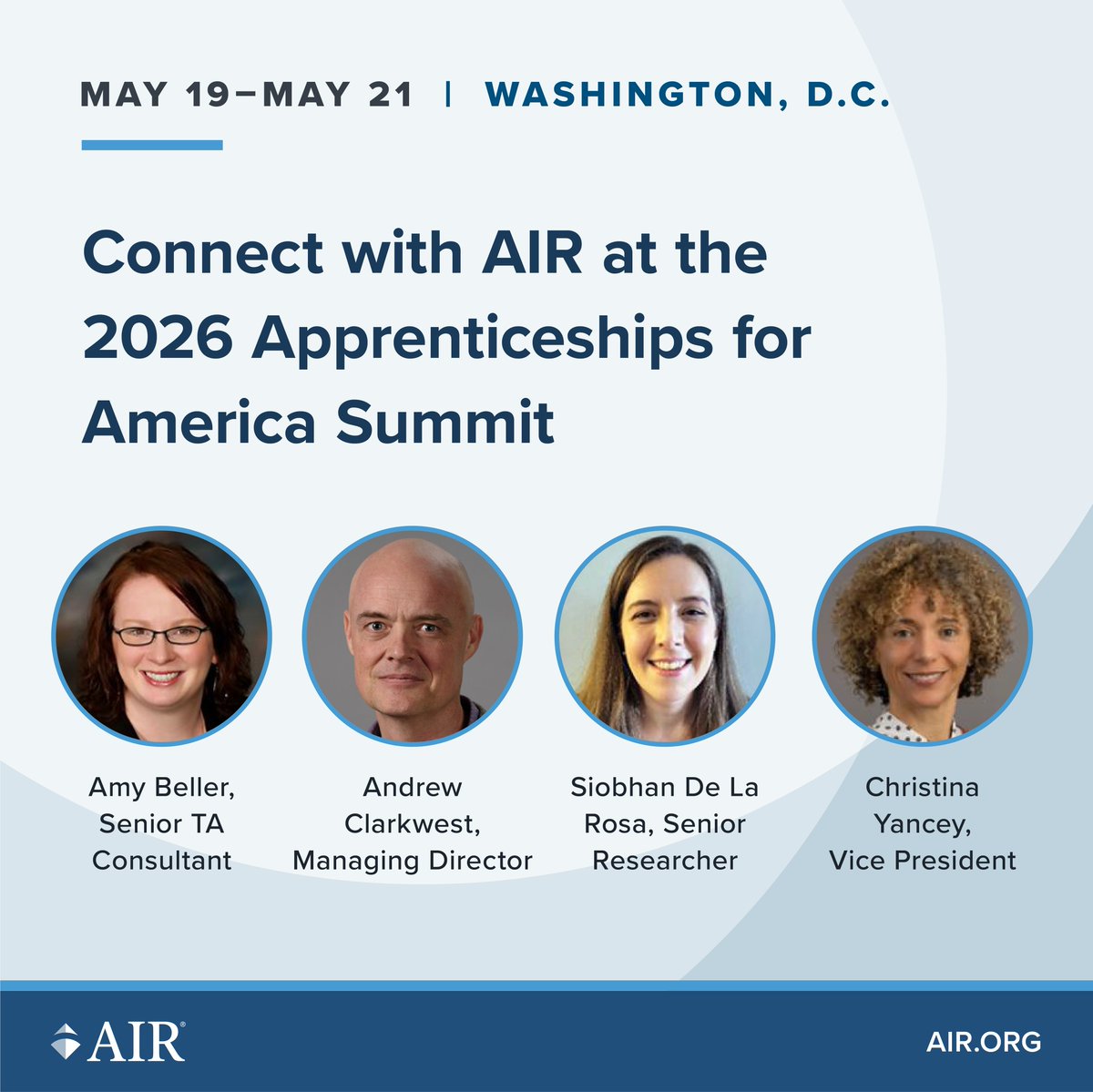
Join AIR at #ARM2026, where our experts will present across a range of health topics. Highlights include Institute Fellow Brandy Farrar sharing findings on the mental health workforce, and sessions on primary care, access, and patient-centered research. https://t.co/dwwiduUV2n
This week, AIR is at #AFA2026, connecting across the field. We’re highlighting our @AscendiumEd-funded Upward Apprenticeship Initiative. Learn more: https://t.co/hbAUxduBdw
The new AIR Health News covers major developments in health and policy—from preventable maternal deaths to AI detecting pancreatic cancer earlier, plus new Medicare coverage for weight loss drugs. https://t.co/H16UcWIJ3b
The energy sector is changing quickly—and the challenges go beyond technology.
AIR brings expertise in workforce development, policy analysis, and evaluation to help leaders navigate what’s next and build systems that work for people and communities.
https://t.co/QVEC34oFh2
When do cash transfers improve health—and when do they save lives?
AIR researchers examine when cash transfers affect nutrition, health care use, and survival—and why timing, systems, and program design make all the difference.
https://t.co/QFDe3a3WGM
Underperformance isn’t one‑size‑fits‑all.
New AIR research shows low‑performing schools in Ohio struggle due to different mixes of underfunding and inefficiency—pointing to smarter, more targeted support.
🔗 https://t.co/hdV20LPeAl
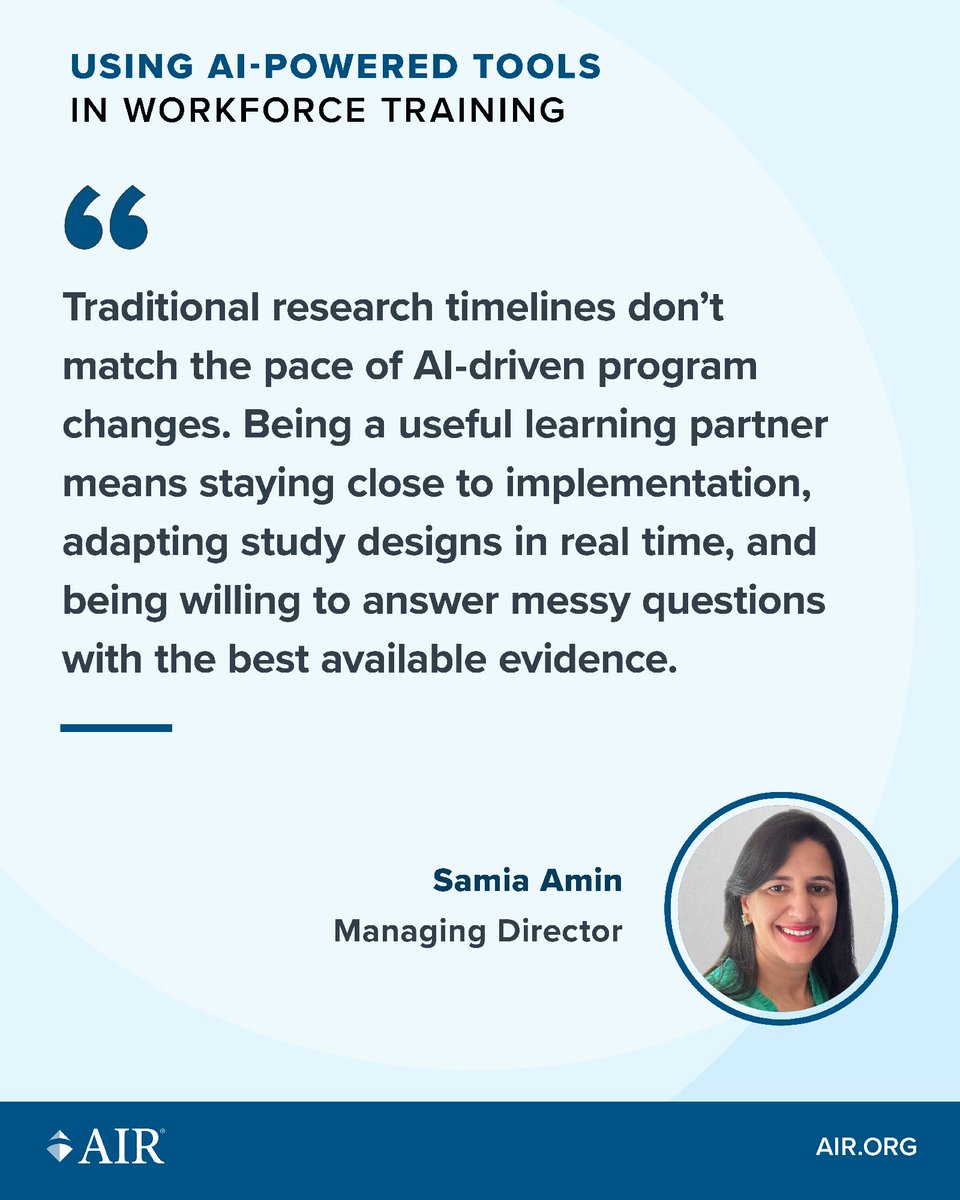
Generative AI could transform workforce training—but only if adoption keeps pace. A new op‑ed by AIR’s Samia Amin and Per Scholas COO Tamara Johnson explores rapid‑cycle learning partnerships and how to scale AI pilots into strategy. Read more: https://t.co/QVLzic7ieX
An @educationweek article examines how staffing shortages and limited prep affect general education teachers supporting English learners. Rebecca Bergey shares solutions that help: preparation, collaboration with EL specialists and practical training. https://t.co/SBjUyk56OZ