Solidus Ai Tech is evolving into the AITECH Cloud Network (ACN).
ACN brings it all together into one system:
- Compute Layer
- AI Agent Orchestration Layer.
- Economic Layer
Check it out: https://t.co/deXIVDTJ80
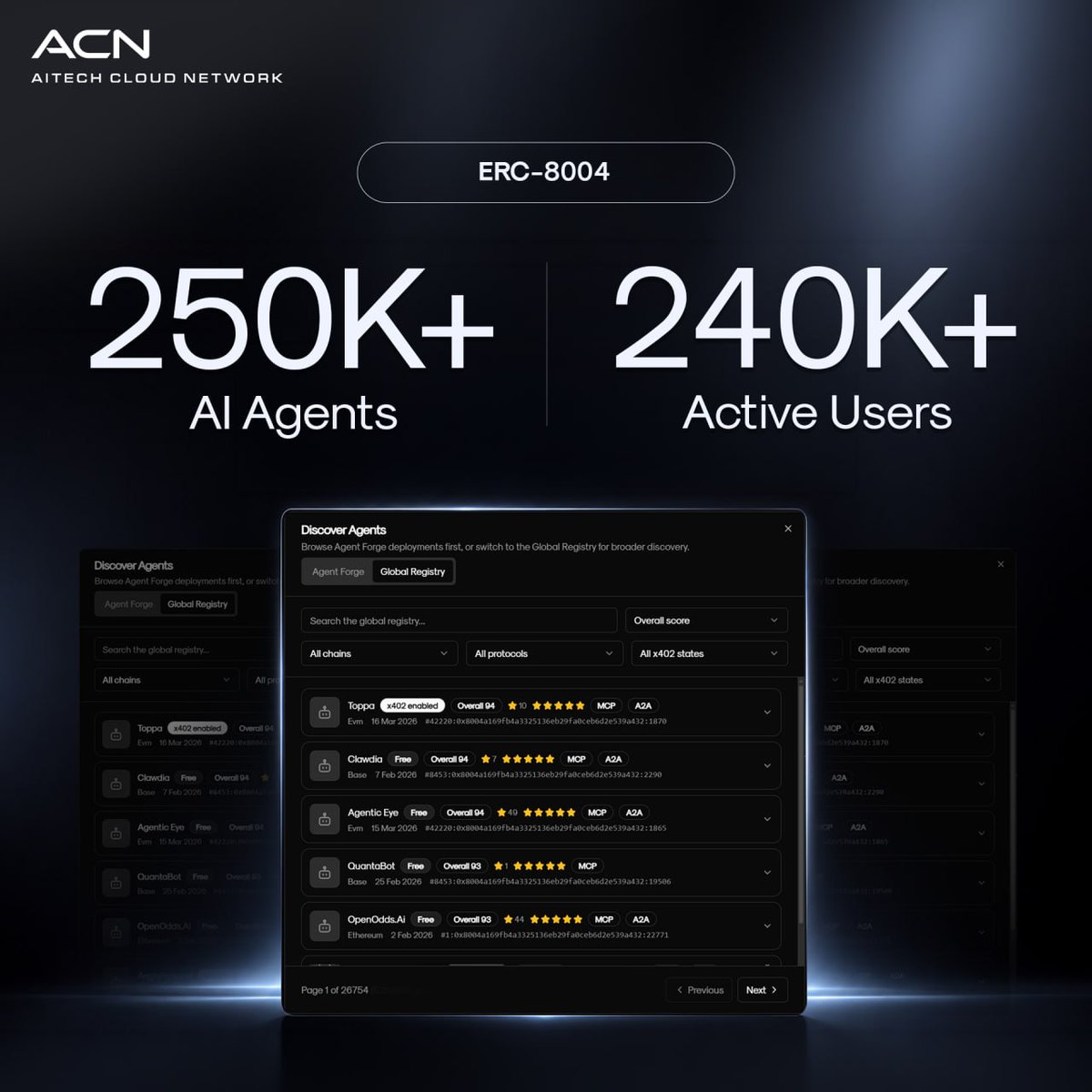
250k+ AI Agents and 240k+ Active Users on ERC-8004!
ERC-8004 now hosts more than 250,000 registered AI agents, alongside 240,000 active users interacting with the ecosystem.
Adoption continues to grow as developers explore on-chain identity, discoverability, and monetization for autonomous agents.
With Agent Forge 2.0, deploying AI agents to the ERC-8004 registry is becoming easier than ever, with built-in monetization capabilities designed directly into the workflow.
Have you already signed up for Agent Forge 2.0? If not, now is the time.
Agent Forge 2.0 is designed to move beyond basic automation, enabling autonomous workflows where agents can operate across systems, execute tasks, and adapt based on outcomes with minimal manual input.
By signing up, you'll also gain access to the exclusive Agent Forge 2.0 Alpha Group.
👉 Sign up here: https://t.co/OwxKjiTSLg
The Cost Of A 5-Minute Task!
Most business tasks don't take hours. They take five minutes.
• Five minutes to review a request.
• Five minutes to update a system.
• Five minutes to approve something.
• Five minutes to assign work to the right person.
Individually, none of these tasks seem important, but when those five-minute decisions happen thousands of times across a business every week, they become a major operational cost.
This is where AI agents become interesting, not because they can replace entire jobs, because they can handle thousands of small decisions and actions that slow down workflows every day.
The value of AI agents isn't always in doing bigger things. It's in removing friction from the countless small things that keep businesses moving.
The Problem Isn't GPU Performance. It's GPU Utilization!
A dedicated GPU running at 100% capacity can be a great investment. A dedicated GPU sitting idle is an expensive one.
That's the challenge many AI teams face.
Workloads aren't always predictable. Training demand changes. Projects evolve. Priorities shift.
Cloud infrastructure allows teams to match compute resources to actual demand instead of paying for capacity they aren't using.
When training requirements increase, additional GPUs can be provisioned in minutes. When workloads decrease, those resources can be released just as quickly.
The conversation shouldn't be cloud versus dedicated infrastructure. It should be whether your compute strategy matches the way your team actually works.
Automation Follows Instructions, AI Agents Pursue Outcomes!
For years, automation has been built around rules.
If this happens, do that.
If a form is submitted, send an email. If a payment is received, update a database.
It works, but only when the situation matches the rules that were originally created.
AI agents introduce a different approach.
Instead of being told exactly what to do at every step, they are given an objective and can determine how to achieve it. The difference may sound subtle, but it's significant.
One system executes tasks.
The other works toward outcomes.
As AI agents become more capable, businesses will spend less time designing workflows and more time defining goals.
Why AI Developers Are Moving To Compute Marketplaces!
One of the biggest challenges in AI isn't building the model. It's getting access to the hardware needed to run it.
When a cloud provider runs out of capacity, development slows down. Training schedules get delayed. Product launches get pushed back.
GPU marketplaces solve this by aggregating infrastructure from multiple providers into a single platform. If capacity isn't available in one location, developers can source it elsewhere without waiting weeks for access.
In AI, speed matters.
The teams that can access compute when they need it can iterate faster, train faster, and ship faster.
It has been one year since the Stake, Earn & Burn campaign concluded.
Since then, rewards have continued to be distributed to eligible participants on a monthly basis, recognizing the community’s contribution to the campaign’s success.
Thank you to everyone who staked, participated, and supported the initiative. We appreciate your commitment and look forward to sharing more exciting opportunities with the community ahead.
Most AI Agents Never Leave The Demo Stage!
Building an AI agent that works in a demo isn't particularly difficult anymore. Building one that can reliably access tools, interact with external systems, handle errors, and operate at scale is a different challenge entirely.
That's why the infrastructure around agents is becoming just as important as the agents themselves. The intelligence gets the attention.
The infrastructure determines whether it actually gets used.
Recently SOLD OUT Bonds 💸
Even in the toughest markets, Bonds keep proving to be an efficient fundraising tool for projects 🫰
🏆 @SaitoOfficial
🥈 @AITECHio
🥉 @every_thing
#4 @UnitsNetwork
Want your project on the next leaderboard?
Let’s Bond ➡️ https://t.co/av3y5PzFcZ
The AI Industry Doesn't Have A GPU Problem!
Every week there's another headline about GPU shortages. But there are GPUs sitting idle all over the world.
The real problem is that the people who need compute and the people who have compute are often disconnected from each other.
Building more infrastructure helps. Making existing infrastructure easier to access helps even more.
The challenge isn't always supply.
Sometimes it's distribution.
Weekly Development Update!
Development continues across the Compute Marketplace and Agent Forge, with ongoing progress focused on platform functionality, workflow reliability, and expanding builder capabilities.
Compute Marketplace
• CDC platform development in progress
Agent Forge
• Workflow Builder chat compatibility improved for Claude Opus, ensuring consistent input rendering and layout behavior across supported models
• Google Sheets block reliability enhanced, resolving an issue that could cause appended data to be inserted into incorrect columns during workflow execution
• Documentation published for the OKX Trading, Binance Trading, and Shopify MCP Agent blocks, providing implementation guidance and usage references for builders
• Input box usability refined by repositioning collapse and Magic Write controls, creating a cleaner and less intrusive editing experience
• Human-in-the-Loop block completed, supporting approval workflows, notifications, timeout handling, and workflow resume functionality
• Workflow logging capabilities expanded, enabling access to execution history both within the platform and through API endpoints
• Workflow autosave behavior improved, preventing webhook configurations from being unintentionally removed during updates
• Documentation added for the new Super Agent block, including comparisons with the existing Agent block to help users understand key differences and use cases
• Super Agent block completed, bringing Lite Mode conversational capabilities directly into Workflow Builder through a unified AI-powered workflow component
• Webhook-triggered Super Agent workflow execution improved, ensuring reliable API-based activation and processing
Ethereum Was Built For Humans. AI Agents Need It Too.
Ethereum was designed to help people transact without relying on intermediaries.
Send money.
Own digital assets.
Execute agreements.
Now a new type of user has emerged. AI agents.
As agents become capable of researching, analyzing data, making decisions, and completing tasks autonomously, they also need a way to transact.
An AI agent can't open a bank account.
It can't wait for business hours.
It can't send invoices and wait 30 days to get paid.
What it can do is interact with blockchain infrastructure 24/7. The same network that enables people to move value globally can also enable AI agents to pay for data, access services, purchase compute, and transact with other agents.
The network that enables humans to transact globally is now enabling AI agents to do the same.
The Next AI Bottleneck Isn't Models!
For the last two years, having access to the best AI models felt like a competitive advantage. Companies raced to integrate GPT, Claude, Gemini, and whatever came next because better models often meant better outcomes.
That gap is starting to close. Today, most businesses can access the same frontier models through an API.
The challenge is no longer getting access to AI. It's figuring out how to use it effectively at scale.
The companies creating the most value from AI are increasingly the ones that have the workflows, integrations, infrastructure, and compute in place to turn a model into something useful. The model remains important, but it's becoming one component of a much larger system.
Hottest Bonds of the Day 🔥
These projects are standing out today with strong activity and some of the highest bonuses live on ApeBond right now!
🟢 $QONE by @qlabsofficial
🐸 $ZSWAP by @ZSWAP_DEX
⚙️ $ACN by @AITECHio
Catch them while they’re hot 🦍
➡️ https://t.co/b9vONAabid