We bring post-quantum security to the digital economy, protecting assets, transactions, and data, with crypto-agile security already running in production.
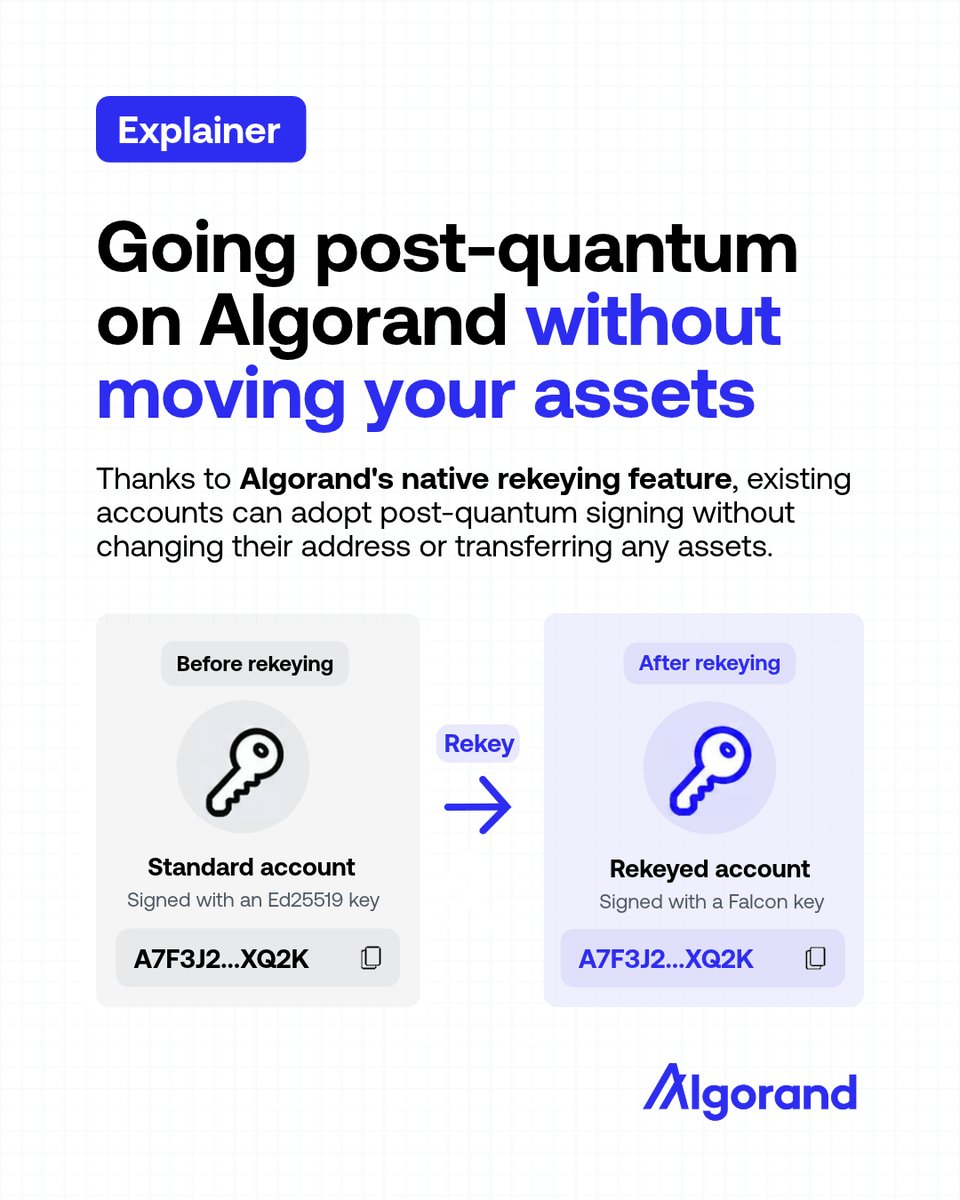
Q: Going post-quantum means creating a new wallet and moving all your assets, right?
A: Not on Algorand.
Thanks to Algorand's rekeying feature, existing accounts can adopt native Falcon-1024 signing without changing their public address or transferring a single asset.
Your assets stay exactly where they are, your transaction history remains intact, and only the signing authority changes.
All of this is built directly into Algorand's protocol, not through some workaround.
And with 2,000+ native PQ accounts having already signed transactions on mainnet, we're way past the promise stage.
Join us for an Algorand Reddit AMA on December 3 in r/AlgorandOfficial.
Algorand's Head of Platform, @SilentRhetoric, and CPO, @wj_beaumont, will be answering your questions throughout the day.
From PQ signing to more flexible, transparent assets, this work is being built in the open.
ARC-62 is live on mainnet, ARC-89 is nearing launch, and Smart ASA v2 is available as a reference implementation.
Full technical breakdown from @cusma_b 👇
🧵 Big ARCs update for the @Algorand ecosystem!
Signing arbitrary data with post-quantum schemes on wallets, a network-wide ASA circulating supply endpoint live on MainNet, and the ASA Metadata Registry closing in on launch.
Here’s what’s new 👇
ARCs are Algorand's open standards, helping wallets, apps, and tools work together.
There's been a lot of progress lately, from post-quantum data signing to token supply, metadata, and a major Smart ASA upgrade.
Here's what's new 🧵
Smart ASA v2 also adds programmable issuance and redemption, pre-approved addresses, global freeze controls, and custom transfer rules.
It integrates ARC-62 supply reporting and ARC-89 metadata too, so wallets and explorers can find the information on-chain.
The @bankofengland is urging major financial institutions to accelerate their transition to post-quantum cryptography.
Algorand has run PQ cryptography in production since 2022.
We're here to help banks, custodians, and issuers make that transition, without having to build the PQ stack themselves.
This year, we're thankful for a lot of things. 🦃
🔐 Native post-quantum accounts on mainnet
⚛️ #1 blockchain by PQ transactions
📄 Featured in PQ research by Google & Coinbase
🟢 100% uptime, seven years in
Happy Thanksgiving.
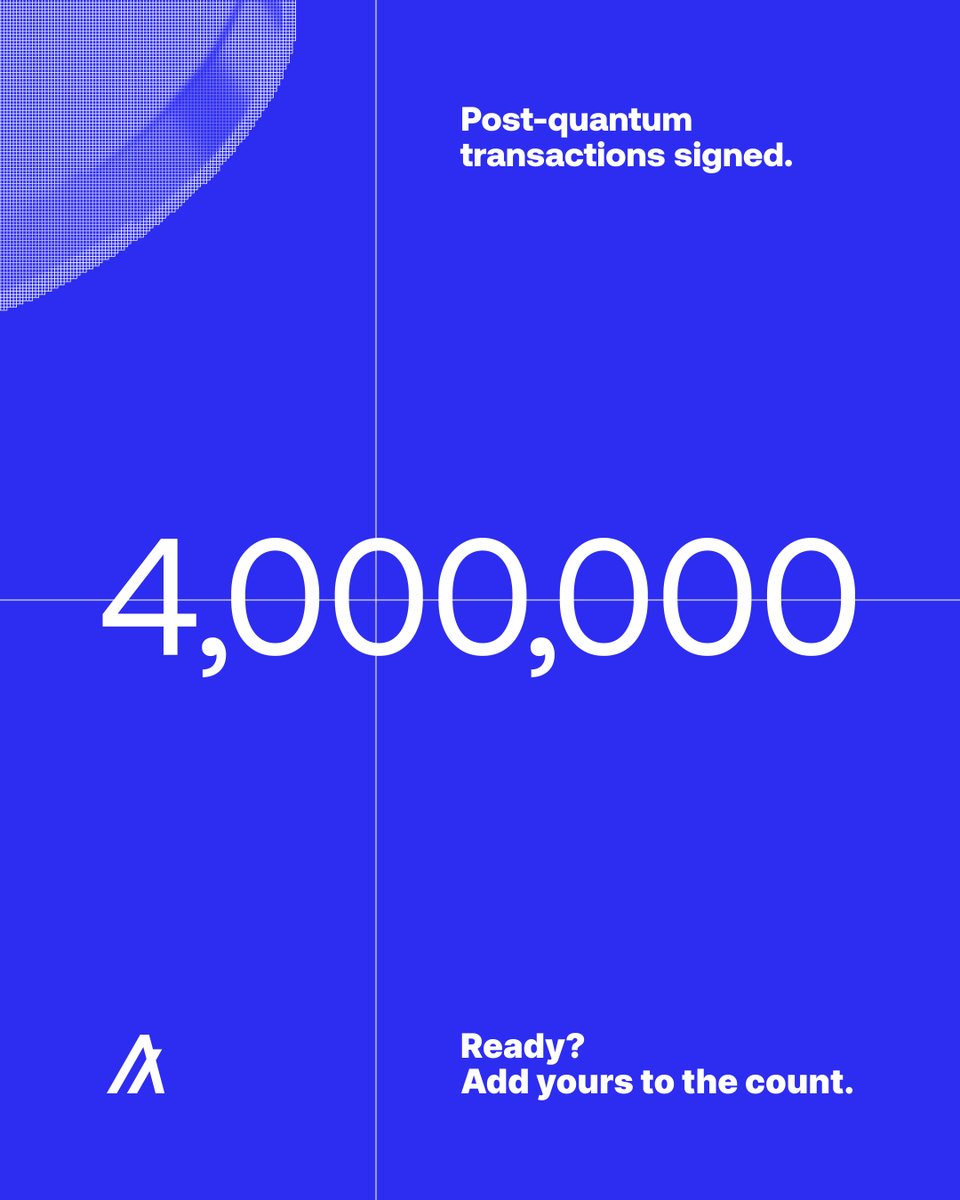
4 MILLION post-quantum transactions have now been signed on Algorand mainnet. 🔐
That's more than any other blockchain on the planet.
And we're just getting started.
Great to see Ethereum make post-quantum security a top priority. 🔐
At Algorand, we've been running PQ cryptography in production since 2022, with native PQ accounts now live on mainnet.
Always happy to share what we've learned and help out. 🤝
In March 2026, @GoogleQuantumAI released a post-quantum paper, highlighting blockchains leading the charge in PQ technology.
Blockchains by number of mentions:
Hedera: 0
Avalanche: 0
Starknet: 2
Stellar: 5
Tron: 6
Cardano: 7
QRL: 11
XRP: 14
Solana: 16
Algorand: 32
Quick heads-up for Algorand node runners:
Please upgrade to algod v5.1.1. It improves efficiency, security, and reliability, and expands the foundation for post-quantum accounts.
If you're running Réti, update your node manager to v1.5.3 as well to fix epoch payout issues.
👇
@Algorand node runners: please upgrade to v5.1.1.
Réti noderunners: upgrade your Réti node manager to the latest v1.5.3, which fixes an issue with epoch payouts against v5.1.1
algod 5.1.1 improves node efficiency, expands the foundation for post-quantum accounts, and strengthens security and reliability. It also brings AVM arithmetic enhancements and API optimizations.
Release notes: https://t.co/FKxPjrawxF
Réti release notes: https://t.co/AHxHOVVJGS