ALWD announcement: applications for 2024 Teaching Grants, supporting professional development of legal research and writing faculty, are due 2/5. Grants enable educators to explore teaching ideas of interest and produce teaching materials that will assist others in the field.
ALWD members, did you hear? SAVE the DATE for the Blackwell Award Reception at AALS in D.C., honoring Kris Tiscione. Thursday, January 4, 2024, 8:00–10:00 p.m.
Reposting the announcement by @JessicaRGunder is a better way to celebrate and share her contribution in @TulaneLawReview than our original post. It's exciting to see our discipline exploring important issues relating to generative AI.
New scholarship alert: ALWD Board member Jessica Gunder (@uidaholaw) has authored a piece on how courts should address AI when pro se litigants rely on it. https://t.co/JTHsgtweOe
And Susan McMahon of @ASUCollegeOfLaw encouraged law professors to embrace a "pedagogy of disruption and creation" to prepare students to creatively advocate for positive change. https://t.co/XTGRxTxYqy
Last weekend's Western Regional Legal Writing Conference @usfca School of Law included some intriguing and inspiring talks. It provided a great start to the fall semester. Lineup appears here: https://t.co/8Nn1lg9sfV
For example, here's the thought-provoking work @djsziff presented, Citation, Slavery, and the Law as Choice: Thoughts on Bluebook Rule 10.7.1(D). https://t.co/qvVJHdLUMi
Do you find it helpful to sometimes have text read aloud to you?
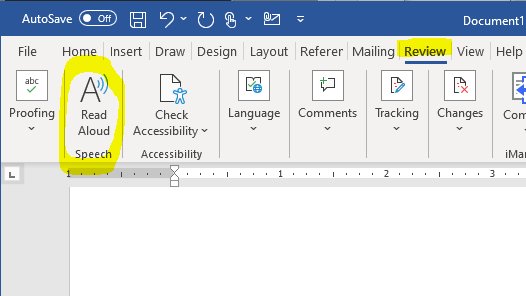
Quick Microsoft Word tip: newer versions of Word have a "Read Aloud" option under the "Review" tab!
Do you find it helpful to sometimes have text read aloud to you?
Quick Microsoft Word tip: newer versions of Word have a "Read Aloud" option under the "Review" tab!
ALWD folks who are thinking about and experimenting with AI: thoughts? Perhaps for complex matters AND ALSO FOR STUDENTS it's best to bring AI tools into the equation later in the writing process?
Most assume that AI is best used in legal writing to help generate a first draft. But this can undermine human understanding of the legal issues. For complex matters it’s thus best to use AI to create a SECOND draft after you work through the problem independently.
This announcement may be interesting to leaders in legal writing education who are considering what could, should, and will change with the rapid development of accessible generative AI tools.
Fun find: Chapter 1 of the new 6th ed. of Ethical Problems in the Practice of Law cites both Alyssa Dragnich of @ASUCollegeOfLaw and @mch_tweets of @UMichLaw.
The baton has been passed. Rachel Croskery-Roberts of @UCILaw is now the President of @ALWD_tweets. Looking forward to a great year under Rachel's leadership.