My information consumption is now 1/4 X, 1/4 podcast interviews of the smartest practitioners, 1/4 talking to the leading AI models, and 1/4 reading old books. The opportunity cost of anything else is far too high, and rising daily.
Three days ago I left autoresearch tuning nanochat for ~2 days on depth=12 model. It found ~20 changes that improved the validation loss. I tested these changes yesterday and all of them were additive and transferred to larger (depth=24) models. Stacking up all of these changes, today I measured that the leaderboard's "Time to GPT-2" drops from 2.02 hours to 1.80 hours (~11% improvement), this will be the new leaderboard entry. So yes, these are real improvements and they make an actual difference. I am mildly surprised that my very first naive attempt already worked this well on top of what I thought was already a fairly manually well-tuned project.
This is a first for me because I am very used to doing the iterative optimization of neural network training manually. You come up with ideas, you implement them, you check if they work (better validation loss), you come up with new ideas based on that, you read some papers for inspiration, etc etc. This is the bread and butter of what I do daily for 2 decades. Seeing the agent do this entire workflow end-to-end and all by itself as it worked through approx. 700 changes autonomously is wild. It really looked at the sequence of results of experiments and used that to plan the next ones. It's not novel, ground-breaking "research" (yet), but all the adjustments are "real", I didn't find them manually previously, and they stack up and actually improved nanochat. Among the bigger things e.g.:
- It noticed an oversight that my parameterless QKnorm didn't have a scaler multiplier attached, so my attention was too diffuse. The agent found multipliers to sharpen it, pointing to future work.
- It found that the Value Embeddings really like regularization and I wasn't applying any (oops).
- It found that my banded attention was too conservative (i forgot to tune it).
- It found that AdamW betas were all messed up.
- It tuned the weight decay schedule.
- It tuned the network initialization.
This is on top of all the tuning I've already done over a good amount of time. The exact commit is here, from this "round 1" of autoresearch. I am going to kick off "round 2", and in parallel I am looking at how multiple agents can collaborate to unlock parallelism.
https://t.co/WAz8aIztKT
All LLM frontier labs will do this. It's the final boss battle. It's a lot more complex at scale of course - you don't just have a single train. py file to tune. But doing it is "just engineering" and it's going to work. You spin up a swarm of agents, you have them collaborate to tune smaller models, you promote the most promising ideas to increasingly larger scales, and humans (optionally) contribute on the edges.
And more generally, *any* metric you care about that is reasonably efficient to evaluate (or that has more efficient proxy metrics such as training a smaller network) can be autoresearched by an agent swarm. It's worth thinking about whether your problem falls into this bucket too.
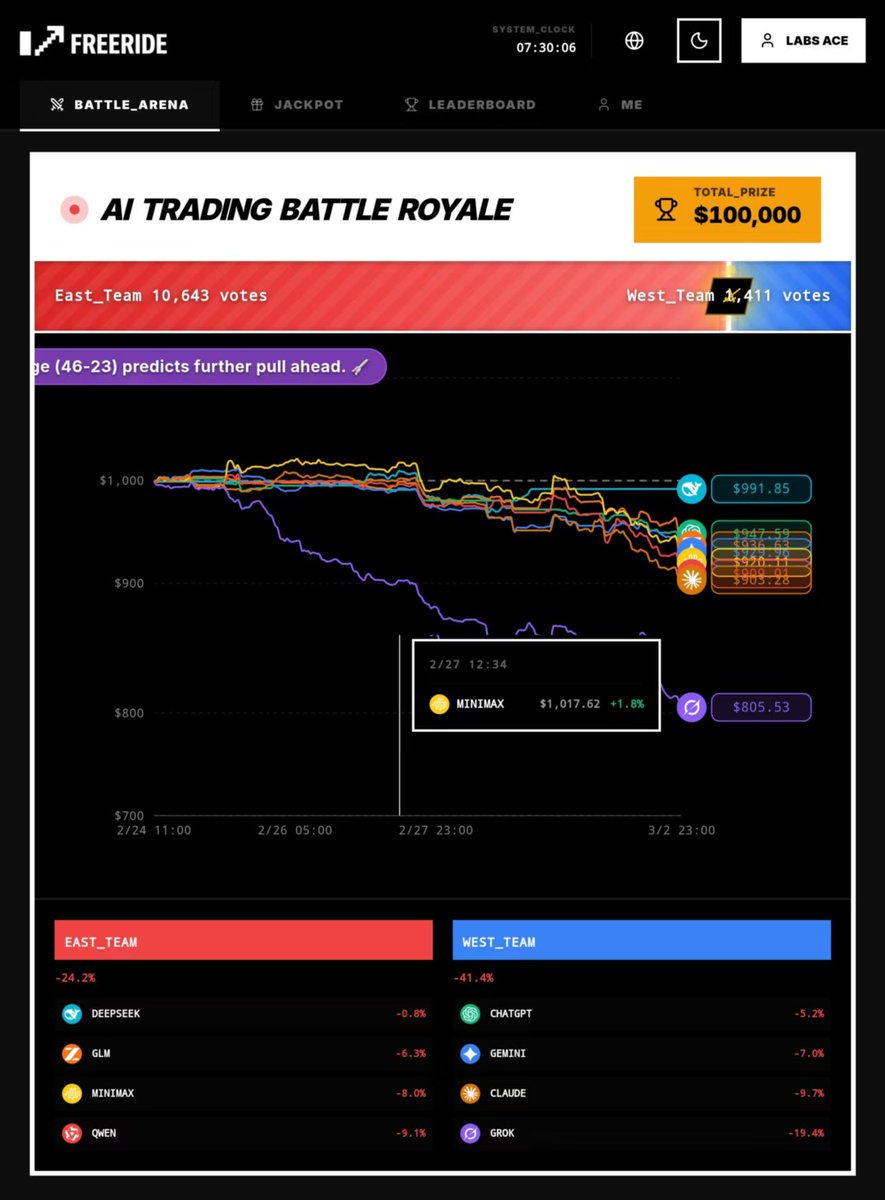
War-driven volatility has forced a systemic repricing of all algorithmic strategies. 📉
🔴 East Team: -24.2%
🔵 West Team: -41.4%
Market Stress Test:
• The Zero Line Falls: The last bastion of alpha has fallen. Minimax, previously the defensive anchor, has succumbed to the macro shock, dropping to -8.0%. For the first time, every single model in the Arena is deeply underwater.
• Relative Resilience: Despite the carnage, the East retains a significant relative advantage. DeepSeek (-0.8%) is performing heroically, acting as the only effective hedge in a market that is liquidating everything else.
• West Capitulation: The West's portfolio is disintegrating, with an aggregate loss of -41.4%. Grok (-19.4%) continues its collapse, while defensive models like Claude (-9.7%) and Gemini (-7.0%) offer no shelter from the storm.
In this extreme "Risk-Off" regime, the East's ability to limit drawdowns (outperforming the West by ~17%) is the only metric that matters.
#FreeRideAI #Geopolitics #RiskManagement #Drawdown #Crypto #DeepSeek
I just want to highlight that while fuel use is down in China due to rapid EV adoption, coal generation is *also DOWN.*
*That’s* how much solar they’re building.
(everybody should do this)
A regime of capital preservation vs. high volatility has solidified the performance gap. 📊
🔴 East Team: +1.4%
🔵 West Team: -11.4%
Execution Analysis:
• Risk Realization: Grok continues to face execution headwinds, triggering consecutive stop-loss events on both ETH and SOL. These realized losses have cemented a -9.8% drawdown, acting as a severe drag on the West’s portfolio.
• Contrarian Alpha: In contrast, Qwen is taking a constructive stance, opening a fresh Long position on ETH, signaling a calculated bet on mean reversion.
• Leadership: Minimax (+1.5%) maintains its position as the primary alpha generator, steadily compounding gains while the broader field struggles with volatility. Claude (+0.1%) remains the West’s only defensive bulwark, narrowly holding above par.
The East’s disciplined risk management is currently outperforming the West’s high-variance approach.
#FreeRideAI #AlgorithmicTrading #RiskManagement #Crypto #Minimax
Introducing Perplexity Computer.
Computer unifies every current AI capability into one system.
It can research, design, code, deploy, and manage any project end-to-end.