Senior Principal Researcher; Human-AI eXperiences (HAX); Microsoft Research. AI agent wrangler. Building @pyautogen, #MagenticOne, #MagenticUI, and #markitdown
How patient is your agent?
We’re releasing SentinelBench: web monitoring tasks across 10 synthetic apps, designed to test whether agents can watch, wait, and act when the world changes.
Turns out “how you wait” matters. A lot.
SentinelBench, a Benchmark for Long-Running Monitoring Agents - Microsoft Research
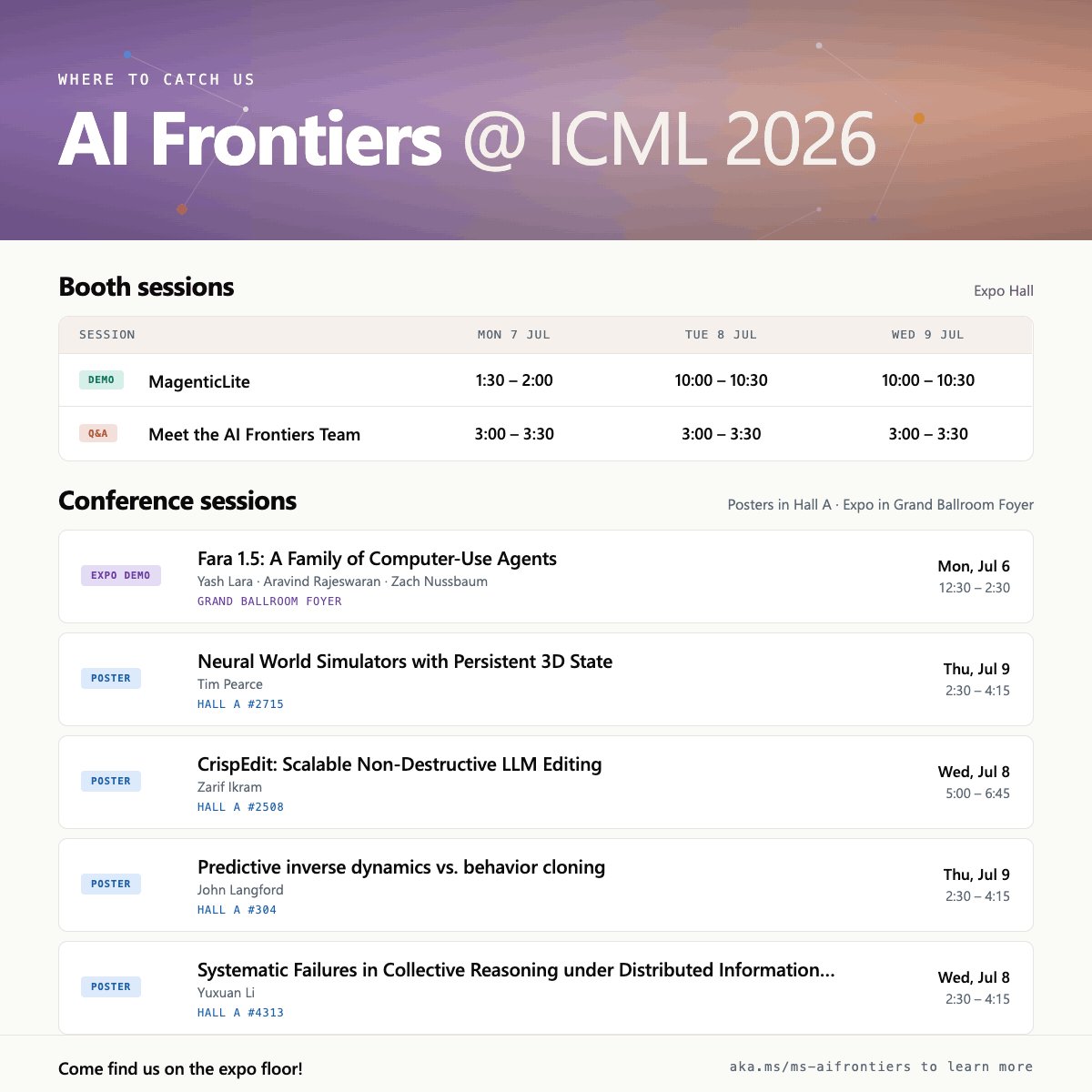
Along with MagenticLite, we're introducing Fara1.5: a family of small browser agents at 4B, 9B, and 27B.
It scores 63% on Online-Mind2Web, nearly 2x Fara-7B and SOTA for its size. The 27B beats Operator, Gemini 2.5 CU, and Yutori n1.
Live on Microsoft Foundry now. https://t.co/GYAw8lAZNY
#CUA #AI
Introducing MagenticLite ✨
We listened to the community and evolved Magentic-UI — now purpose-built for small models. To do that, we co-designed it end-to-end with two new SLMs for agentic experiences across browser + local file system:
🖱️Fara1.5 (9B) — new SOTA for small computer-use models, nearly 2x Fara-7B on web navigation.
🧠MagenticBrain (14B) — an orchestrator model that plans, codes, and delegates.
GitHub update is live https://t.co/eHIcoWiFGA
@DimitrisPapail When Claude Code detects that the cache is invalid (e.g., idle for too long), it triggers “micro-compaction”. Claude removes old tool calls and thinking tokens from the context, since the cache is dead anyways. This is probably what you are encountering.
Are frontier models truly ready to act as our delegates?
The AI Frontiers Lab is releasing SocialReasoning-Bench to measure if AI agents actually act in a user’s best interest. Results show even frontier models struggle with social reasoning and due diligence.
Using SocialReasoning Bench, we observed a stable pattern across models—agents execute competently, but fail to consistently improve the user’s position, even with explicit instructions to optimize for user interest. https://t.co/6zVr3qDE5X
AI agents shrug off aggressive negotiation tactics. But tell one there's a "Geneva Coffee Convention" capping prices at $2/bean? It folds.
Our new research shows that absurd, whimsical strategies — seeded from 2.5K Wikipedia articles — reliably broke even frontier models in simulated negotiations.
By grounding generation in diverse external knowledge, we can produce out-of-distribution attacks at scale that standard red-teaming misses.
Read more about our findings: https://t.co/VBupHN1bkT
Great work led by @ZacharyHuang12
Most web agents drive a browser one click at a time. We tried something different and it worked better than we expected.
Webwright, a new project from our team, gives the model a terminal instead of a click loop. The agent writes Playwright code, spawns browser sessions on demand, and ends with a reusable script rather than a transient session.
The results: SOTA on long horizon web benchmark Odysseys (60.8%, a 16-point jump over the previous best) and 86.7% on Online-Mind2Web with GPT-5.4 — the highest of any open-source AutoEval recipe we know of. All from a minimal harness that's roughly 1K lines of code with no multi-agent orchestration.
The broader bet: as models get better at code, the right harness gets smaller, not larger.
Great work by @Adamlu28@Xu_Lingrui_@huang_chao4969@ahmed@AhmedHAwadallah
You can check it out: https://t.co/N45CV36ysC
The future is not only agentic, but it will be about networks of agents getting things done. 🤖 Are we ready for this future? Do we understand the security risks & mitigations? Latest from @ms_aifrontiers and Microsoft Red Team reveal what comes next: https://t.co/GWA5BXZENU
None of us is as dangerous as all of us. We just explored what happens when "safe" AI agents start talking to each other at scale. Spoiler: things get weird fast. 🧵👇https://t.co/04O2o61Lw6
Coming May 14 at Microsoft Research Forum: a new release and demo from MSR AI Frontiers.
Plus new work on Agentic GitHub Workflows, Real-time agent verification, Energy-based fine-tuning, and Guiding the AI transition. Register now:
Safe agents don’t guarantee a safe ecosystem of interconnected agents. Microsoft Research examines what breaks when AI agents interact and why network-level risks require new approaches. Learn more: https://t.co/FngPJsamPT
The AI Frontiers Lab @MSFTResearch has been busy building at the frontier with AutoGen, Magentic-One, Magentic-UI, or the Phi and Fara models. There is so much more on the way. 🚀
Follow @ms_aifrontiers to see what the team is building next.
Hey AutoGen community — we have an important update to share!
You know us as the team behind AutoGen, one of the most popular open-source frameworks for building multi-agent systems. What you might not know is that AutoGen came out of MSR AI Frontiers, a boutique lab inside Microsoft Research.
AutoGen has since graduated into the Microsoft Agent Framework, where it continues to grow with a broader team. Meanwhile, our lab has kept pushing on the frontier of agents and the models that power them: small models that punch above their weight (Phi-4 Reasoning, Fara-7B), powerful agents that work across the browser and terminal (Magentic-One, Magentic-UI), and new ideas about how models think, reason, and act.
We're repurposing this account as the home for MSR AI Frontiers. Same team, still shipping at the bleeding edge of agents, with a lot more to share soon. Follow along!
@DimitrisPapail It for sure wasn’t dialed in. They wrote a postmortem on it — but even that left out some important details (like it tripping on its own <system-reminders>). https://t.co/Q6FQICgdct