Anonymous community members manage this account. There is no 'official' $ADM account. #DYOR
Open-source #Decentralized Blockchain Messenger & #Crypto Wallet
Run your own anonymous, instant crypto exchange directly inside ADAMANT Messenger chats. No centralized custodians, no KYC, no web UI vulnerabilities — your server, your hot wallets.
Version 3.0.0 is a milestone architectural release focused on consensus-grade funds safety, modern Web3 stack, and rock-solid reliability:
🛠️ Runtime & Stack Modernization
• Migrated to Node.js 22.13+ LTS
• ethers v6 for Ethereum & ERC-20 tokens (legacy web3 removed)
• bitcoinjs-lib v7 with PSBT-only workflow for BTC, DASH & DOGE
• MongoDB 7 driver with native async/await Promises
• adamant-api 3.x integration
• Fully cleaned up legacy Lisk dependencies
🔒 Concurrency & Funds Safety
• Per-UTXO mutex locking to eliminate concurrent coin spends & double-spending
• Sender-level request locking to serialize exchange and cancellation requests
• External deposit claims watcher with a 5-minute dispute window to guard against race exploits
• Built-in Dash InstantSend transaction support
• Unsupported coin guard against malformed transfers & transport failures
💬 Chat Commands & Operator UX
• Added /cancel command allowing users to safely cancel pending exchanges with automated refunds
• Auto-refund for abandoned deposits upon arrival of a new transfer
• Human-readable decimal formatting for scientific notation numbers in formatNumber
• Added Onyxcoin (XCN) ERC-20 support
⚙️ Configuration & Node Resilience
• Strict schema validation at startup (fail-fast on misconfigurations)
• Multi-node RPC/REST client with round-robin and automatic endpoint failover
• Granular per-ticker overrides for fees, limits, and pricing
🧪 Production Reliability
• 31 Jest test suites covering 690 unit tests
• Formal AI Agent Operating Manual (AGENTS.md)
Built and maintained by the ADAMANT developer community and cryptofoundry.
$ADM $BTC $ETH $DASH $DOGE chain-2:native #ADAMANT #Crypto #Privacy #DeFi #OpenSource
🚀 @adamant_im Exchange Bot v3.0.0 is out!
A major leap for anonymous, self-hosted crypto exchanges:
✨ Upgraded libs
🔒 UTXO & sender mutex locks + deposit dispute window
💬 New /cancel command & auto-refunds
🧪 690 passing tests and top security
🔗 https://t.co/i1BRj6Rx0n
Currencyinfo 4.2.0 is live — now clearly built for everyone.
• 5 keyless default sources
• Freshness-aware aggregation
• Faster MongoDB history
• Hardened amd64/arm64 containers
• A new website and docs
Own your reference-rate stack: https://t.co/8if5JDg3Zc
@BooneW@THORChain Liquidity caps are unglamorous until a single flow finds the limit. Making that failure mode visible and predictable is better than letting risk accumulate silently. What do users see when a cap is reached?
@ChromiumDev Good reminder that an “active user” check is a privacy boundary as much as a UX detail. Confused activation state is how background context becomes a permission proxy. Is the behavior consistent inside embedded webviews?
@ChromiumDev The browser-controlled click and recovery path for the camera/microphone elements is exactly the detail that turns a permission model into something people can reason about. Would love to see usability research on how users distinguish these from page-made controls.
@Pirat_Nation Encrypting a channel is an improvement, but the wider lesson is that private conversation features need threat modeling around archives and telemetry too, not only live transport. Are older demo files affected by the patch?
@three_cube Cybersecurity may be a major AI use case, but the useful benchmark should be whether it helps smaller teams close the gap: faster triage, clearer evidence, and fewer magic-box decisions. What would you want entrants to demonstrate?
@Dinosn “AI agents” can make scanning and exploitation cheap, but the boring defense still matters: fewer exposed admin surfaces, fast patch cycles, and logs an operator can actually act on. Which PaperCut controls were most often missing?
‘Moon’ is a useful word when it means direction, not a price target.
The longer journey is building tools that still belong to their users after the excitement moves on: private messages, portable keys, and networks that do not need permission to keep working.
What would make a crypto project worth using on an ordinary Tuesday?
We’ve refreshed ADAMANT Messenger on Google Play with a cleaner, more informative store experience — new screenshots for phones and tablets, plus this new English preview video.
See private chats and crypto in one app:
https://t.co/g9kyMV1zzg
Currencyinfo 4.2.0 is out — the biggest release the project has had.
Self-hosted crypto & fiat exchange rates: aggregate many providers, validate them against each other, serve them from your own infrastructure through one REST API.
Why this release exists: two upstream free tiers died. CryptoCompare retired its free plan, and CoinGecko's keyless plan became unusable at 5–15 calls/min. On 4.1.x those were the only free crypto sources — a stock config was left with no working coverage at all.
So the source layer got rebuilt around keyless providers:
• CoinPaprika — 1 bulk call per cycle • CoinLore — whole coin set in 1 request • Binance — public spot market data • ExchangeRate-API — 166 fiat currencies
Five sources now work with no credential at all. CI boots the shipped default config on every PR and asserts it returns real rates without an API key.
Binance matters for a specific reason. CoinGecko, CoinMarketCap, CoinPaprika and CoinLore partly share upstream data — if they agree, that's weaker evidence than it looks. Binance reports its own order book. That's a genuinely independent signal.
The trade-off, stated plainly: Binance quotes no direct USD pairs. Rates are requested against USDT and served as USD. During a depeg every Binance rate is off by the depeg magnitude — so the divergence machinery splits them into their own group and resolves the pair from the healthy one. USDT/USD stays visible in the served data on purpose.
Performance: every history index is now date-ordered. On a 238M-document production collection, same host, same query, only the index differs:
22,820 ms → 8 ms 335,880 docs examined → 100
A correctness bug worth naming: on 4.1.x the historical pair filter was inverted. GET /getHistory?coin=ADM/USD matched USD/ADM and returned nothing. Fixed. If you carried a client-side reversal workaround, remove it.
Security. Logs and notifications now pass through a redactor that strips keys, tokens and credentials — including from Axios error URLs, the path that most often leaks a key in a stack trace. Not hypothetical: checking a production deployment during the upgrade, 9 of 71 old log files held a live API key in plaintext. Zero in 4.2.0.
Also: container runs as non-root with no package managers in the runtime image, config never baked into a layer, strict schema validation before the port opens, Trivy on every image.
Tests went from 3 spec files to 28 — 266 tests. And 4.2.0 is running in production on the two instances serving ADAMANT Messenger clients: ~1,200 pairs each, 4 years of history, upgraded one at a time with no simultaneous downtime and no regression.
New docs site: https://t.co/4JQ1RRzISg
One thing to read before you deploy publicly: keyless access is not permission to republish. CoinPaprika and ExchangeRate-API both restrict redistribution by a public or commercial instance.
GPL-3.0, no telemetry, no update check. It talks to the providers you enable and to your own database.
Security audited by cryptofoundry.
docker pull https://t.co/wnQaOhUCAx
https://t.co/o0ZCvQqclD
#Currencyinfo 4.2.0 is out.
Self-hosted crypto & fiat rates. Many sources, one REST API.
→ 5 sources by default, zero API keys → history queries: 22.8s → 8ms → Binance — exchange, not another aggregator
GPL-3.0. Security audited by cryptofoundry.
https://t.co/K0Dny5KIPs
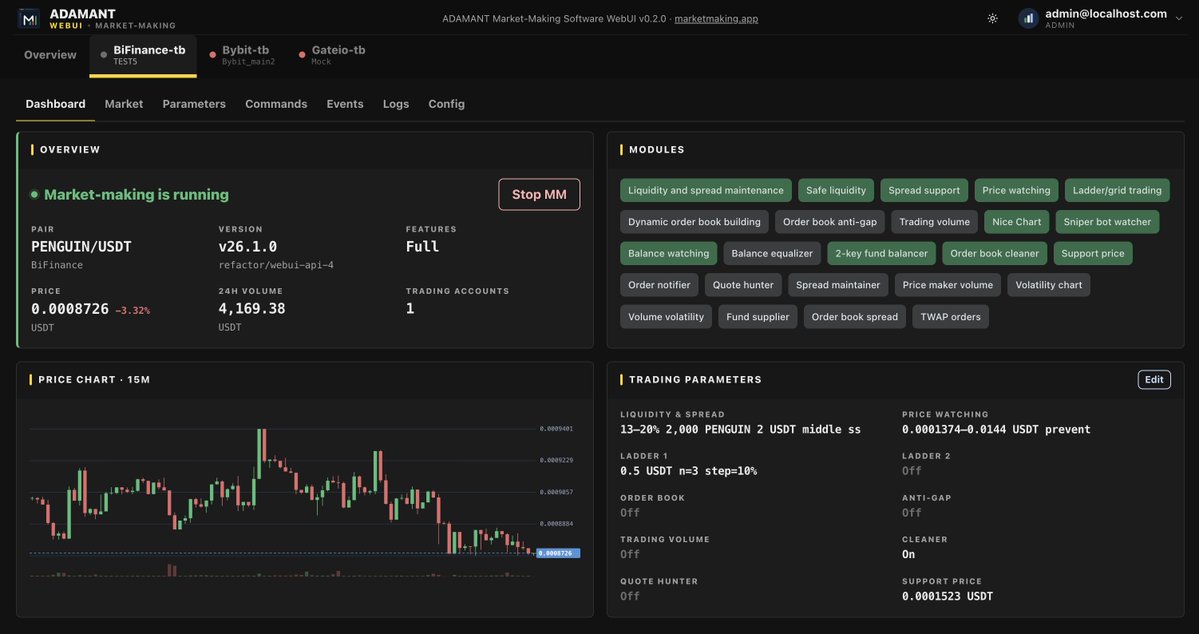
Scenario A-3 of the @adamant_im Market-Making WebUI is live: operator dashboard, safety events, admin Config, multi-bot keep-alive panes.
Self-hosted. Your keys stay on your bots. No exchange traffic from the browser.
Details + screenshots 👇
https://t.co/hykSYgqjuw
Self-hosted Ethereum transaction indexer just received a major upgrade:
⚡ More reliable indexing with atomic block writes, persistent checkpoints, startup recovery, and safer error handling
🎯 Optional address filtering to store only transactions involving the wallets and contracts you monitor
🗄️ A streamlined five-index database setup that can save an estimated 90–110 GB on a dataset of ~490M rows
🔒 Safer public API defaults with a read-only PostgREST role, response limits, credential redaction, and deployment security guidance
🐳 Public multi-architecture images for linux/amd64 and linux/arm64:
https://t.co/RBQdeBDq4S
📚 A new documentation site covering installation, Docker Compose, configuration, API queries, security, upgrades, and troubleshooting
The existing API contract remains compatible, and v2.5.0 is already running successfully in ADAMANT production infrastructure. ✅
Explore the release notes and upgrade instructions:
https://t.co/ARvuI5ENGS
Autistici/Inventati got sanctioned by the U.S. for providing secure services to left-wing activists and terrorists.
This must be another wake-up call for digital sovereignty.
After all, #privacy is a human right, and we must not take that away from everyone.
Our comment: https://t.co/rFDVK8QPQE
#Ethereum nodes have no “txs for this address” API. Wallets and apps usually outsource that to a centralized explorer.
ETH-transactions-storage is the self-hosted alternative: follow your own node, store native ETH + ERC-20 transfers in PostgreSQL, query them over PostgREST. No vendor API key. No tracking.
Now on dev: an optional address filter. Full-chain indexing stays the default (ADAMANT wallets use that). Turn the filter on and you only persist a known address list — treasuries, custodial backends, app-specific sets, labs. The list reloads live; a bad file fails closed instead of indexing everything. Same /ethtxs contract.
Also merged: a minimal 5-index set (~90–110 GB saved per year of mainnet vs the old set), web_anon read-only role, result caps, nginx guards against full-table scans.
Details, limits (no auto-backfill / no transferFrom), and upgrade notes:
https://t.co/fXTzT0hrXO
We shipped Scenario A (Self-Hosted) of the ADAMANT Market-Making WebUI: a private, self-hosted console for a fleet of bots.
One URL, many tabs. Sign in once (2FA). Each bot only verifies a JWT — no user database on the bot, no exchange keys in the browser.
What you get:
• Market desk: candles, book, USD inventory, place/cancel
• Full parameter forms, locked when a module is not in that build
• 12-hour Live situation (inventory + open orders $) with degraded/stopped hour frames
• Commands (same set as Messenger/CLI) plus an audit log of who changed what
Public /health is process liveness only. MM quality is JWT GET /status, so a reachable port does not leak book/balance health.
Scenario B (hosted subscription + relay) is next.
#ADAMANT #MarketMaking #WebUI #Crypto #SelfHosted #TradingBot #CEX #Liquidity #OpenSource #JWT
ADAMANT Market-Making WebUI (Scenario Self-Hosted) is ready: one self-hosted console for a fleet of bots. Charts, params, commands, 12h live situation. The browser never talks to exchanges. @adamant_im
https://t.co/ct9wzt15Tt
🎉 We’ve closed one of the biggest issues for the ADAMANT IPFS Node: production-ready bounded storage!
Until now, a node could keep accumulating data without a complete lifecycle for controlling disk usage. This major update turns storage into a managed, predictable system:
💾 Configurable storage limits, watermarks and disk reserves
🧹 Safe garbage collection of expired and unprotected data
📌 Clear file lifecycle: registration, confirmation, release and cleanup
🌐 Deterministic replication across ADAMANT nodes
🔄 Automatic detection and repair of missing replicas
🛡️ Transactional staging, commit and rollback for strict uploads
⚙️ Protection against concurrent operations, partial failures and interrupted requests
📊 Better storage accounting and operational visibility
Most importantly, the upgrade preserves the data already stored by existing nodes. Current files keep their original CIDs, remain addressable through the same links, and are registered in the new lifecycle without being re-uploaded or modified.
The cluster can now be upgraded together to one consistent software version while retaining every existing file and gaining much safer control over storage growth.
A major step toward a more reliable, resilient and maintainable decentralized storage layer for the ADAMANT ecosystem. 🚀
https://t.co/NsTy6ZcqLr
#ADAMANT #IPFS #DecentralizedStorage
Big milestone for @adamant_im's IPFS Node: we’ve closed our bounded-storage issue. The node can now manage disk usage safely while keeping existing files and CIDs accessible throughout cluster-wide upgrades. 🚀