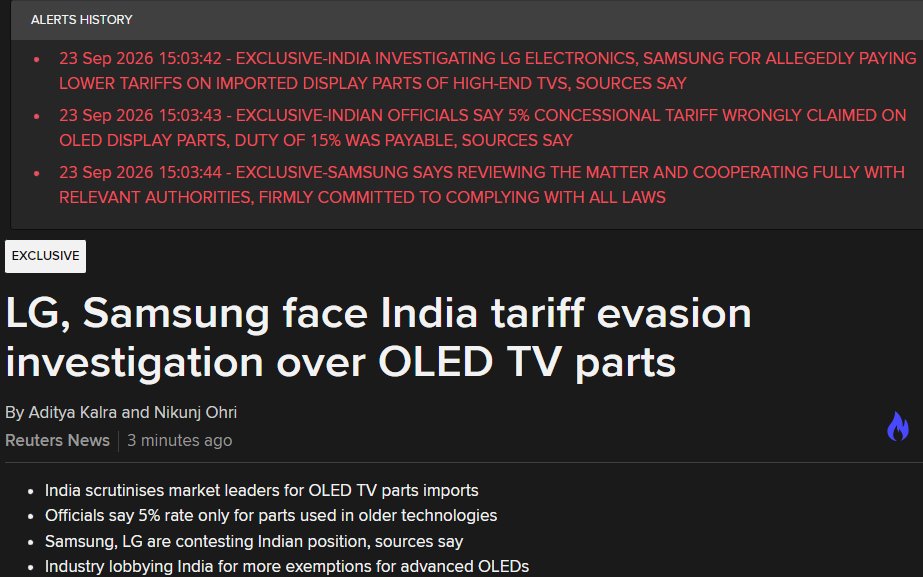
🚨 BREAKING: India is investigating LG and Samsung for allegedly paying lower tariffs on imported display parts of high-end OLED TVs...
📺 Officials allege the companies wrongly claimed a concessional 5% tariff on imported OLED glass screens called open cells -- a rate they say has for years been reserved for older LCD and LED technologies that dominate mass-market sales. The Directorate of Revenue Intelligence believes the duty should have been 15%.
📺 Both companies are privately contesting that position, arguing OLED is nothing but an advanced form of LED and the same tariffs should apply. DRI officers visited Samsung's India headquarters in Gurugram to question officials in recent weeks. LG was sent written questions and has responded, along with a voluntary monetary deposit to cover any extra duty authorities may request.
📺Samsung said it is "reviewing the matter and cooperating fully with the relevant authorities."
📺Meanwhile, industry groups Consumer Electronics and Appliances Manufacturers Association (CEAMA) and MAIT wrote nearly identical confidential letters in August pushing India's IT ministry to extend the 5% rate to OLED parts, calling the current rules an "anomalous situation" that leaves advanced OLED manufacturers "denied the same benefit."
https://t.co/FqAGo5os8i With @Nikunj_Ohri
New on India food authority's warning labels proposal.
India's food safety authority tells the Supreme Court it will implement front-of-pack warning labels in a single phase, not two.
Warning labels will apply even when just ONE nutrient — salt, sugar or fat — is high.
Labels will be a red hexagon on a white square background.
Industry will get 1 year to implement new rules, once finalized
Packages using non-caloric sweeteners must carry a front-of-pack warning saying they "contain non caloric sweetener".
FSSAI says it will take roughly four months to issue and finalise draft regulations, which will go through public and industry consultation.
🚨 BREAKING: India is investigating LG and Samsung for allegedly paying lower tariffs on imported display parts of high-end OLED TVs...
📺 Officials allege the companies wrongly claimed a concessional 5% tariff on imported OLED glass screens called open cells -- a rate they say has for years been reserved for older LCD and LED technologies that dominate mass-market sales. The Directorate of Revenue Intelligence believes the duty should have been 15%.
📺 Both companies are privately contesting that position, arguing OLED is nothing but an advanced form of LED and the same tariffs should apply. DRI officers visited Samsung's India headquarters in Gurugram to question officials in recent weeks. LG was sent written questions and has responded, along with a voluntary monetary deposit to cover any extra duty authorities may request.
📺Samsung said it is "reviewing the matter and cooperating fully with the relevant authorities."
📺Meanwhile, industry groups Consumer Electronics and Appliances Manufacturers Association (CEAMA) and MAIT wrote nearly identical confidential letters in August pushing India's IT ministry to extend the 5% rate to OLED parts, calling the current rules an "anomalous situation" that leaves advanced OLED manufacturers "denied the same benefit."
https://t.co/FqAGo5os8i With @Nikunj_Ohri
Indian court rejects Adani plea that duty-free shops are beyond domestic laws. In a case widely seen as setting a precedent on duty-free sales, Adani in April challenged Indian authorities who said its Mumbai international airport shops illegally stocked and sold nicotine pouches, one of the world's fastest-growing nicotine products, which remain unapproved in India. https://t.co/oMROFHv6ZW
The quiet Tata Group insider was on his way out. Now Natarajan Chandrasekaran has agreed to five more years running India's largest conglomerate, backed by its board but facing opposition from the philanthropies that control it. https://t.co/hsJhbV4ghc
INDIA INC INSIGHTS: War at India's Tata Group - understand the nuances of the complex dispute, and read profiles of both Chandra and Noel Tata as the boardroom rupture unfolds at India's most storied conglomerate. Plus the food regulator challenges Nestlé over baby food, Apple's iOS 18 warranty probe escalates, and a startling tale of half a million fake Gmail accounts. https://t.co/pHOJIIuBBE
N. Chandrasekaran reversed his decision to leave and agreed to another five-year term. He now faces an open rupture between the Tata Sons board and Tata Trusts:
https://t.co/71FMH0TOfH
For decades, Noel Tata built retail and trading businesses away from the spotlight. Now he is central to Tata's leadership and listing decisions:
https://t.co/mK6DAUvFbZ
The battle over Tata's future has broken into the open. At stake: control of India's biggest conglomerate, a possible Tata Sons listing, and the roles of N. Chandrasekaran and Noel Tata. A four-part thread on the saga:
N. Chandrasekaran reversed his decision to leave and agreed to another five-year term. He now faces an open rupture between the Tata Sons board and Tata Trusts:
https://t.co/71FMH0TOfH
Nestle faces legal action by India food safety regulator amid crackdown
Baby food sample found to be substandard
Nestle faces legal cases over two other Nestle baby products, NAN Excella Pro Stage 1 & Lactogen Pro 1 for making misleading claims
https://t.co/wLnNnsbZfH
The Tata boardroom dispute is complex.
Here's a Reuters Explainer.
What is the tussle all about? Why can't Tata Trusts assert its demands if it has a 66% controlling share? What is the charity arm against the market listing proposal?
https://t.co/Oba7stWuG6
India's Tata reappointed N. Chandrasekaran as chairman in a surprise U-turn and decided to consider a public listing, defying the family charity led by Noel Tata which controls the salt-to-software conglomerate and laying bare the disagreements within the 158-year-old group. https://t.co/QxEew7mc3Q
Talking about credit cards. I went to buy a car in 2024 - Kia Seltos - and was excited that I can pay the entire 23L through multiple credit cards and earn some points.
Was quickly told I will have to pay 2% extra if I want to use credit card - had to resort to cheque.
Another layer on this debate -
(1) The merchant community has accepted a similar MDR structure (actually the 0.4% rate comes from the Debit Card regulations) for debit card payments. MDR cannot be passed on to end customers for debit card payments. So why should the UPI MDR be any different?
(3) Credit Cards don’t have a regulatory structure related to MDR but a more privately applicable levy imposed by banks etc which is generally passed on to consumers given the unregulated aspect of such charges.