Aegis is partnering with @babylonlabs_io and @aave to bring fixed-rate borrowing to native Bitcoin collateral.
The integration combines Babylon’s Trustless Bitcoin Vaults, Aave V4, and Aegis’ fixed-rate lending infrastructure to give Bitcoin holders access to stablecoin liquidity without wrapping BTC, bridging assets, or fully relinquishing custody.
For institutions, market makers, and active BTC holders, this unlocks a new way to borrow against long-term Bitcoin positions while locking in borrowing costs for a defined term.
Aegis will go live with the testnet next week, with fixed-rate credit products expected to launch in Q4 2026.
sYUSD 7d APY: 4.61%.
YUSD is backed by $BTC held in @CopperHQ ClearLoop qualified custody, sized 1 to 1 against a short BTC perpetual. sYUSD earns the funding rate carry on that short perpetual plus the reserve allocation.
Backing is published live and verified by @AccountableData.
Stake YUSD: https://t.co/jrrcWrsnqs
YUSD and jUSD backing is published live and verified by @AccountableData.
YUSD backing holds Bitcoin in @CopperHQ ClearLoop qualified custody, sized 1 to 1 against a short BTC perpetual. jUSD backing holds JLP, hedged with short SOL, ETH and wBTC perpetual futures sized to the JLP composition.
The insurance fund covers the funding payments on the days the BTC perpetual funding rate is negative. Through the negative funding days earlier in 2026 it covered the payments in full.
Insurance fund balance: $0.6M.
Proof of reserves: https://t.co/tRbjZlo4sZ
The OCC stablecoin rulemaking from March 2026 does not ban yield. It defines how an issuer can pay yield to holders.
The reading for a yield bearing stablecoin is direct. The issuer states the yield source, sizes the reserve that covers it, and publishes the backing for verification.
For Aegis the path is unchanged. YUSD pays yield from the funding carry on the short BTC perpetual and the reserve allocation, and the backing is published live with @AccountableData.
Proof of reserves: https://t.co/tRbjZlo4sZ
4/ The test is simple. Read the yield figure. Find the named source. Verify the source against a proof of reserves feed. If any step is missing, the yield is not fully disclosed.
A yield bearing stablecoin owes its holders one disclosure: where the yield comes from.
Most holders never get a clear answer. Here is the baseline every issuer should meet 🧵
3/ Aegis names the source for each of its yields. sYUSD yield comes from the funding carry on the short BTC perpetual and the reserve allocation. sjUSD yield comes from the JLP trading fee share and the funding carry on the @JupiterExchange hedge.
YUSD is printing again!
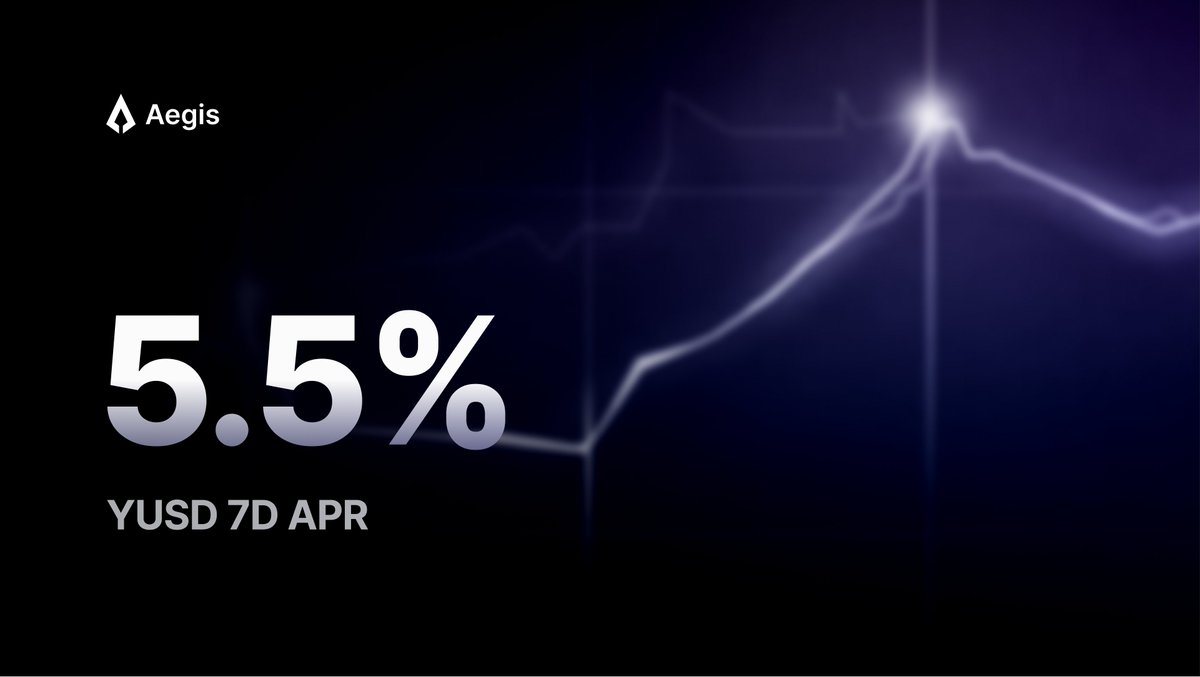
YUSD 7d APY: 5.5%. Last week's APY: 6%
The yield comes from the funding carry on the short BTC-M perpetual that hedges the YUSD Bitcoin backing, and from the reserve allocation.
Yields are verifiable on the proof of reserves page.
Proof of reserves: https://t.co/tRbjZlnwDr
7/ The product targets treasuries, funds and market makers that require a known financing cost before committing capital for a fixed term.
The product is in testnet, with availability targeted for Q4 2026.
Read the full breakdown: https://t.co/epyOpIggS9
Last week Aegis announced fixed rate borrowing for native $BTC, built with @babylonlabs_io and @aave V4.
This thread explains how a Bitcoin holder borrows a stablecoin against $BTC at a rate fixed at origination 🧵
6/ Each BTC vault is one indivisible unit tied to specific Bitcoin UTXOs. On a liquidation the keeper redeems the whole vault. If the redeemed value exceeds the debt, the excess returns to the borrower as a payment in $WBTC.