GPU memory alone won't scale your LLM inference. Find out why KV cache tiering matters: https://t.co/ABZOa7h5hW
As context windows grow and concurrent sessions multiply, KV cache size scales linearly. GPU high-bandwidth memory (HBM) does not. The result: cache evictions, cross-worker misses, and expensive recomputation every time infrastructure restarts.
The fix is a tiered storage hierarchy beneath the GPU:
• GPU HBM for active, latency-sensitive cache entries
• CPU RAM and local SSD for warm data that doesn't need to live on GPU
• Remote KV stores for shared, persistent cache across workers
Each tier trades bandwidth for capacity. Managing movement between them is where the real architecture work happens. Read the full breakdown to see how to design a cache hierarchy that actually scales.
#LLMInference #KVCache #AIInfrastructure #RealTimeData #Aerospike
Aerospike has been named one of DBTA's Awesome Companies in AI 2026, recognized for powering mission-critical AI workloads, from machine learning to generative and agentic AI.
When real-time performance and reliability aren't optional, that's where Aerospike operates.
To see the full list:
https://t.co/jg3kV4DZ9r
#AI #RealtimeData #AerospikeDB #MachineLearning #AgenticAI
The World Cup is the biggest sporting event on the planet. Billions of fans. Matches decided in moments. And behind every live bet placed in real time, infrastructure that cannot flinch.
DraftKings built a platform ready for moments like this: https://t.co/XVHXTuKqEt
DraftKings runs Aerospike across AWS, GCP, and on premises, scaling from six to 20 nodes during peak events, with sub-millisecond latency for live bet validation and real-time locking to prevent duplicate bets.
"Aerospike is the heartbeat of our real-time systems. It's not just a database, it's a coordination layer that helps us operate safely, smoothly, and at massive scale." — Radoslav Mirchev, SRE Manager, DraftKings
#WorldCup2026 #SportsBetting #RealTimeData #Aerospike #DataInfrastructure
Teams usually pick the right database for the system in front of them. The problem is that the decision ages. We break down how in our latest blog: https://t.co/E3XsdtS8rt
Three places teams feel it first:
• Sharding is a one-way process. Once converted, there's no going back. One MarTech company found sharding itself became the bottleneck at 9 TB.
• Routine operations interrupt service. Scaling triggers replica-set elections, and elections mean interruptions.
• Performance at scale requires more DRAM. Secondary indexes live in memory, so costs climb faster than data.
None of this is hidden. It just doesn't matter at small scale, which is why it surprises teams in production.
#RealTimeData #DatabaseArchitecture #ScalableInfrastructure
Active-active vs. active-passive: it's one of the first architecture decisions you make when building for high availability, and one of the most consequential.
For the full breakdown on when to use each architecture, check out: https://t.co/aHo9GlJkjI
Both keep systems running through failures. Here's how they differ:
• Active-active runs multiple nodes simultaneously. If one fails, the others keep serving traffic with near-zero downtime.
• Active-passive keeps standby nodes waiting. Failover is possible, but there's always a brief interruption.
• Active-active scales horizontally. Active-passive is simpler to manage but constrained by a single primary node.
#Aerospike supports both, so you can choose the right fit for your workload today and evolve as your needs change.
#HighAvailability #DatabaseArchitecture #RealTimeData #CloudInfrastructure
Myntra's feature store was hitting its limits on Redis. Lookup latency, scale, and infrastructure costs were all becoming problems.
To see how they solved it: https://t.co/khLMfIOEo5
"Any time you search on the Myntra app, Myntra hits an Aerospike cluster on the back end. [It handles] millions of operations per second at a P99 read as well as write. Reads are submillisecond [latencies]."
Nikhit Nair, Associate Architect, Myntra
After migrating to Aerospike, Myntra saw:
• 10x faster lookups than Redis with a smaller infrastructure footprint
• 500K personalization ops/sec at sub-millisecond response times
• P99 response times under 5ms across business-critical workloads
#Aerospike #RealTimeData #Personalization #Ecommerce #MachineLearning
To see how Aerospike Voyager makes real-time data easier to work with: https://t.co/Ddz9jx09HN
Writing code for real-time data shouldn't require a manual.
The Fluent SDKs for Java and Python are built to be expressive and readable, whether a developer or an AI agent is doing the writing. Less boilerplate, cleaner logic, faster path from idea to production.
#Aerospike #Java #Python #SDK #RealTimeData
Aerospike Voyager supports powerful queries through Aerospike Expression Language, and pairs directly with the new developer SDKs for validated query logic in your code.
To learn more: https://t.co/Ddz9jx09HN
Write expressive queries, validate them at build time, and skip the runtime surprises.
#Aerospike #AerospikeVoyager #RealTimeData #DeveloperTools #DataPlatform
Three companies hit the ceiling with Redis. Here's what broke, and what they did next.
The article below covers how Adjust, Wix, and AppsFlyer navigated the limits of Redis at scale, from latency spikes to cost and operational overhead, and why each one landed on Aerospike.
For all six migrations including Wayfair, TomTom, and ironSource, check out the full breakdown on our blog: https://t.co/BeA6Z4wbyN
#Aerospike #Redis #RealTimeData #DatabaseMigration #ScalableArchitecture
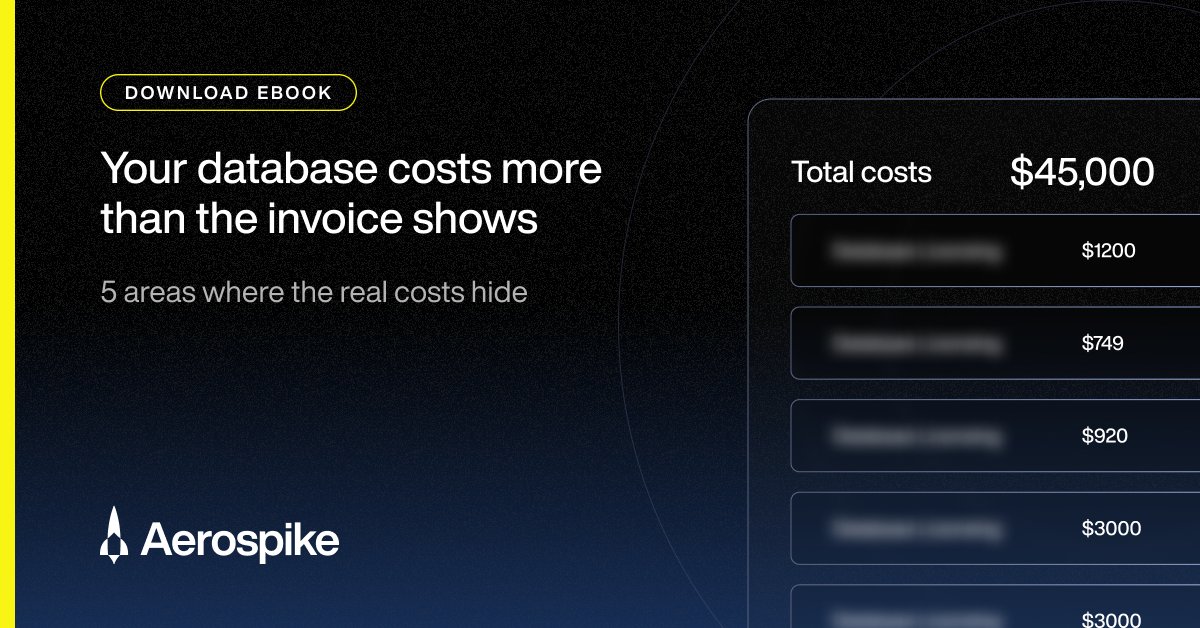
Engineering overhead, downtime, infrastructure sprawl. These aren't database costs. They're the tax on an unpredictable one.
https://t.co/3woMnIbiG3
Our e-book maps five areas where database costs quietly compound and shows how leading databases compare so you can build a clearer picture of true total cost of ownership before it's too late.
#Aerospike #DatabaseCosts #TCO #RealTimeData #NoSQL
Your application is only as fast as its slowest transaction. Caching can't change that math. Here's why: https://t.co/ITV8XEKXgF
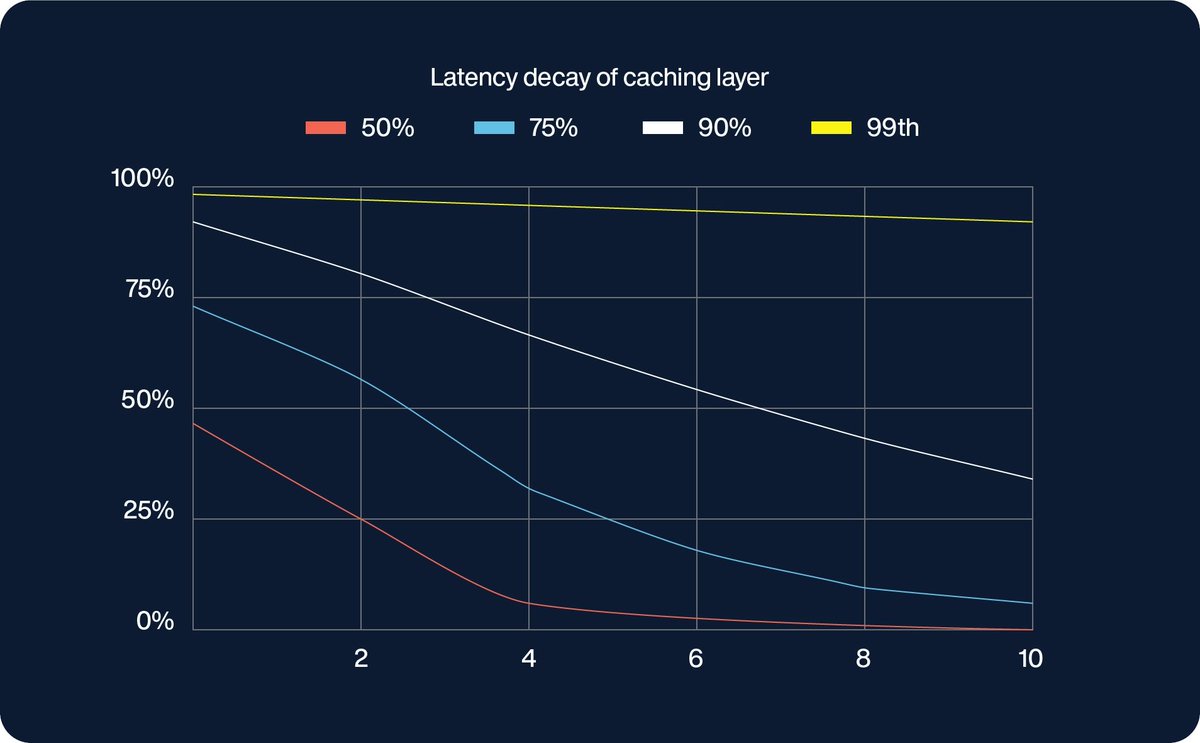
Most database operations are made up of several sub-operations, and if even one bogs down, it drags everything with it. Many teams reach for a caching layer to solve this, but caching is not the silver bullet it appears to be.
• At a 50% cache hit rate with four sub-operations, the probability all four are served from cache drops to just 6%
• Even at a 99% hit rate across five operations, there is still a 5% chance of a cache miss slowing the whole page down
• In use cases like fraud detection, AI, and customer 360, sub-millisecond latency is not a nice to have. It is essential
For real-time applications, that variability isn't acceptable. Aerospike delivers consistent sub-millisecond latency at the database level itself, so there's no second performance regime hiding behind a cache hit rate.
#Aerospike #RealTimeData #DatabasePerformance #SubMillisecondLatency
Aerospike Voyager is now available for preview. Download for free: https://t.co/qltA8TIvb3
Explore your data visually and make safe inline edits, with type-preserving confirmations.
#Aerospike#Voyager#DeveloperTools#NoSQL#DatabaseTools
A nonresponsive EBS volume shouldn't take your entire Aerospike cluster down with it. Here's how to make sure it doesn't: https://t.co/KQDPTV78TH
The default AWS EBS I/O timeout is set to roughly 49 days, meaning a stuck volume will never surface as a failure. #Aerospike keeps waiting instead of routing around it, and performance collapses while everything looks healthy.
Our latest blog walks through the fix, the tradeoffs, and what to test before shipping it to production.
#Aerospike #AWS #EBS #DistributedSystems #CloudInfrastructure #DevOps
Building production-grade agentic systems with LangGraph? Aerospike gives your agents the persistence layer they actually need: https://t.co/Sf8C0p8ETE
As agents traverse multiple nodes, invoke tools, and retry or branch on failures, state is read and updated frequently. These operations must stay fast and predictable. Compounding latency across a workflow isn't a UX problem. It's a data infrastructure problem.
Built-in TTL, high concurrency, fault tolerance, and sub-millisecond access. Built for workloads that can't afford to lose state mid-execution.
#LangGraph #AI #AgenticAI #RealTimeData #Aerospike #DeveloperTools
Aerospike Voyager comes loaded with sample data for common use cases. No setup, no blank slate: https://t.co/Ddz9jx09HN
Open it and start exploring the Aerospike data model right away, running real queries against a working dataset to see how they actually behave.
Download it free.
#DeveloperTools #NoSQL #DatabaseTools
"What does real-time personalization at scale actually require?
👉https://t.co/L2FshbnHDt
Our white paper breaks it down, from architectural foundations and feature store design to multi-stage retrieval, re-ranking strategies, and real-world examples from Sony Interactive Entertainment, Myntra, Flipkart, Wayfair, and Rakuten.
A practical framework for teams ready to move beyond experimental architectures.
#RealTimePersonalization #RecommendationSystems #MachineLearning #Personalization #Aerospike"
Try the new Aerospike Java SDK and Voyager together: build a retail app's database layer in this tutorial https://t.co/vYwGtGVdpZ
You start with a Spring Boot app whose data-access methods are stubbed out, then implement each one using the SDK's fluent API.
Voyager stays open the whole time. Inspect records, build filter expressions visually, and edit data directly in the live cluster.
By the end, you'll have covered inserts, point reads, secondary index queries, Aerospike Expression Language filters, and a check-and-set update on a nested shopping cart document.
All in 30 to 45 minutes.
#Aerospike #Java #SpringBoot #Developers #Database
We put together five case studies of Aerospike in production: https://t.co/1yWCD7ll5i
Five industries. Five very different workloads. One thing in common: the data layer holds when conditions don't.
Adobe, PayPal, Sony Interactive Entertainment, Barclays, and Myntra run their most demanding workloads on Aerospike: fraud prevention, ad targeting, player profiles at scale, e-commerce at peak, and more.
Worth a read if your workload looks anything like these.
Aerospike Voyager closes the gap between exploration and production.
The filter you build is the filter your app ships, no rewrite, no translation layer. And with a built-in MCP server, AI coding agents like Claude Code and Cursor can query your real cluster directly, in the same expression language your code already uses.
Free, cross-platform, and auto-updating. Download at https://t.co/OD6PTr5D12
Real-time bidding happens in the blink of an eye. Around 100 milliseconds end to end, with data retrieval needing to complete in no more than 10 of those milliseconds, across billions of users and millions of potential ads.
We wrote about how to build a user profile store for exactly this use case, and it is still one of the most relevant pieces of content we have on AdTech infrastructure.
Here is what makes it worth revisiting:
• Why data modeling choices have an outsized impact on latency and hardware efficiency at AdTech scale
• How to handle segment expiry at the map level rather than the record level, and why it matters
• How Aerospike delivers near-constant low latency across massive datasets to keep bid decisions fast and predictable
#Aerospike was built for exactly this kind of workload. Flash-optimized storage, a distributed architecture, and powerful list and map operations that make complex data models not just possible but performant at scale.
To learn more about building a high-performance user profile store for real-time bidding, check out the full blog: https://t.co/9Tk8lYDhIH
#AdTech #RealTimeBidding #UserProfileStore #RealTimeData #NoSQL







![aerospikedb's tweet photo. Myntra's feature store was hitting its limits on Redis. Lookup latency, scale, and infrastructure costs were all becoming problems.
To see how they solved it: https://t.co/khLMfIOEo5
"Any time you search on the Myntra app, Myntra hits an Aerospike cluster on the back end. [It handles] millions of operations per second at a P99 read as well as write. Reads are submillisecond [latencies]."
Nikhit Nair, Associate Architect, Myntra
After migrating to Aerospike, Myntra saw:
• 10x faster lookups than Redis with a smaller infrastructure footprint
• 500K personalization ops/sec at sub-millisecond response times
• P99 response times under 5ms across business-critical workloads
#Aerospike #RealTimeData #Personalization #Ecommerce #MachineLearning](https://pbs.twimg.com/media/HSwJRHyXQAAKj9A.jpg)