Jeff Bezos: "We don't have a revenue problem in this country. We already have the most progressive tax system in the world.”
“The Top 1% of taxpayers pay 40% of all taxes.”
“The bottom 50% pay just 3%. We have a spending problem."
Try and watch @realJudebela's Power and Plunder YouTube series, especially the Murtala and Babangida episodes.
If you're completely illiterate about your country's historical context and place in the geopolitical world, you won't be afterwards.
I won't elaborate.
If you keep paying millions to "bandits" to free kidnapped victims, more "bandits" will come
If you take control of every inch of your forests and eliminate all "bandits", more "bandits" will leave
It's a binary choice
It's not easy, but that's why God gave you oil money so you can fund security
You know Nigeria has been on this matter for long when Papa Obafemi Awolowo was already using heavy grammar to describe our leaders… in 1955!
Nigeria, I hail thee!
No be today sha 😂🔥
"If you believe in equal rights, then what do 'women's rights,' and 'gay rights,' etc. mean? Either they are redundant or they are violations of the principle of equal rights for all."
- Thomas Sowell
Niger Takes Full Control Of Arlit Uranium Mine, Revokes French Company’s License
Niger has taken another bold step towards the full nationalization of its resources. On May 18th, 2026, the Nigerien government revoked a 58-year-old concession granted to France’s Atomic Energy Commission (CEA) on the country’s fabled Arlit mine. French mining company Orano had been siphoning uranium from this mine to power France’s nuclear reactors for over 50 years before it was suspended from operating in Niger by the administration of President Abdourahamane Tchiani in 2024.
With this latest move by Niamey, Niger, which has relied on neighboring Nigeria to meet the bulk of its energy demands for decades, is closer than ever to finally harnessing its own energy reserves for the benefit of its masses.
As a member of the Alliance of Sahel States (AES), Niger has faced relentless att@cks by Western-backed t*rrorists, economic isolation and sovereignty violations by Western-aligned African states, and endless slander from Western and Western-aligned media. Despite these externally-imposed challenges, the country and its fellow AES members, Mali and Burkina Faso, have continued to record economic and political wins.
All 3 AES members have pointed to former colonizer France as a key sponsor of t£rror in the region – a claim which has been corroborated by their international allies – and France itself has made no bones about its intentions to revive its dwindling influence in Africa, and in so doing, shore up its presently crumbling economy.
Gold has overtaken US government bonds as the world’s top reserve asset. The shift reflects an attempt by many countries to seek alternatives to the US dollar, the world’s de facto reserve currency https://t.co/h3NnirICcS
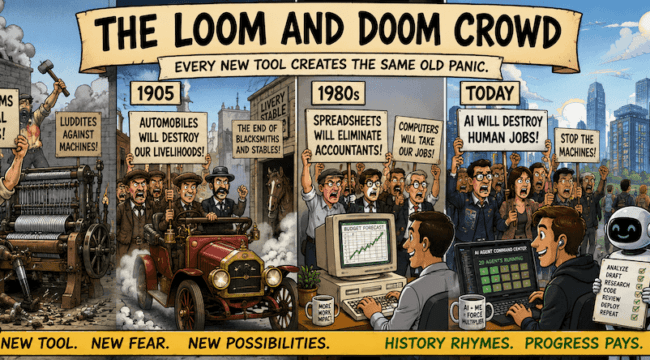
"They were wrong in 1812. They were wrong in 1905. And they’re wrong again.
In 1812, English textile workers stormed mills across Yorkshire and Nottinghamshire. They smashed power looms and burned cotton frames. They called themselves Luddites, after a possibly mythical weaver named Ned Ludd who’d supposedly done the same years before.
Their grievance was simple: the machines were taking their jobs.
They were right about the short term… but spectacularly wrong about the long term.
The power loom didn’t destroy textile work. It created an industry so large Britain built an empire around it. By 1850, there were more textile workers in England than there had ever been, and they were richer, worked in heated buildings, and lived longer.
I call this the Wrecker’s Fallacy: the belief that a tool which replaces one task will destroy all the tasks around it. It sounds sensible. It’s almost always false.
When Gutenberg invented the printing press, scribes panicked. The Church worried about large-scale heresy. Scholars warned that cheap books would drown readers in bad ideas.
But what happened instead? Literacy skyrocketed. Yes, the scribes disappeared. But new professions like editors, typesetters, publishers, and journalists came into being. The written word had become a generous employer indeed.
When the car arrived, blacksmiths and livery stable owners screamed doom. The auto industry killed its trade.
What also happened? America built 4 million miles of road. Mechanics, gas stations, trucking, tourism, suburbs, and fast food emerged from nothing. It gave us more employment, not less.
When spreadsheets hit in the 1980s, accountants feared mass unemployment. The opposite occurred. Cheap computing made financial analysis so useful that demand for accountants rose sharply for the next two decades."
Article published by Sean Ring