Writer, reader, musician, Marxist, anti-imperialist.
Author, 'The East is Still Red – Chinese Socialism in the 21st Century'
Co-editor @socialist_china
I wrote a book about why the left should support Chinese socialism and why all peace-loving people should stand up against the US-led New Cold War. It's called 'The East is Still Red – Chinese socialism in the 21st century'.
Get it from Praxis Press: https://t.co/ES5UjFI0mh
On the 105th anniversary of the Communist Party of China, @Ollie_Vargas_ reflects from Yan'an – where the Long March ended – on why a century-old party keeps its vitality: rigorous self-reform, and an unbroken bond with the people.
https://t.co/erjET3U3NT
China provided Venezuela with satellite images of the affected areas to support relief and assistance efforts.
Chinese companies and associations in Venezuela have donated construction machinery and critical medical supplies for emergencies. They have also formed their own teams to actively support in search and rescue tasks.
The Chinese government will deliver, as soon as possible, an additional 100 million yuan (US $14.7 million) in emergency material assistance.
The main factor in hindering all Venezuelan government response to earthquake relief is over a decade of most extreme and crippling Western sanctions on literally everything.
Beyond any argument.
Yet I have not seen any western media mention it.
A new report from the Asia Group – no friend of Beijing – reaches a striking conclusion: the clear winner of Trump’s war on Iran is China.
We should be absolutely clear that China did not want this war, and opposed the assault from the outset. As the US and Israel struck Iran on 28 February – killing its head of state and dragging the region towards catastrophe – Beijing consistently called for a ceasefire and a negotiated settlement, and named Washington and Tel Aviv as the destabilising parties. That position has been thoroughly vindicated.
What was this war actually about? Beneath the ridiculous pretexts about Iran’s nuclear programme lay an older ambition, set out a quarter of a century ago by the Project for the New American Century: to entrench US global primacy, dominate the energy chokepoints of West Asia, and prevent the emergence of any peer competitor. In 2026 that “peer competitor” has a name. Roughly 80 percent of the oil and 90 percent of the gas passing through the Strait of Hormuz is bound for Asia. A US hand on that valve was meant to be a US hand around China’s throat.
But it didn’t work. China had over 100 days of crude stockpiled, and has been building renewable energy at a scale the rest of the world can barely comprehend: 315GW of new solar last year alone, more than half the global total. When the Strait of Hormuz closed and prices spiked, China simply weathered it, while accelerating the very transition that makes it less dependent on hydrocarbons. The crisis didn’t choke China; it advertised China’s resilience and exposed the US once again as the world’s leading agent of chaos and destruction.
This is the deeper meaning of the report. The war was, in effect, a last roll of the dice for the unipolar project – an attempt to reverse multipolarity by force where it can clearly not be reversed by competition. The US spent billions, killed thousands, saw its military infrastructure in the region turn to dust, and emerged weaker, more isolated and less trusted.
Turns out all the “China do nothing and win” memes are on to something.
In the height of irony, I was detained at John Lennon International AirPort in Liverpool, England by anti-terrorism police concerned about my opposition to the Genocide on Gaza and the war on Iran. They seized my phone, computer, fingerprints and DNA sample. More to come . . .
Dan Kovalik is a US citizen, an international lawyer, among whose clients is the President of Colombia. Yesterday he was seized by British “Anti-Terrorism” police at John Lennon International Airport in Liverpool. His devices were seized his fingerprints and DNA taken under legal duress. The Political Police in Britain are out of control. @KRWLaw
Warfare as a growth strategy: Starmer’s parting gift
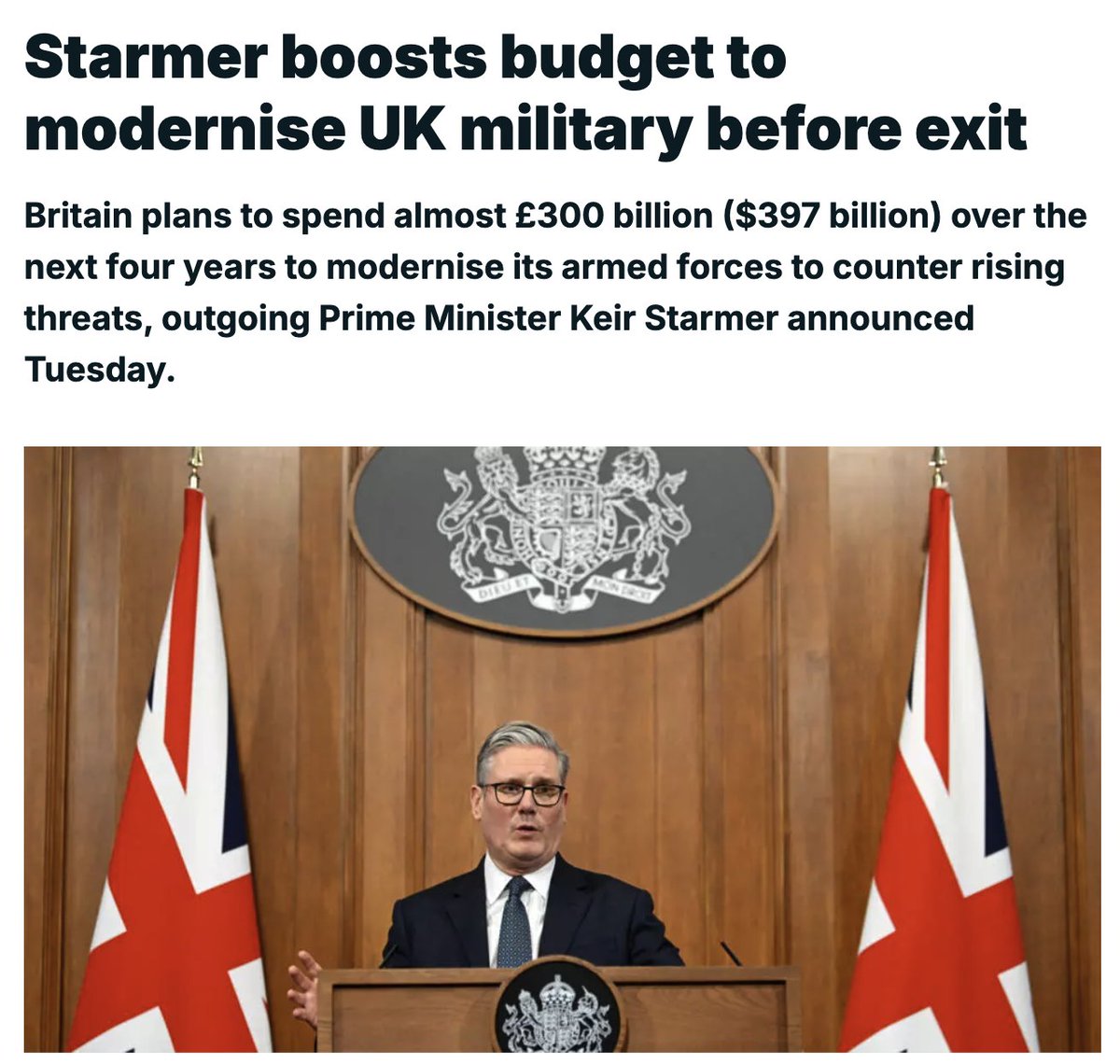
On his way out of the door, Keir Starmer has announced his “legacy”: £300 billion for the military over four years, a new generation of stealth fighters, fleets of attack drones, and a vast upgrade to Britain’s nuclear weapons. The justification? That Russia “might attack a NATO country” by 2030.
We are asked to believe that Russia, on the basis of its concerns about NATO expansion and its insistence on protecting itself against Western aggression, is on the cusp of rolling across Europe and storming the beaches of Kent. The idea is beneath ridicule, which is precisely why it has to be repeated so often and questioned so rarely.
But the threat inflation isn’t really about Russia at all. Strip away the rhetoric and the truth is stark: rearmament is the only economic programme Labour has. There is no serious plan for housing, where a generation is locked out and social housing rots. None for the NHS, buckling after decades of cuts. None for schools, for social care, for the crumbling infrastructure of a country where the trains don’t run and the rivers fill with sewage. The one thing this government can find tens of billions for, at speed, is the military-industrial complex.
Every pound poured into “kamikaze drones”, AUKUS and Trident is a pound not spent on a home, a hospital or a school. And military spending is uniquely useless as stimulus: it builds nothing anyone can live in, learn in or be healed in. It exists to be stockpiled, exported, or blown up.
If the idea is to make Britain safe, this can be best achieved with dignified jobs, good schools, a working health service and warm homes. Not by a vast arsenal pointed at a manufactured enemy.
Starmer calls it his proudest legacy: a government with nothing to offer its people but weapons, and an imaginary war to justify them. Quite the epitaph.
My latest:
“In 1953, Britain and the US could overthrow Mossadegh’s government with a handful of agents and a pile of bribes, and install a compliant dictatorship free from unorthodox ideas about nationalising resources. In 2026, the combined military might of the US and Israel has not been able to break Iran – at least in part because Iran is deeply woven into an emerging multipolar world that is increasingly capable of defending itself against imperial aggression.”
https://t.co/9ojuNKV1xp
BREAKING: After years of forensic investigation failed to locate the Uyghur concentration camps in Xinjiang, intrepid reporters can finally reveal their true location: Royal Mint Court, East London.
According to Taiwan's "ambassador" Vincent Chin-Hsiang Yao, China's proposed new embassy is to double as a secret prison, with interrogation suites and a gulag presumably tucked discreetly between the visa office and the staff canteen, and conveniently located just a few minutes' walk from the nearest Pret.
We've apparently reached a level of hysteria where anything Chinese has to be reframed as a sinister plot, because the actual record – of poverty alleviation, of world leadership in renewables, of peaceful foreign policy – is far too inconvenient to discuss.
🚨🇨🇺🤝🇨🇳15 thousand tons of rice arrive at the Port of Santiago, corresponding to the second batch of 60 thousand tons of rice donated by China to Cuba.
While the U.S. focuses on finding ways to collapse Cuba's economy, China is sending food.
Excellent article by @agent_of_change on defending the reforms occuring in Cuba. Cuba is following the Chinese model of socialist construction. China has mastered Reform and Opening Up!
https://t.co/ZByZeUCNzF
It deeply pained me to see the images of the earthquake that struck Venezuela, especially its capital, Caracas.
For me, these were not just scenes from the news. They were profoundly personal.
I lived in this beautiful country. I came to know its people, and in the darkest period of my life, when I was being pursued politically by NATO and allied Arab regimes, I found protection among its people and its revolutionary government.
In the very neighborhoods affected by the earthquake, I lived a genuine human experience. I built lasting friendships with revolutionaries, ordinary people, shopkeepers, neighbors, and athletes.
In Caracas, I wrote poetry and articles. I joined revolutionary brigades, rode my bicycle through its streets, traveled to its Caribbean coast, and climbed its mountains.
The Venezuelan people taught me that every land has a soul, and that every nation carries a memory that never forgets those who loved it sincerely.
My bond with Venezuela has never been merely political. It is human, cultural, geographical, and deeply spiritual. It is the country that gave me safety when the world closed its doors, and welcomed me with generosity when I needed it most.
Today, my thoughts are with Venezuela, with its resilient people, and with a nation that has stood firm against imperialism without surrender. A nation that has remained a steadfast supporter of the struggles of free peoples, from Palestine to Africa, and everywhere dignity and justice are sought.
May Caracas recover swiftly. Mercy to those who lost their lives, healing to the injured, and strength to the Venezuelan people, who have always known how to rise again from the ruins.
Cuba will outlast Trump. Despite intensifying US pressure and blockade measures, Cuba’s tradition of resistance, strong social organization, and decades of preparation against foreign intervention make regime change or military conquest unlikely.
https://t.co/dU8MXawsjz
Namibian President Netumbo Nandi-Ndaitwah: “The relationship between Namibia and China is founded on mutual respect, shared interests, and a common commitment to development.”
“His allies say they expect a high level of continuity from Sir Keir Starmer’s stance on Britain backing Ukraine and on support for Nato.”
And needless to say he’s a Labour Friends of Israel guy.
"China is a very good country and a friend of ours." China has built 100+ sports arenas across Africa – including Cabo Verde's national stadium, behind the islands' historic World Cup run.
https://t.co/DBLgNNqqqn
Important and profound reflections on China from Domenico Losurdo, republished in the latest edition of International Critical Thought.
“Obviously, it’s completely legitimate to express doubts and criticisms about ‘market socialism.’ But on one point I think the Left should be able to reach a consensus. The reform and opening-up policy Deng Xiaoping introduced has not at all meant the merging of China with the capitalist West, as if the whole world was from then on characterized by a still calm. In reality, starting in 1979, a struggle developed that may have escaped the vision of the more superficial observers but whose importance is being demonstrated with greater and greater evidence.
“The US and its allies hoped to impose an international division of labor in which China’s part was limited to producing low-priced goods with little technological content. In other words, they hoped to conserve and increase the Western monopoly of technology. Under this plan, China, like the entire Third World, would have had to continue to play a dependent role with respect to the capitalist centers.
“It is now well understood that the Chinese Communists have interpreted and carried out a continuation of the struggle for national liberation in order to cause this neo-colonial project to fail: there is no political independence without economic independence. At least those who declare themselves Marxist should understand this truth clearly! Thanks to the desired maintenance of technological monopoly, the US and its allies intended to continue to dictate the terms regarding international relations. With its extraordinary economic and technological development, China has opened the road to democratizing international relations. This result should please not only communists but also all authentic democrats: there are now better conditions for the political and economic emancipation of the Third World.”
https://t.co/YtXMeevUq8
Every new heat record exposes the same divide: workers and the planet vs billionaires.
People are dying in the heat right now. Yet we’re told there’s always billions for endless war and militarisation, but never a serious plan for the climate crisis.
The richest keep profiting from fossil fuels while insulating themselves in air-conditioned bunkers. Everyone else is left to work through dangerous temperatures, live in overheated homes, and rely on public services pushed to breaking point.
Climate breakdown isn’t just an environmental crisis, it’s a class one.
We need rapid decarbonisation, serious investment in adaptation, and workers’ rights that include a legal maximum workplace temperature.