@Optimismking@kunmigbenga@Naija_farmers A lot of people said, "Well done."
But after sharing the story about the cow that was buried
So I made a few calls.
A fully grown cow of that size could easily be worth ₦800,000 to over ₦1.5 million
Think about that for a moment.
That's not a small loss.
One of my cattle died.
The first question people asked was:
"Why didn't you sell it to the butchers?"
My answer was simple: Because I value human life more than money.
When an animal dies, you may not know the exact cause. It could be an infectious disease, and selling it for meat could put many lives at risk.
So I buried the carcass properly, isolated the area, and monitored the rest of my herd.
Yes, I lost money.
But integrity is choosing public health over profit.
As farmers, our responsibility is not just to produce food—it is to produce safe food.
What would you have done?
During our NYSC Digital Literacy CDS, I realized many artisans already own smartphones.
The problem isn't access to technology.
The problem is that nobody has shown them how to turn their phones into income.
I know one tailor for my area.
The man can sew.
Not this Instagram designer wey go use ring light hide poor finishing. This one fit look your body once and know where adjustment suppose enter.
People dey travel come meet am. Weddings, burials, naming ceremonies — na him hand people trust.
But oga no dey post.
His WhatsApp DP na flower. Facebook account dey active only during Christmas and New Year.
As a corps member, our CDS na Digital Literacy. Part of wetin we dey teach be say this phone wey everybody hold fit become shop, billboard and salesperson at the same time.
One day I tell the man, “Oga, make we snap your work.”
He laugh.
He say, “My work dey speak for itself.”
I say, “Oga, e dey speak, but nobody dey hear am.”
We created a WhatsApp status. Posted some native wears. Uploaded one video of him measuring a customer.
Nothing serious.
Few days later, one guy message am.
“Oga, na you sew this senator?”
Another person ask for price.
One lady save his number.
The man come call me.
“So all these years, customers dey inside phone?”
Na there I realize say many Nigerian business owners no get customer problem.
Dem get visibility problem.
The baker, the farmer, the welder, the hairdresser, the tailor — plenty people are excellent at what they do but invisible where everybody now spends their time.
Social media no be only for dancers, influencers and skit makers.
Sometimes na your market.
As corps members, we talk plenty about digital literacy. But digital literacy no be only knowing how to use phone.
Na knowing how to use your phone to change your income.
@MikeAgrow@NITDANigeria
The future of billions in Africa is agriculture.
People have used it and I have used it myself
But the next level of wealth in agriculture may not belong only to those who know how to farm.
It may belong to those who understand both agriculture and investment.
Many of us are building farms, selling produce, raising livestock and running agribusinesses. That's important.
But imagine this:
Plant yam.
Plant tomatoes.
Rear goats.
And also own shares in companies that process rice, produce fertilizer, make agricultural inputs or support the food system.
You don't have to work only on the farm.
You can also own a small piece of the businesses that power agriculture.
I'm not saying stop farming.
I'm not saying stop building your agribusiness.
I'm simply saying: open your eyes to additional streams of income.
The next generation of agripreneurs may not only grow food or process it.
They may also become investors. The deal is :
✅ Learn how investments work.
✅ Understand shares and the stock market.
✅ Follow Nigerian companies.
✅ Learn wealth creation beyond salary and beyond running a business alone.
Agriculture may feed Africa.
But ownership may build wealth.
That may be the next crop young Nigerians need to start paying attention to.
@MikeAgrow
Nigeria has never been Africa's #1 cocoa producer by volume. Not in the colonial era, not at independence, not now.
What we WERE: in the 1950s–60s, the Western Region (under Awolowo's government) made cocoa its core revenue engine. Nigeria became the world's 2nd largest producer, commanding close to 18% of global supply. The
Cocoa money built WNTV — Africa's first TV station — Cocoa House in Ibadan, and Liberty Stadium. When cocoa is funding that kind of infrastructure, it feels like you're at the top. Economically, you basically were.
What we were ALSO when it's comes to quality #1 in: quality
The old Nigerian Produce Marketing Board ran a brutally strict grading system before any bag touched a ship. For aroma and flavor profile — the stuff European chocolate makers actually pay premiums for — Nigerian cocoa was the benchmark in West Africa. The same as ginger
So the question How did we end up 4th, behind Côte d'Ivoire, Ghana, and Cameroon?
1: The oil boom reallocation.
Once petroleum revenue arrived in the 1970s, national attention, capital, and labor moved toward it almost overnight. Cocoa stopped being the priority sector it was under the regional governments. Extension support, replanting subsidies, research funding — all thinned out.
2: The pricing trap.
The marketing boards paid farmers well below world price and kept the spread as a "stabilization" mechanism. Sounds reasonable on paper. In practice, it killed the incentive to replant, expand, or chase quality. A farmer who isn't capturing the upside has no reason to reinvest.
3: Aging trees, aging farmers, no replanting cycle.
Cocoa trees have a productive lifespan. Most of Nigeria's cocoa belt is running on trees well past their prime, with disease pressure (black pod, swollen shoot virus) compounding the yield decline. Without sustained extension and replanting programmes, output stagnates while everyone else's trees keep producing.
4: The competition didn't stand still.
While Nigeria's attention drifted, Côte d'Ivoire scaled aggressively post-independence and overtook Ghana for the global #1 spot in 1978 — a position it's held ever since. Ghana, meanwhile, protected its sector through institutional continuity (COCOBOD has run for decades with minimal disruption). Nigeria's institutional continuity broke repeatedly.
we didn't lose the position by accident — we traded it, slowly, decade after decade, for other priorities. Oil now.
I believe in Nigeria
@MikeAgrow
I know a guy in Lagos who once said, “Farmers complain too much. Just plant and harvest na.”
I ask am if he has ever planted anything before.
He said, “I keep aloe vera in my balcony.”
I shock.
Many urban people think food is like electricity. You press switch, e show. You enter supermarket, tomatoes dey. You order online, rice arrive. You complain say pepper cost too much.
But somewhere, one farmer has not slept because rain refused to fall or it too much of it.
Somebody’s cassava drowned because flood no send anybody.
Somebody borrowed money to plant maize and goats and cows held meeting inside the farm.
Yet when prices go up, the first thing people say is, “These farmers are greedy.”
Bros, the tomato you squeeze inside your stew passed through more problems than some startups.
There are people who have never seen a rice farm but can argue for two hours about why rice is expensive.
There are people who think eggs are produced every morning like bank alerts.
A friend from the city visited a farm once. By 10 a.m. he was already asking where the nearest restaurant was because the sun was “too aggressive.”
That day he discovered that agriculture is not aesthetic. It is not drone shots, cowboy hats and Instagram captions. It is sweat, uncertainty, debt, pests, weather, middlemen and hope.
Maybe this is why food waste is so common in cities. When you don’t understand production, you can’t respect the process.
The distance between the farm and the city is not just kilometres.
It is understanding.
@MikeAgrow
I know a guy in Lagos who once said, “Farmers complain too much. Just plant and harvest na.”
I ask am if he has ever planted anything before.
He said, “I keep aloe vera in my balcony.”
I shock.
Many urban people think food is like electricity. You press switch, e show. You enter supermarket, tomatoes dey. You order online, rice arrive. You complain say pepper cost too much.
But somewhere, one farmer has not slept because rain refused to fall or it too much of it.
Somebody’s cassava drowned because flood no send anybody.
Somebody borrowed money to plant maize and goats and cows held meeting inside the farm.
Yet when prices go up, the first thing people say is, “These farmers are greedy.”
Bros, the tomato you squeeze inside your stew passed through more problems than some startups.
There are people who have never seen a rice farm but can argue for two hours about why rice is expensive.
There are people who think eggs are produced every morning like bank alerts.
A friend from the city visited a farm once. By 10 a.m. he was already asking where the nearest restaurant was because the sun was “too aggressive.”
That day he discovered that agriculture is not aesthetic. It is not drone shots, cowboy hats and Instagram captions. It is sweat, uncertainty, debt, pests, weather, middlemen and hope.
Maybe this is why food waste is so common in cities. When you don’t understand production, you can’t respect the process.
The distance between the farm and the city is not just kilometres.
It is understanding.
@MikeAgrow
Dear Agripreneur,
Nigeria is not poor in agricultural resources.
1. Nigeria has about 84 million hectares of agricultural land, with roughly 35–37 million hectares classified as arable land, yet only a fraction is being fully utilized.
2. Nigeria is blessed with two major river systems — the Niger and the Benue — which provide enormous potential for irrigation and all-season farming.
3. Nigeria's diverse ecological zones allow us to grow cocoa in the South-West, rice across several regions, tomatoes in the North, cassava in the South, and support livestock production across the savannah belt.
4. Nigeria enjoys abundant sunshine throughout most of the year, creating opportunities for year-round farming and solar-powered agriculture.
5. Nigeria has fertile soils, numerous dams, groundwater resources, a large youth population, and over 240 million consumers, making it one of Africa's largest food markets.
The truth is that we are not lacking resources.
We are lacking coordination, infrastructure, efficient markets, storage facilities, value addition, extension services, and the systems that connect farmers to opportunities.
The land is available.
The water is available.
The market is available.
The climate is favorable.
The question is no longer whether Nigeria can feed itself.
The question is:
Do you have the knowledge, skills, and systems to create value from the resources around you?
Dear Agripreneur, the future of agriculture in Nigeria is not waiting to be discovered.
It is waiting to be built.
Agriculture Agribusiness Agripreneur FoodSecurity
Why does an oil and gas country with roughly 13,625 MW installed capacity deliver only about 4,000–5,000 MW most days?
Let me explain Nigeria's electricity system in 13 tweets. 👇
Agriculture is 24.58% of Nigeria's GDP. It gets 3.92% of commercial bank credit.
Everyone blames the banks. Few ask why farmers keep failing the basic tests banks apply to every other business.
No bank lends to you if:
1. You have no credit score
2. You have no registered business name or account
3. You have zero documentation — inputs, labour, yields, nothing tracked
4. You mix personal and business money
5. You have no off-take agreements or buyer contracts
6. You can't prove your land or prove your harvest
7. Everything is cash, memory, and vibes
The next billionaires from Africa won't just be farmers.
They'll be the ones who understand the value chain input to market and build a system around every link in it.
The North-West launch of the Renewed Hope Farm Inputs Support Programme (FISP) Phase 1 is happening in Katsina State.
Implemented by @nadfng and driven by the vision of President @officialABAT, this intervention is delivering essential farm inputs directly to farmers to improve productivity and strengthen food security.
From policy to the farm. From promise to impact.
📍Katsina State
#RenewedHopeFISP #NADFImpact #NADFSupportsFarmers
I came across Mr. Olumide (@voiceofdFarmer) on Facebook, and the first video I saw on his page immediately fascinated me and caught my attention. He has been doing an excellent job in his field, and through the stories he shares about farmers, I’ve learned a lot from him. Follow @voiceofdFarmer
Nigeria lost its ginger industry once before it finished building it. The 2023 blight didn't just kill crops — it killed confidence, shut export pipelines, and exposed a value chain sitting on one point of failure: seed health.
The new Ginger Value Chain Recovery and Sustainability Programme (GVCRSP) — NADF working with NRCRI — is the first response that reads like a system fix, not a bandage.
Three things set it apart:
Seed health, not just seed supply. Six metric tonnes of rhizomes plus tissue culture propagation means disease-screened planting material, not just available material. That's the gap emergency input packs alone couldn't close.
Lab capacity as infrastructure. Upgrading NRCRI's labs, power, and digital systems isn't glamorous. But it's the difference between reacting to the next outbreak and forecasting it.
Germplasm conservation. Genetic banking is the insurance policy nobody notices — until the sector that skipped it gets hit again.
The real test isn't the launch, it's the delivery gap. GRATE targeted 15,000 farmers nationally; on-the-ground reporting put actual Kaduna rollout closer to 5,000. If GVCRSP closes that gap between target and delivery, it's not just ginger recovery — it's a template for handling the next agricultural shock before it becomes a crisis.
NADF Launches Ginger Sustainability Programme, Strengthens Agricultural Research Institutes
The National Agricultural Development Fund (NADF) and the National Root Crops Research Institute (NRCRI), Umudike, have launched the Ginger Value Chain Recovery and Sustainability Programme (GVCRSP), a major intervention aimed at restoring Nigeria's ginger industry following the devastating ginger blight epidemic that crippled production across key growing areas.
Read the full story here: https://t.co/s6Vm6waXkM
Farming is NOT a “set it and forget it” venture.
Every day = weeding, restaking, fertilizing, watching, praying for rain.
It’s sweat, sun, and sleepless nights.
Farmers deserve more than thanks. They deserve a hug. 🤗
#NigerianFarmers@akinwale_cfi@Nig_Farmer
I saw one post this morning that refused to leave my head.
It was about mangoes.
Simple gist. A trader goes to a village, buys mangoes and harvests everything at once. Ripe, unripe, confused ones, everybody enters the basket.
Then somewhere on the journey to the city market, "science" enters the chat.
By the next morning, the mangoes are yellow, fine, attractive and looking like they just graduated from a skincare routine.
Customer sees them and says, "Ah! Fresh mango."
Bros, fresh according to who?
The thing wey shock me be say most of us buy food based on vibes.
The tomato is red.
The mango is yellow.
The cucumber is shining.
Case closed.
Nobody asks where it came from.
Nobody asks how it was stored.
Nobody asks what was sprayed on it.
Nobody asks whether it ripened naturally or somebody forced destiny to happen overnight.
And honestly, can you blame us?
For years, agriculture has been about producing more food. More yield. More hectares. More harvest.
But I think the next big agricultural conversation is something else entirely.
Trust.
Because what use is plenty food if consumers don't know what happened to it before it reached their plates?
The future of agriculture may not belong to the farmer with the biggest farm.
It may belong to the farmer, processor, or brand that can confidently answer one simple question:
"How exactly did this food get here?"
Because food security is not just about having food.
It's also about trusting it.
Question: If every food item in the market came with its full story attached, would you still buy the same things you buy today?
@MikeAgrow
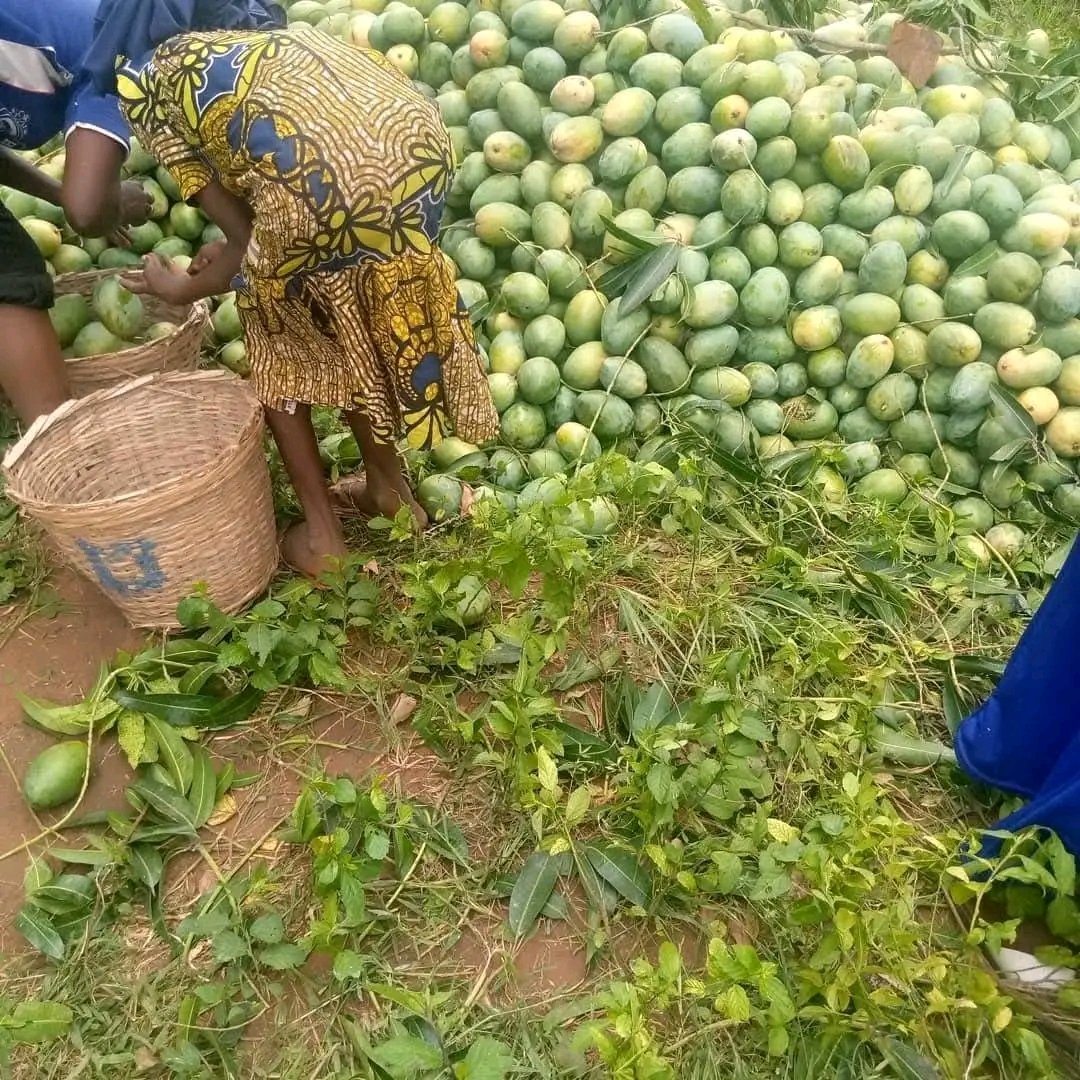
This is how city people buy mango from the village...
They harvest everything on the tree at the same time. Most times the fruits are not ripe.
As they load in the vehicle they add ripening agent.
Ripening agent inform of carbide, acetylene etc. These ripening agents are poisonous to humans
They are never to be consumed
By the next morning in the market, you won't recognize this mangoes again.
They would have been forced ripened
Everything will be looking "kami Kami Kami" meaning "pluck me, pluck me, pluck me"
That's why most mangoes in the city are not sweet despite looking so fresh
Taking those mangoes is like deliberately poisoning yourself
Hence it's even preferable to buy unripe mango 🥭 if you are not sure of the source of that mangoe
But most people are looking for beautiful, yellow and supposedly fresh Mangoes
They do this with tomatoes. Plantain and banana plus so many other fruits
Watch what you eat
farmritewithYinka
@nadfng Launches Renewed Hope FISP Phase 1 Today in Abuja!
The National Agricultural Development Fund (NADF) is officially launching Phase 1 of the Renewed Hope Farm Inputs Support Programme (FISP) today in Abuja. Farmers will receive free farm inputs under this initiative. If you’re a farmer in the FCT, this is your opportunity don’t miss out!
Come, register, and benefit.
#RenewedHopeFISP
#NADFImpact
#NADFSupportsFarmers