Have you seen what is inside the new AMI portal?
Explore industry research, risk reports, and credit ratings, with Agusto GPT included to help you explore Agusto’s research through conversation.
What will you discover first?
Click the link to explore the AMI: https://t.co/0cIMhCsFz6
WE’RE LIVE NOW!
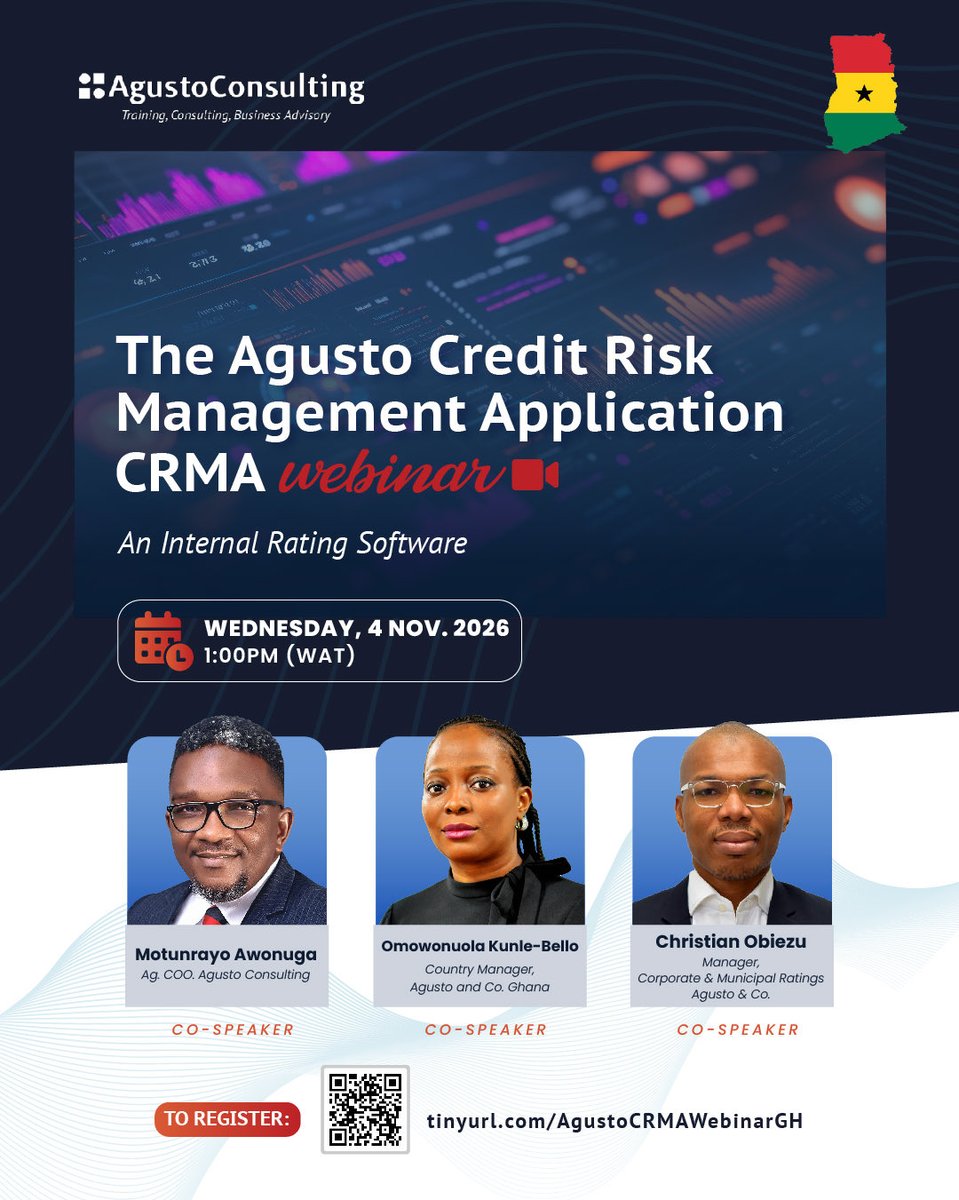
Our executive webinar on the Bank of Ghana’s Credit Risk Management Directive is currently underway!
Join us as we explore practical strategies for strengthening credit risk management and how Agusto’s Credit Risk Management Application (CRMA) can support compliance ahead of the 30 June 2027 deadline.
🔗 Join here: https://t.co/veIKn4ZowX
Haven’t registered? You can join directly using the Zoom meeting details below:
Meeting ID: 898 5613 5337
Passcode: 404702
We look forward to having you join the conversation!
The Bank of Ghana’s Credit Risk Management Directive, issued in October 2026, places renewed emphasis on strengthening lending practices, improving credit risk monitoring and reducing non-performing loans (NPLs).
The directive also highlights the importance of implementing appropriate internal ratings systems and credit assessment tools.
Join us today for an executive webinar exploring practical frameworks to strengthen credit risk management and meet these regulatory expectations, with a focus on Agusto’s Credit Risk Management Application (CRMA).
📅 Wednesday, 4 November 2026
🕚 11:00 AM (Ghana Time | GMT) / 12:00 PM (Nigeria Time | WAT)
🔗 Register here: https://t.co/NJZ7HpIuzm
#Agusto #CreditRiskManagement #BankOfGhana #Banking
The Bank of Ghana’s Credit Risk Management Directive, issued in October 2026, places renewed emphasis on strengthening lending practices, improving credit risk monitoring and reducing non-performing loans (NPLs).
The directive also highlights the importance of implementing appropriate internal ratings systems and credit assessment tools.
Join us tomorrow, for an executive webinar exploring practical frameworks to strengthen credit risk management and meet these regulatory expectations, with a focus on Agusto’s Credit Risk Management Application (CRMA).
📅 Wednesday, 4 November 2026
🕚 11:00 AM GMT
Register here: https://t.co/veIKn4ZowX
#Agusto #CreditRiskManagement #BankOfGhana #Banking
As we enter the final stretch of the year, November presents an opportunity to reflect on progress, sharpen priorities and prepare for what lies ahead.
At Agusto & Co., we believe informed decisions are the foundation of meaningful progress. We remain committed to delivering the research and insights that help businesses navigate challenges and pursue sustainable growth.
Here’s to a productive November and a strong finish to the year.
Happy New Month from all of us at Agusto & Co.!
#AgustoAndCo #HelloNovember #NewMonth
Methodist Boys’ High School held a special place in the heart of our late Founder, Olabode Mubasheer Agusto. His deep connection to his alma mater and passion for education continue to inspire a legacy of giving and opportunity.
For the third consecutive year, Agusto & Co. has honoured his memory through the Olabode Mubasheer Agusto Educational Grant, awarding the three highest-performing a tuition support for their three years of senior secondary education.
At this year’s presentation, our Managing Director, Yinka Adelekan Adelekan, and HRPB, Adedapo Fajemirokun Fajemirokun, joined school representatives, parents and previous beneficiaries to celebrate the recipients and their achievements.
Through this initiative, we continue to honour our founder’s belief in education, excellence and creating opportunities for the next generation.
We congratulate this year’s recipients and wish them continued success in their academic journeys.
#AgustoAndCo #EducationalGrant #academicexcellence
What’s inside the upgraded Agusto Market Intelligence (AMI) portal, and how can it support your research?
Move from understanding an industry’s structure and competitive landscape to examining its risks and the credit profiles of individual organisations. AMI brings these perspectives together through Agusto’s industry reports and credit ratings, with Agusto GPT offering a conversational way to explore the research.
Watch the video for a closer look at what’s inside.
Click the link to explore Agusto Market Intelligence today: https://t.co/0cIMhCs7Jy
#AgustoMarketIntelligence #IndustryResearch #CreditRatings
Agusto Market Intelligence New Portal is Live!!
Explore the new Agusto Market Intelligence (AMI) portal for industry research, quarterly and historical risk reports, credit ratings through ACRSS, and Agusto GPT.
From understanding a sector’s competitive landscape to reviewing an organisation’s credit profile, discover research resources to inform your assessment.
Visit https://t.co/0cIMhCs7Jy to sign in, or sign up.
#AgustoMarketIntelligence #IndustryResearch #CreditRatings
"Transitioning to CNG for logistics is a step in the right direction, but without massive investment in distribution, the relief won't reach businesses fast enough." - Mr. Jimi Ogbobine, Head, Agusto Consulting @agustoandco
As high transportation cost affects businesses' haulage and distribution overheads in 2026, what are the real levers to fix domestic logistics bottlenecks?
Watch the full analysis: https://t.co/QgDqxao66t
"Our ability to continue to run on 5,000 megawatts plus independent generation in homes and in businesses will always cap our growth, for a country that should be aspiring for Chinese-type 7.5% to 9% growth levels."
This edition of the Economy and Politics conversation, anchored by @ottoabasi1, features Mr Jimi Ogbobine, Head, Agusto Consulting, discussing Nigeria’s Business Environment in 2026: Business Confidence, Cost Pressures, and Growth Prospects.
Watch full video: https://t.co/QgDqxao66t
Join Jimi Ogbobine, Head, Agusto Consulting, on our Economy and Politics Conversation anchored by Ottoabasi Abasiekong to discuss "Nigeria’s Business Environment in 2026: Business Confidence, Cost Pressures, and Growth Prospects"
Watch the full conversation on our YouTube channel: https://t.co/Jv1osLBDlk
📅 Monday, October 19, 2026
⏰ 10:00AM WAT
Subscribe and turn on notifications 🔔
Lagos remains Nigeria’s premier real estate market, supported by a population of approximately 22 million, annual population growth of up to 3.7%, and a housing deficit estimated at 3.4 million units.
The market continues to attract significant residential, commercial and industrial demand, while formal housing supply remains substantially below structural requirements.
Infrastructure development is also reshaping real estate values, particularly along the Lekki-Epe corridor, where land prices within 5km of the corridor appreciated by 25–40% between Q1 2025 and Q1 2026.
However, rising development costs and affordability challenges remain key constraints. Building material prices increased by an average of 75% between 2024 and 2026, while the average price of a two-bedroom apartment increased from approximately ₦130 million to ₦190 million over the same period.
Our 2026 Lagos Real Estate Industry Report examines the market’s evolving structure, demand and supply dynamics, investment opportunities, emerging growth corridors and key risks shaping the outlook.
We have released our 2026 Real Estate (Lagos) Industry Report. For more information or to subscribe, please contact us at [email protected]
#AgustoAndCo #LagosRealEstate #RealEstate #Nigeria #PropertyMarket #MarketIntelligence
Nigeria’s pension industry delivered one of its strongest performances since the introduction of the Contributory Pension Scheme.
In 2025, total pension assets increased by 22% to ₦27.45 trillion, from ₦22.51 trillion in the prior year. By June 2026, pension assets had reached ₦31.48 trillion, and we estimate that Industry assets would exceed ₦35 trillion by the end of 2026.
The investment landscape also shifted significantly, with equity investments increasing by over 150% year-on-year to approximately ₦6.5 trillion.
Looking ahead, continued regulatory reforms, portfolio diversification and the significant untapped potential of the informal sector are expected to support sustained asset growth and broader pension coverage.
We have just released our 2026 Pensions Industry report. For more information or to subscribe, contact us at [email protected].
#AgustoAndCo #PensionIndustry #Pension #Nigeria #PFAs #RetirementPlanning #FinancialServices #MarketIntelligence
𝗡𝗶𝗴𝗲𝗿𝗶𝗮’𝘀 𝗦𝗼𝗹𝗮𝗿 𝗣𝗼𝘄𝗲𝗿 𝗜𝗻𝗱𝘂𝘀𝘁𝗿𝘆: 𝗣𝗼𝘀𝗶𝘁𝗶𝘃𝗲 𝗢𝘂𝘁𝗹𝗼𝗼𝗸
Nigeria’s solar power industry is estimated at ₦146 billion, with the off-grid segment accounting for 95.9% of industry revenue in 2025.
The Industry remains at an early stage of development, with increasing demand for alternative power solutions driving new market entrants and investment.
The outlook remains positive, supported by growing off-grid solar adoption among corporates, rural communities, and households. Battery energy storage is also expected to play an increasingly important role in supporting solar deployment.
However, grid infrastructure constraints, foreign exchange volatility, tariff uncertainty, affordability challenges, and project bankability remain key risks to the Industry’s growth.
We have released our 2026 Renewable Energy Industry Report. For more information or to subscribe, please get in touch with us at [email protected]
#AgustoAndCo #SolarEnergy #RenewableEnergy #Nigeria #Energy #MarketIntelligence
𝗜𝗻𝘁𝗿𝗼𝗱𝘂𝗰𝘁𝗶𝗼𝗻: 𝗦𝘁𝗮𝗯𝗶𝗹𝗶𝘁𝘆 𝗡𝗮𝗿𝗿𝗮𝘁𝗶𝘃𝗲𝘀 𝘃𝗲𝗿𝘀𝘂𝘀 𝗟𝗶𝘃𝗲𝗱 𝗥𝗲𝗮𝗹𝗶𝘁𝗶𝗲𝘀
As Nigeria crosses the midpoint of 2026, the macroeconomic story is one of simultaneous progress and persistent fragility. Institutional reforms have delivered measurable fiscal and administrative gains; in practice, these achievements are colliding with entrenched structural constraints, foreign exchange-linked energy shocks and the early shadow of the 2027 election cycle. For analysts interrogating earnings resilience and policymakers grappling with sovereign balance sheet risk, the next twelve months will test whether recent reforms represent genuine inflection points or simply old vulnerabilities dressed in new policy language. The first half of 2026 (H1 2026) has already forced a recalibration of traditional macro models, as familiar anchors – cheap fuel, subsidised foreign exchange (FX) and benign debt dynamics – give way to tighter, more unforgiving fundamentals.
𝗖𝗹𝗶𝗰𝗸 𝘁𝗼 𝗿𝗲𝗮𝗱 𝗺𝗼𝗿𝗲 -https://t.co/e1yIc1TmPT
Dangote’s decision to transition from naira to dollar-denominated product sales is broadly negative for Nigeria’s external reserves position and exchange rate stability. By setting the ex-depot price of Premium Motor Spirit (PMS) at USD 0.779/litre and Automotive Gas Oil (AGO) at USD 1.087/litre, the refinery converts what was expected to be an FX-saving domestic solution into a structure that raises domestic dollar demand. This arrangement drastically strengthens the pass-through from global oil and FX shocks into Nigerian prices and incomes, heightening the inflationary impact of any oil-market disruption stemming from deteriorating US-Iran relations.
𝗠𝗲𝗰𝗵𝗮𝗻𝗶𝗰𝘀: 𝗥𝗲𝘀𝗲𝗿𝘃𝗲𝘀, 𝗙𝗫 𝗙𝗹𝗼𝘄𝘀, 𝗮𝗻𝗱 𝘁𝗵𝗲 𝗡𝗮𝗶𝗿𝗮
Under the original policy narrative, large-scale domestic refining was expected to reduce Nigeria’s FX outflows by substituting imported refined products with locally refined fuel paid for in naira. In that setup, crude exports would still earn dollars, while the FX bill for petrol, diesel, and aviation fuel imports would fall – supporting the current account and easing pressure on reserves and the naira. Dollar pricing by a dominant domestic refiner reverses much of that logic. If the refinery purchases crude in dollars and then invoices domestic marketers in dollars, the downstream system becomes a net demander of FX, even though the physical trade has been localised.
𝗖𝗼𝗻𝘁𝗶𝗻𝘂𝗲 𝗿𝗲𝗮𝗱𝗶𝗻𝗴: https://t.co/j7xRpRxftH
Agusto & Co’s 2025 Asset Management report focuses on the activities of non-pension asset management companies in Nigeria, as well as the various products available in this space. The Securities and Exchange Commission (SEC) regulates the non-pension market, which comprises over 208 operators across traditional asset management, trusteeship, private equity and insurance-linked structures. The Nigerian asset management industry recorded another year of exceptional growth in 2025, with total assets under management (AuM) rising by 63.4% to an estimated ₦16.5 trillion, from ₦10.1 trillion in the prior year. The expansion was supported by improving macroeconomic stability, moderating inflation, relative exchange rate stability and sustained investor confidence. In addition, increased adoption of digital investment platforms, rising retail participation and continued institutional demand for professionally managed investment solutions contributed to the industry’s strong performance.
We have released our 2026 Asset Management Industry Report. For more information or to subscribe, please email us at [email protected].
Click to read more -https://t.co/O9eMFqp9bQ
𝗡𝗶𝗴𝗲𝗿𝗶𝗮’𝘀 𝗥𝗲𝗳𝗼𝗿𝗺 𝗗𝗶𝘃𝗶𝗱𝗲𝗻𝗱: 𝗦𝘁𝗮𝗯𝗶𝗹𝗶𝘀𝗮𝘁𝗶𝗼𝗻 𝗪𝗶𝘁𝗵𝗼𝘂𝘁 𝗣𝗿𝗼𝘀𝗽𝗲𝗿𝗶𝘁𝘆?
𝗧𝗵𝗲 𝗗𝗶𝘀𝘀𝗼𝗻𝗮𝗻𝗰𝗲: 𝗔𝗯𝘂𝗷𝗮 𝘃𝘀. 𝘁𝗵𝗲 𝗦𝘁𝗿𝗲𝗲𝘁𝘀
Over the past three years, Nigeria has embarked on its most sweeping macroeconomic adjustment programme since returning to democratic governance. The core pillars have been unapologetically aggressive: the complete elimination of the premium motor spirit subsidy, stringent monetary tightening, fiscal consolidation, and foreign exchange market liberalisation. Evaluated strictly on the International Monetary Fund’s (IMF) orthodox scorecard, these reforms have delivered on their primary technical objectives. Macroeconomic stability has unequivocally improved, external buffers have been successfully rebuilt, and the sovereign’s access to international capital markets is thoroughly restored.
Yet this apparent success sits uncomfortably alongside deteriorating household welfare. Recent IMF surveillance concedes that poverty and food insecurity have worsened even as the headline indicators celebrated in Abuja and Washington have turned decisively upward. The result is a widening disconnect between an official narrative of stabilisation and the lived experience of households facing shrinking real incomes, erratic public services, and heightened insecurity. For policymakers, investors, and corporate decision‑makers, this gap is seeming increasingly like a direct threat to the durability of the reform path and to the sovereign’s evolving risk profile, and is likely to test institutional credibility as the political calendar advances.
𝗖𝗹𝗶𝗰𝗸 𝘁𝗼 𝗰𝗼𝗻𝘁𝗶𝗻𝘂𝗲 𝗿𝗲𝗮𝗱𝗶𝗻𝗴 - https://t.co/bQYhLSfKHh
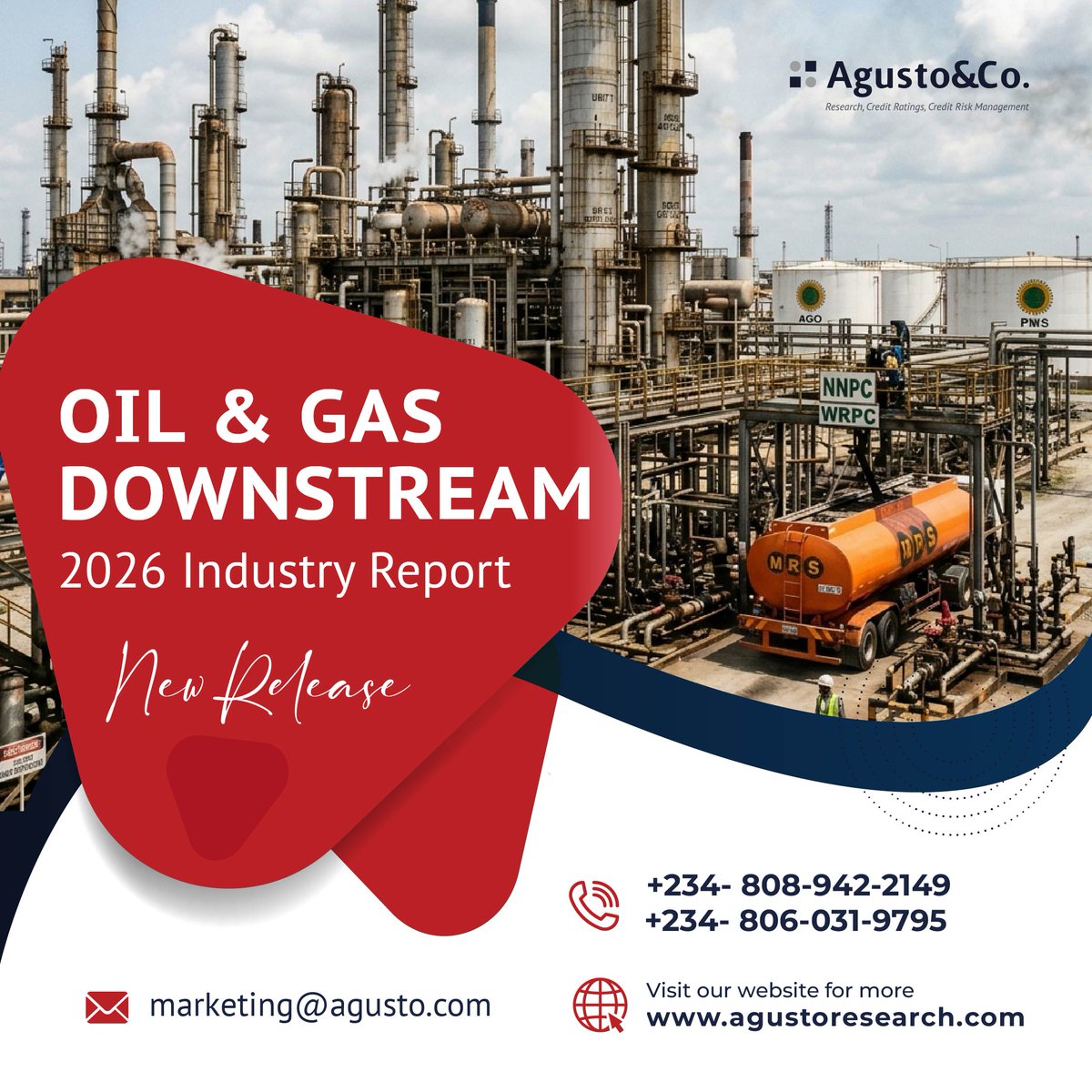
The Nigerian Downstream Oil & Gas Industry (‘the Industry’) plays a vital role in the national economy, encompassing the refining, storage, distribution, marketing and retailing of key petroleum products such as Premium Motor Spirit (PMS), Automotive Gas Oil (AGO), Aviation Turbine Kerosene (ATK), Dual-Purpose Kerosene (DPK) and Liquefied Petroleum Gas (LPG). The year 2025 marked a pivotal juncture for the Industry, as the full deregulation of PMS pricing improved product availability and intensified market competition. A defining development was the progressive ramp-up of the Dangote Petroleum Refinery, which reached its full nameplate capacity of 650,000 barrels per day in February 2026. Domestic refineries supplied approximately 37.5% of national PMS consumption in 2025, with a decisive structural shift occurring in January 2026 when domestic production surpassed imports for the first time. This positions Nigeria to displace petroleum product imports and emerge as a refining hub of regional significance, even as BUA Group’s 200,000 bpd refinery in Akwa Ibom remained under construction.
We have released our 2026 Oil & Gas Downstream Industry Report. For more information or to subscribe, please email us at [email protected].
𝗖𝗹𝗶𝗰𝗸 𝘁𝗼 𝗿𝗲𝗮𝗱 𝗺𝗼𝗿𝗲 -https://t.co/mFi9f7dTdC