Akash Compute Forwards, an onchain order book for future GPU hours.
It's a design today, nothing trades, but 3 things go live today.
A white paper, with detailed rules, a simulation you can run, and detailed documentation on how to use and how to build on the forwards market.
@gregosuri at Breakpoint today 👇
Happy Thanksgiving from Akash.
This network runs because people chose to share.
Thank you for every deploy, every bug report and every GPU you put online.
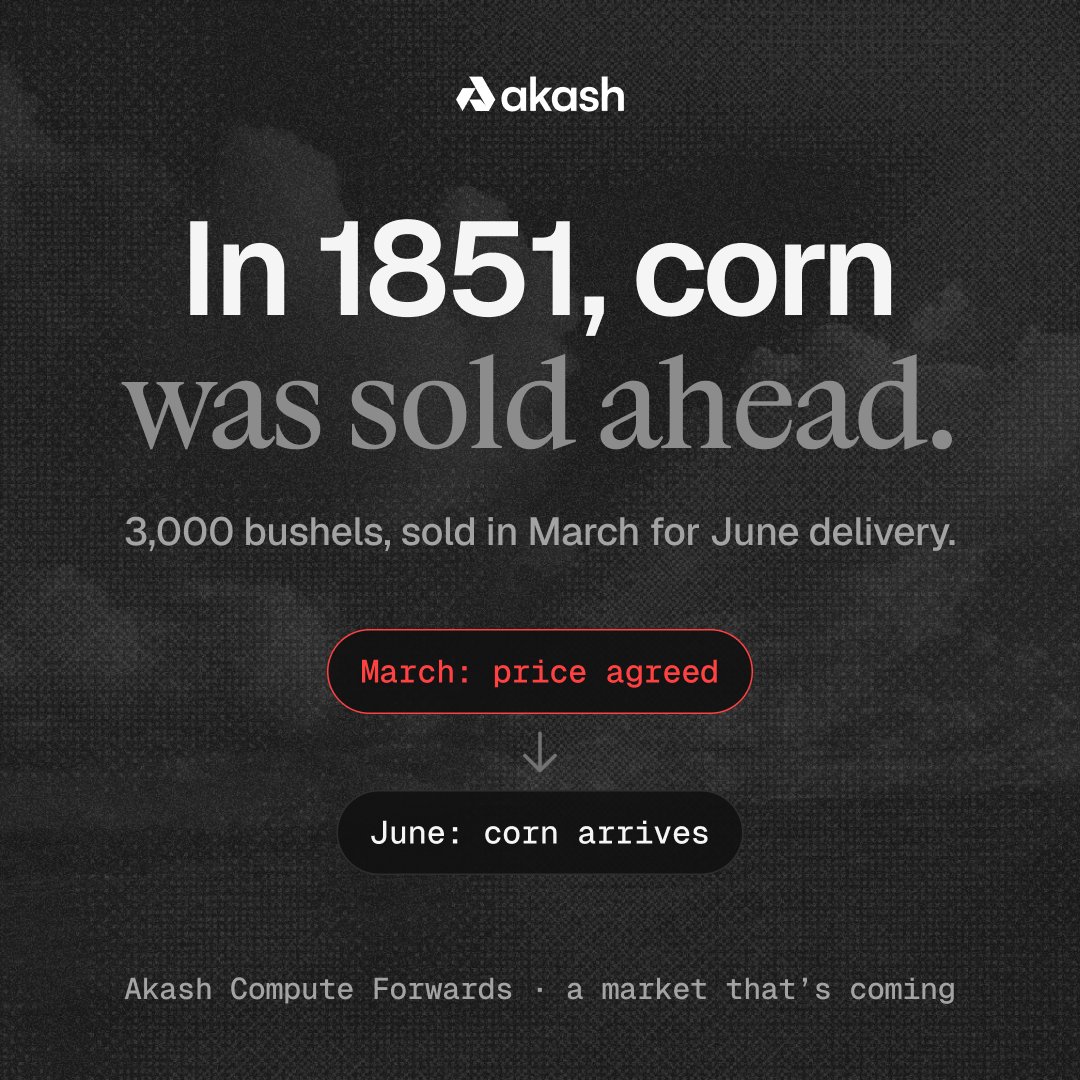
In 1851, a Chicago buyer agreed in March on the price of corn that would arrive in June.
Gas, power and crops all work this way now. A GPU hour still doesn't, so you can't lock in next year's.
Akash Compute Forwards is a market that's coming to change that. Nothing trades yet.
@dajalwala Ha, do you mean the price or the vanishing part? If it's the vanishing, you can mark storage as persistent in your SDL, so your data stays when the container restarts.
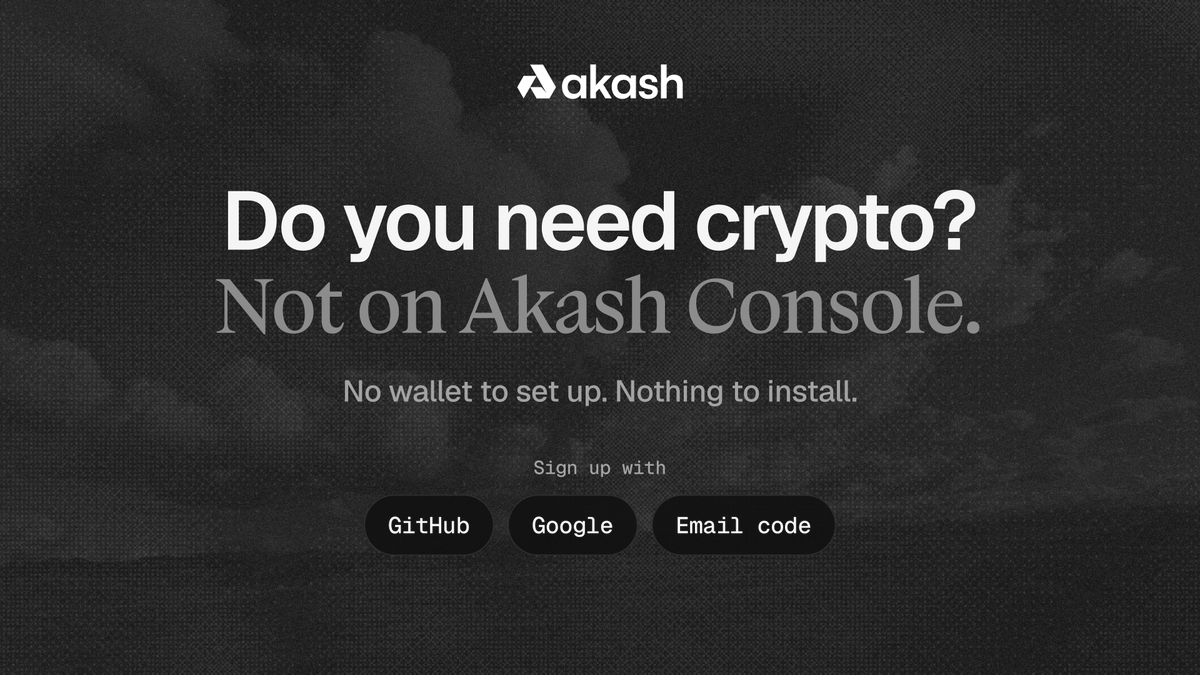
Do you need crypto to deploy on Akash? No.
You sign up with GitHub, Google or an email code, like any other app. So there's no wallet to create first.
Your account starts with $1 of credit and no card on file, which means you can try a real deploy before you pay anything.
@tolu_EVM@costa__io You can do it either way. The box already has Node and git set up, so you can install Pi yourself after it's up, or just ask one of the agents on the box to do it for you.
@AppalachiaDanny Love that. An agent that spins up a render only when it's needed is a smart way to run it. What are you rendering, and does it usually grab the same GPU each time?
The fundamental problem here is that the price comes from an opaque source and there is no way to verify it hasn't been tampered with.
The reason why the CFTC is holding off on approving compute futures.
Open markets and prices discovered in the open are the only way forward.
Three weeks into working at an AI compute company, one thing still surprises me.
You can price a flight for next June today. A month of GPUs for next June has no public price, so you get a private quote and can't tell if it's fair.
I'm learning how that changes. Follow along.
How a business would book GPUs on Akash Compute Forwards:
→ Pick a month and a region
→ Bid in a daily auction that sets one price
→ Get paired with a verified GPU node
→ Pay only for hours served
Nothing trades yet, if you need B300s next year? Tell us which months 👇
BREAKING: Jensen Huang officially returns to Nvidia's office, $NVDA, and receives a standing ovation from Nvidia employees.
"I'm going to be a better CEO the second time around," Jensen Huang told employees.
Greg on what Jensen Huang has meant for open source AI.
He calls him the backstop: the person the industry counted on to keep open models coming, and the one who held NVIDIA's supplier ecosystem together.
"I think Jensen is the most important leader in AI."
Akash Compute Forwards is a market that's coming to give both sides a price ahead of time.
If your business buys or runs B300s, tell us where you fit👇
https://t.co/dpWrb0YP7m
Why AI businesses can't plan around GPUs.
Buyers don't know what a B300 hour will cost next month, so they can't price their own product.
Providers can wait two years for chips, so they can't know what those hours will earn.
Both sides are guessing.
There's no public market for GPU compute. The CME can't launch compute futures yet, the regulators keep holding approval back.
The reason: the price per GPU hour comes from a few private and opaque data sources. No open order book. No price everyone can see.
The solution? Tomorrow at Breakpoint.
Nvidia's board just reinstated Jensen Huang as CEO.
A week ago at Breakpoint, @gregosuri said:
"I think Jensen is the most important leader in AI."
He'd have sold his Nvidia shares without him.
"But him coming back, I'm very, very excited."
The board bringing him back proves Greg right: Nvidia needs Jensen.
$NVDA