Top 5 best parts of Grammar
1. Verbs
2. Syntax
3. Pronouns, they're so versatile
4. Cases (anything noun related that isn't cases is boring)
5. Verbal Nouns/Participles/Gerunds/Infinitives
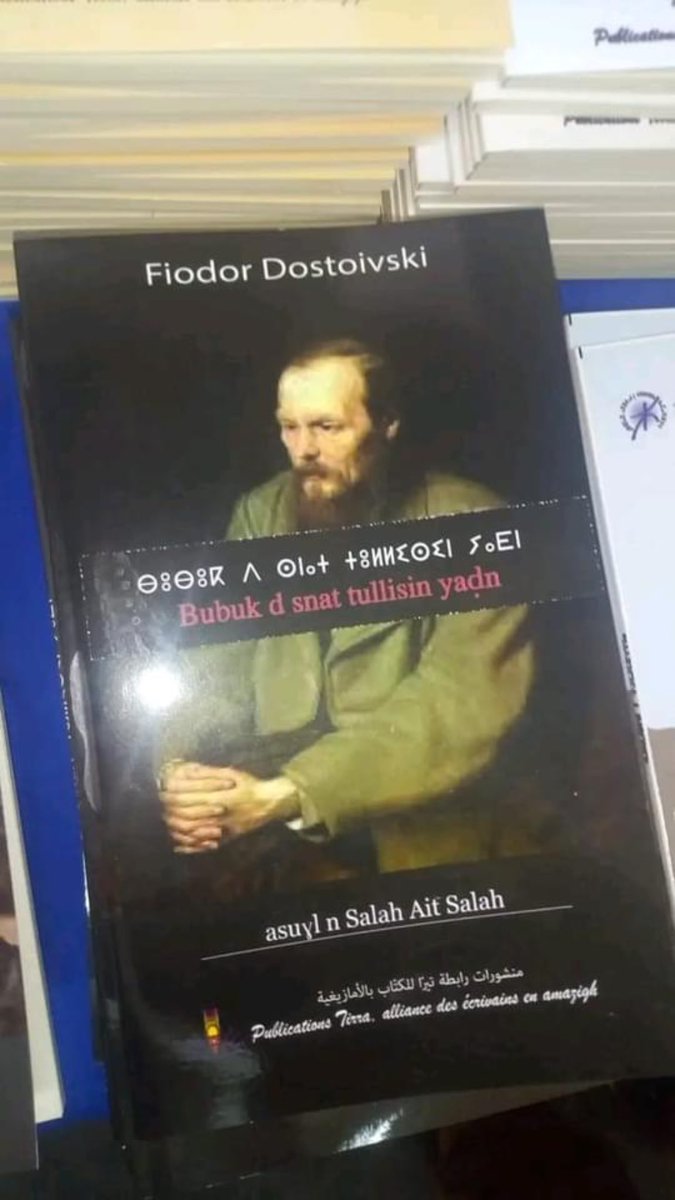
الأديب الروسي العالمي فيودور دوستويفسكي بالأمازيغية ...
" بوبوك وقصص أخرى " من إنجاز الأديب الأمازيغي صالح آيت صالح ، منشورات رابطة تيرا للكٌتاب بالأمازيغية ...
Is Jinn Possession Possible? 🤔
In our upcoming episode of the @oasis_wisdom Podcast, featuring Filip Holm (@itsfilipholm), we explore a wide range of topics, including jinn possession, Sufism, online apologetics, and much much more. Stay tuned!
This got me to finally go back to a document I started in my pandemic sabbatical (2020-21).
Now that I'm in my next sabbatical, I'd love to get everyone's input on my table of Perso-Arabic letters used in each language of Pakistan 😊
https://t.co/CEjZkbwgbP
"奉 Subhanallah"
When read vertically, it reads as 奉 in Chinese; when rotated 90 degrees to the right, it reads as Subhanallah in Arabic.
Japanese Islamicate calligraphy inspired by Haj Noor Deen's Sini script.
Calligrapher: Naoki Yamamoto
This is outdated. Kobayashi debunked their relationship in 2022. Brahui and Kurukh-Malto are separate branches of Dravidian. Also, Kalat didn't even speak Iranic back then, so I don't know why you'd expect Old Iranian loans. How common are Avestan loans in Balochi and Sindhi? But regardless, local Dardic loanwords are completely nonexistent in Northeast Pashto and adjacent Hindko, yet nobody doubts those areas used to be inhabited by Dards and are now inhabited by different groups.
Just had a very interesting conversation with @itsfilipholm and @dmontetheno1 on jinn, apologetics and Sufism. The full podcast episode will be out soon!
My perspective on this which I don’t think is a strong general case against Quranic phenomenology in all cases (as someone who has studied Quranic cosmology with the likes of Sinai and co).
@avzaagzonunaada Is there a reason we know why so many IA languages developed this specific pattern
1-18
19-28
29-38
39-48
49-58
59-68
69-78
79-89
90-99
The problem is that we don't even know if they spoke a Dravidian language or Indo Aryan language or a completely unrelated dead language
We have no reasonable basis to assert they spoke any language family we have record of today
The Script vs Language and multiple Languages.
Let's take example of Brāhmi. It was used to write both Dravidian languages as well as Indo Aryan languages like Pali, and various Prakrits.
But before decipherment, both looked almost identical, with differences only understood in details post decipherment. The pulli system, the Bhattiporlu variation, etc.
This is applicable to IVC script as well.
Some seals are in Proto-Dravidian and some in an archaic form of IE, let's say proto-Sanskrit.
You cannot decipher the IVC script without knowing which is which.
This is the reason why the IVC script has not been deciphered yet. Because the approach is not multi-lingual but uni-lingual.
Therefore, reading the inscription in the image below as Pali, would have been a dead end.
Pic below : Mangulam Tamil-Brahmi inscription at Dakshin Chithra, Chennai. It was discovered by Robert Sewell in 1882, and deciphered by Subrahmanya Aiyer in 1924. Direction left to right.
The decipherment of the ancient Brahmi script, the ancestor of most modern Indic writing systems, was cracked in 1837 by British scholar James Prinsep. This monumental breakthrough unlocked Emperor Ashoka’s 3rd-century BCE rock and pillar edicts, ultimately revealing an extensive, previously lost chapter of Indian history.The decoding of Brahmi did not happen overnight. It was achieved through a step-by-step process:
1. The Key Clue: Bilingual Coins
In the mid-1830s, Norwegian scholar Christian Lassen and James Prinsep analyzed newly excavated coins issued by Indo-Greek kings (such as Agathocles and Pantaleon). These coins featured Greek script on one side and an equivalent translation in the Brahmi script on the other. Because the names of the Greek kings were known, scholars were able to match the Greek letters to the corresponding Brahmi symbols.
2. The Formulaic Breakthrough
Prinsep collected copies of the Ashokan edicts spanning across India—from the Allahabad pillar to the Sanchi Stupa. He noticed that several short inscriptions at the Sanchi Stupa frequently ended with the same two characters. He consulted with local scholars and realized that these repeating symbols stood for the Pali word "dāna" (gift or donation), which frequently appeared in Buddhist offerings.
3. The Letter Chart
By isolating these recurring letters and cross-referencing them against known names on the Greek-Brahmi coins, Prinsep painstakingly built a comprehensive decipherment chart. He successfully matched each geometric Brahmi character to its phonetic sound in the Sanskrit/Pali alphabet.
4. Reading the Language
Once the alphabet was decoded, scholars discovered that the language of Ashoka's edicts was not classical Sanskrit, but rather a colloquial, vernacular Prakrit. Today, Brahmi remains one of the most thoroughly understood ancient writing systems. Its decipherment serves as the foundational text for studying South Asian epigraphy, numismatics, and ancient linguistics.
@Nash_Siddiqui Recent evidence supports that Brahui is from a recent migration and not an inheritance from a while ago
There's absolutely 0 link between Elamite and Dravidian linguistically