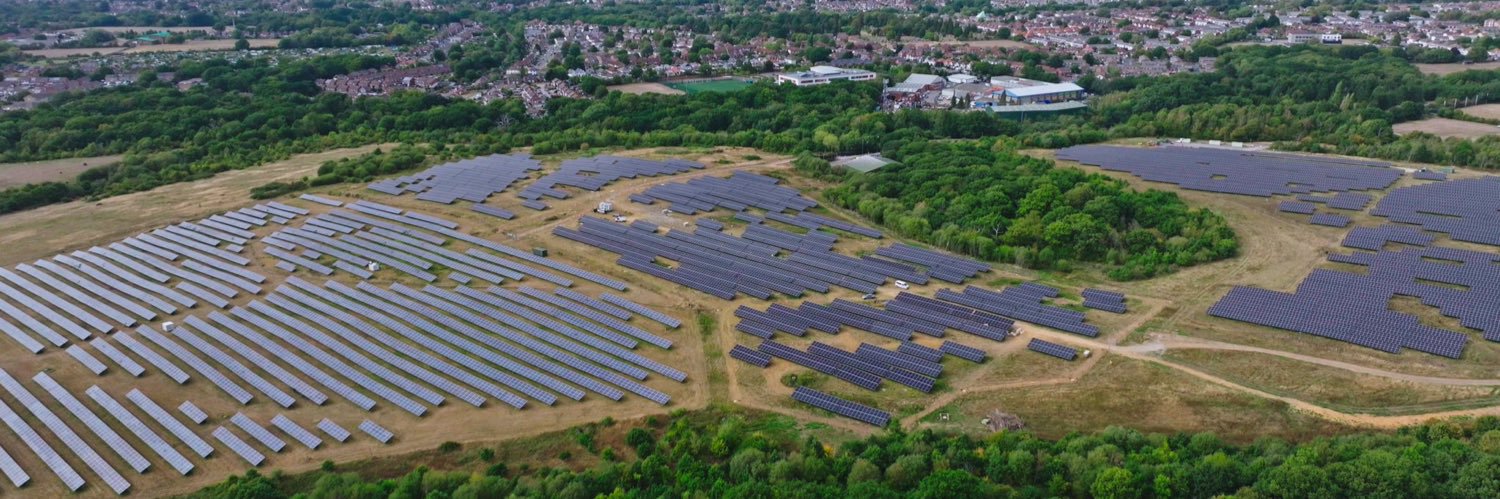
For far too long solar and storage systems are only accessible if you have >£8k to spare and a roof you own.
So we built Jules.
It’s a 2.5 kWh battery that plugs into a normal 3-pin socket. No electrician, no scaffolding, no hardwiring.
Add up to four 500W panels on a balcony, wall or in the garden. No space for panels? It also works battery-only. It runs itself: charges when electricity is cheap, discharges when it’s expensive, forecasts your solar production and your usage from your smart meter. Up to £330 a year off your bill. £799 outright. £199 if you fix with Fuse for 5 years. Panels £189 each. 10-year warranty. Reservations are open today, launch estimated 2027. Fuse customers get priority.
https://t.co/7ZocH5ubbG
Meet Jules by Fuse Energy.
An intelligent energy system for your home. Plug in and autopilot does the rest.
It learns your habits, stores power, trades the excess and continuously lowers your bills.
Solar and storage is now for everyone.
Energy intelligently designed for you.
Up to £330 a year off your bills.
Reservations now open
Founder CEOs: make yourself unfirable.
Your investors and board should not be able to remove you.
If you can’t get that, staff your board with people who have actually built something.
People who have never built anything will eventually sabotage the company.
I really want to build nuclear reactors. We won’t, not until Fuse makes at least $1B a year in free cash flow.
People ask me all the time why Fuse isn’t doing SMRs or fusion. Truth is, I want to. It really pains me to say but it’s not wise, at least not yet.
Nuclear startups are betting everything on a single technology. They have my deepest respect, but it is very risky. From R&D to licensing, an SMR takes at least 10 years to reach meaningful revenue. That is 10 years of deeply negative cash flow, funded almost entirely by investors.
Unfortunately venture money follows what’s hot. It stops when you stop being hot. Over 10 years you will almost certainly go through at least one bear market. All it takes is one missed technical milestone, and you are deeply fucked. Fusion is even worse - it is one big venture funded science experiment where no one even knows if the unit economics will work.
At Fuse, we take a different approach. We start with mature energy technologies and just out execute incumbents.
We have been generating operating free cash flow for almost a year without taking any science risk.
We will keep taking zero science risk until we get to at least $1B in annual free cash flow. That is the only funding I fully trust, because it will still be there in a bear market.
Then we take a percentage of it and bet big on SMRs and fusion.
A data centre can wait up to 15 years for a grid connection. We think it should be weeks.
So Fuse is now acquiring and expanding power grids.
Grids are the real bottleneck on growth. Data centres, distribution centres, factories.
Our approach is simple:
1. Buy grid
2. Build generation
3. Build storage
4. Expand the grid: more cables, more substations
Do this and the grid can carry far more industrial load.
The bonus: more energy users on the same cables means the fixed costs get spread thinner, so grid charges for everyone on the same grid come down (grid charges account for up to half of your energy bill)
Renewables actually made gas power more expensive, not cheaper.
Today, a gas engine only runs about 20% of the year. The other 80% of the time, it can’t compete with wind and solar on costs. Same fixed costs, one-fifth the output & the cost per gas powered MWhs increases. Fuse started in grid-scale solar (~100MW live and under construction). But solar only works when the sun shines, so we are now buying operational and building gas engines too.
We are solving the utilisation problem by putting Fuse Compute right next to the engine.
Power cost is a small fraction of GPU revenue, power availability is the key bottleneck to deploying compute. Co-locating AI compute allows us to run these gas engines at nearly 100% utilisation instead of 20%. The cost of every gas-powered MWh goes down by ~25%. Cheaper gas power means lower cost for Fuse energy customers.
We are hiring for the projects team (aka the build-everything team). If you are an electrical or mechanical engineer who just wants to build without BS politics & redtape, join us.
@fergustp on policy side 100% aligned, no technology should be subsidised or taxed. Each technology should compete on its own 2 feet. That being said renewables will still undercut gas engines (there is no fuel cost and very little maintenance cost for renewables)
@sorenbs@omotforest Batteries are indeed getting cheaper, but not cheap enough today and no one will build unprofitably. I agree with you on what you wish for, and I also wish the same, and large part why we started Fuse. I do think low cost low carbon future is possible, but it will take time.
@sorenbs@omotforest Grid scale batteries are mostly 2 hour batteries today, you can’t sustain long periods of low solar and wind. Interconnects is simply shifting the problem to another country. They are both helpful and we should build more but does not solve the root cause of intermittency
This is an over simplistic view of energy, renewables can help lower total system level cost up to a point (which is why we are building a tonne of solar), but it’s not possible to rely on due to intermittency. Due to excessive regulation western governments have made it too expensive to build nuclear, and storage technology today can store only 2 hours of energy. there is literally no cheaper technology than gas engines to fill in renewable gaps today.
@sorenbs I agree this should be the goal, and we do plan to do R&D in long term energy storage but unfortunately what you are describing does not exist today.