Electrons, Not Silicon: Is This Really the New AI Thesis?
When Microsoft’s CEO Satya Nadella casually mentioned in recent podcasts that energy—not GPU availability—is the real constraint in AI infrastructure, it should have sent shockwaves through the market. Instead, most investors kept buying chip stocks like nothing changed.
Electrons, not silicon. Could this be the insight that redefines the entire AI investment landscape?
Here’s the puzzle: we’ve spent the last two years obsessing over semiconductor supply chains, watching leading chip makers climb to multi-trillion dollar valuations, and tracking GPU allocations. But what if the chips are already available, waiting for something more fundamental, power?
Consider the timeline mismatch. Hyperscalers can receive GPU deliveries within months. But securing hundreds of megawatts? That’s a multi-year journey involving utility negotiations, regulatory approvals, and physical construction. If this is the real bottleneck, the entire investment thesis needs reconstruction.
Does the Competitive Moat Shift?
Perhaps algorithmic improvements—achievable in months—matter less than whoever secured power purchase agreements years ago. This would mean utility companies suddenly become more critical than specialized chip designers. Data center REITs with existing power contracts would possess advantages newcomers cannot replicate quickly.
There’s also the depreciation problem: if product cycles accelerate to 12-18 months, but GPUs can’t deploy immediately due to power constraints, what happens to ROI? Each delay month means lost earnings while hardware loses edge against newer releases.
Or Is Satya Talking His Book?
Microsoft announcing slowed GPU purchases could be negotiating leverage with chip suppliers, or genuine constraint acknowledgment. Probably both. Perhaps this concern is temporary, energy infrastructure will eventually catch up. Maybe the market already quietly rotated toward vertically integrated hyperscalers and energy plays.
But here’s what makes this consequential: semiconductor companies now carry enormous weight in major stock indexes. If this thesis gains traction and their multiples compress, the ripple effects could reshape broader market performance in ways most investors aren’t anticipating.
Is “electrons, not silicon” the new framework for AI infrastructure investment? Or just one constraint among many? We lean toward the former. Regardless, the answer could determine not only whether chip stocks deserve their valuations, but whether index funds face unexpected headwinds from a sector that’s been carrying markets higher.
It’s Dr. Copper’s Time
After a remarkable rally in the the yellow metal, i.e., gold, the time has come for the orange metal to outperform in the commodity space. As we always do in our investment cases, we will go through the 3 main hurdles an investment case needs to pass in order to be regarded as having an asymmetric risk/reward profile. We start with the structural fundamentals, in this case the supply and demand outlook going forward, go through the cyclical/macro to gauge the wind’s direction for a certain asset class, and lastly we always check the charts for potential entry points and overall risk management considerations. This of course should not be construed as investment advice, only as a reflection on the case for higher copper prices going forward.
Structurally, the fundamentals could not be clearer. On the demand side, we have some of the big trends such as the energy transition (e.g., EVs) and the massive copper needs for AI data centers. We could also mention the reconstruction of entire cities and countries when their respective wars end, such as Ukraine or Gaza. Lastly, Trump has been emphatic about the US’s old infrastructure and the need to eventually rebuild it, which would of course need massive amounts of copper. On the supply side, after almost a decade of underinvestment and decreasing ore grades, we now have 3 of the world’s largest mines with technical problems and revising down production guidance. That means the expected deficit in the next decade just keeps getting larger and larger, and that does not account for geopolitical risks from trade and future wars. So higher prices are a matter of when and not if.
Cyclically, we always try to ascertain how growth, inflation and liquidity are likely to behave in the next 3-6 months. On growth, we believe that the Fed’s resumed cutting cycle, coupled with the start of some of the main parts of Trump’s OBBBA (particularly the bonus depreciation cause for capex) and very loose financial conditions should foster a growth re-acceleration into the first quarter of 2026. Additionally, our main leading indicators are also sniffing out an inflection point after many months of slowing growth. On the inflation side, the full effect of tariffs, the increase in bank lending and higher growth should also result in a re-acceleartion in the next few months. Finally, global liquidity should still be a tailwind for most asset classes, sustained by the weaker dollar and China’s liquidity injections. In all, this would configure a classic reflation scenario, where commodities tend to perform well. Another box checked.
Lastly, the charts further confirm our bias. As one can see below on the monthly chart, the copper price seems to be on the cusp of breaking out of a huge arc that spans more than a decade. It is also almost breaking out from a shorter arc that starts around the pandemic. All the moving averages are pointing up, showing us the trend. On the weekly time-frame, the picture is also one that is screaming higher prices on the horizon. With the exception of the tariff-related spike, price needs to finish a week at a new high to trigger the breakout. Targets from there indicate much higher prices.
In sum, copper ticks all our boxes in spectacular fashion. In a world where commodities will most likely outperform other asset classes, copper should be one of the fastest horses, and that could start shortly.
Com o passar dos anos, desenvolvi o irritante hábito de me forçar a ver as vantagens de envelhecer. Quanto mais penso sobre o assunto, mais percebo que elas não são tantas assim - pelo menos não numericamente. Três, porém, valem cada fio branco que tenho: i) a família que construí; ii) as amizades que cultivei e iii) os aprendizados que acumulei, muitos deles nascidos de “certezas” que se mostraram equivocadas ao longo do tempo. Entre essas certezas que se mostraram equivocadas, destaco minhas previsões para as eleições presidenciais de 2006 e 2014 (principalmente a luz de 2005 e 2013), que se provaram erradas. Passados mais de uma década da reeleição da Presidente Dilma, vejo o cenário de entorno bem diferente. Nesse cenário Lula não será reeleito. A ideia desse texto é explicar por quê.
O penúltimo ano dos mandatos de Lula I, Dilma I e Lula III compartilha uma característica: a queda na popularidade do chefe do Executivo. Em 2005, o escândalo do mensalão — esquema de corrupção que envolvia pagamento de propinas a parlamentares da base aliada em troca de apoio político — custou cerca de 10 pontos percentuais na aprovação de Lula, segundo pesquisa CNT/Sensus de setembro daquele ano. Em 2013, o aumento das passagens de ônibus desencadeou protestos contra a gestão Dilma Rousseff, resultando em uma queda de 27 pontos em sua popularidade, conforme o Datafolha de junho de 2013. Em 2025, a denúncia de um esquema de fraude na folha de pagamento de aposentados e pensionistas do INSS sepultou a recuperação da “crise do PIX”, consolidando uma queda de aproximadamente 15% na popularidade de Lula.
Se Lula e Dilma conseguiram reverter essas quedas e se reelegerem cerca de um ano depois, o que impediria Lula de repetir o feito? A análise do contexto histórico e atual ajuda a responder. No caso do mensalão, o forte desempenho econômico (crescimento do PIB e inflação controlada) e o carisma de Lula, que desviou a culpa do escândalo para seu partido, foram cruciais para sua reeleição, apesar do desgaste inicial. Já na reeleição de Dilma, mesmo com sinais de uma crise econômica iminente, a então presidente assegurou a vitória por meio de: i) uma campanha agressiva que associava adversários (Aécio Neves e, posteriormente, Marina Silva) ao fim de programas sociais, como o Bolsa Família; e ii) a transferência de votos de Lula, especialmente no Nordeste.
Por que agora é diferente?
As condições que sustentaram as reeleições de Lula e Dilma não estão presentes, nem se repetirão em 2026, especialmente:
Desaceleração econômica: Diferentemente de 2006, quando o PIB crescia robustamente, a economia atual enfrenta sinais de estagnação, com inflação pressionando o custo de vida e reduzindo o otimismo do eleitor.
Declínio do carisma e energia de Lula: Com a idade e o desgaste político, Lula já não exerce o carisma, nem demonstra a estamina que marcaram suas campanhas anteriores. Diferentemente de 2005, quando Lula reduziu de maneira expressiva suas viagens internacionais para "reverter" o quadro de desgastes, Lula agora parece mais preocupado com pautas internacionais do que a solução de problemas domésticos.
Terrorismo social: Programas como o Auxílio Brasil mostraram ao eleitor que políticas sociais são de Estado e não de um partido específico. Isso reduziu o medo de perdê-las com a alternância de poder. De acordo com pesquisas recentes, a maior parte do eleitorado nao teme perder o benefício social em caso de alternancia de poder em 2026.
Eleitorado mais conservador e empreendedor: A falta de oportunidades formais impulsionou o empreendedorismo, tornando o eleitor mais sensível a agendas como o tamanho do Estado e redução de impostos. Outro ponto importante é a gradual "evangelização" da população (Censo de 2022 revelou que 26,9% da população brasileira se identifica como evangélica) traz um desafio adicional de difícil transposição. 1/2
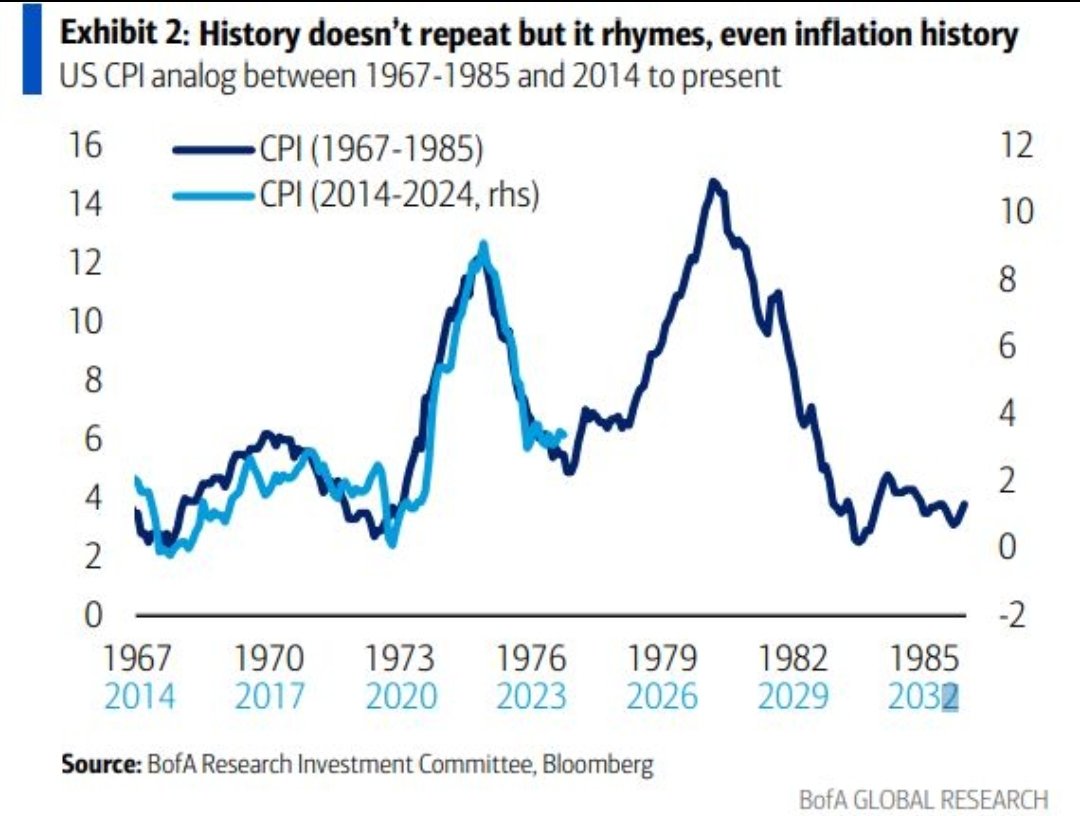
"History doesn’t repeat itself, but it rhymes." – Mark Twain (attributed)
Sometimes, events unfold in a way that feels eerily familiar, as if history is not just moving forward but echoing past moments with remarkable similarities. 1/x
*Adivinha quem?*
Cercado de bajuladores, vi a inflação disparar e a corrupção corroer meu governo. Ignorei o povo, lidei mal com crises e acabei perdendo o poder de forma humilhante.
Meu nome é ____ ____ ____ ____ ____!!
Caso tenha sua inegibilidade confirmada, qual candidato Jair Bolsonaro deveria apoiar nas eleições presidenciais de 2026, a fim de preservar o slogan "Brasil acima de tudo, Deus acima de todos"?
O BC estima que a nova regra acarretará aumento na exigência de capital para o SFN de R$ 34 bilhões (2,6% do PR). A norma entra em vigor em 1/1/25 e será implantada de forma faseada até 2028, suavizando o impacto no capital requerido...
Cronograma generoso = div. extraordinário!