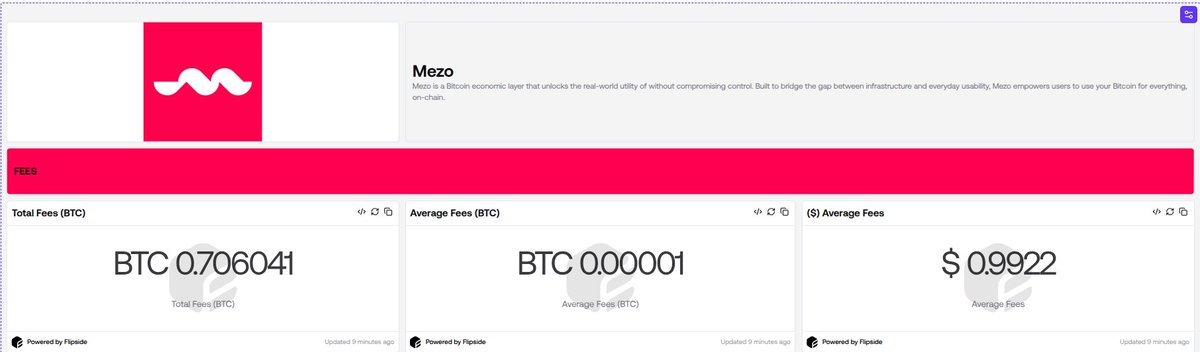
🚨 Testnet’s live and it’s not just a demo — it’s a Bitcoin-powered money machine (@MezoNetwork )
Save it. Spend it. Lend it. Borrow it. Bank on yourself, all backed by Bitcoin.
— 🔥 4,000+ users already in
🚀 456 new users in the last 24 hrs
💰 $57K+ in fees generated
📄 582 unique contracts deployed
⚙️ 6.9K total contracts on-chain
This is not just another testnet noise , it is real usage, real traction, and real builders and users showing up daily.
Devs are shipping.
Contracts are flipping.
And Bitcoin’s finally getting some DeFi drip.
🫡
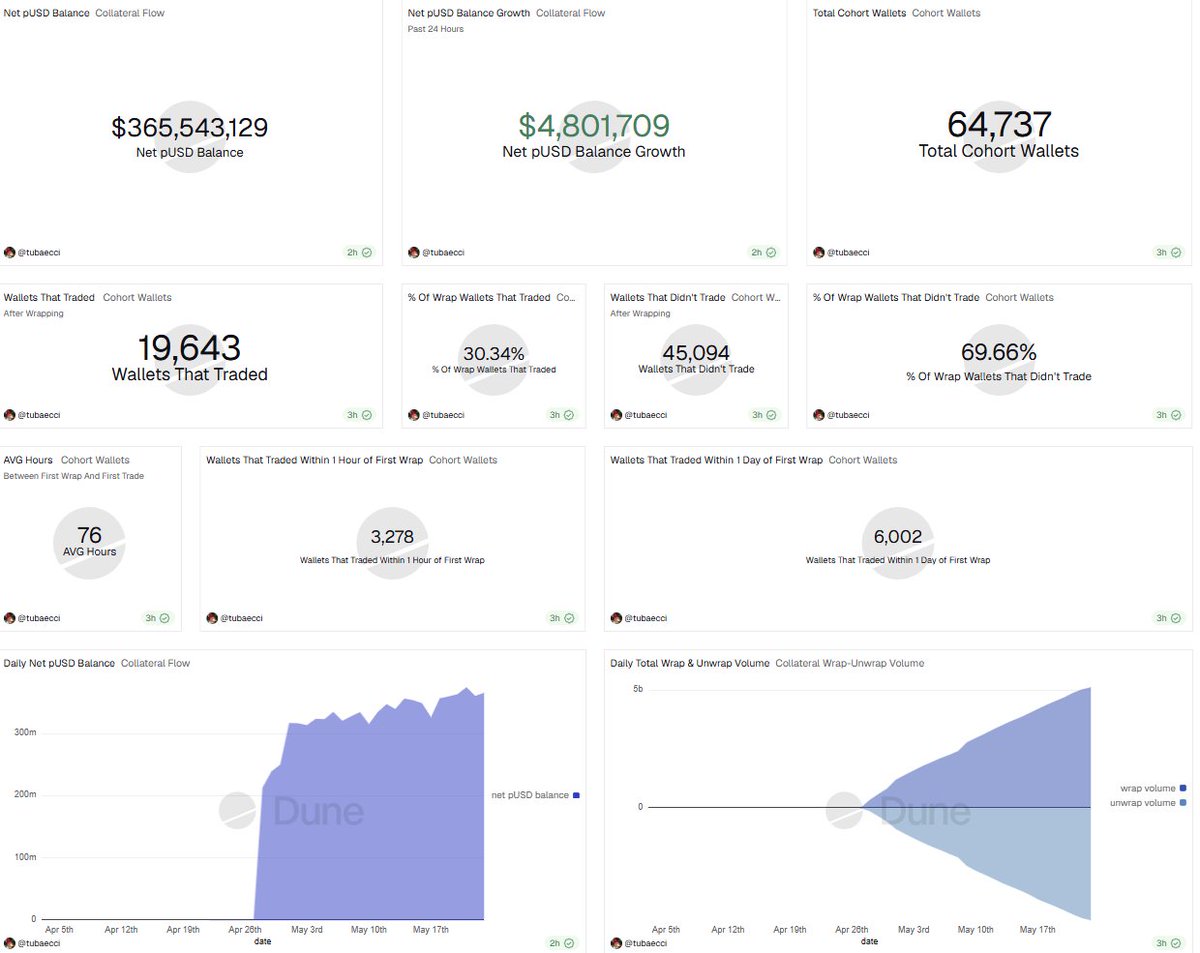
On April 28, @Polymarket executed its biggest infrastructure upgrade ever.
New contracts. New collateral token. Onchain builder attribution for the first time.
I built a Dune dashboard to track what actually changed post-migration. Here's what the data says 🧵
1/
Most traders watch price.
Few watch execution.
In another episode of @tradeparagon's market dynamics, let’s break down it’s slippage & spreads, and what they reveal about real market liquidity 👇
Traveling out of my comfort zone is one of the best experiences in my life.
I was in dubai and right from the immigration everything felt different and stress free, no hassle. My entire perspective of life changed.
Currently in Malaysia @ns , waking up to an amazing view overlooking the beach , dining with the best builders in the world.
Your mind can only reach the extent of your imagination
Gm Gm..
I’ve built and shipped machine learning systems in production, not just models.
Both in large-scale Solana game analytics and ML-Powered Churn Prediction https://t.co/uHgIyV7QFo and in my latest build, https://t.co/e0rFnKvhoR.
And one thing has been consistent every time:
The model was never the hard part.
On https://t.co/yle4ryf6K4, ML only works because the system around it works.
Before touching any model, I designed the full data pipeline:
• Raw onchain ingestion
• Cross-sector normalization
• Deterministic feature generation
• Aggressive caching and monitoring
• Reproducible transformations
That same structure came from my earlier Solana games work, where I processed 60M+ transactions and built churn prediction and behavior forecasting directly into the pipeline.
No notebooks running in isolation.
No manual experiments.
No “rerun and hope”.
Data flows in.
Features are created automatically.
Models retrain on schedule.
Predictions are evaluated continuously.
Failures are visible immediately.
At that point, model choice becomes secondary.
What actually matters is:
• Can the pipeline survive scale?
• Can you detect drift early?
• Can you swap models without breaking the product?
• Can teams trust the outputs?
That’s how ML exists inside RonHub today.
Not as a headline feature.
But as an internal system that strengthens health scoring, behavior analysis, and ecosystem monitoring on Ronin.
This is why I don’t think in terms of “building models” anymore.
I build systems where models are expected to change.
Model building is table stakes now.
Owning the system around it is where leverage compounds.
If you’re serious about ML, learn how to design pipelines first.
Models will follow.
I set this goal this week and by God’s grace it’s been accomplished.
It’s crazy how much you can accomplish when you put your heart and mind to it.
We go again next week 🙏🏻🤲🏻
1/10
Building an end-to-end ML portfolio optimization system for crypto trading.
Using Hierarchical Risk Parity (HRP) — an unsupervised ML approach that outperforms traditional Markowitz optimization in volatile markets.
Here's the thread 🧵👇
The Biggest Problem with Polymarket and How https://t.co/O2FwjsfGVd Approaches it.
Prediction markets promise a tidy metric for messy futures: a market price that aggregates information into a single probability. But they, like any system that turns real-world facts into cash, live or die on one mechanic: how outcomes are decided and paid out. For large, high-stakes events (think national elections), small differences in who declares the result, how it’s measured, and who has the power to dispute it can create outsized mistrust. @Polymarket , the best-known crypto-native platform, solved some technical pieces but still leans on adjudication backstops that create friction in controversial cases. Newer social-first apps such as @polldotfun attack the problem differently: by shifting resolution risk onto human reputation and community verification rather than a single oracle gatekeeper. Bet on poll https://t.co/2hisgWn7bu
What Polymarket is
For those who still live under a rock. @Polymarket is a blockchain-based prediction market where traders buy and sell binary outcome shares (yes/no) whose price reflects the market’s probability of an event. It rose to prominence during major news on political contests and macro questions because prices update in real time as information arrives. The platform routes its settlement logic through @UMAprotocol optimistic oracle and a formal dispute backstop, which lets someone post a proposed resolution, allows a short challenge window, and if disputed can escalate to UMA’s Data Verification Mechanism (DVM) for voting.
Why accurate result resolution is core to trust
A prediction market is only useful if traders believe the answer will be judged fairly and promptly. If resolution is slow, opaque, or plausibly manipulable, traders widen spreads and liquidity dries up. Resolution rules are the social contract of a market: they turn belief into cash. One of the clearest examples of the resolution problem surfaced during the 2024 Venezuela presidential election. The country’s electoral authority, the CNE, officially declared Nicolás Maduro the winner, but the result was widely disputed due to missing precinct data, irregularities, and a lack of transparency. When Polymarket settled its “Venezuela Election Winner” market, its oracle system ultimately resolved against the official declaration and in favor of opposition candidate Edmundo González, citing alternative credible sources. The decision triggered backlash from users who argued that the stated rules prioritized official Venezuelan results, not outside reporting. The controversy revealed how, in politically charged or opaque situations, even a leading platform like @Polymarket can face accusations of subjectivity, inconsistency, and broken trust; underscoring how fragile resolution can be when the real world itself is contested.
What is https://t.co/O2FwjsfGVd?
. @polldotfun is a social betting app that emphasizes lightweight market creation, private & public bets, and reputation-driven settlement inside small communities and open feeds. It’s built as a social product, think chat-integrated wagers and leaderboards rather than as a pure clearinghouse. The platform’s help and trust pages explicitly call out voting-based outcomes and a reputation/leaderboard layer that tracks creators and bettors. Bet on polls https://t.co/2hisgWn7bu
Its model : social, creator-driven markets
@polldotfun allows users to create custom bets (user generated markets), decide whether they’re public or private, and rely on bettors voting or creators voting and the creator’s stated rules to settle outcomes. The product design puts market creators, the participants who follow them, and a visible trust score at the center of the resolution process rather than delegating every contested question to an external oracle or distant token-holder vote.
How https://t.co/O2FwjsfGVd Approaches Result Resolution
Poll’s design tackles resolution pressure by leaning on human reputation and community governance rather than solely on an external oracle.
Transparent resolution logic (human + rules)
Bets on @polldotfun include creator-defined rules and a voting mechanism for participants, so outcomes are decided by the community around a market, using the creator’s stated resolution source as the baseline. The platform foregrounds clarity in bet phrasing and gives users tools to dispute outcomes inside the app.
Creator credibility and reputation as a backstop
.@polldotfun exposes who created a market, shows leaderboards, and links reputation to settlement history. While the platform does not publish every detail of its scoring algorithm publicly, its product primitives (leaderboards, dispute flows, USDC-backed wallets) make it natural for reputation to grow with an accurate settlement record and on-platform skin-in-the-game. In effect, creator reputation functions like a “social oracle”: a high-credibility creator who consistently settles cleanly is trusted to run markets that won’t be second-guessed. That reduces both disputes and the need for escalation.
Blended market creation and private bets
@polldotfun supports both user-created markets and company-created ones, and it allows private bets (friend-only) alongside public markets. Private bets let small groups resolve outcomes by shared norms rather than by distant oracle votes which keeps low-stakes disputes cheap and fast. Public bets carry visible reputation signals so anyone joining can evaluate the creator’s track record first. Bet at
https://t.co/2hisgWn7bu
Working on manipulating bits is pretty much confusing, so I started to take down my thought process while solving a bit manipulation puzzle and put it out on github
This is kinda my first c project (still in progress......)
https://t.co/zBqtgoUnXF
1/5
Just shipped: A Bitcoin Options Pricing Dashboard using the Heston Stochastic Volatility Model
Built a full-stack app that:
• Fetches live BTC data
• Calibrates volatility models via MLE
• Runs Monte Carlo simulations
• Prices options 3 different ways
How it works 👇
Our Web3 Data Journey Continues!
What a weekend! ✈️
I just got back from Kigali, Rwanda, where @AnalyticSages hosted our first-ever Blockchain Data Analytics Workshop outside Nigeria - and wow, what an experience!
Seeing participants go from “What’s onchain data?” to “I just built my first dashboard on Dune!” was truly inspiring. In fact, over 90% of the attendees built something they were proud of!
Huge shoutout to my amazing team @Onyiobaziaquah and @SimileoluwaOlu1 for putting this together with excellence.
And of course, massive gratitude to our partners:
@alueducation , @Afresearch_VC , Aleph Biz Solutions Ltd, and the ALU Traders Community for believing in this vision. 💙
Kigali reminded me that Africa’s data frontier is wide open and we’re just getting started!